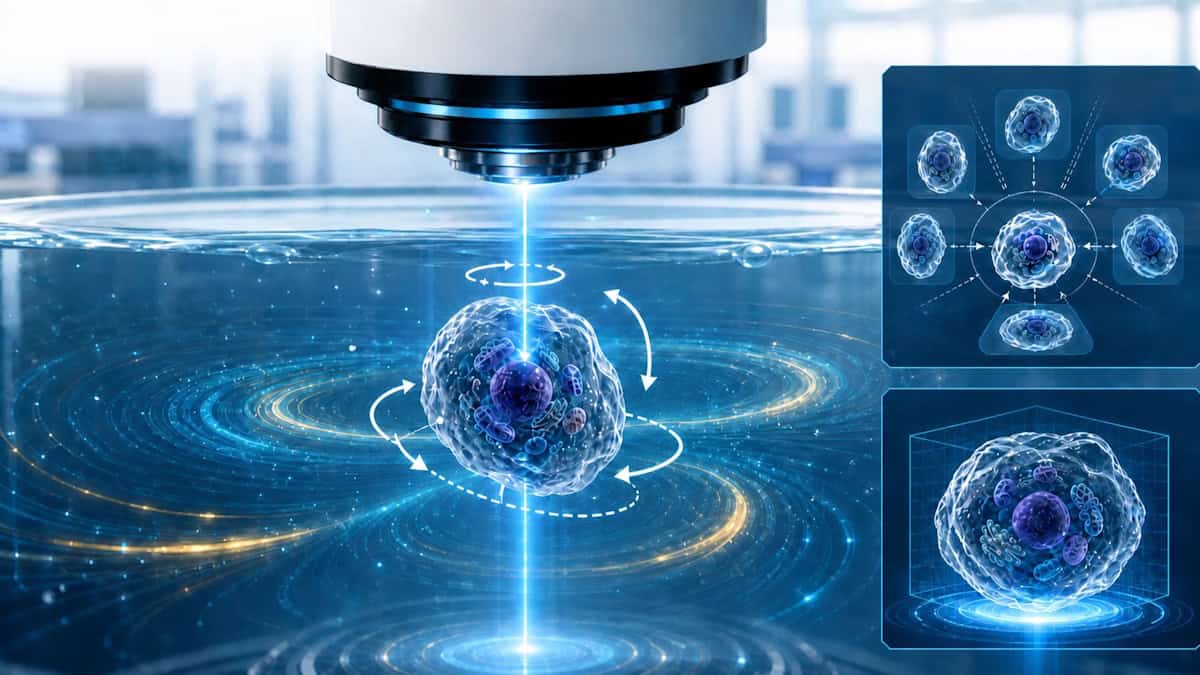
A new contact-free way of rotating delicate samples, such as biological cells, undergoing three-dimensional (3D) optical microscopy increases the image resolution and could reveal more details about microscale structures and processes.
Current optical microscopes provide extremely good image resolution in a single plane, but since depth information is often lacking, samples are routinely rotated and imaged at multiple different angles to create a 3D picture. Because rotating via mechanical microtools such as tiny grippers, needles or pipettes can damage samples, contact-free approaches such as optical tweezers, magnetic manipulation or optothermal forces are often used instead. However, these methods rely on the sample being birefringent, magnetic, light-absorbing or specially shaped.
By contrast, the laser-based technique developed by a team led by Moritz Kreysing and Fan Nan from the Institute of Biological and Chemical Systems at the Karlsruher Institut für Technologie (KIT) in Germany can rotate and spin floating microscopic objects no matter what their shape or material properties.
Their method involves focusing a 1455 nm infrared laser beam on a small region of a highly viscous liquid – initially at 25°C – in which the sample will be suspended. This gently heats that region of the liquid by a few degrees. But rather than focusing on one spot, an acousto-optic deflector steers the beam rapidly along a carefully designed two-dimensional (2D) pattern.
“Because the viscosity of the liquid changes with temperature, this moving heat pattern generates tiny fluid flows, known as thermoviscous flows. By choosing the scan geometry and timing correctly, these flows become three-dimensional and helical, like microscopic corkscrew-shaped currents,” explain Kreysing and Nan. Once a small object is floated freely in these 3D helical flows, it can be rotated, spun, transported or stabilized solely via software-defined scan patterns, with different symmetries controlling the movement of the surrounding liquid.
The KIT technique allows stacks of high-resolution images focused at different depths to be acquired along multiple different angles by re-orienting the sample, a feature that “can help overcome the anisotropic resolution of conventional 3D microscopy”, explain the researchers. Using a high-viscosity liquid to suspend the samples not only enables kinematic stop-and-go actuation, it also suppresses Brownian motion (the jiggling around of tiny particles in fluids), which otherwise decreases image resolution and makes the study of cellular transport processes tricky.
Since previous methods of laser-driving fluid flows could only create motion in one plane, the researchers found it “particularly exciting” when they first observed their laser scanning in a 2D plane generating 3D flow fields. “Another key moment was the observation of opto-hydrodynamic focusing. The particles did not just rotate; their spiral motion converged toward a stable height and position. This was significant because it meant that the optofluid could stabilize the sample, rather than requiring mechanical confinement or complex feedback control.”
As detailed in their recent Light: Science & Applications paper, the KIT team demonstrated rotation and spinning of various samples including stained biological cells, nano-printed micro-tiles and perfectly spherical beads. “We see immediate potential in advanced optical microscopy, especially multi-view imaging of suspended cells, cell clusters, organelles, microstructures or soft materials,” Kreysing and Nan tell Physics World.
High-speed 3D microscope improves live imaging of fast biological processes

Since the basic hardware components of their system will be familiar to many optics and microscopy labs, they are hoping for early adoption by specialized research groups. But to optimize the technique for biological applications, they will now investigate the use of different liquids and operating conditions “that better preserve the viability of live mammalian cells while still providing sufficient stability for precise rotation and imaging”.
The researchers suggest that future areas of application could include microfluidics, microrobotics, colloidal assembly, materials science and 3D microfabrication. As such, they also want to develop more advanced scan patterns that can generate curved, programmable or multi-axis helical flows. “This could allow more complex 3D manipulation, such as controlled orientation of irregular objects, coordinated actuation of multiple particles, or integration with microfabrication workflows,” they explain.