A bolometer that can measure absorbed energy at a resolution of less than a zeptojoule (10−21 J) has been unveiled by Mikko Möttönen and colleagues at Finland’s Aalto University. Their device could soon enable researchers to measure the energy of individual lower-energy photons – leading to new opportunities in quantum computing and information processing.
A bolometer detects radiation using two main components: an absorber, which heats up as it captures incoming radiation, and a thermometer, which converts this temperature rise into a measurable electrical signal. Bolometers are some of the most sensitive radiation detectors in use today.
Indeed, high-performance bolometers based on nonlinear oscillators, superconducting qubits or Josephson junctions are sensitive enough to detect individual microwave photons with energies of about 10−23 J. However, these devices are not able to resolve photon energies very well and only work over certain photon energy ranges.
Normal sandwich
A Josephson junction comprises a normal (non-superconducting) material sandwiched between two superconductors. Thanks to the proximity effect, superconducting Cooper pairs of electrons can penetrate some distance into the normal material. So, if the normal material is narrow enough, a supercurrent will flow across the junction.
“We started to build bolometers based on so-called proximity superconductivity around 2010 when I obtained my European Research Council Starting Grant,” says Möttönen.
In the team’s previous bolometer design, the normal material (a metal) absorbs photons, thereby increasing the temperature of the Josephson junction. This results in a shift in the impedance of the junction – and this shift is measured and related to the amount of energy absorbed. A key feature of this approach is the integration of the absorber and thermometer functions into a single structure.
In their latest study, Möttönen’s team has expanded their design to include multiple junctions. “We used gold-palladium (AuPd) and aluminium as the materials such that we can independently engineer the absorber part of the device from the thermometer part,” he describes. “We can optimize the strength of the superconductivity in the thermometer for high sensitivity.”
Impedance match
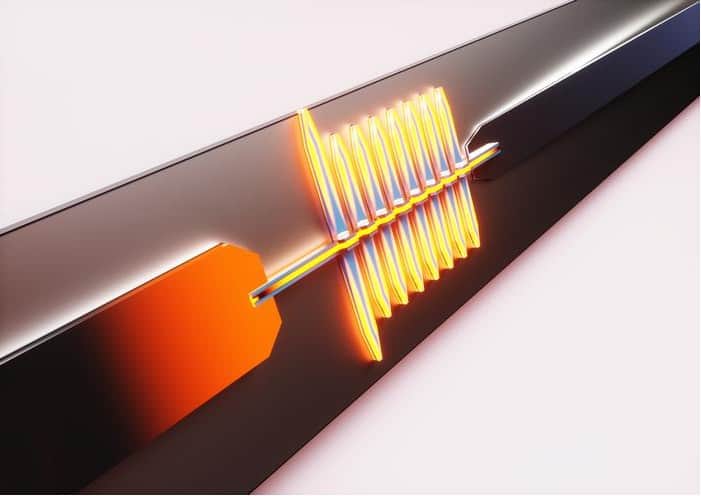
Their design consists of a AuPd nanowire (a normal metal), split into two segments. The first acts as an absorber and is tuned to match the impedance of the transmission line delivering microwave photons. This ensures that the highest possible amount of microwave power is transferred to the nanowire, across a broad range of photon energies.
Bolometer measures state of superconducting qubit

The other nanowire segment acts as the thermometer. Superconducting aluminium islands are placed next to the nanowire, creating a series of Josephson junctions. By measuring inductance shifts across the junctions the team determined the energies of single photons at resolutions smaller than 1 zJ.
The researchers are hopeful that their design will be developed to create practical detectors of single lower-energy photons – and potentially other types of particle. This would be especially useful for calibrating the components of quantum computers.
“We will use this sensor in what I refer to as an autonomous quantum processing unit to measure qubits at millikelvin temperatures and feed back to information through millikelvin controllers and microwave sources,” Möttönen says. “This will dramatically reduce the price of quantum computers in the future.” The detector design could be also adjusted to receive telecom signals at the single-photon level – providing an ideal platform for the ultra-secure communication method of quantum key distribution.