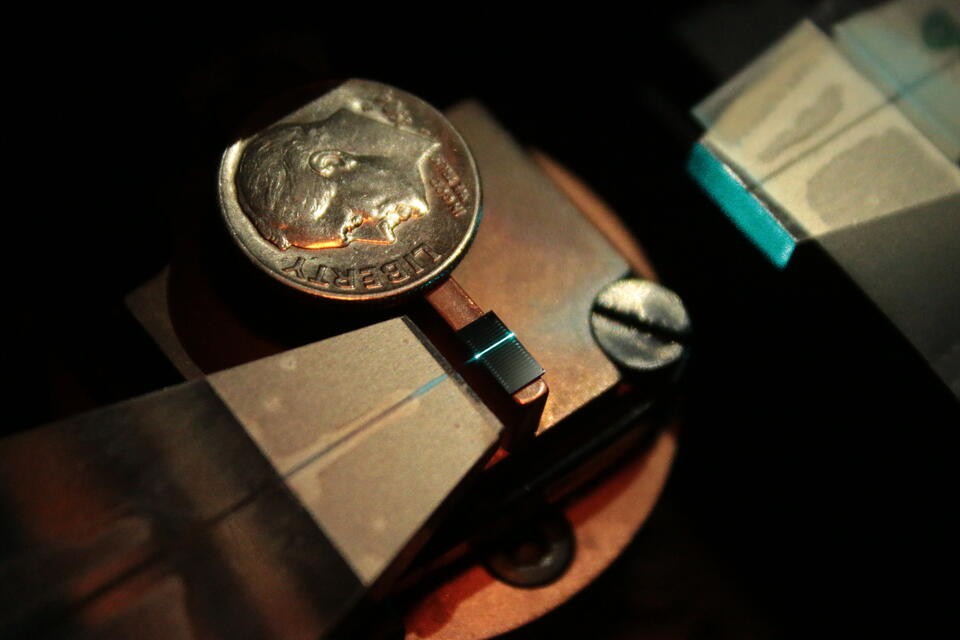
By harnessing the unique properties of tantala (tantalum pentoxide), a team of US-based researchers has created a photonic integrated circuit that can be tuned to deliver laser light across a broad spectrum of visible and infrared wavelengths.
The work was done by researchers at the National Institute of Standards and Technology (NIST) and colleagues at Octave Photonics.
From consumer electronics to atom-based metrology systems, many modern technologies depend on sources that deliver light at specific wavelengths. However, delivering high-quality narrow-band light is difficult – especially at visible wavelengths. As a result many of these technologies cannot be miniaturized to create low-cost, portable devices. Instead they must be implemented in bulky tabletop setups that are operated in expensive laboratory settings.
“Photonics technology offers routes to miniaturize components like laser sources and switches to the chip scale – devices smaller than a grain of rice,” explains study leader Grant Brodnik . “Different photonic materials have different strengths and limitations, and there is currently no single material ecosystem that can accommodate all the diverse demands of photonics.”
Mismatched materials
One promising solution involves integrating multiple advanced materials into the same device, harnessing combinations of their photonic properties to engineer capabilities that would not be possible with any single material. The key challenge is that many photonic materials have mismatched thermal, mechanical, and chemical properties, making them broadly incompatible with one another. So far, this has prevented researchers from seamlessly combining multiple materials into chip-scale devices.
To address this challenge, Brodnik’s team looked to the unique properties of tantala. A key feature of the material is that it can transform laser light at one frequency into laser light within a broad spectrum of light at visible and infrared wavelengths.
Tantala can be deposited onto other materials at room temperature, before being annealed at relatively modest temperatures of around 500 °C. In comparison, more conventional materials such as silicon nitride require annealing temperatures approaching 1200 °C.
Once deposited, tantala benefits from low internal mechanical stress, at around 38 MPa compared with around 800 MPa for silicon nitride. Together, these properties make it compatible with a broad range of underlying substrates and structures without damaging devices during fabrication.
In this latest work, Brodnik and colleagues deposited tantala directly onto a patterned thin-film substrate of lithium niobate – which itself an advanced photonic material. The result is a monolithically integrated, 3D photonic platform.
Sprinkling tantala
“We essentially sprinkle tantala directly on top of existing photonic circuitry,” Brodnik explains. “Then, we can make new photonics circuits on top, link other circuits below, or even operate together with the underlayer material and devices for new functionality.”
The team then showed that their combined platform is capable of a range of useful capabilities. “We demonstrated various photonic functions that involve generating new, custom-colour light sources from single-colour input lasers,” Brodnik says. “We also made frequency combs and supercontinuum, which are important tools for things like optical communications, precision metrology, and sensing applications.”
Several of these devices relied on the tantala and lithium niobate layers working in tandem. For instance, they used tantala to generate intense laser pulses, before passing light into the lithium niobate layer for further nonlinear processing. This allowed them to precisely measure the frequency of the laser light.
The work points to a new and broadly applicable route to the 3D integration of photonic materials, which could make it far easier to link advanced photonic functions across existing platforms.
In turn, this could open new pathways towards the scalable, affordable fabrication of complex photonic circuits, applicable in real-world devices. “New configurations offer opportunities to realise entirely new photonic designs that will drive lab experiments to field-deployable systems,” Brodnik says.
The research is described in Nature.
- This article was updated on 12 May 2026 to recognize the contributions from researchers at Octave Photonics.