Physicists have determined the mass of the W boson with the highest precision yet by analysing more than a billion proton collision events at CERN’s Large Hadron Collider (LHC). The new result confirms a prediction from the Standard Model of particle physics while refuting a comparably precise measurement made by Fermilab’s CDF Collaboration in 2022. This is significant because the older measurement, which used data from the defunct Tevatron collider, differed from the Standard Model’s predictions by seven standard deviations, suggesting that the W boson might be far heavier than the model allows.
The W boson is one of two elementary particles that acts as a carrier for the weak force (the other is the Z boson). As one of the four fundamental forces in nature, the weak force is what allows protons to change into neutrons (and vice versa), making it the driving factor behind radioactive decay and nuclear fusion. Precise measurements of the W and Z boson basses are therefore important for understanding these processes as well as for testing the Standard Model.
While physicists have measured the mass of the Z boson to an extremely high precision of 22 ppm (or 2.0 MeV), measuring the mass of the W boson with the same exactitude has proven more difficult. The main hurdle is that the W boson cannot easily be detected in colliders such as the LHC because it decays almost instantly. Scientists can look for its decay products instead, but that, too, is awkward. In one important channel, for example, it decays into a neutrino and a muon – and neutrinos are even more elusive than W bosons.
A fading mystery
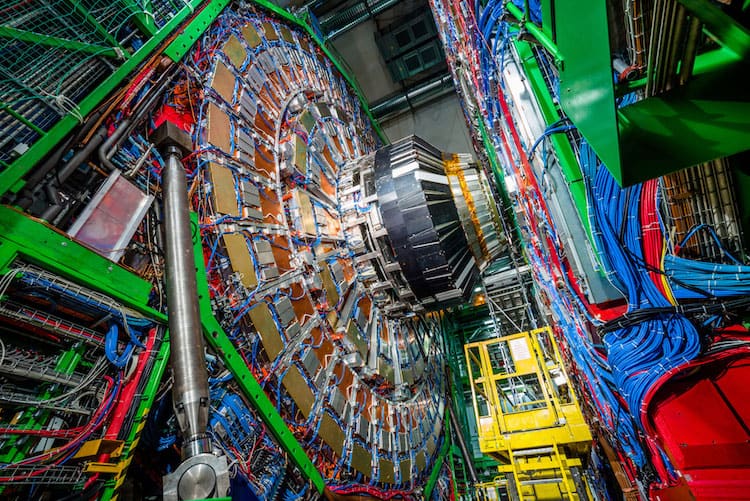
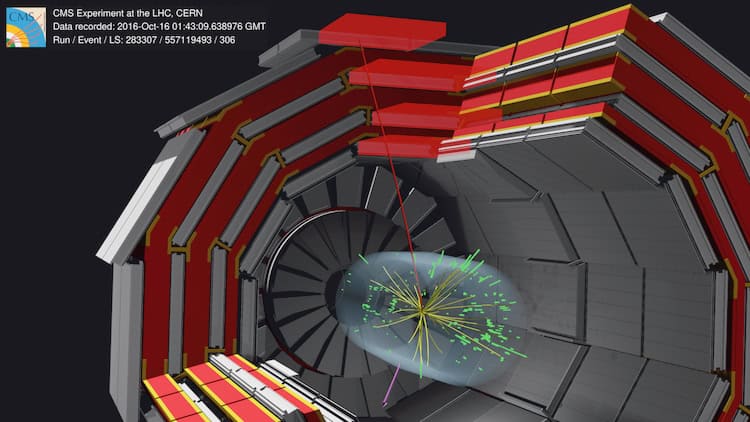
In the new work, CERN’s Compact Muon Solenoid (CMS) Collaboration studied more than a billion proton collision events produced at the LHC in 2016. Amongst these, they identified 100 million as producing a W boson that decayed into a neutrino and a muon.
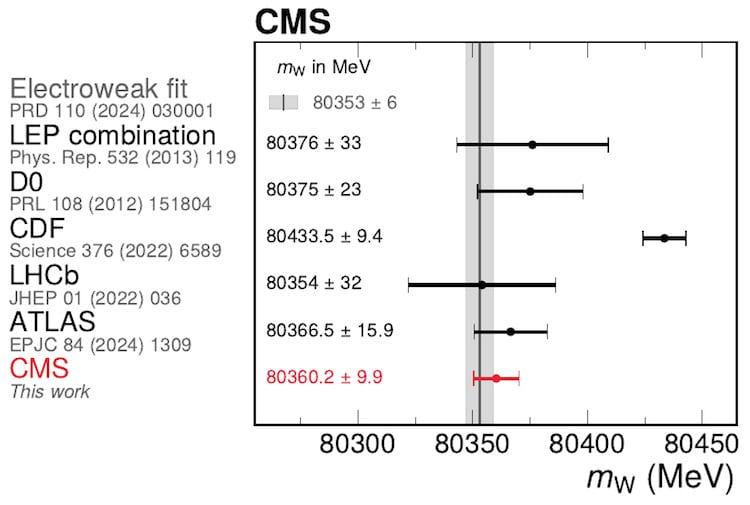
By analysing these events and simulating all the possible scenarios that could produce them, they measured the mass of the W boson to be 80360.2 ± 9.9 MeV. This is significantly less than the CDF Collaboration’s measurement, but it agrees with other previous experiments. Importantly, it also lies within the range the Standard Model predicts, leaving the CDF result – the most precise measurement before this one – looking like an outlier.
“If you take the CDF measurement at face value, you would say there must be new physics beyond the Standard Model,” says Christoph Paus, a physicist at the Massachusetts Institute of Technology (MIT) in the US and one of the lead investigators of the CMS Collaboration. “And of course, that was the big mystery.”
Now that the new, even more precise measurement agrees well with predicted values for the W boson mass, that mystery is fading, Paus tells Physics World.
Some physicists may find this disappointing. However, study lead author Kenneth Long, who was a senior postdoc in MIT’s Laboratory for Nuclear Science at the time and has since moved to a research position in Lyon, France, says the new result is “just a huge relief to be honest” and “a strong confirmation that we can trust the Standard Model”.
A starting point for precision measurements
To obtain their result, the CMS researchers needed to measure the momentum of the muon and use it to infer the W boson’s mass. This is possible for two reasons. The first is that in the W’s rest frame, its decay energy is shared roughly equally between its two daughter particles (the muon and the neutrino). The second is that muons are charged leptons, and the strong magnetic field inside the CMS detector makes them travel in a path whose curvature is a function of their momentum.
“The momentum is different to the mass, of course, but is strongly correlated with it,” explains Paus. “The challenge is therefore to track the path of the muon and every possible interaction it could have with other particles and its surroundings to estimate a value for its initial momentum.”
W boson mass measurement surprises physicists

The CMS experiment had long planned on doing such a measurement, but it took a while to set up. Now that the measurement is complete, Paus, whose MIT group joined the W boson mass analysis effort in earnest at the end of 2020, describes it as an important starting point for the collaboration. He explains that the result proves it’s possible to measure the W boson in what he calls a “high pile-up environment”, meaning one where many proton-proton collisions overlap in a single recording, without using the Z boson mass as a calibration (as was previously done in analyses at hadron colliders). “It has put the CMS experiment finally on the map for an electroweak precision measurement of this kind,” he says.
The CMS researchers are now collaborating with experimentalist colleagues at CERN’s ATLAS and LHCb detectors, as well as their theorist partners, in hopes of setting a new standard in electroweak precision physics. Their measurement is published in Nature.