While modern Japan has had a good record in winning Nobel prizes, the country had to wait 48 years since the inception of the awards in 1901 to receive its first Nobel prize.
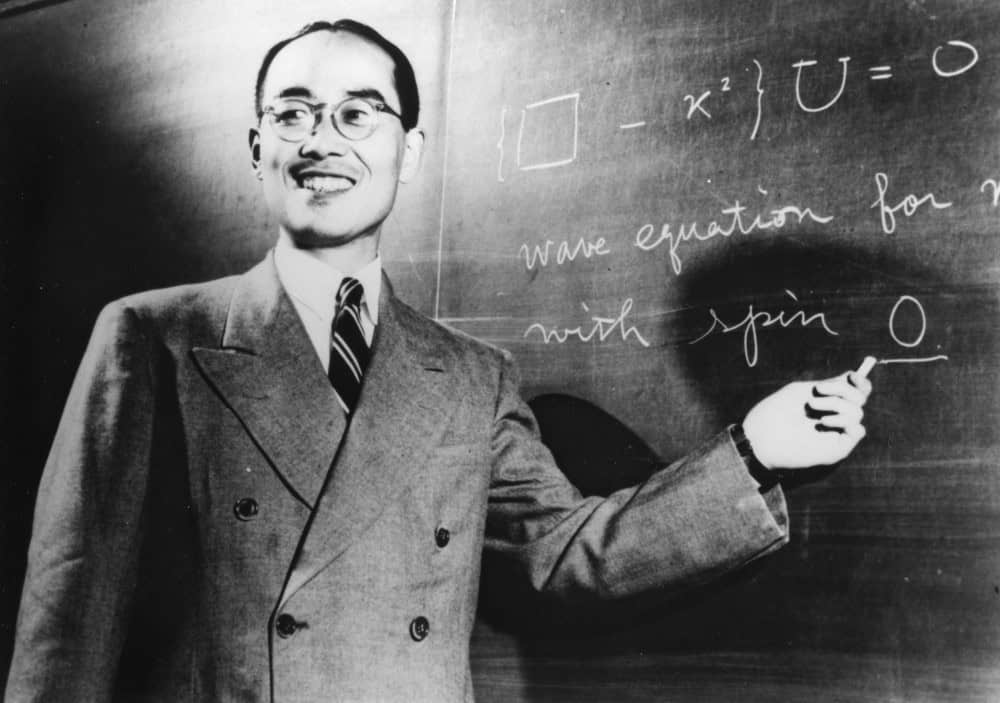
The accolade went to particle physicist Hideki Yukawa, who published his theory of mesons in the 1930s that explained the interaction between protons and neutrons.
Yukawa was born in Tokyo on 23 January 1907, graduating from Kyoto University in 1929. He then moved to Osaka University in 1933 for a PhD, which is where he did his Nobel-prize-winning work.
As positively charged protons repel each other through electromagnetic force, an issue at the time in nuclear physics was that this should cause the atomic nucleus to fly apart.
In 1935 Yukawa proposed a short-range, highly attractive nuclear force that overcomes this repulsion and suggested this force is created by the exchange of massive subatomic particles between protons and neutrons, which he called mesons.
Yukawa calculated that the mass of these exchange particles should be roughly between an electron and a proton.
Building a legacy
In 1937 three separate research groups conducted cloud-chamber experiments and discovered a new particle with a mass consistent with Yukawa’s prediction, but it was later identified as a muon.
In 1938 Yukawa was awarded a PhD and a year later moved back to Kyoto University but it took a few more years before Yukawa’s particle was finally discovered.
The first evidence of a meson came in 1947 with the discovery of the pi meson (pion) by a research group led by Cecil Powell at the University of Bristol. The team measured the particle by exposing photographic plates to cosmic rays at high altitudes (Powell won the 1950 Nobel Prize in Physics for the work).
Yukawa was then awarded the 1949 Nobel Prize in Physics “for his prediction of the existence of mesons on the basis of theoretical work on nuclear forces”.
The news was met with tremendous joy in Japan and encouraged scientists to continue their research in spite of the economic condition and the challenges of doing experimental science in postwar Japan. Revitalizing Japanese physics
In Yukawa’s honour, the Japanese government built a three-storey building named Yukawa Hall in 1952. Its focus was on developing theoretical physics in Japan and featured lecture halls, seminar rooms, offices and a library.
In 1953 the hall became home to the Research Institute for Fundamental Physics (now the Yukawa Institute for Theoretical Physics), of which Yukawa was the first director – a position he held until retiring in 1970.
The institute invited research scholars from all over Japan and held symposia and seminars on particle physics. It also published the monthly English-language journal Progress of Theoretical Physics (now known as Progress of Theoretical and Experimental Physics), together with the Physical Society of Japan (JPS).
The journal was founded by Yukawa in 1946 to publish results that had remained unpublished because of JPS’s financial difficulties.
As well as the Nobel prize, Yukawa also won many other international prizes and he was also vocal about issues in physics and society. In 1955 Yukawa joined 10 other scientists in signing the Russell–Einstein Manifesto that called for nuclear disarmament.
Yukawa died on 8 September 1981 and since he was awarded the Nobel Prize in Physics, 11 other Japanese-born physicists have gone on to win the physics Nobel – making Japan one of the most successful countries in the world.

SmarAct proudly supports Physics World‘s Nobel Prize coverage, advancing breakthroughs in science and technology through high-precision positioning, metrology and automation. Discover how SmarAct shapes the future of innovation at smaract.com.