Deuterium nuclei fired into thin foils of palladium and titanium keep fusing when the nuclei’s incident energies are reduced to the level where the process should be all but extinguished. Instead, physicists in the US have found that as the incident energy is reduced, the fusion rate plateaus – even at the lowest energies probed. Indeed, the low-energy fusion rate exceeds predictions for isolated nuclei by more than 1018. While significant, the enhanced fusion rates remain far too small for energy generation.
The results suggest that a metal’s electrons and internal defects can influence how fusion occurs, according to the researchers at the University of California, Davis and Lawrence Berkeley National Laboratory
Nuclear fusion powers the stars, but here on Earth it has so far been impossible to create a practical fusion reactor that delivers usable energy to the electricity grid
“Fusion is hard in the laboratory because positive nuclei repel each other,” explains team member Thomas Schenkel at Berkeley. Quantum mechanics offers a loophole – nuclei can tunnel through the repulsive barrier without having enough kinetic energy to overcome it. However, the tunnelling probability is very small at low energies.
Not fade away
Physicists measure these nuclear collision energies in kiloelectronvolts (keV). Today’s fusion reactors tend to operate plasmas at temperatures that correspond to collision energies of about 10 keV. Below that, reactions fade away, and earlier experiments showed that fusion pretty well stopped near 5 keV.
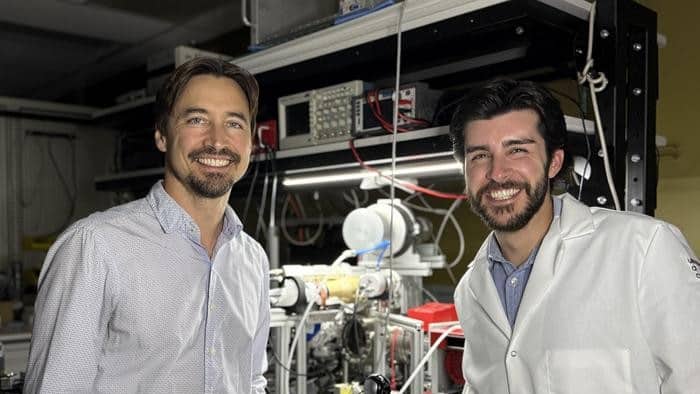
Yet a solid is a very different environment to a plasma. “Metal lattices contain electrons, defects, and locally concentrated deuterium, all of which can combine to create reaction environments that do not exist in a conventional plasma,” says Jeremy Munday who along with Micah Karahadian is based at UC Davis . The metal’s electron cloud partly shields the repulsion between nuclei, letting them approach more closely. This “screening” effect has been studied since the 1990s and is still not fully understood. The field also carries the scars of the 1989 cold-fusion debacle, during which experiments reporting enhanced fusion rates in solids at room temperature could not be reproduced.
Schenkel and Munday came to this field in the 2010s as participants in a Google-funded effort that revisited the 1989 claims. The programme found no evidence for room-temperature fusion, but it seeded their current collaboration.
Membrane reactor
The team’s apparatus places a metal foil, a quarter of a millimetre thick, between two very different environments. “At the heart of our experimental setup is a type of membrane reactor that combines an electrochemical cell with a deuterium ion beam,” says Schenkel. On one side, an electrochemical process – “similar in principle to charging a battery,” says Munday – pushes deuterium into the metal from a liquid. On the other side, in vacuum, a beam of deuterium ions strikes the same foil, burying itself just a few millionths of a millimetre below the surface.
Each fusion event spits out a fast proton or neutron, caught by two independent detectors. “Detecting these products independently, along with extensive background and control measurements, gave us confidence that the signals came from fusion,” Munday says.
As the team reduced the incident energy, they were surprised. “We observed the well-known exponential rate drop, but then the rates did not drop anymore but rather plateaued as we further decreased the ion energy,” says Schenkel. The plateau appeared below about 2 keV in both metals, and loading extra deuterium electrochemically roughly doubled the yield.
“This is an enormous relative enhancement, although the absolute fusion rate remains far too small for energy production,” Munday stresses. “The immediate significance of our work is therefore the discovery of a new physical regime in which the material actively influences the nuclear reaction, rather than the demonstration of a practical energy source.”
Welcome corroboration
Konrad Czerski, professor of nuclear and medical physics at the University of Szczecin, Poland, sees the result as welcome corroboration. “The Berkeley study represents an independent confirmation of the effect found by our research group over two years ago within Europe’s CleanHME project,” he says. His team saw a similar plateau in zirconium, palladium and titanium with a different technique. The palladium results of the two groups agree well, he notes, but the titanium data differ.
Czerski is not persuaded by the American team’s explanation, which attributes the plateau to unusually strong screening in the foil’s damaged surface layer. His group’s measurements, he argues, “demonstrate unambiguously that the yield plateau arises from fusion of deuterium at ordinary thermal energies, and the screening energy doesn’t change.”
The disagreement underlines how much remains open in the field. “The most important next step is to identify the microscopic origin of the low-energy plateau,” says Munday. This would involve untangling the roles of screening, surface damage and the way deuterium moves and gets trapped in the metal. The US team also wants to test whether light or crystal vibrations can affect the reaction rate. Near-term applications, he suggests, might include compact neutron sources rather than reactors.
Czerski has a bolder vision for the future. “The experimental setups and the results obtained can launch a new research field focused on materials and enhancing the electron screening effect in nuclear reactions,” he says – one that “can finally lead to commercial applications, and even possibly to construction of a new energy source.”
The research is described in Nature Communications.