Thanks to new resonance lidar measurements, researchers in Germany, the UK and Peru have successfully measured and traced a lithium plume created by a rocket stage as it uncontrollably re-entered and broke up in the upper atmosphere. The work represents the first time that upper-atmospheric pollution from space debris re-entry has been directly detected, they say. Such pollution is a growing concern and is only likely to worsen as more and more satellites are being launched into space, and in particular into low-Earth orbit.
The number of satellite and rocket launches has increased dramatically over the last decade and this number is set to increase as ever more commercial mega-constellations are deployed. For example, the Starlink constellation is planned to consist of over 40 000 satellites, each with a mass of between 305 and 960 kg. Given their typical operational lifetimes of five years, these satellites are expected to re-enter Earth’s atmosphere through uncontrolled decay within the next several years.
Previous studies in this domain have mainly focused on the dangers of space debris falling to the ground, but we still know little about the environmental effects that the debris can have on our atmosphere. We do know, however, that the upper atmosphere is today host to many exotic atomic and molecular species that cannot be explained as having naturally come from meteors. This is worrying since the upper atmosphere is crucial for shielding life on Earth from meteoroids and UV radiation.
An intense fireball
At roughly 03:42 UTC on 19 February 2025, the upper stage of a SpaceX Falcon 9 rocket uncontrollably re-entered the atmosphere at an altitude of around 100 km, off the western coast of Ireland. This event produced an intense fireball that many people (and radar systems) were witness to, as well as a persistent high-altitude plume of lithium vapour. It also made headline news when fragments of the debris, including a fuel tank, were recovered near Poznań in Poland.
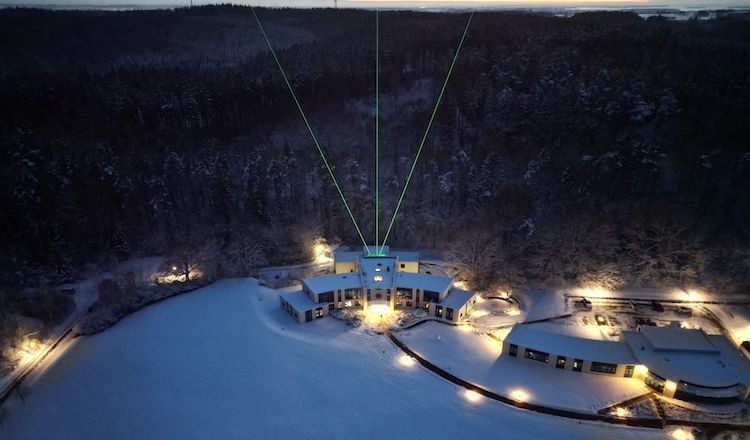
A team of researchers led by Robin Wing of the Leibniz Institute of Atmospheric Physics in Germany measured the concentration of lithium atoms in the mesosphere (which lies between 50 and 85 km in altitude) and the lower thermosphere (between around 85 and 120 km in altitude). They detected the lithium plume in the latter, using a resonance fluorescence lidar in Kühlungsborn in Germany. They also used locally measured winds from the SIMONe Germany meteor radar and global winds from the Upper Atmosphere ICON (UA-ICON) model to determine the path the lithium plume took and where it had originated.
Lidar is a laser-based remote sensing instrument that can be used to measure conditions in the atmosphere. The researchers chose to focus on lithium because it is routinely employed in spacecraft components, such as lithium-ion batteries and lithium-aluminium (Li-Al) alloy hull plating, but it is only naturally present in trace amounts at the altitudes studied. The flux of natural lithium (which comes from meteoric sources) is estimated to be around 80 g per day, while the amount of lithium contained in a single rocket stage is about 30 kg. This large disparity therefore makes lithium a sensitive tracer of man-made input from space debris re-entries, explain the researchers.
Vaporization of lithium begins at approximately 98 km altitude
Scientists already know that lithium rapidly vaporizes when a Li-Al structure ablates and it appears in the atmosphere as the aluminium matrix melts at 933 K. In their work, Wing and colleagues estimated the altitudes at which a Li-Al hull will begin to melt using the Leeds Chemical Ablation Model. For the hull thickness of the Falcon 9, they expect melting and vaporization of lithium to begin at approximately 98 km.
The strong atomic resonance fluorescence line of lithium at 670.7926 nm allows lidar to detect very trace amounts of lithium, both in the mesosphere and lower thermosphere. This enabled the researchers to perform altitude- and time-resolved measurements of the amount of lithium during and after re-entry events. Thanks to their measurements during six hours on the night of 19-20 February, they detected a sudden increase in the signal at about 96 km altitude, by a factor of 10 from the baseline value, just after midnight UTC on 20 February.
The results from this work, which is detailed in Communications Earth & Environment, also back up a recent study of the lower stratosphere conducted by Daniel Murphy at the NOAA and colleagues, which attributed significant middle-atmospheric pollution to space debris.
Potential harm to the ozone layer
Analysing the impact of re-entering space debris on the atmosphere is quite new, says Wing. “The paper by Murphy and colleagues, which was published in 2023, showed that 10% of stratospheric aerosols are already contaminated by materials from space debris. This previous work really motivated us to build a lidar capable of measuring what is left behind when rockets or satellites disintegrate in the atmosphere.”
A rubbish challenge: how do we dump space junk?

The primary concern surrounding how space debris impacts the atmosphere is currently potential harm to the ozone layer, he tells Physics World. “Our work shows that we can now measure emissions from re-entering space objects and can use winds from radar observations and models to identify potential sources. By applying similar or improved setups to ours around the globe, the scientific community could provide the space industry with solid findings so we can all optimize the use of space.”
The researchers say they are now working on building a new and improved system to measure lithium and sodium. “We would also like to conduct the first survey of various metals such as copper, titanium and lead in the atmosphere that could be connected to space debris,” says Wing.