Sugars are a vital ingredient in the recipe for life, responsible for a range of biological processes and a key component of nucleic acids such as DNA and RNA. The question of how these essential biomolecules were produced on primitive Earth is a pressing concern for origin-of-life researchers, with laboratory experiments suggesting that primordial conditions would not yield sufficient quantities.
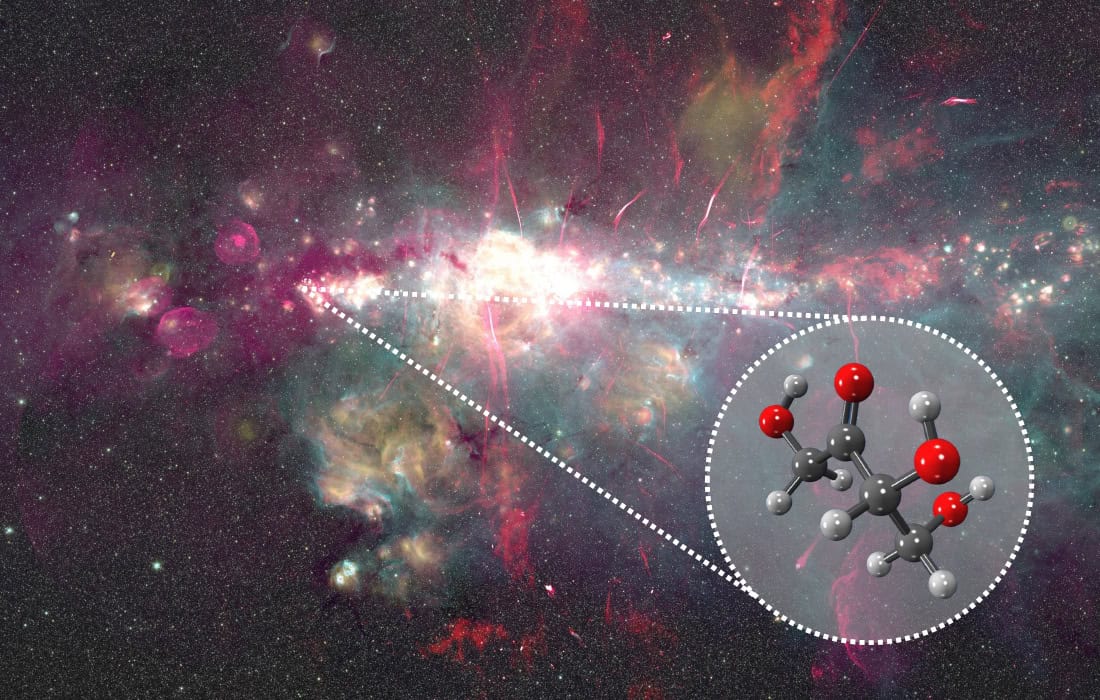
In a study led by Izaskun Jiménez-Serra at the Centro de Astrobiología (CAB, CSIC-INTA) in Spain, researchers have observed a four-carbon sugar, erythrulose, in the interstellar medium for the first time. Such sugar could have contributed to the resources available for early biological processes, providing insight into how life began on Earth.
Sugars in space
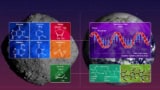
Based on studies of asteroid samples, researchers suggest that key building blocks for life may have had an extraterrestrial origin. Previous analysis of samples from the asteroid Bennu has demonstrated the presence of the sugar glucose, a primary energy source for biological processes, and ribose, a sugar that contributes to the development of nucleic acids.
The idea is that meteorites and comets containing these important chemical components impacted Earth and contributed to the resources available to develop life. This latest research looks backwards in this process to question whether these molecules may have formed in the clouds of dust and gas that parent these astronomical bodies.
Detailed in Nature Astronomy, this first observation of sugar in the interstellar medium suggests that the ingredients for life may indeed form in dust clouds as previously proposed.
Detecting erythrulose
To detect these molecules, Jiménez-Serra and colleagues used the Yebes 40 m and IRAM 30 m telescopes in Spain. Ultrasensitive, broadband spectral surveys allowed them to identify the signature of erythrulose inside G+0.693−0.027, a cloud of gas close to the centre of the Milky Way.
The team had to overcome various challenges, including the spectral signatures of different molecules overlapping and blending into one another. To ensure the validity of their observations, they identified over 180 molecular species to better understand any possible interference with the emission of erythrulose. This extensive characterization allowed the researchers to obtain very high levels of confidence in their observations, they say.
The team also analysed how the erythrulose may have been formed in the extreme low temperatures and vacuum conditions of interstellar space. The abundance of erythrulose is eight times that of three-carbon sugars which are currently undetected by these incredibly sensitive observations. This led the team to model the formation of erythrulose from simpler and more readily available two-carbon aldehydes and alcohols – a process that occurs on the surface of grains of dust in space, with the potential to then contribute to chemical systems on Earth.
Extraterrestrial building blocks
On Earth, erythrulose is found in fruits such as melons and raspberries. In aqueous environments, such as bodies of water on Earth, erythrulose easily changes its configuration into the sugar threose. Similar to ribose in RNA, threose appears in threose nucleic acid (TNA). One of the simplest nucleic acids, TNA may be one of the first involved in the early development of life.
According to Jiménez-Serra: “The discovery of erythrulose in the interstellar medium opens up the possibility for these key organic compounds to form in other molecular clouds in the Galaxy where stars and planets are forming”.
Components of RNA among life’s building blocks found in NASA asteroid sample
The team’s future plans include searching for larger sugars such as the five-carbon ribose found in RNA. “By combining astronomical observations with laboratory experiments and theoretical calculations, we will explore the chemistry of these sugars and of their related compounds, which could have played a key role in the origin of life,” shared Jiménez-Serra.
The work is being completed as part of the ERC consolidator grant OPENS. This highly interdisciplinary project draws from a range of research methods and scientific fields to approach the question of how life begun on earth. By continuing this research, the team hopes to learn more about the very earliest stage of our journey on this planet.