By controlling a type of polarized light widely used in quantum optics, researchers have transformed subtle optical patterns in our peripheral vision into vibrant, easily perceptible shapes. Led by Dusan Sarenac at the University of Waterloo, Canada, the team showed for the first time that the “Boehm’s brushes” perceived by participants can be altered by adjusting the topology of spin-orbit coupled light. Their results, reported in Proceedings of the National Academy of Sciences, could lead to promising new techniques for checking our eye health.
For the most part, human eyes are incapable of detecting polarization in visible light. But in some rare cases, structures inside the eye itself can scatter light in different ways depending on its polarization, creating subtle yet perceivable “entoptic” patterns. Perhaps the best-known examples of these are “Haidinger’s brushes”: hourglass-shaped patterns that can form in our central vision, but only when viewing linearly polarized light at blue wavelengths.
In 1940, Swiss biophysicist Gundo Boehm discovered another example: a two-lobed, bowtie-shaped entoptic pattern that forms when viewing linearly polarized light in the peripheral vision as it scatters from subcellular structures in the inner retina. Unlike Haidinger’s brushes, this lesser-known effect is driven by angular variations in scattering strength relative to the polarization direction.
But as Sarenac explains, these ethereal shapes are more than just a curiosity. “Because retinal disease may alter a person’s ability to perceive the pattern, researchers have long considered whether Boehm’s brushes could serve as a biomarker of retinal health,” he says. “However, their weak visibility has limited practical use.”
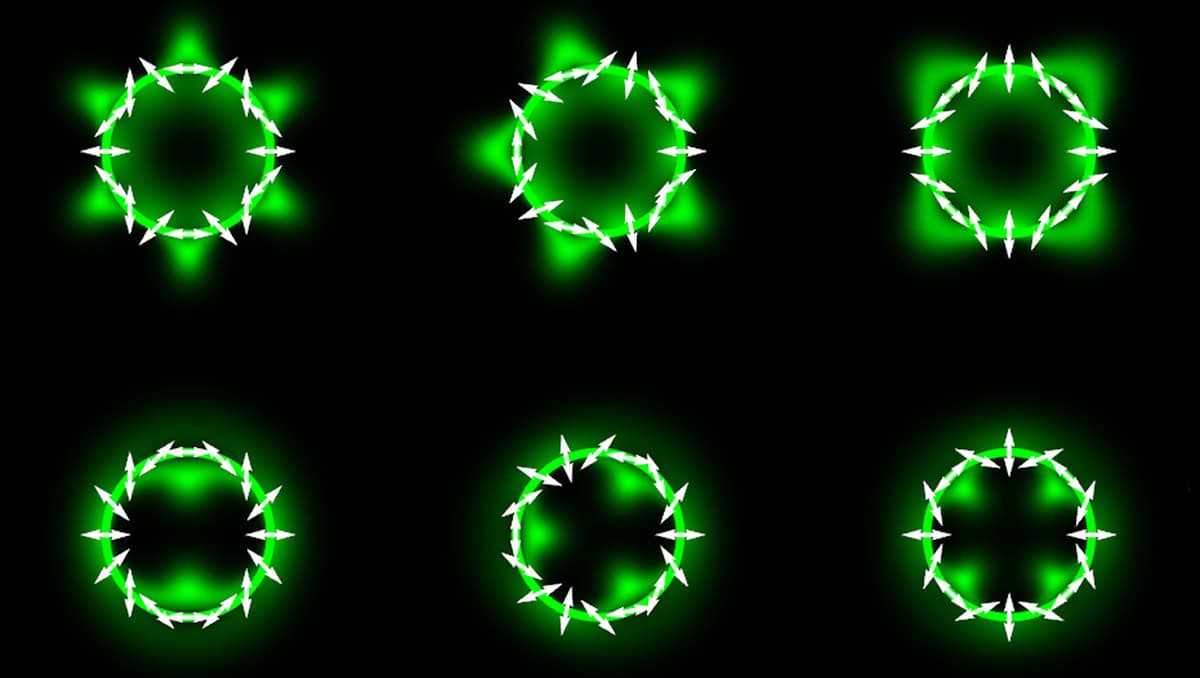
Whereas previous studies simply asked participants to passively observe the effect, Sarenac’s team considered what would happen if the light’s polarization was constantly varied. To explore this possibility, the researchers created a beam of spin-orbit coupled light, in which polarization is linked to the light’s orbital angular momentum – a property describing how the wavefront twists as the beam travels – so that the polarization direction rotates steadily across the beam.
In quantum optics, these structured waveforms are already being widely explored for their possibilities in imaging, communication and information processing. But for the first time, Sarenac’s team considered how our eyes could actually perceive this light. “We engineered the spatial polarization of the light to match the symmetry of the retinal scattering response,” Sarenac describes. “This allowed many weak local contributions to reinforce one another.”
The researchers then projected this structured light through a ring-shaped aperture, targeting specific regions in the periphery of participants’ retinas, which could also be adjusted to target varying distances from the centre of vision. Using an automated test, they measured how much contrast participants needed to reliably distinguish a Boehm’s brush from the background at these varying distances.
Based on the subject’s responses, Sarenac’s team determined that the use of spin-orbit coupled light not only made Boehm’s brushes appear far more vivid to the participants, it also transformed the bowtie shape into a multi-lobed pattern, with the number of lobes varying depending on the topology of the light’s twisting polarization.
Seeing single photons: could human eyes detect quantum effects?

“Across 11 participants, detection thresholds improved exponentially away from the centre of vision, and the pattern became robustly visible at approximately one degree of retinal angular distance,” Sarenac describes. These results reveal a fascinating link between human vision and quantum mechanics, which the team hope could be harnessed in practical healthcare. With further studies involving patients with retinal disease, they now envisage eye tests where retinal conditions could be diagnosed in people who can’t clearly perceive vibrant, multi-lobed Boehm’s brushes in their peripheral vision.
“In the longer term, these patterns may provide a non-invasive functional probe of retinal integrity because their shape and visibility can be measured across different retinal locations,” Sarenac says.