Researchers at Stockholm University in Sweden have found experimental evidence of a long-predicted critical point in water at -63 °C. The result, which they obtained by supercooling liquid water and probing it with ultrafast laser pulses before it could freeze, provides further evidence that liquid water exists in two distinct phases.
Water is a strange substance. Unlike most other materials, its liquid form is denser at ambient pressures than the ice it forms when it freezes. It also expands, rather than contracting, as it cools, and it becomes less viscous when compressed. All told, water exhibits around 60 different anomalous behaviours, and it is especially atypical when cooled below its usual freezing point. This so-called “supercooled” state of water occurs naturally in high-altitude clouds, and it can be produced in a laboratory by applying high pressures as the water is cooled to low temperatures.
In 1992, a computational study led by the physicist Francesco Sciortino (then at Boston University in the US) indicated a further unusual trait. According to simulations by Sciortino, Peter Poole, Ulrich Essmann and H Eugene Stanley, supercooled water can undergo a transition between two different liquid phases, with a liquid-liquid critical point (LLCP) occurring at pressures 2000 times higher than atmospheric pressure at sea level. “These two liquids would coexist on a line in the supercooled water’s phase diagram,” explains Stockholm’s Anders Nilsson, who led the new study. “As pressure is lowered and temperature is increased, the two phases would vanish to leave only one phase.”
At this critical point, where two phases meld into one, theory predicts that fluctuations will arise between the two liquid states. These fluctuations are not confined to the critical point, however. They also occur in a large region of the phase diagram at temperatures above it; indeed, the predicted phase diagram contains further anomalies that persist up to around 50°C. This means that the existence of an LLCP could play a role in the behaviour of water under ordinary conditions. In fact, its presence could provide a straightforward explanation for many of water’s oddities, especially at low temperatures.
Before the new study, though, this LLCP was only predicted, never proven. “It has been difficult to identify because it has not been possible to conduct experiments at the low temperatures at which ice forms very quickly,” Nilsson says.
A role for ultrafast lasers
The key to the latest work, which is detailed in Science, was a new technology. “Ultrafast X-ray lasers allow us to perform such experiments and probe water before it freezes,” Nilsson tells Physics World.
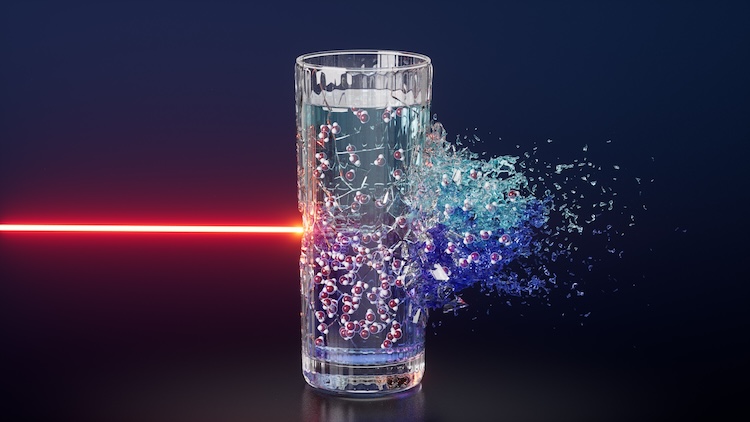
Working at POSTECH University and the PAL-XFEL facility in South Korea, Nilsson and his colleagues studied supercooled water using ultrafast infrared laser pulses followed by x-ray scattering. This allowed them to detect the phases formed before the supercooled water began to turn into ice. “By varying the laser’s fluence, we were able to access liquid states straddling the predicted critical point,” explains Nilsson.
The Stockholm researchers report that they observed a crossover from a discontinuous to a continuous transition, where the system undergoes broad and slow structural changes. Such a pattern agrees well with the existence of critical fluctuations at this point, Nilsson says. They also observed a rapid increase in the material’s heat capacity indicating a critical divergence at 210 ± 8 K, which is coincident with enhanced density fluctuations. “These results suggest that our experiments have directly probed the vicinity of a critical point in supercooled water,” Nilsson says.
Investigating the impossible
Nilsson adds that finding this critical point had long been a “holy grail” for scientists who study water, with many believing it would be impossible for experimentalists to access. As an X-ray scientist, however, Nilsson realized that the new generation of X-ray lasers could make a difference.
“I took on this challenge 15 years ago and the most difficult aspect was to move water through the phase diagram – by changing the pressure and temperature – very quickly and study it on ultrafast time scales (in less than a microsecond), before ice formation occurred,” he says. “It took us many years of planning and testing: we identified the two liquid phases, a result that we also published in Science in 2020, and have now finally succeeded in reaching the critical point.”
Second critical point appears in two models of water

The researchers now plan to continue investigating the critical point in detail, with the goal of understanding the timescales of the fluctuations that occur as the pressure and temperature are nudged away from it. “We also need to research the implications of ordinary water becoming supercritical at interfaces that are important for energy applications, such as fuel cells and water splitting,” Nilsson says. “Other important areas to consider [include] how supercriticality is important for water in living cells; water as a solute for chemical reactions; water in geological pores; and water in clouds, which are important for understanding climate change.”
Team member Fivos Perakis adds that the results are “very exciting”, given that water is the only supercritical liquid known to be present under conditions where life exists. “We also know there is no life without water,” Perakis observes. “Is this a pure coincidence or is there some essential knowledge for us to gain in the future?”
- This article was amended on 27/04/2026 to clarify the roles of the scientists involved in the 1992 study that predicted a liquid-liquid critical point in water.