Researchers in China have developed a new way of probing the magnetic domains within altermagnetic materials and used it to study a prominent altermagnet candidate, alpha-phase iron oxide. According to their measurements, this material shares certain properties with ferromagnets despite having a near-zero net magnetization – a fact the researchers say supports its classification as an altermagnet.
In most magnetically ordered materials, the spins of atoms (that is, their magnetic moments) can either line up parallel with each other or antiparallel, alternating up and down. These arrangements are driven by spin-exchange interactions between the atoms, and they lead to ferromagnetism and antiferromagnetism, respectively.
Altermagnets, which were identified as a distinct class of magnets in 2022, behave differently. While their neighbouring spins are antiparallel, like an antiferromagnet, the atoms hosting these antiparallel spins are related to each other by rotational or mirror symmetries rather than the spatial inversion and half-lattice translation symmetries found in conventional antiferromagnets, explain physicists Luyi Yang and Wanjun Jiang of Tsinghua University, Beijing, who led this study. This unique property leads to a zero net magnetization in altermagnets while still allowing for the spin-split electronic band structures typically found in ferromagnets.
An altermagnet candidate
Alpha-phase iron oxide (α-Fe2O3) is a naturally occurring mineral commonly known as haematite. It was long believed to be an antiferromagnet, but recent theoretical research has suggested that it should be relabelled as an altermagnet.
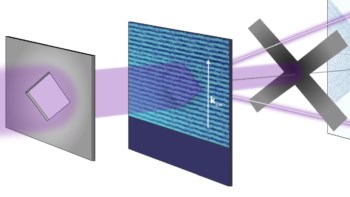
To shed more light on the nature of α-Fe2O3, the team turned to a phenomenon known as the giant magneto-optical Kerr effect (giant MOKE). Named after the Scottish physicist John Kerr, who discovered it in 1877, it occurs when linearly polarized light reflects off the surface of a magnet. Interactions between the light and the material’s magnetic domains cause the polarization vector of the light to rotate, and the direction of rotation can be reversed by reversing the direction of magnetization. The effect therefore provides a “window” into materials’ magnetization states, enabling scientists to monitor and characterize them.
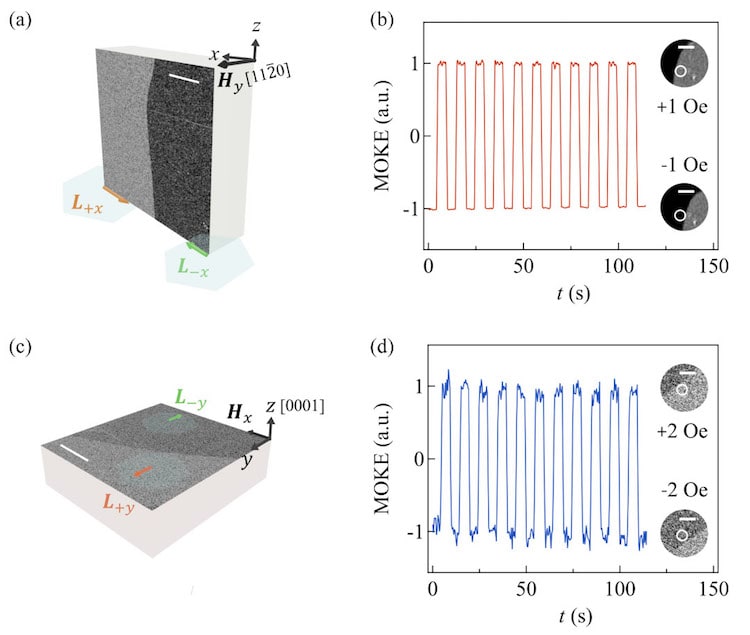
The Tsinghua University researchers say they found evidence of a connection between the material’s MOKE responses and its Néel vector, which is a parameter that defines its so-called staggered magnetic order. In altermagnets, the orientation of this Néel vector determines the material’s magnetic space group, which in turn dictates whether magneto-optical responses are allowed or not, they explain.
“By using magnetic fields to switch the Néel vector through a tiny canted magnetization in α-Fe2O3, we selectively measured the symmetry-permitted MOKE signals and confirmed the absence of symmetry-forbidden components on different surface orientations of α-Fe2O3 single crystals,” they say.
The researchers also observed that at large applied magnetic fields, the MOKE signals remain constant. This finding further rules out contributions from canted magnetization, which should increase with the field. These experiments therefore strengthen the idea that the MOKE signal they measured is truly driven by the Néel vector and the corresponding symmetry of α-Fe2O3.
Broadening methods for imaging altermagnetic domains
To date, most experimental studies on altermagnets have focused on spin transport. Yang, Jiang and colleagues say that they turned to MOKE-based measurements because they would like to study insulating altermagnets, for which electrical transport measurements are inaccessible. “We aimed to uncover the symmetry requirements for magneto-optical responses and broaden the methods for imaging altermagnetic domains,” they explain.
The main challenge they encountered was proving that the MOKE they observed predominantly originates from the Néel vector, rather than from the canted weak magnetization. The researchers say they addressed this through symmetry analysis, first-principles calculations and performing the experiment in different configurations to show that the Kerr signal remains nearly constant even as the canted magnetization keeps increasing at large applied magnetic fields. “By examining such effects on single crystals with different surface orientations, we confirmed that different Néel vector orientations produce distinct MOKE responses, which are consistent with the symmetry of magnetic space group predicted by theory,” they tell Physics World.
Layer-spintronics makes its debut

The researchers say their work shows that MOKE responses are not limited to ferromagnets, as is conventionally understood. Provided the symmetry requirements are satisfied, altermagnets can also exhibit giant MOKE. “We have shown that standard MOKE imaging microscopy can be used to visualize altermagnetic domains and domain walls in α-Fe2O3,” they say. “This could accelerate the development of altermagnetic spintronics based on these structures, with potential applications in advanced memory and logic devices.”
The researchers now plan to extend their approach to other altermagnetic insulators and metals and to use the magneto-optical response to study the (presumably) ultrafast dynamics of domain walls. Their present study is detailed in Chinese Physics Letters.