Pristine iron telluride is a superconductor, with the natural material’s superconductivity suppressed by excess iron in the crystal lattice, researchers in the US have shown. This resolves a long-standing puzzle about why, when other materials with similar structures showed superconductivity at low temperatures, iron telluride had always retained an antiferromagnetic order. The results provide a secure platform for further exploration of iron-based superconductivity, and could open the door to the study of interesting physics such as potential topological superconductivity in iron telluride itself.
Much like the cuprates, iron-based superconductors such as chalcogenides like iron selenide often exhibit complex phase diagrams in which antiferromagnetic ground states compete with superconducting ones. Although tellurium sits directly underneath selenium in the periodic table, superconductivity has never been observed in pure iron telluride. It can behave as a “parent compound” for inducing superconductivity via chemical substitution with selenium, for example.
“One thing that’s always been a puzzle in the field is that the magnetic structure of iron telluride is fundamentally different from that of all other iron-based superconductors,” says condensed matter physicist Pengcheng Dai of Rice University in Texas; “People say ‘Oh, it’s more correlated’ – but the problem with that is that when you dope it with selenium and it does become superconducting, all the electric and magnetic properties occur at the exact same wave vector as other iron-based superconductors.”
Barely discussed
Condensed matter experimentalist Cui-Zu Chang of Pennysylvania State University in the US and colleagues had conducted multiple experiments involving the growth of tellurium compounds on iron telluride substrates, and reliably found that these produced supercondivity. Nevertheless, says Chang, the possibility that iron telluride itself might have a superconducting state was barely discussed by theorists.
Following Chang’s philosophy that “for superconductivity, if you follow theory and try to do something, 99% of the time you will fail,” the researchers set out to ascertain the state of pristine iron telluride experimentally. They bombarded a strontium titanate substrate with high purity beams of gaseous iron and tellurium atoms to produce 40-layer-thick films of iron tellurium. When they examined these using a scanning tunnelling microscope, they found that the films showed antiferromagnetic order. However, electron microscopy showed that the structures contained excess iron atoms clustered together periodically.
Stoichiometric iron telluride is a superconductor: magnetic mystery is solved
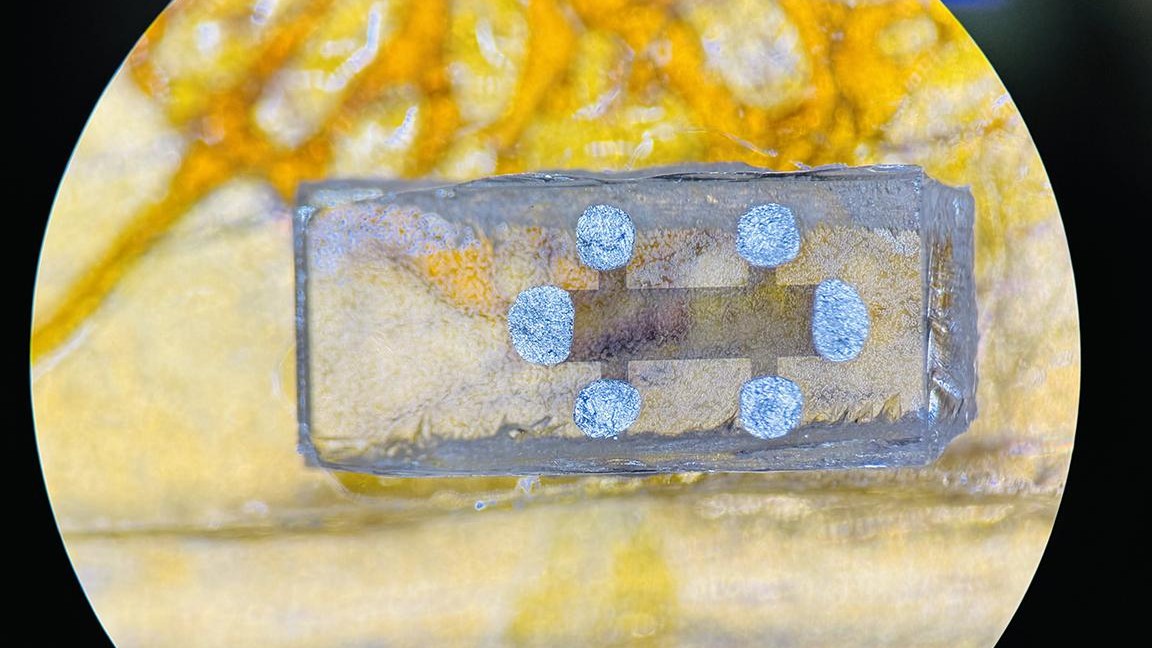
The researchers therefore performed multiple cycles of post-growth annealing, bombarding the structure with pure tellurium. These reacted with the interstitial iron, removing it from the structure by forming more iron telluride on the surface. The researchers monitored the electrical behaviour of the sample in tandem with its structural evolution, finding that, as regions approached stoichiometric FeTe, the antiferromagnetic order disappeared. After five cycles of annealing, the material was pure iron telluride, and the researchers showed that it behaved as a robust superconductor with a critical temperature of around 13.5 K. They confirmed this with the observation of the Josephson effect, Cooper-pair tunnelling and other related phenomena.
The researchers now intend to study the specific properties of stoichiometric iron telluride in more detail: “Because tellurium is heavier than selenium you have stronger spin-orbit coupling, so iron telluride should be a topological insulator at the same time as it’s a superconductor,” says Chang; “We call these topological superconductors.” Such topological superconductors – the first of which was uranium ditelluride – are of great interest in quantum computing thanks to their potential to host protected Majorana qubits. More broadly, the researchers believe it is important to study whether other materials may host “hidden” superconducting states suppressed by disorder.
Dai, who was not involved in the research, is impressed: “It’s surprising, in the sense that it solves a fundamental puzzle that’s been in the field for some time,” he says. He notes that definitive proof is not achieved because the material is on a substrate, so techniques such as neutron diffraction traditionally used to probe the magnetic structure of bulk materials are impossible. It is also possible to question whether the substrate is influencing the material. Nevertheless, he is persuaded: “At least to me, it really unifies the picture that the magnetism is probably universal for all the iron-based superconductors,” he concludes; “In the same way that in the cuprates, the parent compounds are basically Mott insulators, from this experiment we can basically say that in iron-based superconductors the parent compounds are basically simple stripes, and this oddball is because of the excess iron that stabilizes the particular structure.”
The research is described in Nature.