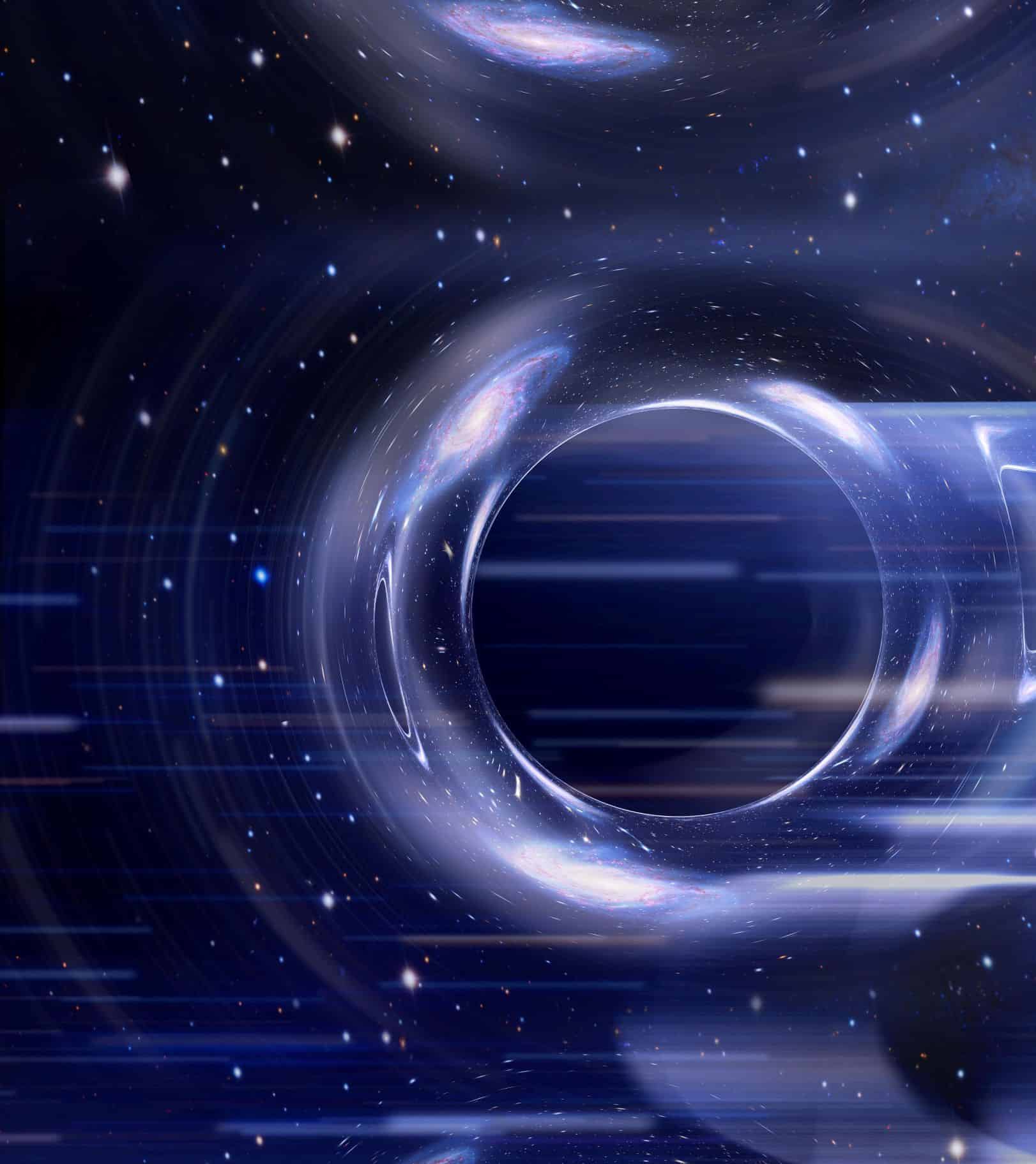
An exceptionally loud gravitational wave signal has offered an unprecedented glimpse into the region of space near a black hole’s event horizon – the “surface of no return” beyond which nothing, not even light, can escape the pull of gravity. Denoted GW250114, the signal originated from the merger of two black holes, and its unusual strength and clarity meant that astrophysicists could extract information from it that was previously only accessible via theoretical modelling.
Physicists describe a black hole’s event horizon in terms of two parameters: the black hole’s rotation frequency ΩH and its surface gravity κ. When an object falls into a black hole, it appears to orbit at ΩH because of a phenomenon known as frame dragging in which the black hole literally drags nearby spacetime along with it as it rotates. This means that objects near a black hole’s edge are constantly in motion relative to observers on Earth.
Regions of space near an event horizon can be described very well theoretically, but observational data has been hard to come by – at least until recently. “Gravitational waves are changing that,” says Sizheng Ma, a postdoctoral researcher at Canada’s Perimeter Institute who led the new study alongside astrophysicist Ling Sun and PhD student Neil Lu from the ARC Centre of Excellence for Gravitational Wave Discovery (OzGrav) and the Australian National University.
Gravitational waves are ripples in spacetime produced whenever dense astronomical objects such as black holes and neutron stars collide. With facilities such as the Laser Interferometer Gravitational-Wave Observatory (LIGO), Virgo and KAGRA (Kamioka Gravitational Wave Detector) now routinely recording these ripples, Ma says, “something that once sounded almost like science fiction – learning about black-hole horizons through observations – is now becoming a real scientific programme”.
From prediction to observation
In earlier theoretical work, Ma and colleagues in Japan, China and the US predicted that if Einstein’s general theory of relativity is correct, the gravitational waves produced when two black holes merge should carry information about the near-horizon region during the final stage of the merger. This information takes the form of a gravitational-wave component known as a direct wave that oscillates around a value that is twice that of ΩH. “The big question was whether such a signal could actually be seen in real gravitational-wave data,” Ma says.
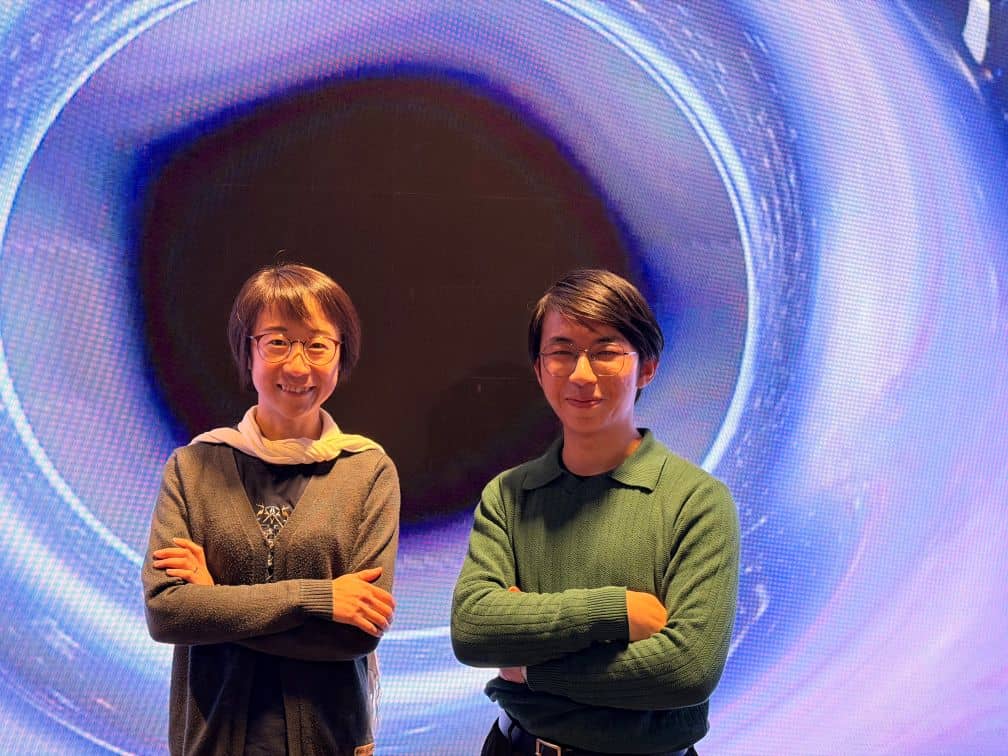
The main challenge, he explains, is that gravitational-wave data are hard to interpret. “Interesting features can appear for many reasons, so we had to be very cautious,” he says. “We needed to separate this possible direct-wave signature from the much stronger and better-known ‘ringdown’ signal of the final black hole, and then check whether the remaining pattern behaved as the theory predicted.”
When the LIGO-Virgo-KAGRA network detected GW250114 last year, the astrophysicists realized they were in luck. With a network signal-to-noise ratio of approximately 80, this event was around three times louder than LIGO’s first gravitational-wave signal in 2016, and it gave the team a rare opportunity to test their prediction against data. “Our new analyses have allowed us to decrypt the signal and measure ΩH and κ for the first time,” Ma says.
“A new way of studying black holes”
Even with an unusually clear signal, Ma acknowledges that the work required “careful modelling and many double-checks to make sure we were not overinterpreting a feature in the noise”. But if the team’s interpretation holds up, Ma tells Physics World that their method could become a new way of studying black holes. Gravitational-wave observations have already enabled scientists to study how black holes orbit, merge and settle down, Ma notes. The present work extends this by offering access to the near-event-horizon region during the merger’s final stage.
“That gives us a new observational handle on some of the most extreme predictions of Einstein’s theory, allowing us to perform sharper tests of this theory and better understand how black holes form and relax after a merger,” he says. “It also allows us to explore whether the near-horizon region behaves exactly as Einstein predicted.”
The researchers’ next step will be to improve their direct-wave model so that it describes realistic black hole mergers in greater detail. “On the observational side, we want to apply the analysis to more gravitational-wave events,” Ma says. “The result detailed in this study comes from one exceptionally loud and clean event, so the most convincing confirmation would be to see the same kind of near-horizon signature in other black-hole mergers.”
LIGO–Virgo spots its most massive black hole merger so far
The good news is that as gravitational-wave detectors continue to improve, the researchers hope to collect more such high-quality events. “These will allow us to test whether this pattern appears consistently in the way general relativity predicts and eventually turn this first result into a more systematic way of studying the regions near black hole horizons,” Ma says.
The research is published in Nature.