The International System of Units is the foundation of metrology, ensuring that all units across science are consistent. But in among the strict modern definitions based on universal constants, there are some unusual quirks, as Ben Stein explains
Even though it is the bedrock of modern measurements, the International System of Units (SI) is not set in stone. As science advances, the SI’s stewards are committed to changing the system for the better, replacing definitions based on objects to ones reliant on unchanging universal constants of nature.
The most famous recent example came in 2019, when the kilogram was redefined in terms of the Planck constant, replacing the standard platinum-iridium mass stored for more than 100 years at the Bureau International des Poids et Mesures (BIPM) in France. The next base unit of measurement likely to be redefined is the second, with modern atomic (and potentially nuclear) clocks offering more precision than those based on the stalwart caesium atom, which has defined the unit of time since 1967.
But as the SI continues to evolve, it has also retained its share of quirks, some that arose from the practical limitations of technology and others due to our human biology.
Not just a gram
Today’s SI has seven fundamental base units of measurement (see box below), including metres for length, amperes for electric current and kelvins for thermodynamic temperature. So why is the base unit of mass not one gram (g) but a thousand grams (kg)?
The reason is quite simple: it was once hard to make objects that are exactly one gram. Kilograms – which are roughly two bags of flour – were much easier to make accurately and more useful in day-to-day trade.
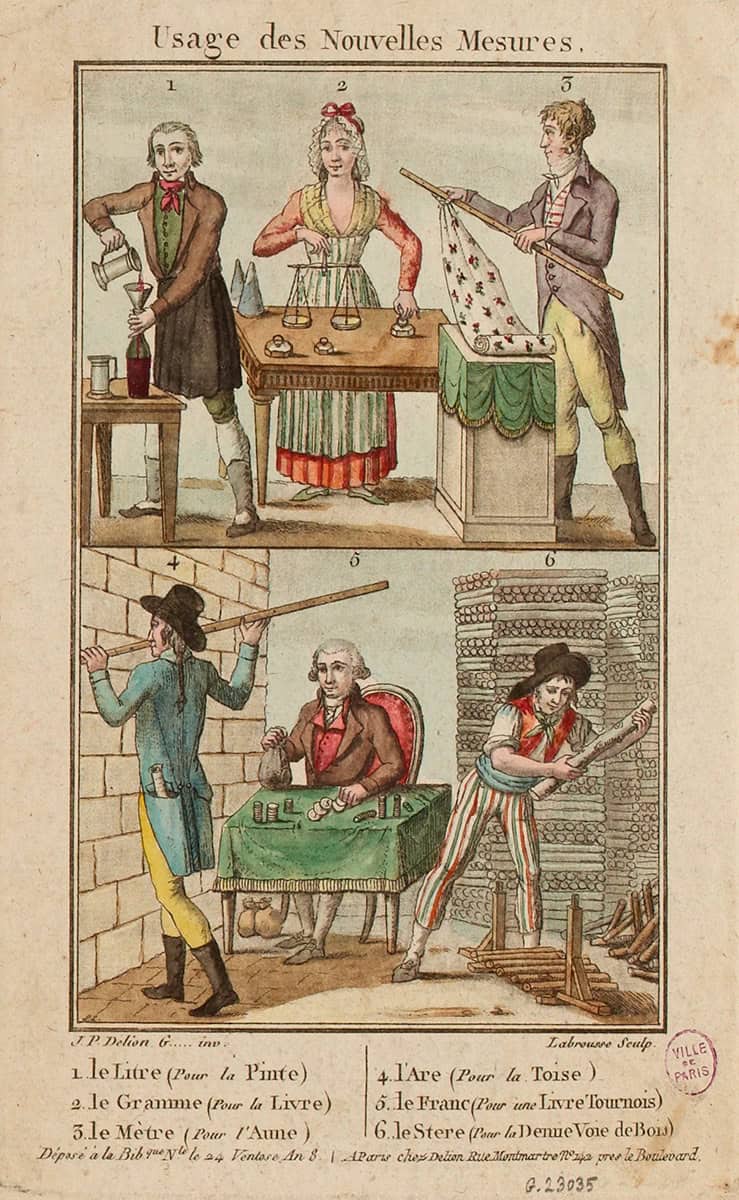
In 1795 the French revolutionary government, working off the country’s Commission on Weights and Measures, formally defined the gram as the mass of a one centimetre cube of water at 4 °C. But that’s about the size of five green peas and the weight of five raisins – it doesn’t make for a very practical definition for commerce.
So they simultaneously commissioned the making of a standard that was 1000 times heavier. Following years of careful calculations by a scientific committee, a metallurgist named Étienne Lenoir crafted a solid platinum cylinder in 1799 that represented the original prototype kilogram. By 1875 the kilogram took hold internationally when 17 countries signed the Metre Convention – an international treaty establishing agreed-upon references for length and mass. The UK signed on in 1884, and nowadays there are 65 member states and 35 associate states and economies.
In 1889 “Le Grand K” – a new platinum and iridium prototype for the kilogram – was declared the official definition of the unit. Stored in an underground vault at BIPM, it served as the international standard of mass until as recently as 2019.
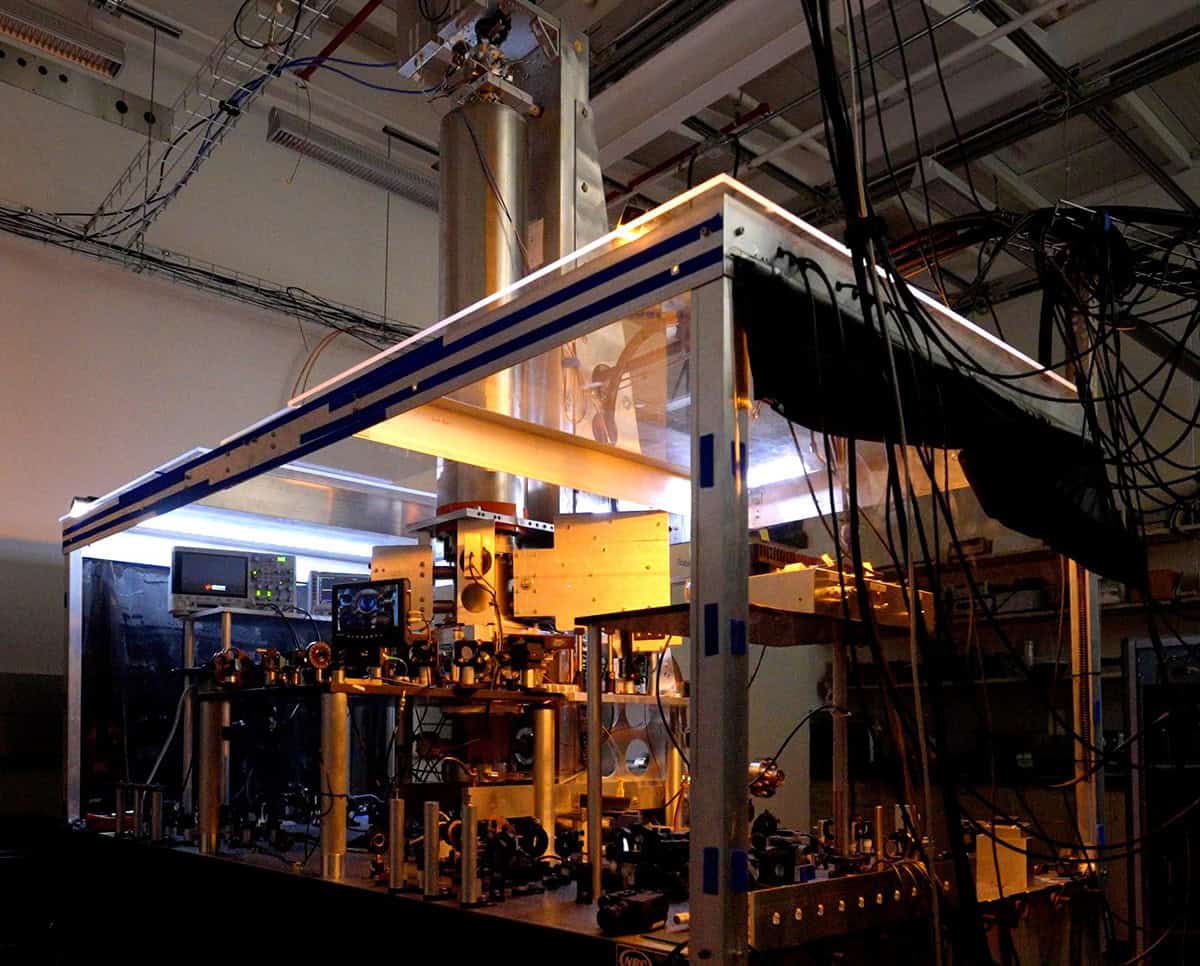
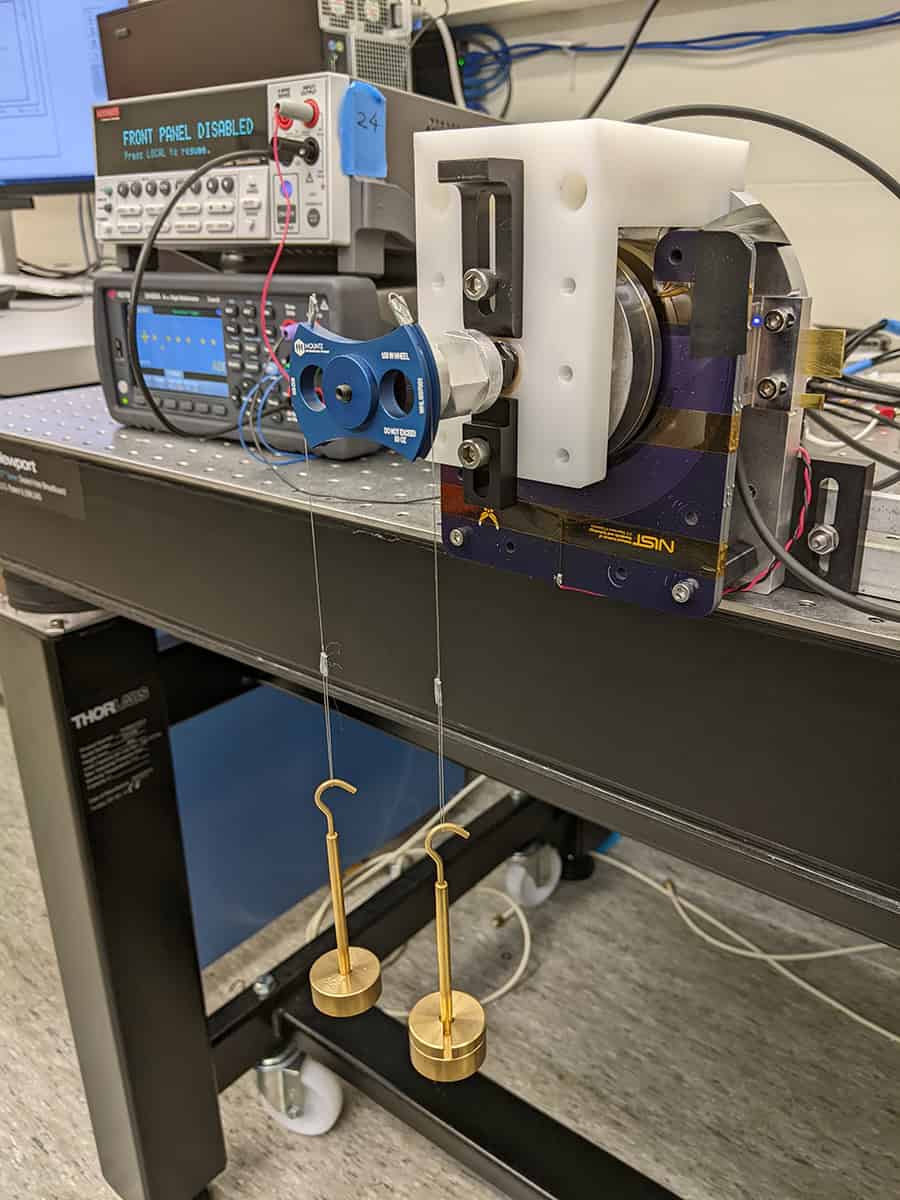
The new definition for the kilogram relies on a fixed Planck constant h. To measure this value as precisely as possible, metrologists used two techniques: X-ray crystal density (XRCD, also known as the Avogadro experiment), and the Kibble balance. The latter uses electromagnetic forces provided by a coil of wire immersed in a magnetic field to balance a mass. The equipment let metrologists obtain accurate values of current and voltage, from which the Planck constant could be derived. But as of 20 May 2019, when the constant was set in stone and the kilogram was redefined, the Kibble balance could be used to measure mass with high precision instead.
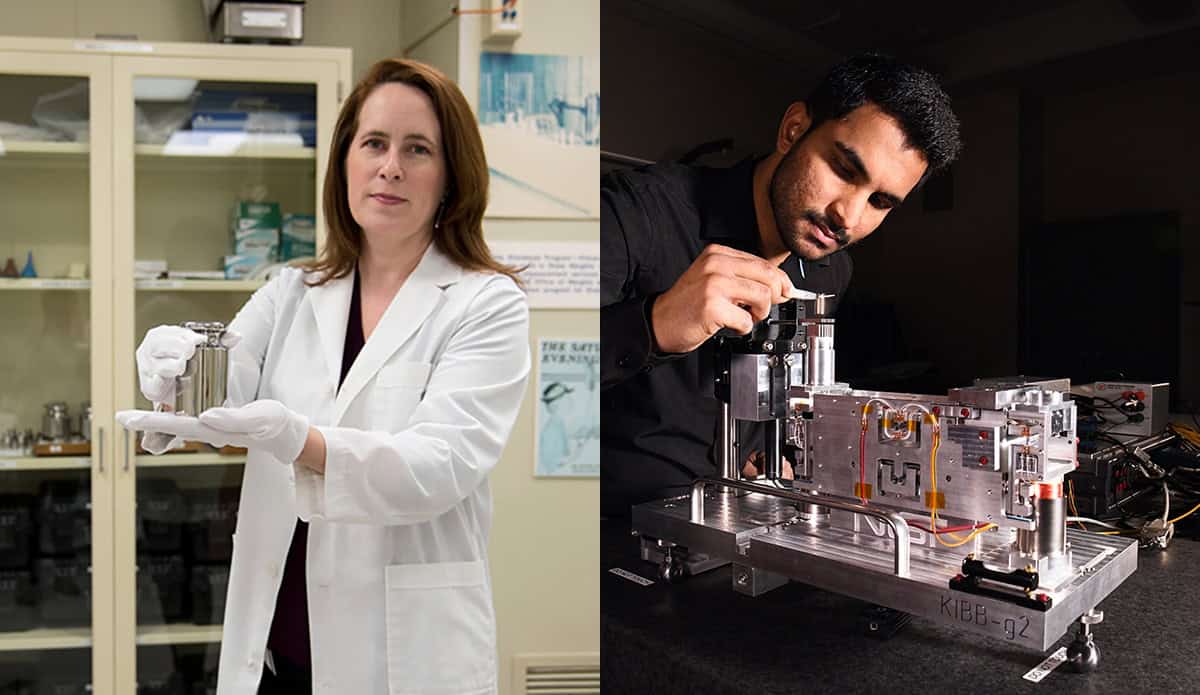
While the kilogram is still the official international unit of mass, researchers are using tabletop Kibble balances and other instruments to directly measure the gram in terms of the Planck constant. Improving our ability to measure the gram is useful for pharmaceutical manufacturers, who want to dispense drug doses accurately, and for the military and companies that need to make precision parts for electronics, aerospace and other critical applications.
But there is one place where the gram has long been a shining star: the classroom. As my NIST colleague Elizabeth Benham points out, educational companies make one-gram cubes that are one centimetre on each side, and one millilitre in volume. These “centimetre cubes” excel at showing the relationships between mass, length and volume. Students can build 10 by 10 layers (1000 cubes) to create a “supercube” that is a kilogram in mass and a litre in volume. So if you’re sad about the gram not being a base unit, you can take solace in the fact that for school students, it is the mass measurement unit of choice.
The base seven: how we measure our world
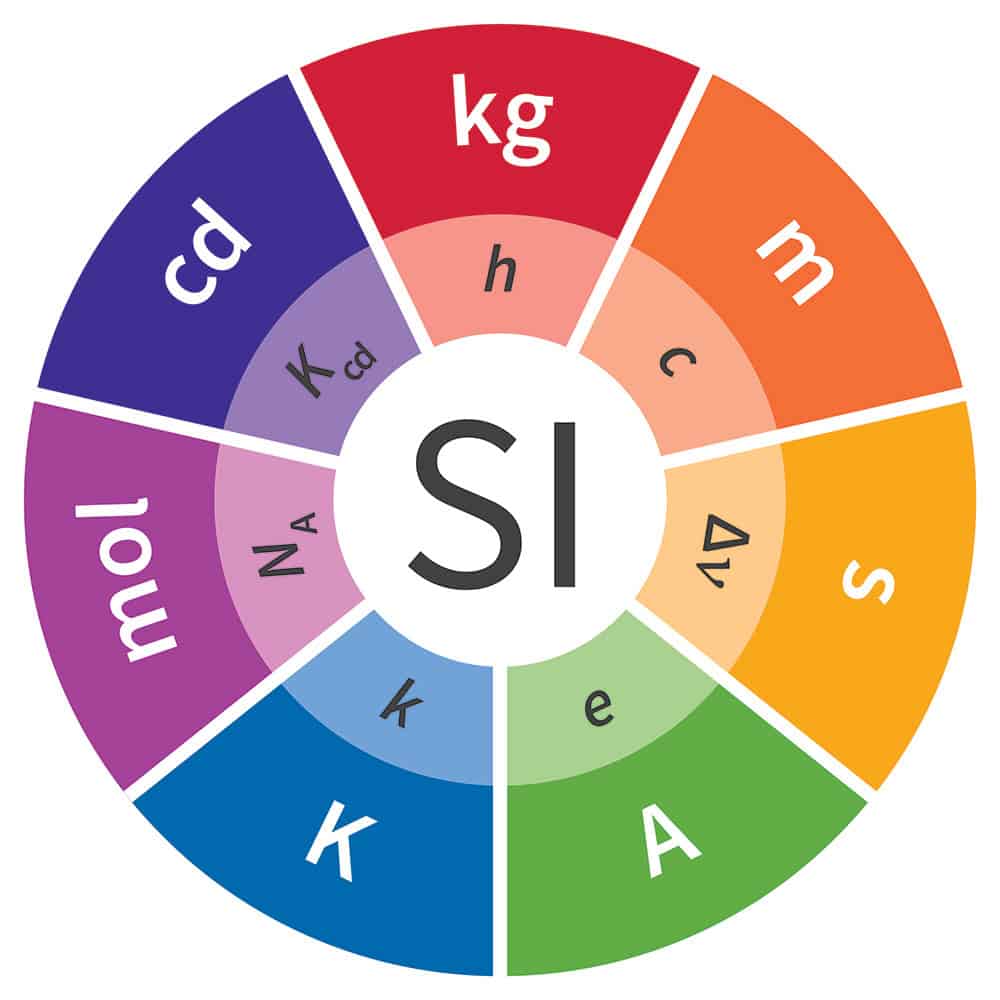
There are seven base units in the International System of Units (SI). Over the centuries since they were adopted globally, each has evolved from their original definition so they can be applied and measured more consistently and accurately. In 2019 the latest definitions of these units took effect. Not only are all seven base units defined by fundamental constants like the Planck constant, but the values of these constants are locked as exact numbers based on the best scientific measurements available at the time.
Unit for time: second
The second (s) was once simply reliant on the length of a day, but is currently defined by the unperturbed ground-state hyperfine transition frequency of the caesium-133 atom, ΔνCs. In 2019 the frequency was fixed as an exact unchanging value. It is likely that the definition will be refined further using atomic or nuclear clocks.
Unit for length: metre
Historically, the metre (m) was 1/10,000,000 of the distance from Earth’s equator to the North Pole. Today, it is the distance that light travels through a vacuum in 1/299,792,458 seconds, where the denominator is the exact value of the speed of light in vacuum, c.
Unit for mass: kilogram
The kilogram (kg) used to be defined by the mass of a platinum-iridium cylinder called the International Prototype Kilogram, or Le Grand K. It is now defined in terms of the Planck constant, h.
Unit for electric current: ampere
The ampere (A) was once defined by an imaginary and impossible experiment involving the force between two infinite parallel, current-carrying wires. It is now defined in terms of the elementary charge, e.
Unit for amount of substance: mole
The mole (mol) used to be defined by the number of atoms in 0.012 kg of carbon-12. To avoid it depending on the mass of a sample, it is now defined in terms of a specific number of atoms or molecules, the Avogadro constant, NA.
Unit for thermodynamic temperature: kelvin
Previously, the kelvin (K) was defined by the thermodynamic triple point of water, but it is now tied to an exact value of the Boltzmann constant, k, which relates thermodynamic temperature to energy.
Unit for luminous intensity: candela
The candela (cd) was simply based on the light emitted by a burning candle. The current definition is reliant on a fixed numerical value for the luminous efficacy of monochromatic radiation of frequency 540 × 1012 Hz, Kcd.
The most human unit
In today’s SI, the base units are defined by fundamental constants of nature, such as the Planck constant and the charge of the electron. As best as we can tell, these constants appear to be the same everywhere in the universe, so extraterrestrials would measure the same values for these constants as we do.
But there is one base unit that is very specific to humans: the candela, which means “candle” in Latin, Spanish and Italian. It stems from the UK parliament introducing a unit known as “candlepower” in 1860 so the country could achieve uniform street lighting. Initially, scientists defined the unit in terms of a single candle made from whale fat, with a bit of beeswax to improve the burn. Inevitably, this standard was abandoned because no two objects are exactly alike: one candle shines light at a slightly different rate than another.
By the middle of the 20th century, scientists tried to define the unit in terms of a more universal property – namely, blackbody radiation, the electromagnetic energy from an object that is a perfect absorber and emitter. In 1946 the International Committee for Weights and Measures in France proposed a “new candle” based on the intensity of radiation from platinum at its freezing point (2041.4 K). In 1948 the General Conference on Weights and Measures (CGPM) ratified this standard and named it the “candela”. The new definition also specified that the candela was a measure of intensity as perceived by the human visual system.
This is a very practical addition because researchers can actually quantify human visual perception. In the early 20th century, scientists carefully measured how sensitive the eye is to visible light and established a “photopic curve” – average levels of human sensitivity to different colours. To cite a contemporary example, green laser pointers appear brighter to us than red laser pointers with the same power as a result of our human biology.
In 1979 the CGPM eliminated blackbodies from the definition. Even this fundamental concept was problematic, since no object can be a perfect blackbody. Instead, the group defined the candela directly in terms of a single colour of visible light, with a frequency of 540 × 1012 Hz.
This reference colour is a shade of yellow-green to which the human eye is most sensitive in a well-lit room, and from it, scientists use the photopic curve to determine the luminous intensity of other colours. Scientists think our eyes adapted to this chartreuse hue because it lines up with the peak spectral irradiance of sunlight that strikes the Earth’s surface. Early humans’ sensitivity to this colour could have helped them spot different types of vegetation when foraging, with yellow-green leaves indicating younger, more calorie-dense food, while greener leaves signify that a plant’s nutrients have moved to other places such as the roots and stems.
In 2019 the candela was officially redefined yet again. It is now expressed by fixing the luminous efficacy of 540 × 1012 Hz light as a constant of 683 lumens per watt – a sort of conversion factor between the physical intensity of visible light and human perception of its intensity.
If extraterrestrials have plant-like food, they might be more sensitive to another colour in the spectrum based on the star (or stars) that shines over their home planets. For example, at least one scientist has speculated that plants in a red-dwarf star system might look black to us because they might need to absorb as much light as possible from this cooler star. But a native creature may have evolved to see lower-frequency light, which would make the plant appear intensely infrared to them. If we ever make contact, measurement scientists from our planet will likely be very interested in knowing how aliens might define their own candela.
Time’s unusual unit
As all physicists know, the SI centres on the number 10, whether measuring molecules at nanometre (nm or 10–9m) scales or a nuclear power plant with a gigawatt (GW or 1012 W) of power.
Whereas older measurement systems often had complicated conversions involving different units – such as 16 ounces in a pound and 14 pounds in a stone – the metric system sticks with the same unit and helpfully adds prefixes to indicate quantities on the mindbogglingly wide scale of 10–30 to 1030. In fact, the expansion of the prefixes from 48 to 60 orders of magnitude is another recent SI improvement (made in 2022) to accommodate the latest needs in computing and other scientific fields. We now have ronna (R) for 1027, quetta (Q) for 1030, ronto (r) for 10–27 and quecto (q) for 10–30.
Despite all this, we count time a bit differently. We still express decimal fractions of a second the metric way – we call a thousandth of a second a millisecond, and a billionth of a second is a nanosecond – but on the scale of seconds and minutes, timekeeping becomes a base-60 system. When we reach 60 seconds, it becomes one minute, and then 60 minutes equal one hour, and we call 24 hours a day. Minutes, hours and days are not official SI units, but they are accepted for use within the metric system.
Humans have good reasons to use base-10 system – scientists believe that our affinity for base-10 has to do with the number of fingers we have for counting. However, the origin of our base-60 system is more complicated.
People living in one of the earliest civilizations, the Sumerians, first developed base-60 around 3000 BCE. While the reasons they chose 60 are unknown, scientists speculate that 60 is a convenient number for arithmetic – it is evenly divisible by many numbers, including 1 through 6, 10, 12, 15, 20 and 30. And going back to human fingers, we can count to 60 pretty easily by using our knuckles. Knuckles split each finger (excluding the thumb) into three parts, so four fingers add up to 12 parts. If you use the thumb and fingers of your other hand to count by 12s, the total is 60.
Starting around 2000 BCE, the Babylonians used base-60 for astronomical observations, splitting the sky into that many sectors. In medieval times, the Persian scholar Al-Bīrūnī used this system in his writings to split the hour into 60 minutes, and the minute into 60 seconds. By the time of the Renaissance, clocks and watches began to display this base-60 logic. To this day, even our smart watches continue to use the ancient Babylonian system.
But why didn’t minutes and hours get updated into a base-10 system like the other scales? It wasn’t for lack of trying. In 1793 the revolutionary French government passed a decimal time system. It split the day into 10 decimal hours, an hour into 100 decimal minutes, and a minute into 100 decimal seconds. The French public swiftly rejected this new system, so the idea was suspended just 17 months later. It was a hassle to use new decimal clocks, let alone try to sync their timekeeping devices to the rest of Europe.
No unit of rotation
The SI is very straight-edged, with the metre as our base unit for length. However, there is no base unit for geometrical angles. In our round world and curved universe, why isn’t there a base unit devoted to rotation?
It’s more than a philosophical question. An SI without a base unit for angles creates real-world issues. For example, measurements of an object’s torque (such as when you twist a screwdriver) have the same units as work (like when lifting a weight straight up from the ground). The units for both are “Newton metres”. So if you see a measurement in Newton metres, you may not know if it’s a measure of torque or work.
Go back to the French revolution and it turns out we were en route to a very metric definition of angle. The grade, later known as the gradian, was proposed as the angular unit of measurement. A circle would be divided into 400 grads, with 100 grads representing a right angle. On the Earth’s surface (very slightly curved from our ant-like vantage point) a hundredth of a grad would represent 1 km of arc length along the Earth’s surface.
But the grade eventually became overshadowed by the radian, a concept that was introduced by British mathematician Roger Cotes, a colleague of Isaac Newton. (A similar unit was proposed in the 1400s by Persian mathematician Al-Kashi.) Because its angular measurements were expressed in terms of π, proportional to the actual circumference of a circle, the radian was considered a more mathematically useful unit. Look no further than calculus: with sine and cosine as a function of x in radians (instead of degrees) it’s a piece of cake (or pie?) to take derivatives and integrals, without having to worry about ugly conversion factors such as π/180 when working with degrees. Similarly, approximating trigonometric functions by expanding them into Taylor series is easy when you work in radians.
While mathematically convenient, the radian can also be metrologically terrifying. The radian, as defined, is a dimensionless unit: the arc length (in metres) divided by the length of the radius (also in metres), cancels out the metres. So it’s “just a number” as some might say.
To remedy this, the National Institute of Standards and Technology (NIST)’s Peter Mohr and Bill Phillips (building upon suggestions from others) proposed in 2015 that the radian become a base unit of measurement.
Elevating the radian to a base unit would bake in the idea of a dimension along the arc of a circle. By expressing an angle in terms of radians as a base unit, you’d be specifying not only the amount of the angle but also that the dimension is circular.
This would solve the real-world problem that we mentioned earlier. Torque could now be defined in terms of Newton metres per radian. With this new definition, you’d be able to show torque as the amount of energy per rotation of an object, perhaps a more physically accurate concept than what we had before. And more generally, making the radian a unit would allow the SI to more fundamentally communicate concepts such as rotation and the angle at which an object is oriented.
But a radian base unit also has major problems, creating dimensional headaches of its own. If you were measuring the power of a rotating system, you would need a new dimensional constant (1/radians) to convert “rotational power” into linear power. Another complication is that the widely used “h-bar” in quantum mechanics, h/2π, would become expressed in units of J·s/radians, which would require changes in quantum mechanics textbooks and software that performs quantum mechanics calculations.
For these and other reasons, an international metrology group exploring this issue decided in 2024 to keep the radian a dimensionless “quantity with the unit one” but also added special notes for the latest version of the official SI brochure. It now says that radians should be “written explicitly where appropriate” to clarify a measurement, an improvement that would finally help to distinguish torque from linear work.
The SI’s more “quirky” features remind us that it is not a perfectly logical or consistent system. If we someday communicate with intelligent extraterrestrials, and learn about their measurement systems, will their otherworldly metrology contain as many oddities? While this is an answer we are not likely to learn during our lifetimes, one thing is for sure: the SI reflects our history and identity as humans, down to our chartreuse-sensitive eyes and our base-60 hands.