Do you, like the cosmologist Dan Hooper, feel under attack from people who think physics is a waste of time and money? If so, Robert P Crease sees three ways to respond

So you’re at a family gathering and a distant, well-educated relative comes over to talk about physics. Despite being a non-scientist, this person knows quite a lot about your field. You must be disappointed, the relative says, because dark matter, your life’s work, is proven not to exist. Furthermore, you’re told your field is crammed with dishonest people who are only in it for the money.
This is what happened to Dan Hooper, a physicist and cosmologist at the University of Wisconsin, Madison, who specializes in dark matter himself. It was the first time he’d encountered what Hooper calls a “new narrative” about physics, though other colleagues told him that they also had heard it. Some believers in this narrative, Hooper found, were so angry about the state of physics that they threatened him and his colleagues with violence.
Hooper’s response is his forthcoming book The Attack of the Science Populists: In Defense of Fundamental Physics. Published by Harvard University Press, it aims to counter what Hooper calls the “growing torrent of criticism directed at the state of contemporary physics”.
So who exactly are the critics? Hooper mentions several podcasters and YouTubers who use their “wealth and fame” to make “sensationalist” claims about modern physics that, he says, amount to “little more than noise”.
Other critics have no scientific credentials at all. There is, for example, the actor Terrance Howard who villainizes the scientific community, promotes his own loopy theory called “Terryology”, and even thinks 1 × 1 = 2.
Still others have “scientific credentials”, such as Sabine Hossenfelder. A former academic theoretical physicist, she’s now a YouTuber who accuses scientists working in supersymmetry as guilty of scientific malpractice and who makes other claims about that field that “have little to do with reality”.
Another of Hooper’s targets is the venture capitalist Eric Weinstein. Weinstein does have a PhD in mathematics but uses his popular tabloid podcasts to attack contemporary theoretical physics and promote an evidence-free “theory of everything” that he calls “Geometric Unity”.
These and other influencers, according to Hooper, claim that theoretical physics is stagnant and riven with “many blind spots, biases, and misaligned incentives” created by “the dishonesty and opportunistic behaviour of the scientists pursuing this research”.
The attacks, Hooper goes on to say, are amplified by “social media, videos, and podcasts” and amount to “carefully orchestrated and highly effective campaigns of science populism” reaching increasingly large audiences. Most of Hossenfelder’s videos on YouTube, for instance, have hundreds of thousands of views.
What’s new about these attacks on science, Hooper writes, is that they are directed not against specific theories but against “the scientists and institutions of science” that develop these theories. Hooper labels it “populist physics” and calls it a global threat not only to physics but to expertise and rational behaviour.
Others have also noticed the trend. In the Wall Street Journal, the Science writer Dan Kagan-Kans has called it “conspiracy physics”, while the University of Rochester astrophysicist Adam Frank wrote in the New York Times about “conspiracy-tinged mazes rooted in misinformation” emitted by the “manosphere”.
Three responses
So is populist physics being peddled by only a few contrarians? Or is there really a growing, culture-wide anti-science movement? You can’t really tell from Hooper’s book. What is most interesting about the book, in my view, is how Hooper responds to the critics.
I can imagine three types of response. One is to ignore or laugh. That, I think, is the attitude of most physicists. I knew a physicist at Brookhaven National Laboratory who, when asked by a neighbour if the lab was studying a crashed UFO, responded, “I wouldn’t be surprised”. It was just easiest, he told me, and he didn’t want to get into a fight with a neighbour.
Physicists aren’t trained to deal with gullible people, so why bother? However, ignoring people with exaggerated and wrongheaded opinions encourages them and can be read as implicitly admitting guilt. Ignoring the attacks, too, tolerates and may even promote scientific illiteracy in ways that can ultimately affect political support and thus the field itself.
A second response is to engage the opponents on their own epistemological and rhetorical turf, becoming as aggressive and polemical as they are. If you haven’t yet seen the British broadcaster Piers Morgan’s podcast in which the theoretical physicist Sean Carroll brawls with Weinstein, you must. The encounter lives up to its billing as a “fight club”. It evokes the advice that one should never wrestle with pigs: you get dirty, you never win, and the pig likes it.
But it’s inspiring to see Carroll willing to get into the pen and stand his ground. It makes us wish that we, too, had the guts and demeanour to be as wicked and witty while at the same time calm, cool and collected. Most of us are not, unfortunately, and if you lose in that pen you lose big.
A third response is to sigh and give an earnest account of what you are doing and why, as well as what you’ve accomplished and didn’t. This aims to counter criticism by emphasizing the integrity of the profession. Hooper’s book takes this route.
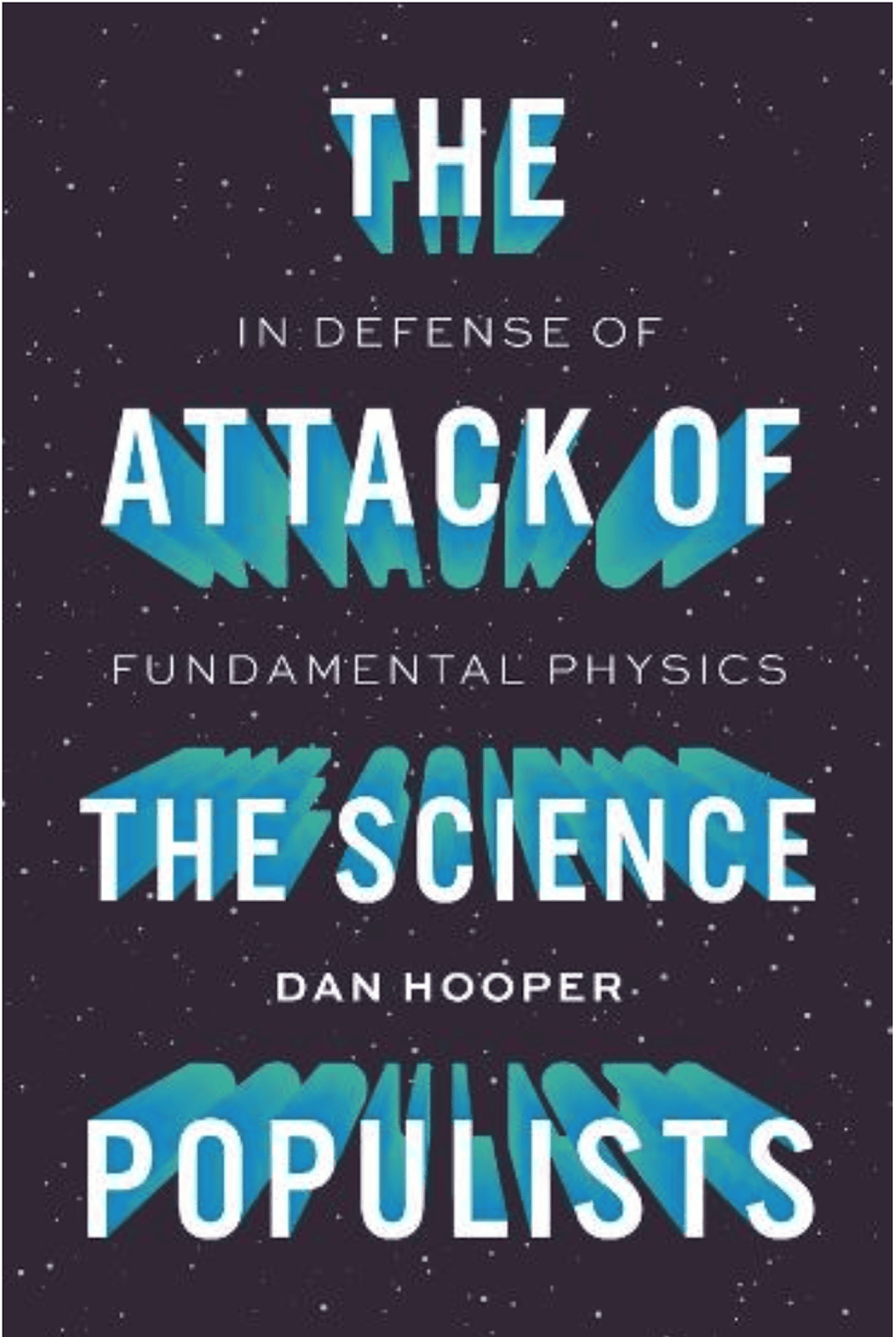
Despite its title, The Attack of the Science Populists is in fact a popular-science book and a very good one at that. It distinguishes itself from other popular-science books by not only explaining contemporary physics but also emphasizing its failures.
Physicists hoped for great things from the Large Hadron Collider (LHC), Hooper writes (he’s aiming his book at readers who don’t know what the LHC is). But while it has made amazing discoveries, such as the Higgs particle, Hooper also describes the fundamental things that it was expected to find but didn’t, such as supersymmetry particles that might have explained why the Higgs has the mass it does.
In another chapter he writes that string theory seemed like a good bet because it is able to handle quantum gravity, but that “this bet has not paid off”. Hooper explains in clear language the aims and disappointments of the LIGO gravitational-wave detector, Modified Newtonian Dynamics (MOND), the Standard Model of particle physics, supersymmetry, the multiverse and other theories. But he also makes clear how their flaws relate to the boldness of their ambitions.
If your friends ask for popular books summarizing the current state of theoretical physics, include Hooper’s on the list.
The critical point
I think “populism” is the wrong word here. To me, the term suggests widespread and genuine if incompletely articulated grievances, whether it’s about the need for cheaper homes, more jobs or better healthcare. But is Hooper really talking about the masses? What does Terryology have in common with Geometric Unity? In the Venn diagram of Howard, Hossenfelder and Weinstein, how big is the audience overlap?
Many of the field’s assailants seem not to be motivated by widely shared grievances but more like individual self-aggrandizing types who say, “Pay attention to my theory!” Even Hooper calls them “fringe” and “outsider mavericks” who make for a good story. It’s not populism or conspiracy when a bunch of glam narcissists stand out only because of their large social media following.
So what would genuine “populist physics” be? It would, I think, be a shared concern and insistence by non-scientists that the billions of dollars spent on physics, on the hundreds of thousands of professional physicists, and on all their labs are used in ways that return something to the people who are paying for it.
Such a return doesn’t necessarily have to result in improving our material ways of life, but might involve providing answers to questions that we all have at one time or another about the origin, nature and future of the universe. Populist physics therefore would arise in opposition to wealthy influencers who dominate social media to promote merely sensationalist and self-interested claims.
In this sense, what Hooper is doing with his new book is seeking to reassure readers that populist physics is what his field has been up to all along.