

Nanomesh sensors for home healthcare
Flexible on-skin sensor can display the moving waveform of an electrocardiogram
 Read article: Nanomesh sensors for home healthcare

Flexible on-skin sensor can display the moving waveform of an electrocardiogram
Read article: Nanomesh sensors for home healthcare
New device cuts off a tumour’s blood supply thanks to a blood-coagulating protein payload
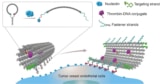 Read article: DNA nanobot ‘starves’ tumours
Supramolecular structure carries on rotating thanks to spontaneous symmetry breaking
 Read article: Frustrated liquid crystal film makes continuously rotating soft engine
Carbon-based electromechanical devices operating at over 900 °C would work in harsh or extreme environments
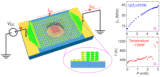 Read article: Graphene resonators can stand the heat
Two new breakthroughs could help in the development of large-scale spin-based processors in the future
 Read article: Silicon qubits show promise for quantum computers
New Venus-flytrap-inspired dialyzer might be used to create a nanotechnology platform for making artificial kidneys
 Read article: Bendable nanowires capture bacteria in blood
Single-particle measurements provide a much more accurate picture of the behaviour of these materials
 Read article: Low-energy states could be secret to perovskites’ success
Researchers succeed in electrically detecting the quasiparticles in metallic multilayers at room temperature for the first time
 Read article: Magnetic skyrmions could make storage bits for next-generation memories
Devices are now more efficient at converting heat and light into electricity and are stable in air for the first time
 Read article: Insulator layers give optical rectennas a boost
A new form of neuromorphic synapse operates just like its biological counterpart while being faster and more energy efficient
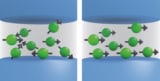 Read article: Magnetic Josephson junctions could help make artificial brains