

The yoctogram weighs in
Nanotube mass sensor sets new record
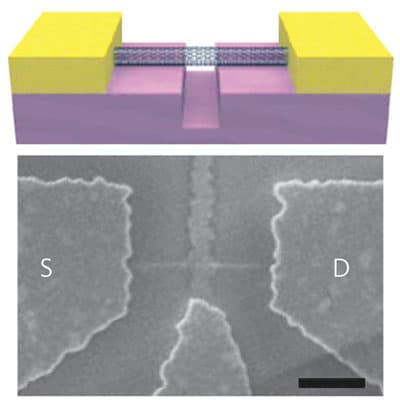 Read article: The yoctogram weighs in

Nanotube mass sensor sets new record
Read article: The yoctogram weighs in
Stacked layers of graphene could make effective shields
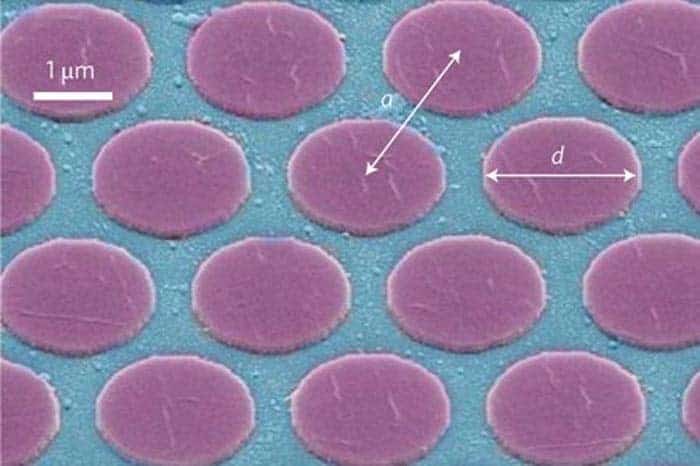 Read article: New material filters and polarizes terahertz radiation
Population inversion and optical gain spotted in wonder material
 Read article: Graphene emits infrared light
Band structures could be engineered to create a range of electronic devices
 Read article: Dirac cones could exist in bismuth–antimony films
Researchers can now "see" more clearly through liquid cells
 Read article: Graphene capsule reveals nanocrystal growth in action
Material could find use in tunnel devices and ultrafast transistors
 Read article: Electrons tunnel nicely through boron nitride
Nanoparticles imaged in 3D with atomic resolution for the first time
 Read article: Electron tomography peers into the nanoworld
Devices could power flexible and portable electronics
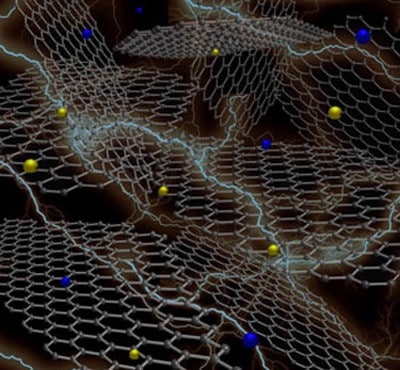 Read article: Laser writer makes graphene supercapacitors
Artificial form of 2D material sheds light on Dirac fermions
 Read article: ‘Designer’ graphene makes its debut
Cell harvests thermal energy from its surroundings
 Read article: Graphene in new ‘battery’ breakthrough?