

Surface superconductivity appears in topological materials
Majorana states for quantum computing applications might be observed in two new types of structures
 Read article: Surface superconductivity appears in topological materials

Majorana states for quantum computing applications might be observed in two new types of structures
Read article: Surface superconductivity appears in topological materials
The collapse of the main current that warms Europe would have far-reaching consequences for ecosystems as well as human civilization
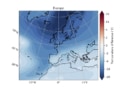 Read article: Atlantic current circulation could shut down, say climate scientists
First experimental evidence of true vacuum “bubbles” could have implications for cosmology as well as condensed-matter physics
 Read article: Physicists observe false vacuum decay in a ferromagnetic superfluid
New device switches between two operating modes as it is extended and contracted and might also be deployed in space
 Read article: Collapsible helix antenna could aid disaster recovery
New two-dimensional compound could be used to study interactions that produce unconventional superconductivity and related quantum phenomena
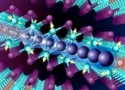 Read article: Heavy fermions appear in a layered intermetallic crystal
Findings could help improve cell efficiencies still further, say physicists
 Read article: Shallow defects drive slow recombination, high efficiency in perovskite solar cells
Discovery could aid the development of quantum computing architectures in which qubits are implanted randomly into a host matrix
 Read article: Long-lived qubits survive as ‘islands’ in a noisy environment
Validation of Wiedemann–Franz law in cuprates has implications for electron transport in strongly correlated materials
 Read article: 170-year-old physical law unexpectedly holds true in high-temperature superconductors
Layered clays called ophiolites trap carbon efficiently and may still be cooling the planet today
 Read article: Weathering and ocean burial of rocks could have triggered Earth’s ice ages
Biomechanical stability of bonds between the spike protein on the SARS-CoV-2 virus and its receptors on human cells helps explain rapid spread of certain variants
 Read article: Physical forces explain why some COVID variants are more virulent than others