

Spins freeze in monocrystalline magnet
Rare spin-frustrated 2D material could become a testbed for studies of magnetism and spin disordered states, say researchers
 Read article: Spins freeze in monocrystalline magnet

Rare spin-frustrated 2D material could become a testbed for studies of magnetism and spin disordered states, say researchers
Read article: Spins freeze in monocrystalline magnet
Nonlinear dielectric nanostructures could control the flow of light in next-generation devices for information processing and communications
 Read article: Meta-atoms act like road signs for light waves
Materials that switch from one phase to another when illuminated by light with different polarizations could enable parallel data storage, communications and computing
 Read article: Polarization switch makes ultrafast photonic computer
Mars may have accreted chondrite volatile elements before nebular gases, say researchers
 Read article: Martian meteorite analysis overturns planet formation theory
New approach combines a numerical reconstruction algorithm with an X-ray lens to achieve higher image quality
 Read article: X-ray microscopy sharpens up
The material has a superconducting transition temperature of 9.5 K at a pressure of around 15 GPa
 Read article: Manganese joins a new family of superconductors
Unusual state allows microscopic objects to spin on a crystalline surface with minimal torque
 Read article: Low-friction state makes moving micro-objects easier
Computational model shows that growing or stamping layers of material on an uneven surface reproduces novel electronic properties of twisted-layer technique
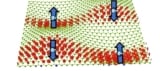 Read article: Undulations could replace twists in 2D materials
Elaborate quantum structures have a novel topology and must be described using knot theory
 Read article: Weyl loops link up
"Traps" for charge carriers reduce the longevity of these promising solar-cell materials as well as their efficiency
 Read article: Nanoscale impurities degrade halide perovskites