

Water splitting on haematite photoanodes changes with light intensity
Mechanism appears to mimic the activation of photosystem II during photosynthesis
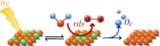 Read article: Water splitting on haematite photoanodes changes with light intensity

Mechanism appears to mimic the activation of photosystem II during photosynthesis
Read article: Water splitting on haematite photoanodes changes with light intensity
New quantum computing platform could also be used to measure tiny electric and magnetic fields
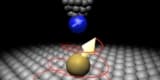 Read article: Atomic spins on a surface make good quantum bits
New device is better than traditional microelectrode and fluorescence-based approaches
 Read article: Plasmonic nanoprobe optically monitors neural activity
The effect occurs at room temperature and will be important for a host of technology applications
 Read article: Giant negative thermal expansion seen in nanomagnet
New work could help advance battery research for engineering next-generation high-energy-density technologies
 Read article: Sealed cell improves oxide-peroxide conversion in lithium-ion battery
IBM researchers have solved a long-standing two-carrier transport problem in the Hall effect with light
 Read article: New equation unlocks 140-year-old Hall effect secret
New work will be important for making and controlling high-fidelity gates in quantum computers
 Read article: Hamiltonian learning technique advances quantum spin register
Technique could produce scalable, reversible, shape-shifting structures with hitherto unseen complexity for use in a host of practical applications
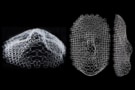 Read article: Material lattice morphs into doubly curved shapes
Researchers observe exotic state at 100 K, a result that bodes well for coherent optoelectronics applications and perhaps even high-temperature superconductivity
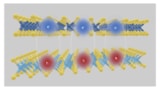 Read article: Exciton condensation breaks new temperature record
The carbon sheet can no longer be considered as a purely 2D material as far as certain mechanical properties are concerned say researchers
 Read article: High-pressure experiments reveal graphene’s 3D nature