

Hydrogel helps make self-cooling solar panels
New technology could be an environmentally friendly way to cool down photovoltaics and other devices
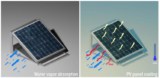 Read article: Hydrogel helps make self-cooling solar panels

New technology could be an environmentally friendly way to cool down photovoltaics and other devices
Read article: Hydrogel helps make self-cooling solar panels
“Topological superconductivity” could come in useful for a host of new applications
 Read article: Supercurrent goes to the edge
The materials can store large amounts of hydrogen and methane in their nanoscopic pores
 Read article: Ultraporous metal-organic frameworks could make clean energy carriers
New low-power technique detects the spin of electrons in a non-volatile way that does not require ferromagnets
 Read article: Electric fields control spintronics devices
New hybrid technique produces detailed images of live biological cells
 Read article: Biochemical quantitative phase imaging goes photothermal
Material also recovers waste heat and converts it into electricity
 Read article: Thermogalvanic hydrogel cools down electronic devices
Compound-specific accelerator mass spectrometry provides the first direct estimates for the age of clay artefacts
 Read article: New technique uses food residues to date prehistoric pottery
Findings will be important for planetary science as well as condensed-matter physics
 Read article: Machine learning teases out differences in high-pressure ice phases
Researchers develop "recipe" for identifying topological invariants in the laboratory
 Read article: Randomized measurements reveal topological quantum states
Non-invasive spectroscopy and synchrotron radiation X-ray techniques shed light on the chemical degradation of paints in Munch’s masterpiece
 Read article: Saving The Scream