

Where did all the antimatter go?
Measurements of B mesons confirm that the Standard Model of particle physics cannot explain why the universe is made of matter rather than antimatter
 Read article: Where did all the antimatter go?

Measurements of B mesons confirm that the Standard Model of particle physics cannot explain why the universe is made of matter rather than antimatter
Read article: Where did all the antimatter go?
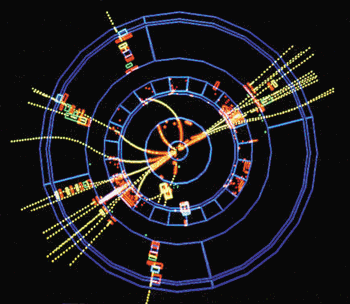
Currently there are, at most, five centres operating in the front line of particle physics: CERN and DESY in Europe, Fermilab and Stanford in the US, and KEK in Japan. How many of these laboratories are still with us in a decade or two from now remains to be seen. The year 2020 might seem […]
 Read article: Straight choices
The behaviour of magnetic vortices controls many physical properties of high-temperature superconductors, including their ability to carry current without resistance – a classic hallmark of superconductivity. Indeed, vortices provide an ideal platform for the creation and study of novel phases and phase transitions. Now Nurit Avraham at the Weizmann Institute in Israel and co-workers from […]

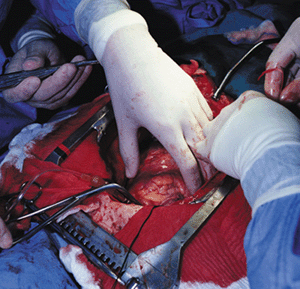
High-intensity sound waves could soon be used to treat internal bleeding safely and effectively at accident scenes, as well as a variety of tumours located deep within the body
 Read article: Acoustic surgery
Self-focusing occurs at high intensities in transparent media when the refractive index is proportional to the intensity. The change in refractive index causes the medium to act as a lens that focuses the laser – hence the name self-focusing. This lens is the ultimate adaptive-optics element as it responds instantly to the shape of the […]
Peter Gwynne looks at the huge impact of the Los Alamos pre-print server
 Read article: Web server celebrates a decade of hits
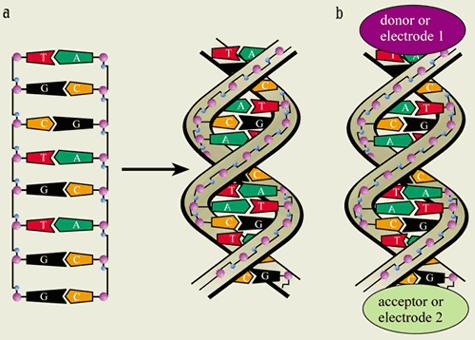
The building block of life is often heralded as the cornerstone of a new generation of electronic devices and computers, but the electronic properties of DNA remain highly controversial
 Read article: Electronic properties of DNA
The point at which a phase transition occurs is called the critical point and is dear to every physicist’s heart. The fascination with systems at the critical point stems from the fact that a small change in one parameter, such as temperature, can trigger spectacular changes in the other properties. Indeed, it is this discontinuity […]
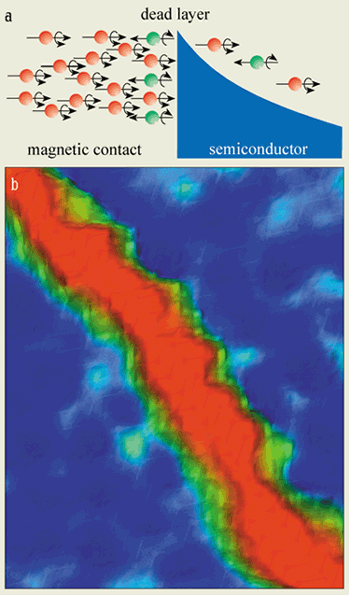
Nearly all electronic and optoelectronic devices are made of semiconductors and rely on the exact control of electric charges. Electrons, however, possess a well defined “spin” angular momentum, in addition to a well defined charge. Their spin is either +1/2 or -1/2: in other words an electron can rotate either clockwise or anticlockwise around its […]
 Read article: Injection of spin for electronics
Under certain conditions, the Coulomb force can pull charges together
 Read article: Positive ions pull together