Author
Array
(
[0] => linkedin
[1] => facebook
[2] => twitter
[3] => google-plus
[4] => youtube
)
Array
(
[0] => linkedin
[1] => facebook
[2] => twitter
[3] => google-plus
[4] => youtube
)
Array
(
[0] => linkedin
[1] => facebook
[2] => twitter
[3] => google-plus
[4] => youtube
)
Array
(
[0] => linkedin
[1] => facebook
[2] => twitter
[3] => google-plus
[4] => youtube
)
Array
(
[0] => linkedin
[1] => facebook
[2] => twitter
[3] => google-plus
[4] => youtube
)
No Author
Author archive
The UK is about to experience an explosion in the number of new interactive science centres. By this time next year about a dozen major new science-centre projects will have opened (see table). These large-scale capital schemes have been funded by a mixture of National Lottery grants from the Millennium Commission and money from public […]
 Read article: Science centres face the future
The researchers at the French GANIL accelerator studied heavy, highly charged ions, in which the attraction between the nucleus and the remaining electrons is extremely strong. As a result, the difference in energy between atomic states can actually be higher than different states in the nucleus. To observe the effect, the group fired high-energy tellurium-125 […]

What effect does technology have on the performance of athletes, asks Steve Haake
 Read article: Physics, technology and the Olympics
Nothing can travel faster than light. Despite a recent raft of reports in the media, this statement is as true now as it ever was. Nonetheless, experiments over the past 20 years have been forcing us to re-examine what we mean by the word “nothing”. In the latest experiment, a group of researchers at the […]
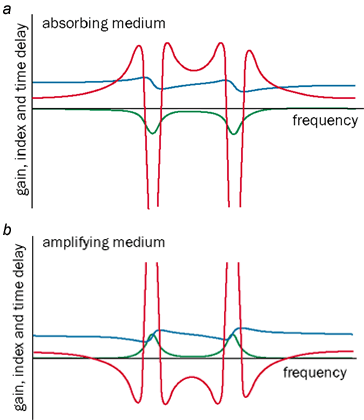 Read article: No thing goes faster than light
In 1951 Herman Weyl, a pioneer in the application of the mathematics of symmetry to physics, published a popular account of the field. His book was called, quite simply, Symmetry. To the uninitiated, Gordon Kane’s new book Supersymmetry might be construed as evidence that the world of physics has been gripped by the same inflationary […]
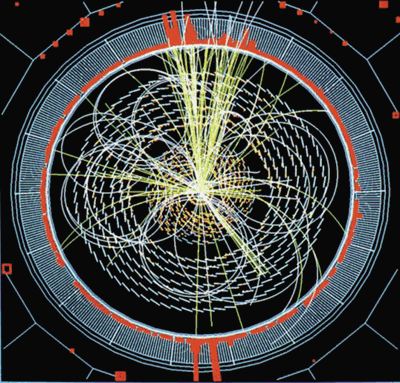 Read article: Supersymmetry makes its case
The latest evidence comes from an analysis of the magnetic fields surrounding Europa. When a conducting body is placed inside a time-varying magnetic field, electrical currents are induced inside the conductor, which in turn produce measurable secondary magnetic fields. In this case the conductor is Europa and the magnetic field is the magnetosphere of Jupiter. […]
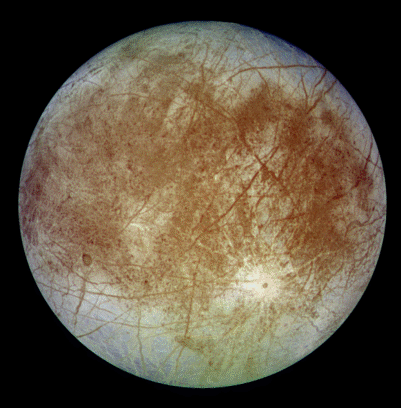 Read article: Europa: water, water everywhere
Argon is the lightest yet of the inert gases to have formed a compound. It is difficult to persuade light inert gases to react because their outer electrons are shielded less from the electrostatic pull of the nucleus by the inner electrons that are present in heavier noble gases. Khriachtchev and co-workers created the new […]
Sandage is best known for his efforts to pin down the values of the Hubble constant, the age of the Universe and its deceleration parameter through observations. Peebles is a theoretical cosmologist who has worked on problems ranging from light-element synthesis to the nature of dark matter. The awards will be presented at the Pontifical […]
The expansion of the universe means that the light from distant galaxies is red-shifted when observed on Earth. The larger the red shift, the greater the distance to the galaxy. Moreover, when we view a galaxy with a high redshift, we are seeing it as it was billions of years ago. By measuring the red […]
Hendrik Schon, Christian Kloc and Batlogg investigated three different acenes: anthracene (which contains three linked rings), tetracene (four) and pentacene (five). The crystals are normally insulating, but when a thin layer of the material was included in a field-effect transistor, it became superconducting. The superconducting transition temperature ranged from 2 Kelvin for pentacene to 4 […]
Copyright © 2026 by IOP Publishing Ltd and individual contributors


