Author
Array
(
[0] => linkedin
[1] => facebook
[2] => twitter
[3] => google-plus
[4] => youtube
)
Array
(
[0] => linkedin
[1] => facebook
[2] => twitter
[3] => google-plus
[4] => youtube
)
Array
(
[0] => linkedin
[1] => facebook
[2] => twitter
[3] => google-plus
[4] => youtube
)
Array
(
[0] => linkedin
[1] => facebook
[2] => twitter
[3] => google-plus
[4] => youtube
)
Array
(
[0] => linkedin
[1] => facebook
[2] => twitter
[3] => google-plus
[4] => youtube
)
No Author
Author archive
The experiment also found that changes in the strength of the Earth’s magnetic field with latitude do not alter the number of low-energy protons hitting the Earth’s atmosphere. However the experiment failed to detect any anti-helium atoms among the three million ordinary helium atoms that it detected. The two main goals of the experiment are […]

Richard Feynman, both as a man and as a scientist, excited varied reactions: you either loved him or you hated him. As a man, he was either narrow-minded and sexist, or else charming and completely fair in the most unselfconscious way. As a scientist, he was either “a magician” – the most impressive kind of […]
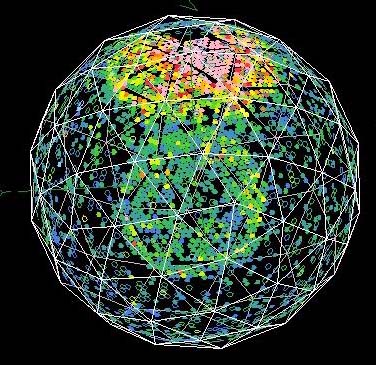
The observatory is a joint project between Canada, the US and the UK, and was officially opened last year. It is the first detector that is capable of distinguishing between the three different types of neutrino – electron, muon and tau neutrinos. Neutrinos are generated by nuclear reactions deep inside the sun, by cosmic ray […]
 Read article: Neutrino lab sees “first light”
1. The Elegant Universe: Superstrings, Hidden Dimensions, and the Quest for the Ultimate Theory by Brian Greene A fascinating and thought-provoking journey through the mysteries of space, time, and matter. Today physicists and mathematicians throughout the world are feverishly working on one of the most ambitious theories ever proposed: superstring theory. String theory proclaims that […]
The new elements were made by bombarding a lead-208 target with an intense beam of high- energy krypton-86 ions over an 11-day period. The krypton ions were accelerated by the 88-inch cyclotron at the Lawrence Berkeley National Laboratory in California. Three atoms of element 118 were detected, all containing 118 protons and 175 neutrons. The […]
The physicists scanned a series of Pollock’s artworks into a computer and masked each painting with a series of grids. They then counted the number of squares that contained part of the painted pattern (N) – using the well-know ‘box-counting’ method of fractal geometry – and reduced the size of the squares (L). The largest […]
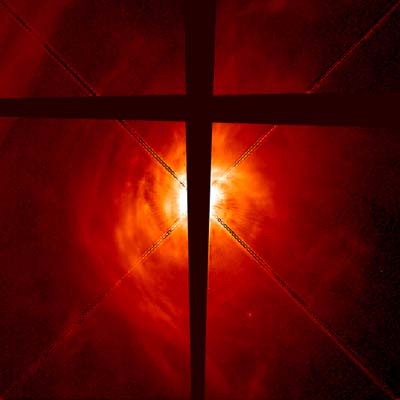
The results help to confirm the view that other planetary systems form in ways similar to our solar system. The Kuiper belt is a disk of dust, gas and icy comets stretching from 40 to 10000 times the Earth-Sun distance. Recently astronomers observed protoplanetary disks encircling young stars up to 1 million years old and […]
 Read article: Hubble finds planetary transition point
The collisions are termed “asymmetric” because the electrons are accelerated to 9 GeV – three times the energy of the positrons. As the two beams collide, they generate B mesons that decay within a trillionth of a second. The newly formed particles fly into the detector at different velocities, which makes it easier to separate […]
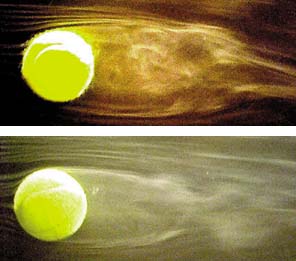
To many sports fans, the month of June is synonymous with the Wimbledon tennis tournament. Thousands of people will flock to the All England Lawn Tennis Club to watch the players battle it out on the grass courts, and millions more will watch the tournament on television. But many tennis officials, players and spectators complain […]
 Read article: Game, set and slower match
There is no doubt that the world has an increasingly intense love-hate relationship with science. Physics certainly does not escape this deep ambivalence, and we naturally wonder if there is anything that might make “them” love us a little more and hate us a little less? This question can be formulated seriously, and will be […]
Copyright © 2026 by IOP Publishing Ltd and individual contributors


