

Graphene target boosts laser-driven ion acceleration
New technique could make it possible to produce relativistic beams of ions using less intense lasers
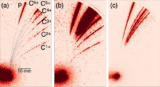 Read article: Graphene target boosts laser-driven ion acceleration

New technique could make it possible to produce relativistic beams of ions using less intense lasers
Read article: Graphene target boosts laser-driven ion acceleration
Interference patterns create robust lenses, simulations suggest
 Read article: Holographic plasma lenses could focus ultrahigh-intensity lasers
Sensing, machine learning and database technologies monitor ultracold atoms
 Read article: New system could control quantum experiments in space
Dissipation–time uncertainty relation studied using a trapped ion
 Read article: ‘Speed limit’ on changes in non-equilibrium systems confirmed by new experiment
Talbot self-imaging method is adapted for non-periodic signals
 Read article: New technique amplifies weak optical signals while reducing noise
Perovskite-based device could be used in reconfigurable networks
 Read article: Device can transform into four components for artificial intelligence systems
Material can be manufactured in bulk
 Read article: Artificial material mimics tooth enamel, but is tougher
Infrared observations of old stars reveal cavities in protoplanetary discs
 Read article: Ancient binary stars could give birth to planets, study suggests
Shaken optical lattice undergoes discontinuous phase transition
 Read article: Ultracold atoms move closer to simulating the early universe
Black holes probably had a chance encounter in a dense star cluster
 Read article: Highly eccentric black-hole merger is identified in LIGO–Virgo observation