Researchers ‘tattoo’ gold nanopatterns onto live cells
New technique can print living cells and tissues with flexible arrays of gold nanodots and nanowires
Read article: Researchers ‘tattoo’ gold nanopatterns onto live cells
Thank you for registering with Physics World
If you'd like to change your details at any time, please visit My account
I am an online editor for Physics World. I write and commission articles for the medical physics, and biophysics and bioengineering sections of the website. I did a PhD in molecular physics at Leeds University, followed by a postdoc in the medical physics department. I joined IOP Publishing in 1999, and in 2008 I became editor of the website medicalphysicsweb. Outside of work, I enjoy travelling, as well as singing and dancing in musical theatre productions.

New technique can print living cells and tissues with flexible arrays of gold nanodots and nanowires
Read article: Researchers ‘tattoo’ gold nanopatterns onto live cells
First Light Fusion is developing a low-cost inertial fusion power plant that could also be used to generate a range of essential medical isotopes
Read article: Projectile fusion reactor could generate much-needed medical isotopes
Attendees at the recent AAPM Annual Meeting learnt how quantum computers could potentially be employed to enhance radiation therapy
Read article: Quantum computing could tackle radiotherapy’s intractable problems
Breast imaging using grating interferometry-based phase-contrast CT offers increased resolution for the same radiation dose
Read article: Grating interferometry could enable earlier detection of breast cancer
An emerging technique combines radiotherapy with photodynamic therapy to enhance the treatment of deep-seated tumours
Read article: Radiodynamic therapy: harnessing light to improve cancer treatments
The MedPhys Slam at the AAPM Annual Meeting saw students and trainees describe their research projects in just three minutes using just three slides
Read article: Brain bleed detection study wins AAPM’s MedPhys Slam
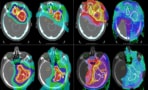
A reconstruction method that separates two PET isotopes increases the information attainable from a single diagnostic scan
Read article: Multiplexed PET can image two radiotracers in a single scan
Artificial intelligence classifies cardiac functions and valvular heart diseases from widely available chest radiographs
Read article: Deep-learning model uses chest X-rays to detect heart disease
Researchers demonstrate the first use of an in-beam PET scanner for imaging and dosimetry of a proton FLASH beam
Read article: In-beam PET provides the first glimpse of a proton FLASH beam
Magnetic fields that reactivate damaged motoneurons could one day provide a new treatment for neurodegenerative diseases
Read article: Towards a cure for ALS: magnetic stimulation restores impaired motoneurons