The flood-plains of Ganymede
Icy lava could have created the flat regions on Jupiter's largest moon
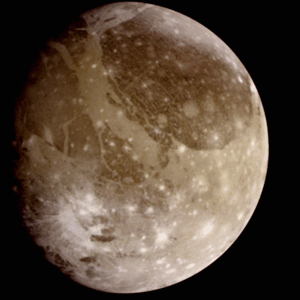 Read article: The flood-plains of Ganymede

Icy lava could have created the flat regions on Jupiter's largest moon
Read article: The flood-plains of Ganymede
Signals from the dark side of Venus shed light on our neighbour's atmosphere

Andrew Collier Cameron explains how astronomers are searching for an Earth-like planet outside our solar system that could harbour life
 Read article: Extrasolar planets
Titan’s atmosphere has much in common with our own: it consists mainly of nitrogen, contains organic material, and exerts a pressure one-and-a half times what we feel on Earth. But Titan receive...
Many planets have been discovered outside our solar system, but they are usually detected by observing the wobble of the parent star induced by the gravitational pull of the orbiting planet. Zapatero ...
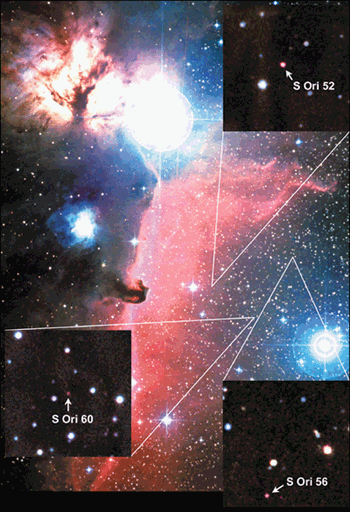 Read article: ‘Floating planets’ challenge theorists
The CODAG experiment recreated for the first time conditions in the early solar system in order to observe the dust clustering process. Micron-sized silicon oxide grains were injected into a chamber f...
The latest evidence comes from an analysis of the magnetic fields surrounding Europa. When a conducting body is placed inside a time-varying magnetic field, electrical currents are induced inside the ...
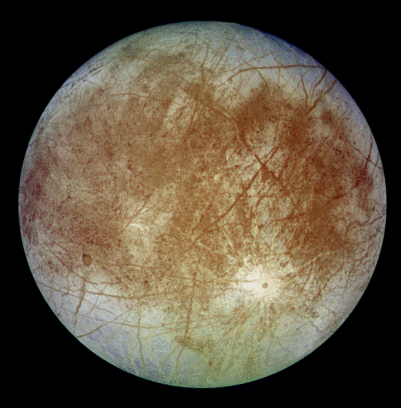 Read article: Europa: water, water everywhere
The Rumba and Tango satellites were sent into space on board a French-Russia launcher. Over the next week they will rendezvous with the Salsa and Samba satellites that were launched on July 16. The fo...
Gaidos and Nimmo say that the tidal forces from Jupiter can cause regions of ice near a fault or defect to move relative to one another. This relative motion causes frictional heating that increases t...
White Mars is about a group of men and women who are marooned on Mars at the end of the 21st century. Living in enormous self-perpetuating domes, they produce their own food and oxygen, and extract wa...