Moon illuminates climate study
Dark side of the Moon can reveal changes in our atmosphere
 Read article: Moon illuminates climate study

Dark side of the Moon can reveal changes in our atmosphere
Read article: Moon illuminates climate study
The solar wind and the giant planet's magnetic field combine to produce a huge plume
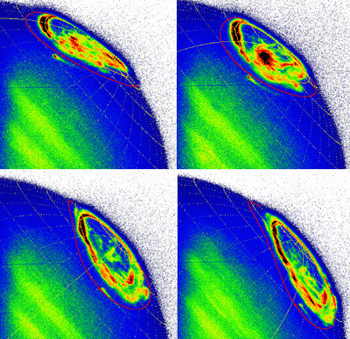 Read article: Jets on Jupiter: first view of an auroral flare
Signals from the dark side of Venus shed light on our neighbour's atmosphere

Titan’s atmosphere has much in common with our own: it consists mainly of nitrogen, contains organic material, and exerts a pressure one-and-a half times what we feel on Earth. But Titan receive...
Previously is was thought that the result might have been due to some inadequacy in the data for the troposphere. However, Dian Gaffen from the US National Oceanic and Atmospheric Administration and c...
Ball lightning has only been seen during thunderstorms. The average ball lightning appears as a sphere about 30 cm across and lasts for about 10 seconds. The earliest reports of ball lightning date ba...
Eckermann and Preusse analysed data from the cryogenic infrared spectrometer and telescope for the atmosphere (CRISTA), which was flown on the Space Shuttle Atlantis in 1994. They discovered that the ...
Global warming – sometimes called the greenhouse effect – is caused by gases in the atmosphere that absorb and then re-emit infrared radiation, thereby ‘trapping’ the heat on t...
The Earth’s average global temperature has increased by 0.6 Kelvin in the past 100 years. There are believed to be four main processes that can effect the Earth’s climate. Two of these, sm...