

Cluster takes shape
The Rumba and Tango satellites were sent into space on board a French-Russia launcher. Over the next week they will rendezvous with the Salsa and Samba satellites that were launched on July 16. The fo...

The Rumba and Tango satellites were sent into space on board a French-Russia launcher. Over the next week they will rendezvous with the Salsa and Samba satellites that were launched on July 16. The fo...
A team from the University of Colorado at Boulder will present evidence for what it believes is the youngest massive star cluster ever detected in the Milky Way. It contains about 100 type-O stars, th...
 Read article: New planets and star birth in Manchester
The so-called ‘complex oxides’ are a group of ceramics with a common chemical formula consisting of two pairs of metallic cations and seven oxygen atoms. Sickafus and co-workers at Los Ala...
His best-known work was a biography of Einstein, Subtle is the Lord: The Science and the Life of Albert Einstein, which was published in 1982 and won the 1983 American Book Award. Pais went on to publ...
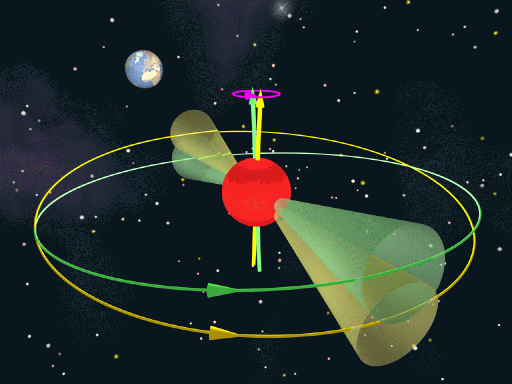
Pulsars are rotating neutron stars, and are the collapsed cores of supergiant stars that have exploded as supernovae. They are extremely dense, typically 20 km across but with masses a million times g...
 Read article: Wobbling pulsar discovered
When the formalism of quantum mechanics is applied to experiments involving microscopic objects such as electrons, we often find that the resulting description assigns finite probability amplitudes to...
 Read article: New life for Schrödinger’s cat
In a ‘scale-free’ network of many interconnected nodes, like the Internet, most of the nodes are connected to a relatively small number of other nodes. Only a very small minority have a la...
The DONUT team fired an intense beam of neutrinos, which they expected to contain tau neutrinos, at a target consisting of iron plates with layers of emulsion sandwiched between them. One in a million...
Oliphant was born in Adelaide in 1901 and attended the local university before going to Cambridge University in 1927, where he worked on nuclear physics experiments with Ernest Rutherford. In 1937 he ...
Stefan Hell and co-workers at Gottingen have adapted a technique known as fluorescence microscopy. In this form of microscopy the specimen is irradiated at a wavelength which excites either natural or...
