

Vacuum fluctuations could be a non-invasive way to tune superconductivity
Gravity from entropy theory offer hints of why low-entropy regions persist in the universe

New concept exploits both the heat of the Sun and the coldness of outer space
New analyses of MESSENGER data find that present-day magnetic field can explain most of its crustal magnetism
New finding could help create active matter with a structure that continuously reorganizes itself
New work on predictability limits suggests that around 129 days is probably the maximum limit
New work will help advance the development of more reliable free-space networks
A novel graphene oxide bilayer pushes triple-junction perovskite solar cells to a milestone 27.3% efficiency with unprecedented operational longevity
 Read article: Bilayer approach ramps performance of all-perovskite triple-junction solar cells
An unexpected material comes to the rescue of 2D material transfer
 Read article: Cling film helps stamp two-dimensional materials onto patterned surfaces
Heavy particle could be dominated by gluons
 Read article: Missing decay at BESIII points to long-sought glueball
Using a crystal as an atomic-scale interferometer enables direct visualization of local atomic arrangements
 Read article: Researchers shrink double-slit experiment to atomic scale
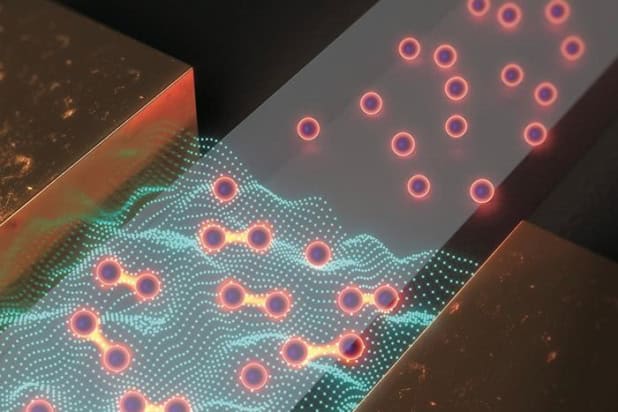
Two superconducting qubits, a metre of cable apart, have been driven into an entangled state not in spite of their environment, but by it
 Read article: Noise that entangles may accelerate the dawn of quantum technologies
Study of inclusions in a primordial meteorite suggests that magnetism must be considered in simulations of planet formation, and may even be the dominant factor
 Read article: Magnetism likely played a key role in early solar system formation
Heat and fire may have caused the mass extinction of Cretaceous creatures
 Read article: ‘Lid’ of asteroid dust smothered and burned the dinosaurs, say scientists
Sensitive new measurements suggest that monitoring can continue even when reactors are offline
 Read article: Antineutrino detector could monitor spent nuclear fuel for clandestine activity
New nanostructure could be used to make lasers that work in the terahertz frequency range
 Read article: Plasmonic metamaterial makes a photonic time crystal
A 2D magnetic material exhibits a charge-ordered state in which electrons move collectively and unusually slowly while maintaining quantum coherence
 Read article: Two-dimensional material shows promise for long-term memory, thanks to slow electrons
A creative spin on MRI technology measures the amount of drug delivered to a brain tumour
 Read article: Breaking in: how ultrasound smuggles drugs past the blood–brain barrier
Effect could damage outdoor equipment and monuments
 Read article: Sliding water droplets corrode Teflon-coated metal