A new mechanism governing the geometric shapes of growing elastic sheets has been identified by a trio of physicists in Israel. Through a combination of simulations and experiments, Eran Sharon and colleagues at the Hebrew University of Jerusalem showed that the dimpled patterns that form in a growing elastic object have topological origins.
This mechanism is unrelated to geometric incompatibilities, which are known to dimple natural materials. The discovery could lead to a deeper understanding of how complex shapes emerge in the natural world – and to the development of new artificial materials.
Thin sheets are ubiquitous in nature: examples include leaves, petals, and the cellular linings of organs and blood vessels. The complex makeup of natural sheets means that local regions within them have preferred mechanical rest states that are incompatible with those of other regions. As a result, there is no way to arrange the sheet so that every part is simultaneously stress free – leading to effects like wrinkling, bending, and buckling.
Called geometric incompatibility, this phenomenon is responsible for numerous geometric forms in the natural world, enabling growing tissues to shape themselves without any external influence. For some time, researchers have attempted to mimic these natural mechanisms in synthetic materials.
Richness of shapes
“Looking at natural growth processes, as in plants growth, or embryo development, we see amazing richness of shapes and shape development that currently cannot be achieved with conventional fabrication methods,” says Sharon.
Sharon’s group has already shown that many patterns in nature can be understood in terms of the Gauss and Mainardi-Codazzi-Peterson incompatibilities – which were developed in the 19th century. Together with team member Michael Moshe, whose group explores the interplay between mechanics and geometry in soft materials, their work led to discoveries including the mechanical origins of shape selection in rose petals.
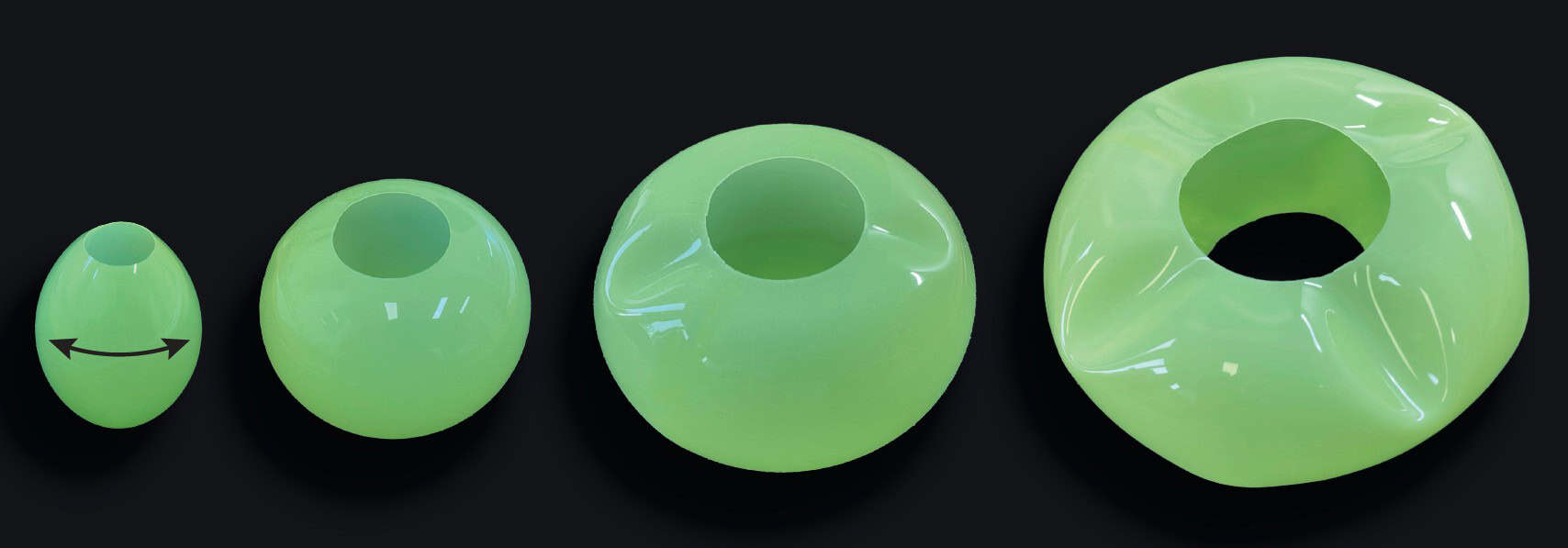
Now, Moshe and Sharon have teamed-up with Yafei Zhang to identify a phenomenon that cannot be explained by those mechanical instabilities. In their experiment, they started with a uniform elastic sheet formed into a hollow sphere, with circular holes at each pole. When they added wedges of material into the sheet to mimic growth, it initially behaved like a smooth, growing sphere – but only up to a certain point.
Missing mechanism
“The growing sheet satisfies the established local compatibility conditions, and is thus expected to show smooth ‘boring’ shape,” Moshe explains. “Yet it unexpectedly, develops a crumpled appearance, suggesting that an important shaping mechanism was missing from the existing framework.”
Important clues came when the team cut into the crumpled sphere along a meridian, from pole to pole. Instantly, the crumpling disappeared, and the sphere relaxed back to its original smooth shape. This effect also occurs in simulations of a smoothly growing sphere.
The mechanics behind rose petal shapes revealed

With no changes to the Gauss or Mainardi-Codazzi-Peterson incompatibilities governing the mechanical forces in the sheet, the trio concluded that the sudden transformation emerged from an entirely different mechanism, rooted in the mathematical principles of topology. In this view, unlike smooth geometric transformations such as bending, stretching, or twisting, which preserve a shape’s mechanical properties, cutting introduces a sudden transformation that changes its mechanical behaviour.
In this way, the meridional cut brought the sphere into a new topological state. “Unlike conventional incompatibility, this frustration is topological in character, and can be quantified by a global measure,” Moshe explains. “It provides a new mechanism by which growing sheets can select complex, wrinkled or dimpled shapes.”
The trio’s discovery now raises new mathematical questions about the limits of growing elastic sheets, beyond which their smooth geometries can no longer be maintained. “What we have discovered that the geometrical principles we knew before should be supplemented with topological considerations, leading to an even wider class of shaping principles,” Sharon says. “This allows a better understanding of morphogenetic processes and expands our abilities to shape synthetic structures.”
In turn, the team’s insights could uncover new understanding of how shaping mechanisms could be harnessed, perhaps leading to the discovery of new metamaterials, with shapes and mechanical functions programmed into their growth.
The research is described in Physical Review Letters.