A system of seven rocky exoplanets – recently found to be orbiting the same star – avoid colliding with each because their orbits are highly synchronized, according to computer simulations done by astrophysicists in Canada.
The TRAPPIST-1 system, which astronomers announced in February that they had discovered, is the largest known system of Earth-like exoplanets. Three of the planets appear to be in the habitable zone of the star, which means that they could harbour liquid water and possibly even life.
Since its discovery, however, astronomers have puzzled over how TRAPPIST-1 remains stable. “If you simulate the system, the planets start crashing into one another in less than a million years,” says Dan Tamayo, who works at the University of Toronto’s Centre for Planetary Science. One possibility is that astronomers have been incredibly lucky to see the system before it falls apart – but Tamayo was convinced that there must be a reason why TRAPPIST-1 is stable.
Resonant chain
He therefore joined forces with Matt Russo, Andrew Santaguida and others at Toronto, who began by looking at the sequence of the ratios of the orbital periods of adjacent exoplanets in the system. Astronomers know that this sequence is a “resonant chain”, which means that all of the orbits are synchronized with each other. The exoplanets therefore undergo a highly choreographed and repetitive dance as they travel around the star – and never collide with each other.
“Most planetary systems are like bands of amateur musicians playing their parts at different speeds,” says Russo. “TRAPPIST-1 is different. It’s a super-group with all seven members synchronizing their parts in nearly perfect time.”
The problem, however, is that for such a resonant chain to remain stable for a very long time, the seven orbits must be perfectly aligned. And because astronomers cannot currently measure this alignment to high precision, computer simulations that incorporate this uncertainty suggested that TRAPPIST-1 is unstable.
Supercomputing cluster
Tamayo and colleagues have taken a different approach by looking at how the system formed from a disc of gas and dust and evolved towards its current configuration. Using a supercomputing cluster at the Canadian Institute for Theoretical Astrophysics, the team did a number of simulations that traced the formation and evolution of TRAPPIST-1. In most cases, the system that formed was found to remain stable over a period of 50 million years, which is the longest period of time they were able to simulate.
The team believes that the exoplanets settled naturally into the stable resonant condition during the formation process. “This means that early on, each planet’s orbit was tuned to make it harmonious with its neighbours, in the same way that instruments are tuned by a band before it begins to play,” says Russo.
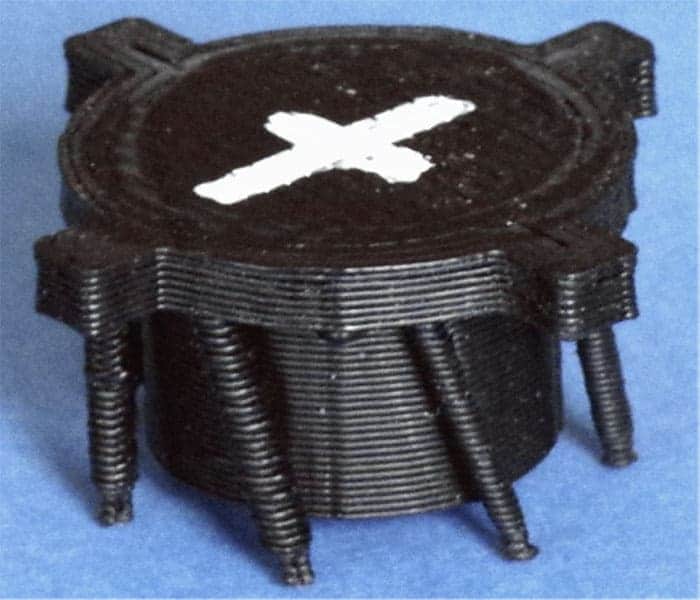
Hop to it: a vibrot jumps and turns. (Courtesy: C Scholz and T Pöschel / Phys. Rev. Lett.)
Hopping vibrots confirm granular gas theory
A theory that describes how a dilute collection of solid grains – such as sand in a sandstorm – behave much like molecules in a gas has been verified experimentally using vibrots. These are specially made cylindrical objects measuring about 15 mm in diameter. They have springy legs that cause a vibrot to rotate when placed on a vibrating table. Christian Scholz and Thorsten Pöschel of Friedrich-Alexander-Universität Erlangen-Nürnberg in Germany placed several hundred vibrots on a vibrating table, where they occupied 60% of the surface area. The vibrots were set in motion and tracked as they moved around the surface. The team measured the velocity distribution of the vibrots and discovered that it is similar to that of a molecular gas with an important exception – there were more vibrots with higher velocities than are seen in a molecular gas. This exception is predicted by granular gas theory, but this is the first time that these high-velocity outliers have been observed in an experiment. The study is described in Physical Review Letters and could help boost our understanding of phenomena as diverse as avalanches and the rings of Saturn.
Galactic neighbours have a magnetic cosmic bridge
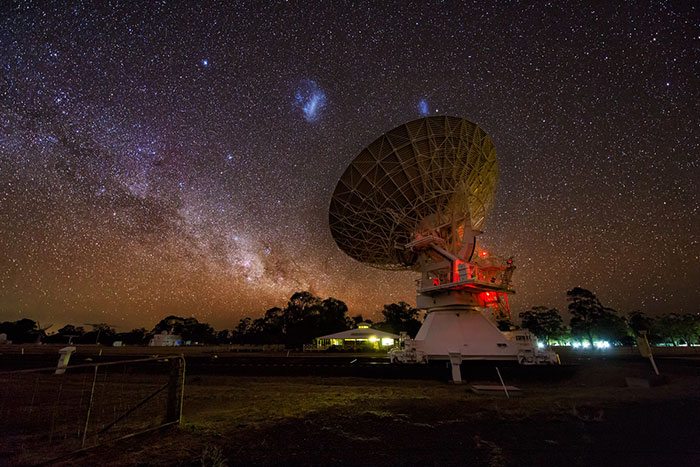
Bridge the gap: gas links the Large (centre left) and Small (centre right) Magellanic Clouds. Pictured above the Australia Telescope Compact Array. (Courtesy: Mike Salway)
The magnetic field associated with the Magellanic Bridge has been mapped for the first time. Spanning 75 thousand light-years, the cosmic bridge is a filament of gas that stretches between the Large and Small Magellanic Clouds (LMC and SMC). These two dwarf galaxies orbit the Milky Way and, at 160 and 200 thousand light-years from Earth, respectively, are our nearest galactic neighbours. Ongoing interactions between the LMC and SMC have created tidal structures, including the Magellanic Stream, the Leading Arm and the Magellanic Bridge. Using radio observations taken by the Australia Telescope Compact Array at the Paul Wild Observatory, researchers have detected the Bridge’s magnetic fields for the first time. Jane Kaczmarek from the University of Sydney in Australia and colleagues studied the radio emissions of distant galaxies that lie beyond the Bridge. “[The Bridge’s] magnetic field then changes the polarization of the radio signal,” explains Kaczmarek. “How the polarized light is changed tells us about the intervening magnetic field.” The phenomenon, called Faraday rotation, indicates that the magnetic field is one-millionth the strength of Earth’s. The researchers argue that the Bridge had no means of generating the detected magnetic field, and they instead suggest it was tidally stripped from the galaxies along with the gas that forms the structure. Kaczmarek and colleagues hope the work, presented in the Monthly Notices of the Royal Astronomical Society, will help provide insights into how galaxies like the Milky Way evolve. “Understanding the role that magnetic fields play in the evolution of galaxies and their environment is a fundamental question in astronomy that remains to be answered,” says Kaczmarek.
Hydrogen-bond strength measured directly
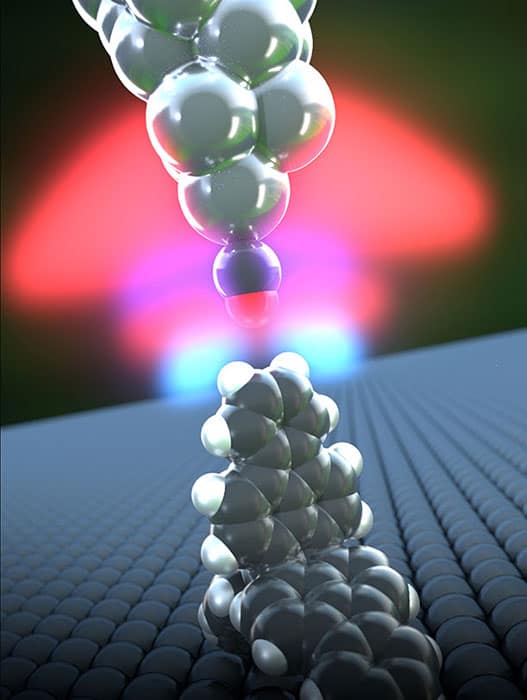
Top tip: AFM measures hydrogen bonds. Artist’s impression of an AFM tip (upper structure) being used to study hydrogen bonds between the tip and a propellane molecule (lower structure). (Courtesy: University of Basel, Department of Physics)
The first direct measurements of the strength of hydrogen bonds in individual molecules have been claimed by an international team of physicists. Unlike chemical bonds, which involve the sharing or transfer of electrons, hydrogen bonds are dipole–dipole interactions between certain molecules containing hydrogen. As well as playing key roles in defining the properties of proteins and nucleic acids, hydrogen bonds are also responsible for the relatively high boiling point of water. Shigeki Kawai of the University of Basel in Switzerland, Adam Foster of Aalto University in Finland an colleagues used an atomic force microscope (AFM) to study hydrogen bonds in molecules called propellanes – which arrange themselves on surfaces such that two hydrogen atoms are pointing upwards. Their AFM tip comprised a single oxygen atom, which was positioned so close to a propellane molecule that a hydrogen bond formed between the oxygen atom and the two hydrogen atoms. Then, the AFM was used to measure the strength of the bond as a function of the separation between the oxygen and hydrogen atoms. The measurements confirmed that the hydrogen bond is much weaker than chemical bonds, but much stronger than van der Waals forces – which is a dipolar interaction that is weaker than hydrogen bonding. The measurements were also in agreement with calculations of bond strength done by members of the team. Writing in Science Advances, the team says that the experimental technique could be used to identify 3D molecules such as DNA and polymers.
You can find all our daily Flash Physics posts in the website’s news section, as well as on Twitter and Facebook using #FlashPhysics. Tune in to physicsworld.com later today to read today’s extensive news story on the Trappist-1 system of exoplanets.
Proton therapy is considered by some as the optimal radiation delivery modality – with the finite range of protons enabling highly conformal dose targeting and reduced dose to normal tissue. Image guidance, using cone-beam CT (CBCT) for example, should increase the accuracy and improve outcomes further. But alongside, recent years have seen the emergence of online MR-guided radiotherapy, promising unparalleled soft-tissue image contrast and the ability to “see what you treat”. In a theatrical debate at last week’s ESTRO 36, speakers considered whether proton-guided photons will be superior to photon-guided protons.
Bas Raaymakers from University Medical Center Utrecht kicked off the debate by presenting the case for MRI-guided photon therapy. The first consideration, he said, is comparison of photons with protons. He described a fierce debate back in 2008 suggesting that in 10 years’ time all radiotherapy will be delivered via protons. “That isn’t going to happen,” he pointed out.
One major obstacle is that protons are so much more expensive. A proton therapy installation starts at Euro 30m, while MR-guided radiotherapy systems cost around €6–10m. “People have asked whether protons are worth the investment,” said Raaymakers. “It is a hard case to make.”
Raaymakers explained that while there are currently 58 operational proton therapy facilities and another 52 on the way, the number of MR-guided radiotherapy systems is also increasing fast. “In a few years’ time, we’ll be at half the number of proton facilities,” he predicted. “We’re already way ahead of the number offering CBCT-guided protons. The ViewRay system has been treating patients since 2014, this is reality right now.”
Another, more pressing problem, Raaymakers suggested, is the high level of uncertainty associated with proton therapy, including uncertainties in range, dose calculation, beam modelling and biology. “In reality, you can’t exploit the Bragg peak because you don’t know exactly where the range ends,” he said, citing the common use of two opposing beams for prostate treatments, rather than daring to hit the tumour with the distal edge. “This is holding back proton progress.”
He also noted that the patients predicted to benefit most from proton therapy are those chosen to be treated. “This is very sensible, but also a sign that protons are not superior to the MR-linac at all, because you have to heavily select patients.”
The second comparison to consider is MRI versus CBCT. “Either you can see virtually nothing prior to beam-on, or you can see everything during treatment. It’s a no brainer,” said Raaymakers. “It’s very hard to see what you need to using CBCT, while MRI can follow all deformations with time and really see what’s going on during delivery.”
Another benefit of MRI is the ability reconstruct delivered dose distributions and, if needed, create a completely new plan each day. This enables margin reduction and, consequently, lower integral dose. “We have better alternatives than just the Bragg peak to reduce the dose,” Raaymakers explained.
Proton promise
Arguing the case for CBCT-guided proton therapy, Tony Lomax from the Paul Scherrer Institute took to the podium. “Proton-guided photons may reduce the margins, but photon-guided protons will reduce the volume of normal tissue receiving mid- to low-doses: the dose bath,” he told the audience. “That bath may be low dose, but it is there and may be more significant than we think.”
Lomax suggested that protons offer “a shower instead of a bath”, and shared a host of examples demonstrating “the benefits of a good shower”. First up, he cited a study comparing 558 proton therapy patients with 558 age-matched proton patients. The second cancer incidence at 10 years was 5.4% for patients treated with protons, compared with 8.6% for those receiving X-ray therapy. This factor-of-two difference mirrors the reduction in bath dose, he noted.
Another study examined paediatric medulloblastoma patients treated with protons or photons Proton therapy significantly reduce adverse effects, resulting in a 2.8-times reduction in hypothyroidism (23% versus 65% for photon irradiation), a 6.3-times reduction in sex hormone deficiency (3% versus 19%) and a 1.4-times reduction in the need for endocrine replacement therapy (55% versus 78%).
Elsewhere, a study of children with brain tumours treated with protons or photons showed that proton therapy can improve quality-of-life (QoL) after treatment. “The health-related QoL was close to that of normal controls for proton patients, while for photon patients it was reduced,” Lomax explained.
To illustrate the adverse consequences of the dose bath, he described some animal studies. For example, irradiating rats’ parotid glands showed that a 1 Gy added dose bath led to 30% reduced parotid flow. Meanwhile, adding a 4 Gy dose bath when irradiating a rat’s spinal cord reduced spinal cord tolerance by 25%.
Lomax also described a study in which the distal edge was employed to spare nearby organs-at-risk. High-dose scanned protons were used to treat 31 paraspinal/retroperitoneal tumours, a malignancy where dose was historically limited by small bowel dose constraints. Despite target doses of more than 70 Gy(RBE), no acute toxicities were observed, with just one patient suffering a grade 1 toxicity. “We’re basically putting no dose into the rest of the bowel so there’s virtually no toxicity,” said Lomax. “This is the power of the shower.”
Likewise, in a study of 222 patients with skull-base chordomas treated with pencil-beam scanned protons, not one brainstem toxicity was seen. “I don’t believe any of these indications would benefit from treatment with the MR-linac,” Lomax noted.
The delegates decide
At this point, the session chairs polled the audience using what chair Joseph Deasy described as an “intensity-modulated voting system”. The audience voted convincingly for photon-guided protons, creating a noise level of 82 dB (as measured by co-chair Jan-Jakob Sonke) compared with 75 dB for proton-guided photons.
But the story doesn’t end there. The speakers returned to the podium to present their rebuttals. Raaymakers emphasized that, right now, the main aim is to deliver conformal dose to target. While a low overall dose is obviously advantageous, if a target lies next to a sensitive organ, then using MRI to reduce margins can give a smaller high-dose area and less dose-limiting toxicities. “First we have to solve the geometric challenge, then bring in the biology,” he said, pointing out that if you can visualize the delivered dose, this can be correlated with toxicities to help understand the biology.
“Clearly there are cases where proton therapy can do a better job; brain and paediatric patients need best the treatment, of course,” Raaymakers concurred. “But we need to treat all cases, we need a general purpose better radiotherapy. MR-guided radiotherapy will be the workhorse.”
“I agree that we need to see the target,” replied Lomax. “But do we need to do MR online?” He pointed out that it is possible to perform MRI offline and create patient-specific motion models. Combining such models with images of a surrogate during treatment enables target motion prediction to within about 2 mm.
“I personally look forward to seeing future clinical results from both proton-guided photons and photon-guided protons, as well as proton-guided protons and even phonon-guided protons and photons,” concluded Lomax. “Let’s come back in 10 years’ time and see where we are.”
A final intensity-modulated vote revealed a change of heart from the audience, with fans of photon-guided protons registering 81 dB and those choosing proton-guided photons reaching 82 dB. Perhaps the future does indeed lie in MR-guided radiotherapy – or maybe its proponents can just cheer louder.
You might find this surprising, but Romania is one of the main reasons I became a journalist. Back in 2006, having recently graduated with a degree in natural sciences, I spent the summer in the Transylvanian city of Brasov, teaching English to school kids. While there, I was talked into writing a few articles about my experiences for the local tourism magazine, Brasov Visitor. To cut a rambling story short, I had a memorable summer and caught the writing bug. Eventually, I landed a job at Physics World, which enabled me to combine my journalistic leanings with my scientific background.
Space radiation has been reproduced in a lab on Earth. Scientists have used a laser-plasma accelerator to replicate the high-energy particle radiation that surrounds our planet. The research could help study the effects of space exploration on humans and lead to more resilient satellite and rocket equipment.
The radiation in space is a major obstacle for our ambitions to explore the solar system. Highly energetic ionizing particles from the Sun and deep space are extremely dangerous for human health because they can pass right through the skin and deposit energy, irreversibly damaging cells and DNA. On top of that, the radiation can also wreak havoc on satellites and equipment.
While the most obvious way to study these effects is to take experiments into space, this is very expensive and impractical. Yet doing the reverse – producing space-like radiation on Earth – is surprisingly difficult. Scientists have tried using conventional cyclotrons and linear particle accelerators. However, these can only produce monoenergetic particles that do not accurately represent the broad range of particle energies found in space radiation.
Now, researchers led by Bernhard Hidding from the University of Strathclyde in the UK have found a solution. The team used laser-plasma accelerators at the University of Dusseldorf and the Rutherford Appleton Laboratory to produce broadband electrons and protons typical of those found in the van-Allen belts – zones of particle radiation caused by Earth’s protective magnetic fields.
After all, radiation in space is one of the key showstoppers for human spaceflight
Bernhard Hidding, University of Strathclyde
Laser to plasma
The accelerator works by firing a high-energy, high-intensity laser at a tiny spot just a few μm2 on a thin-metal-foil target. “The sheer intensity of the laser pulse means that the electric fields involved are orders of magnitude larger than the inneratomic Coulomb forces,” explains Hidding, “The metal-foil target is therefore instantly converted into a plasma.” The plasma particles – electrons and protons – are accelerated by the intense electromagnetic fields of the laser and the collective fields of the other plasma particles. The extent at which this happens depends on the particle’s initial position, resulting in the huge range of energies.
The team studied its plasma particles using electron-sensitive image plates, radiochromic films for protons and scintillating phosphor screens. Then, to prove the lab-made radiation was comparable to space radiation, the team used simulations from NASA. “The NASA codes are based on models as well as a few measurements, so they represent the best knowledge we have,” says Hidding.
Monitoring the damage
The next task was to prove that the system could be used to test the effects of space radiation by subjecting optocouplers to the particle radiation. Optocouplers are common devices that transfer electric signals between isolated circuits. As they are characterized by their current transfer ratio, Hidding and team were able to monitor the radiation-induced degradation by measuring this performance.
The proof-of-concept experiment, described in Scientific Reports, could represent a major breakthrough towards understanding the effects of space radiation without the need to leave Earth. The next step will be to develop a testing standard that can be used to test electronics and biological samples – “After all, radiation in space is one of the key showstoppers for human spaceflight,” Hidding remarks.
Strathclyde’s newly installed laser will also play a key role in future research – “[It is] the highest-average-power laser system in the world today,” says Hiddings. Housed in three radiation-shielded bunkers at the Scottish Centre for the Application of Plasma-based Accelerators (SCAPA), the system will power up to seven beamlines. “The vision is to develop a dedicated beamline for space-radiation reproduction and testing, and to put this to use for the growing space industry in the UK and beyond.”
Carson Huey-You was just 11 years old when he arrived at Texas Christian University to study physics. Now, at the ripe old age of 14, he is about to graduate, according to an article in the Huffington Post. “I knew I wanted to do physics when I was in high school, but then quantum physics was the one that stood out to me, because it was abstract,” says Huey-You. Most American children start high school at age 14, but Huey-You was learning calculus by the time he was three – a subject usually reserved for high school seniors. And precociousness runs in the family because his younger brother Cannan is starting university in September aged 11. The siblings are delightful and interviewed in the above video.
Liquid droplets sprayed onto a stretched film reveal asymmetries in the tension within the film – according to physicists in Canada and France. Rafael Schulman, Kari Dalnoki-Veress and colleagues at McMaster University and ESPCI Paris found that glycerol on an elastic polymer film formed circular droplets when the film is stretched with a tension that is uniform in all directions. However, when the tension is greater in one direction, the droplets form with elliptical shapes. What is more, the long axes of the elliptical droplets point along the direction of highest tension. By measuring the 3D shape of a droplet, the team was also able calculate the local tension of the film. By studying droplets distributed across a film, the researchers were able to measure the stress vector at different points in the material – mapping how shear and boundaries affect stress, for example. The technique is described in Physical Review Letters and could lead to a new non-destructive way of measuring stress.
3D-printing sensitive robot skin
A 3D-printed electronic fabric could allow robots to feel. The “bionic skin” has been developed by Michael McAlpine of the University of Minnesota in the US and colleagues, and is a step towards wearable electronics for human skin. To create the sensing fabric, the team built a customized 3D printer and used specialized “inks” to build the layers of the skin. The resulting structure has a base layer of silicone topped with electrodes and a coil-shaped pressure sensor, all made of conductive silver-silicone ink. A sacrificial layer holds the layers in place while the ink sets and is then washed away in the final manufacturing stage. Unlike conventional 3D-printing materials, the inks used set at room temperature and stretch up to three times their original size. “This is a completely new way to approach 3D printing of electronics,” says McAlpine, “We have a multifunctional printer that can print several layers to make these flexible sensory devices. This could take us into so many directions from health monitoring to energy harvesting to chemical sensing.” The bionic skin, presented in Advanced Materials, could also be applied to surgical robots, giving surgeons a sense of touch while working remotely. The discovery could even lead to printing electronics onto human skin. “While we haven’t printed on human skin yet, we were able to print on the curved surface of a model hand using our technique,” McAlpine says: “We also interfaced a printed device with the skin and were surprised that the device was so sensitive that it could detect your pulse in real time.” The next step for the research is to develop semiconductor inks and print on a human body.
Accelerator institute spins out beam-monitor technology
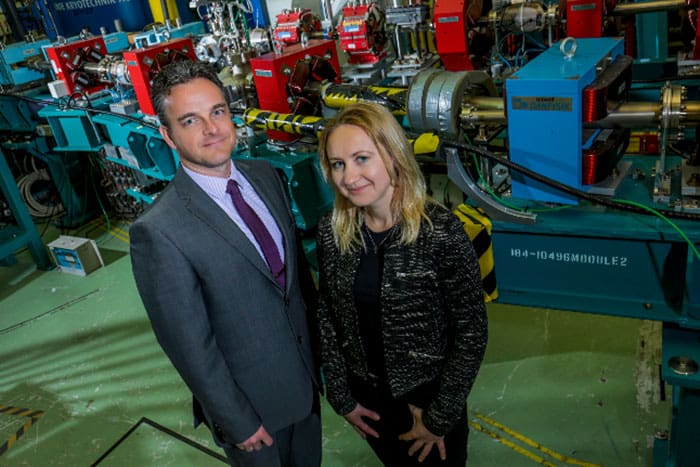
D-Beam’s co-founders Carsten Welsch (left) and Alexandra Alexandrova. (Courtesy: Cockcroft Institute)
A new commercial device for monitoring beam loss in accelerators has been developed by D-Beam, which is a spin-out company from the Cockcroft Institute accelerator centre at the Daresbury Laboratory in the UK. The company was co-founded by Carsten Welsch and Alexandra Alexandrova who are both at the University of Liverpool, which is one of five partners that operate the Cockcroft Institute. The company’s first product is new type of sensor that can monitor the “halo” of particles lost by a beam of particles as it moves through an accelerator. In some cases this loss introduces unwanted noise into experiments, and in some extreme situations beam loss can damage accelerators. The system uses optical fibres fitted with advanced light detectors. Whenever a stray particle crosses a fibre, it creates a light pulse that is recorded with extreme precision – revealing both the time and place in the accelerator where the particle was detected. “Another product we are considering for commercialization is a gas-jet-based monitor that can characterize the profile of the beam, another key feature that needs constant surveillance,” says Welsch. The monitor – which will be deployed in the next upgrade of the Large Hadron Collider at CERN – fires a cold supersonic gas jet shaped across the path of the beam. When the beam particles hit the atoms of the gas, light is generated, which creates a “photograph” of the beam’s profile.
You can find all our daily Flash Physics posts in the website’s news section, as well as on Twitter and Facebook using #FlashPhysics. Tune in to physicsworld.com later today to read today’s extensive news story on creating space radiation on Earth.
Physicists have used interferometry to detect the minute tidal forces acting on individual atoms exposed to a local gravitational field. This allowed them to measure the curvature of space–time on a very small scale and argue that their observations are perhaps “the first of gravity in a quantum-mechanical system”. The team adds that its sensitive apparatus might also improve prospecting for oil and minerals.
Tidal forces arise due to the finite size of gravitating objects. When one body is attracted to another it will experience a larger attractive force on the side nearest the second body than it will on the far side. In the case of the Earth, the oceans nearest the Moon are attracted slightly more to our celestial neighbour than are the oceans on the far side of the planet, causing the former to bulge slightly and create a high tide.
In the latest work, Mark Kasevich at Stanford University in the US and colleagues instead measure the minuscule tidal forces created when single atoms are allowed to fall in the presence of a nearby massive object. They did so to study the effect of space–time curvature on the atoms’ wave functions – tidal forces being directly related to this curvature – with the idea that gravity might conceivably destroy quantum coherence.
Wave–particle duality
The team used an atom interferometer, a device that exploits the principle of wave–particle duality to enable very precise measurements of acceleration. Like an optical interferometer, it involves splitting a particle’s wave function, sending the two halves along different paths and then recombining the separate waves to establish whether or not the waves’ relative phase has changed along the way.
The Stanford group propelled ultracold rubidium atoms up a 10 m-high tube and then fired a precise series of laser pulses at the atoms as they fell back down to Earth. These pulses acted as the equivalent of beam splitters, mirrors and other components in an optical interferometer.
Wave packets of individual atoms were divided such that the two parts travelled inside different interferometers placed 30 cm apart. One of the interferometers was created close to an 84 kg lead mass, and it was the roughly 10 cm-wide partial wave packet that travelled through this device that was monitored for evidence of tidal forces. The other interferometer – beyond the gravitational range of the lead – was instead used as a reference to eliminate the effect of Earth’s gravity and instrumental vibrations.
We were able to establish the fingerprint for tidal forces
Mark Kasevich, Stanford University
By varying the distance between the arms in the first interferometer, the researchers found that the resulting differences in relative phase yielded a quadratic dependence in agreement with the calculated space-time curvature created by the lead mass. “We were able to establish the fingerprint for tidal forces,” says Kasevich.
This is not the first time that atom interferometers have been used to measure space–time curvature. In 2015, Guglielmo Tino of the University of Florence in Italy and colleagues demonstrated the presence of curvature by comparing the accelerations of atoms within three separate clouds placed in the gravitational field of a set of tungsten-alloy masses. But Kasevich says that atoms in different clouds do not exist in a single coherent quantum state. Only by measuring the tidal force across individual wave packets, he says, would it be possible to observe gravity’s destruction of quantum coherence – should that take place in nature.
Coherence preserved
Kasevich says that the results obtained in the current work are “completely consistent” with the preservation of quantum coherence. As to what level of experimental sensitivity might be needed to observe any decoherence, he says that current theory provides little guidance. Most physicists working on theories of quantum gravity, he adds, are interested in the “strong-field limit” characteristic of black holes and other massive objects, in contrast to the very small fields that generate atomic tidal forces. Nevertheless, he believes it is important to make the measurements. “I am an experimental physicist,” he says. “My job is to push physical systems into new domains.”
According to Kasevich, his group’s work is also important technically since it shows how to carry out quantum measurements on the centimetre, as opposed to millimetre, scale. As for applications, he says the group’s apparatus might potentially improve gravity-based searches for oil and other resources. To identify substances with particular densities under the Earth’s surface, engineers generally employ gravimeters that measure the variation in gravitational acceleration from one point to another. But, as Kasevich explains, the equivalence principle dictates that if such devices are used on board helicopters, for example, it then becomes difficult to distinguish between vibrational and gravitational accelerations. This, he says, is not a problem when measuring space–time curvature.
Hard work needed
Kasevich acknowledges that there “is still a lot of work” needed to make a practical version of their instrument – one that “is not a 10 m-high tower located in the basement of a building”. In particular, he says, lasers must have “reasonable power levels and good control over polarization”. But he believes that these challenges can be overcome, arguing that money from UK, European and US schemes in quantum technology can “make these things come to fruition”.
Tino praises the California team, noting the importance of being able to split wave packets over longer distances than previously. “This is a further demonstration of the potential of atom interferometry for the investigation of gravity in yet unexplored systems,” he says. The work is described in Physical Review Letters.
Scientists are aware that many different animals appear sensitive to the Earth’s magnetic field lines. But what is not so well understood are the underlying mechanisms that make navigation possible. In this latest work at Simon Fraser University in Vancouver, researchers have identified particles of magnetite – a ferromagnetic material – within the abdomen of honey bees.
In the podcast, Glester speaks with biologist Veronika Lambinet and physicist Michael Hayden who describe the group’s experiments with bees. They describe studying the reaction of live bees exposed to magnetic fields stronger than the Earth’s field. Another experiment involved placing bee body parts within a superconducting quantum interference device (SQUID) to study the magnetization effects.
Glester also meets with Heather Lampard, a science communicator and beekeeper in Bristol, UK, where Andrew and Physics World are based. Clearly a huge admirer of her stripy friends, Lampard gives a crash course in the science of bees, explaining how they detect plants’ electric fields and why honeycombs are hexagonal-shaped. You can watch Lampard explain how bees produce honey, in this video she produced for the Bristol Nature Channel.
The quantum properties of molecular ions have been controlled by physicists in the US and Germany. Led by Chin-wen Chou of the National Institute of Standards and Technology (NIST) in the US, the researchers determined a molecular-ion’s quantum state by transferring the information to an atomic ion. A calcium ion and calcium-hydride ion are first confined in an electromagnetic trap. The atomic ion is then laser cooled, which also slows the motion of the partner molecular ion. Although the molecular ion is now in its lowest-energy electronic and vibrational states, it still rotates randomly. A pulse of laser light is applied to the molecule at a frequency that targets only one, unique transition in its rotational spectrum. If the molecule does jump into the target state, the system remains motionless. But if it makes the transition, both ions start moving again because energy is returned to their shared motion. This movement can be detected by applying a laser pulse to the atomic ion that changes its internal state, causing it to scatter light that can be detected. Described in Nature, the method is an alternative to laser cooling and controlling molecules, which has proven very difficult to do. “Whatever trick you can play with atomic ions is now within reach with molecular ions,” says Chou. “This is comparable to when scientists could first laser cool and trap atoms, opening the floodgates to applications in precision metrology and information processing. It’s our dream to achieve all these things with molecules.”
Biophysicist to lead Royal Society of Biology
The biophysicist Julia Goodfellow will be the next president of the UK’s Royal Society of Biology (RSB). Currently vice chancellor of the University of Kent and president of Universities UK, Goodfellow did a PhD in biophysics at the Open University Research Unit before embarking on a career in biomolecular science at Birkbeck College, where she served as vice-master and head of the School of Crystallography. She has also served as chief executive of the UK’s Biotechnology and Biological Sciences Research Council and chair of the British Science Association. Goodfellow will succeed the current RSB president Jean Thomas in May 2018 and will become the third president of the society since it was founded in 2009. “I look forward to working with the RSB to help strengthen the bioscience community they have successfully fostered, and ensure we are able to represent their views and priorities in the coming months and years,” says Goodfellow.
Stretchy hologram switches between images
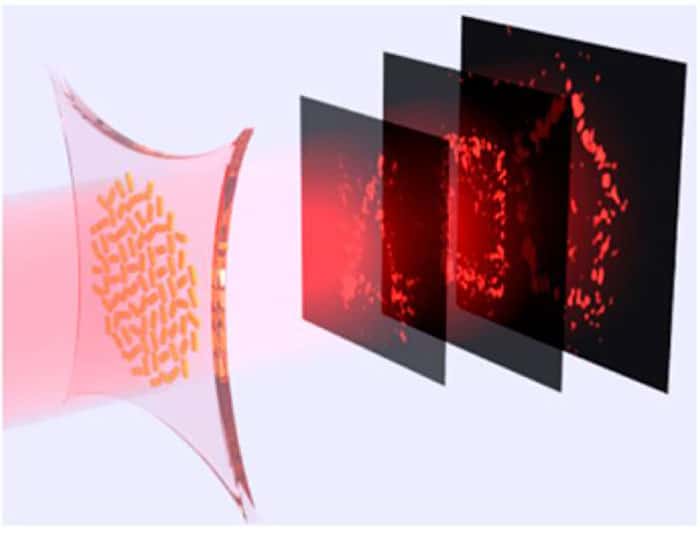
At a stretch: holograms shaped like a triangle, square and pentagram can be made by stretching the same metasurface. (Courtesy: American Chemical Society)
A hologram that switches between multiple images as the material used to generate it is stretched has been unveiled by Ritesh Agarwal and colleagues that the University of Pennsylvania in the US. The system is based on a metasurface, which is a flat, ultrathin material with nanometre-scale features. The team had previously shown that coherent light passing through such metasurfaces can produce colour holograms – 3D images created by the interference of light. Now, Agarwal and colleagues have created a metasurface by embedding gold nanorods in a stretchable film of polydimethylsiloxane (PDMS). Using a computer simulation, the team worked-out the distribution of nanorods that would result in a sequence of different holograms as the film is stretched. In its relaxed state, a pentagon-shaped hologram forms 340 μm away from the film. As the material is stretched the hologram changes shape – changes first becoming a square and then a triangle. The team was also able to switch between a happy-face hologram and a sad face. The new technique could have applications in virtual reality, flat displays and optical communications and is described in ACS Nano.
You can find all our daily Flash Physics posts in the website’s news section, as well as on Twitter and Facebook using #FlashPhysics. Tune in to physicsworld.com later today to read today’s extensive news story on the tidal forces on single atoms.