Caroline Herschel has enjoyed fluctuating fame since the day in 1786 when she discovered her first comet. In The Comet Sweeper: Caroline Herschel’s Astronomical Ambition, author Claire Brock examines the reasons for that as well as the circumstances of Herschel’s life, which were not straightforward.
As the youngest daughter in a large family, Herschel’s mother earmarked her early on for a life of domestic servitude, to save paying another servant. This conflicted with – and perhaps even caused – Herschel’s own ambition to earn enough to support herself. Brock argues that this remained Herschel’s primary ambition for much of her life, though the means by which she tried to earn her keep changed a few times. There was a brief flirtation with millinery and a much longer, not unsuccessful, musical career in Bath before her brother William’s interest in astronomy stopped being a side project and he co-opted Caroline as his assistant.
Brock quotes extensively from Herschel’s letters and memoirs, revealing a woman who often came across as bitter about her lot in life – particularly her dependence on William. But Brock argues that while Herschel perhaps never did love astronomy, she certainly had ambition to make real contributions to it, for the sake of science as well as her own personal advancement. In 1787 she was granted her own salary by King George III, thus becoming the first woman to earn her living from astronomy and achieving her life’s ambition.
Brock also quotes from other contemporary accounts, particularly those by women, to give a deeper flavour of the life Herschel lived. But most of all, she emphasizes Herschel’s drive to always improve herself, to self-educate in every spare moment. Brock paints a rounded portrait of a woman too-often reduced to a side note in her brother’s biography.
Robert Kephart of Fermilab speaking about the “beam business” at IPAC17.
By Margaret Harris at the International Particle Accelerator Conference in Copenhagen
Normally, you’d expect a particle-accelerator conference to focus on research – either the fundamental research done at accelerator facilities around the world, or the applied research required to get such facilities up and running in the first place. And for the most part, that has been absolutely true of the 8th International Particle Accelerator Conference (IPAC), which is taking place this week on the outskirts of Copenhagen, Denmark.
On Tuesday, however, the conference organizers dedicated a session to the ways that accelerator science engages with industry. In a two-hour series of talks, audience members heard from speakers as varied as Bjerne Clausen, CEO of the Danish chemical technologies firm Haldor Topsoe; Bob Kephart, director of the Fermilab-affiliated Illinois Accelerator Research Center (IARC); and Giovanni Anelli, who leads the Knowledge Transfer group at CERN.
Apart from our home planet of Earth, the red planet is the most visited planet in our solar system. It is not surprising then, that humans have long been interested in and intrigued by Mars, both scientifically and culturally. In 4th Rock from the Sun: the Story of Mars, author Nicky Jenner explores all these aspects of one of our nearest neighbours, going into the planet’s evolution, its geology and its moons, as well covering our robotic explorations of Mars and plans for humans to visit it in the near future. Despite a somewhat banal beginning, Jenner picks up the pace in her opening chapter as she tries to deduce our fascination with the planet, giving the reader a good description of what it would be like to traverse the Martian surface, before describing why, in fact, Mars would make for a rather boring and inhospitable holiday destination. Although most of us will be aware of the rather cold and varying temperatures on Mars, it may come as a surprise to find out that standing on the Martian surface would put your feet tens of degrees warmer than your head. The next few chapters are also interesting – Jenner digs into how human beings have anthropomorphized the planet; the fact that its red hue is particularly eye-catching; the planet’s apparent switch in direction (retrograde motion); and the fact that many respectable scientists were, at one point, convinced that Mars harboured advanced life forms. Other chapters talk about Mars’ moons Phobos and Deimos; “robot cars” or rovers and their exploration of the dusty planet; and the realities of a manned mission to Mars. In a particularly strong chapter, Jenner discusses the “massive Mars problem” – the issue of how Mars’ size has thrown off our theories for how terrestrial planets form. Although the book is somewhat haphazard in its flow, and Jenner occasionally repeats herself, 4th Rock from the Sun is both a useful and enjoyable read, especially for those interested in the planet’s cultural significance as much as the science. Grab a copy to catch up on all things Martian, especially if you plan on visiting the red planet anytime soon.
After being found guilty of heresy by the Catholic Church, Galileo Galilei was infamously placed under house arrest for the last nine years of his life. But he was far from idle during this time, writing one of the foundational works of modern science, Discourses and Mathematical Demonstrations Relating to Two New Sciences. The text includes a discussion of why it would be impossible to scale up an animal, a tree or a building to infinity. Galileo phrased it as a question of geometry – assuming a fixed shape for an object, its volume will increase at a much faster rate than its area. In practical terms, as an animal grows in size, its weight increases faster than the corresponding strength of its limbs, until the animal collapses under the force of its own weight. That’s why there could never be an animal the size of Godzilla, or Hollywood’s latest incarnation of King Kong.
In other words, there are very real constraints on how large a complex organism can grow. This is the essence of all modern-day scaling laws, and the subject of Geoffrey West’s provocative new book, Scale: the Universal Laws of Life and Death in Organisms, Cities and Companies. A physicist by training, West is a pioneer in the field of complexity science, and former director of the prestigious Santa Fe Institute in the US. Scale is the culmination of years of interdisciplinary research geared toward answering one fundamental question: could there be just a few simple rules that all complex organisms obey, whether they are animals, corporations or cities?
West clearly thinks the answer is yes, in the form of a handful of inter-related scaling laws. As evidence, he points to three simple graphs: one plots the number of heartbeats in an animal’s lifetime versus the weight; another plots metabolic rate versus rate in various animals; and the third plots the net assets and income of publicly traded companies versus number of employees. All three show strong scaling behaviour. In fact, West makes the bold claim that just by knowing the size of a mammal, he can use scaling laws to determine how much food it requires, its heart rate, life span, even the radius of its aorta, among other measurable characteristics.
The essence of any complex adaptive system – a person, a company or a city – is that there are many small interacting components within a network that iteratively follow very simple rules. Over time, complex behaviour emerges in the system, usually in an unpredictable way. Such networks can be observed all around us, and West maintains that they are the mechanism by which nature distributes energy and materials.
Within this framework, a company is much like a living mammal, consuming energy and resources to transform them into something useful – it has a metabolism, if you will. So what happens to that company as you scale it up in size? Common sense might dictate that doubling in size would require a doubling of resources, but that is not what West found when he analysed the data. An animal that is twice the size of another only needs 75% more food and energy per day, and the same goes for a company that is twice the size of another. It’s an example of sublinear scaling – and it’s the reason companies, like living organisms, have a finite life span. They grow rapidly when they are young, but growth gradually slows as they mature, until they “die” via bankruptcy, mergers or acquisitions.
Cities behave very differently, according to West. They show the same sublinear scaling when it comes to infrastructure: the bigger the city, the more efficient the distribution of its roads, cables, gas stations, power lines, railways and other infrastructure, so the fewer of those a city needs.
But the essence of any city is its people, interacting and collaborating with each other to innovate and create wealth. The socioeconomic aspects of cities – wages, number of patents, wealth, not to mention negative aspects such as crime, pollution and disease – exhibit what West terms superlinear scaling. Cities also become more diverse as they grow, while companies become more homogenized and risk-averse, making them less robust when the inevitable catastrophic fluctuation hits. Cities therefore rarely die, even after a catastrophic event. The Japanese city of Hiroshima thrives today despite the devastation wreaked on it by the atomic bomb in 1945.
Of course, there is a catch to West’s theory: such unbounded growth is ultimately unsustainable. It’s the Godzilla problem with a twist. Such a system will keep growing to infinity, requiring infinite resources, and that is just not possible in the real world. The key is innovation via disruptive technologies, for instance. A major paradigm shift will essentially reset the system, staving off collapse. But those shifts must occur at an ever-accelerating pace. There may have been thousands of years between the Stone, Bronze and Iron Ages, West writes, but only two decades between the computer age and the dawn of the information age. He likens it to having to jump around on a series of accelerating treadmills at an ever-increasing rate. And he predicts we’re due another major shift in the next 20–30 years.
Physicists are infamous, especially among statisticians, for seeing power laws everywhere, but West has constructed a rigorous and convincing case for his thesis, in clear and engaging prose. Alas, he frequently repeats himself, and he can’t quite shake off the awkward academese. (I lost count of how many times the reader is told that something will be discussed in more detail later.) That said, given the sheer scope of his subject, perhaps it’s not a bad idea to hammer the central message home several times.
Reading Scale, one’s thoughts inevitably turn to death – what Steve Jobs once called “life’s change agent”. By West’s scaling calculations, human beings in the early 21st century have roughly three billion heartbeats in a life span. How can we best make use of that time? Perhaps this is why West invokes the famous chess-playing scene from Ingmar Bergman’s classic film The Seventh Seal, where Death asks Antonius if he ever stops questioning. Antonius answers, “No, I never stop.” As West concludes, “And neither should we.” Only by constantly asking questions about how the world works, can we hope to ensure our continued survival.
Ocean-going ships face a constant struggle. In order to maintain their motion, they must continuously overcome the drag of the water that surrounds them. When one considers that marine shipping accounts for 4% of all fossil-fuel use, a similar percentage of climate-change-causing emissions and more particulate pollution than all of the world’s cars combined, it is clear that reducing this drag by even a small fraction would bring considerable benefits. Since the drag consists mostly of friction between the skin of the moving hull and the stationary water around it, lubricating this surface to reduce frictional motion would be a big help in reducing total drag.
We usually think of lubricants as being liquids, such as oil, but when friction occurs between a solid and a liquid, gas is the only real option for lubrication. For example, a torpedo can “fly” underwater, reaching otherwise unimaginable speeds, if a large pocket of water vapour engulfs its entire body via a method known as supercavitation. Also, blowing air bubbles onto the bottom side of a ship’s hull would allow the ship to move faster at a given propelling power.
You might ask, then, why we do not have gas-lubricated boats around us already. The problem is that unlike a liquid lubricant on a solid surface, a gas lubricant on a solid surface in a liquid (such as air in water) will leave the surface rather than staying on it. And unfortunately, providing a continuous supply of a rapidly disappearing gas consumes a lot of energy, which tends to cancel out the energy saved through lubrication, limiting the overall benefit.
Superhydrophobicity to the rescue
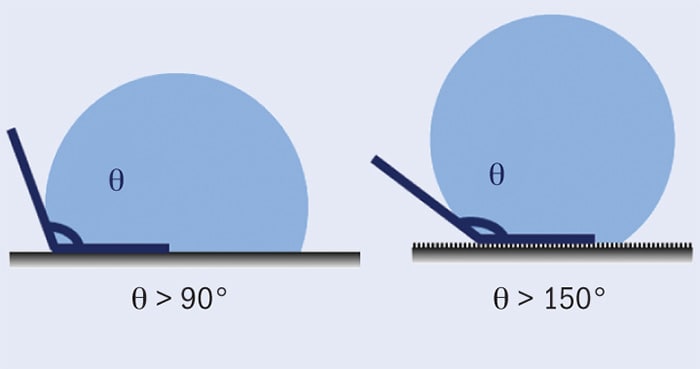
This frustration helps to explain why superhydrophobic (SHPo) surfaces were so exciting when, in the early 2000s, researchers began considering their applications for drag reduction. A SHPo surface is one that repels water much more strongly than usual. For example, a Teflon surface will repel water, forming a contact angle of around 110° between the water droplet and the surface. However, when such a naturally water-repellent material is roughened, water will sit on top of the roughness as if levitated by the air in the rough surface, with contact angles increasing to more than 150° (figure 1). As a result, the water will bead up and roll straight off when the surface is tilted. This “lotus leaf” effect has been a very popular topic in science and engineering for the past two decades, and thousands of images and online videos vividly demonstrate its intriguing properties.
If SHPo surfaces repel water so well, they must reduce the drag of water – or so the thinking went. Returning to the gas lubrication process discussed above, it was speculated that gases would persist on the SHPo surface, and thus finally make it possible to lubricate water friction with a gas layer that would not dissipate. Yet despite this logical expectation, and a torrent of research activities worldwide over the last 15 years, so far no publication has reported a successful demonstration of superhydrophobicity reducing the drag on a boat in ocean water. This article discusses why this is so, and whether there is a light at the end of this tunnel.
To identify the problems, let’s break down the issues. First, is it at least theoretically possible to obtain an appreciable drag reduction using a SHPo surface for real applications, such as a boat? Second, would a SHPo surface really save us from having to constantly supply a gaseous lubricant? Third, would it be economical to produce and implement such a SHPo surface for practical applications?
1 Water repelling The surface of a hydrophobic material (left) becomes superhydrophobic when roughened, as water sits on the top of the roughness (right).
Enough drag reduction?
Scientifically, there is no doubt that a layer of air (known as a “plastron”) on the SHPo surface in water will lubricate the motion and help reduce the drag. The real question is, just how much reduction are we talking about? If it is more than 10%, for example, that would be meaningful in practice. If the reduction is below 1%, however, we would not expect much impact in the real world even though it would still be scientifically interesting.
Despite the excitement generated by the idea’s scientific merit, and some encouraging early experimental results, it took nearly 10 years for the research community to understand how much drag reduction would be possible, and on what kinds of SHPo surfaces. Looking back, a few reasons for the slow advance are apparent. First, hydrophobicity is related to drag reduction, but not directly. Since the dynamics of bulk water and droplets are fundamentally different, a surface more favourable for droplet rolling is not necessarily more slippery to water continuously flowing by. The underlying, and still widespread, notion – that if a SHPo is very repellent to water, then it must be also very slippery to water flowing on it – is now known to be flawed.
Second, there was some confusion between drag reduction and the “slipperiness” of the surface. These concepts are linked, but they are not the same thing: the amount of drag reduction is determined not only by how slippery a surface is, but also by the flow system where the surface is employed. This means that for a given drag-reducing surface, one may obtain 50% drag reduction in a microscopic channel but not even 0.1% reduction on a boat. This mix-up made it difficult to objectively compare one SHPo surface with another in terms of their ability to reduce drag.
A third source of delays was related to measurement. Some early work on SHPo surfaces reported fantastically large reductions in drag – reductions that we now know were impossible. In many cases, the errors seem to have come from the challenge of measuring drag reduction accurately. While the observed trends may have been correct, the actual amount of reduction was simply wrong. These early, incorrect experimental data probably slowed down the establishment of the knowledge base for SHPo drag reduction.
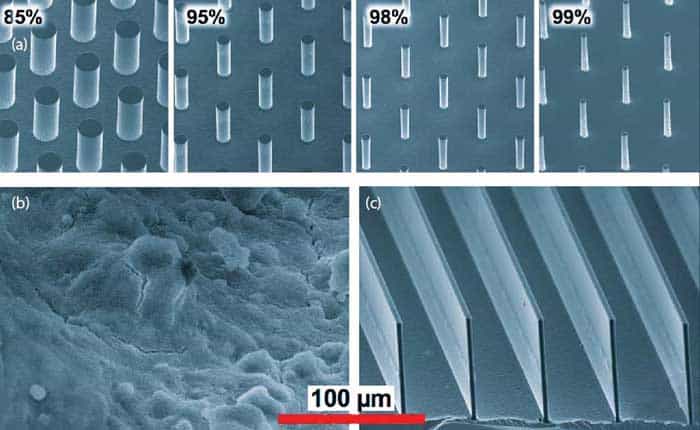
Today, the research community uses an objective measure called “slip length” to describe the slipperiness of a given SHPo surface. We also understand how much drag reduction a particular slip length will entail under a certain flow condition, at least for turbulence-free (laminar) flows. Micro and nanofabrication technologies using microelectromechanical systems (MEMS) have played a key role in advancing the field. By enabling researchers to construct SHPo surfaces with exact and deterministic micro and nano structures (figure 2a), rather than random roughness (figure 2b), these technologies have made it possible to confirm theoretical predictions about SHPo behaviour. In a nutshell, we have learned that a SHPo surface will be more slippery (that is, its slip length will be large) if its microstructures are slender (more void spaces and fewer solid portions) and dispersed (greater distances between the structure peaks).
These theoretical predictions have been confirmed for laminar flows. If we extrapolate this to turbulent flows, it seems that a highly slippery surface, consisting of slender microstructures dispersed far apart, is required before a boat will enjoy an appreciable reduction in drag. By fabricating SHPo surfaces full of parallel trenches tens of microns apart with a large void space between them (figure 2c), our lab has reported drag reductions as large as 75% in turbulent flows. This level of reduction was obtained under well-controlled flow experiments using a small (2 × 2 cm) SHPo surface made precisely by MEMS technology, and it may not be reproduced with large surfaces in field conditions. Nevertheless, it demonstrates the potential of SHPo drag reduction. The theory also suggests that more typical SHPo surfaces (figure 2b) with microscopic random roughness would have a slip length that is too small to induce any appreciable drag reduction for macroscale applications such as a boat in open water.
2 Exact construction vs random roughness These periodic microstructures were made precisely by microelectromechanical systems and helped to establish a quantitative relationship between a superhydrophobic surface’s geometry and how slippery it is. The percentages are the proportion of void spaces on the superhydrophobic surface; surfaces with higher void percentages proved more slippery in tests. (Courtesy: CJ Kim)
Maintaining an air layer
Recall that in the early days, SHPo surfaces were considered promising for drag reduction because of their presumed ability to retain an air layer (plastron) between the surface and water even when fully submerged. The assumption was that this plastron would persist for as long as it was needed to keep the surface lubricated. The reality is not so simple, and plastron behaviour is currently the most critical issue in the field of SHPo drag reduction.
Unlike in air, where microscopic voids between microstructures or roughness in a SHPo surface stay dry even after temporary wetting by water droplets, a SHPo surface fully submerged in water will become wetted once it loses the plastron. And unfortunately, the plastron is easily lost underwater because hydrostatic pressure forces the surrounding water into the spaces between microstructures. The smaller the spaces, the more persistent the plastron – but as we have already noted, narrowly packed SHPo structures are not very slippery. We cannot have it both ways: careful quantitative studies have shown that SHPo surfaces capable of providing an appreciable (>10%) drag reduction for a boat simply cannot retain the plastron if the SHPo surface is submerged to a depth of more than a few centimetres. For most applications the surface would need to be much deeper than that.
If the plastron will be lost for most applications, the principle of SHPo drag reduction won’t apply to them either. Faced with this fundamental limitation, the only reasonable approach that is valid for all flow applications is to replenish the lost gas – ideally, using a method that is simple to implement and consumes a minimal amount of energy. Our lab is pioneering such an approach, but much still needs to be learned before it becomes practical for real-world applications.
Most drag-reduction research has been performed using SHPo surfaces with microstructures that are randomly rough. This is mainly because such surfaces are easy to fabricate: all you need to do is apply a commercially available SHPo spray coating. In contrast, SHPo surfaces with well-defined periodic microstructures, and thus a superior slip, would be simply too expensive to manufacture and implement on a ship hull – or so the discussion goes. The inconvenient fact, however, is that a surface with microscopic random roughness is simply not capable of providing enough slip to achieve meaningful drag reduction in most practical applications. A better approach would be to address this economic challenge by developing techniques to mass-manufacture SHPo surfaces that do have a chance of providing appreciable drag reduction.
Another reason why random SHPo surfaces continue to be studied, despite the well-established theory that indicates their severe limitations, is that one can also find many successful results reported in the literature. The reason for this apparent contradiction lies in the way drag reductions are tested. Most drag-reduction experiments have been performed in a water tunnel, in keeping with traditional flow experiments. But as my group confirmed recently, in flow tests using a water tunnel, the water quickly becomes supersaturated with air. In this supersaturated condition a very thick plastron forms on random SHPo surfaces, assisted by the few tallest rough protrusions. Naturally, one obtains a large drag reduction in these conditions: basically, you get the plastron you would expect from a SHPo surface with slender microstructures spaced far apart.
The problem, unfortunately, is that this thick plastron would disappear in open-water conditions, where the water is mostly undersaturated and tends to take the gas away. This dissimilarity between the water tunnel and open-water conditions is most likely why apparently successful lab studies have so far never been repeated in the real marine environment. In fact, the rare studies carried out in tow tanks actually reported an increase in drag, rather than a reduction, with random SHPo surfaces. The increase is understandable because high peaks of the random roughness will penetrate into the water once the plastron becomes thin, impeding the flow – rather like a coating of tiny barnacles.
On the other hand, a SHPo surface that is slippery enough to produce appreciable drag reduction in macroscale applications (such as a boat) is difficult to test in open-water conditions. These types of SHPo surface have large spaces between microstructures so they lose the plastron easily, and since they must be fabricated using MEMS technologies, it is difficult to manufacture the relatively large samples (more than 1 m2) used for open-water tests. Actual boats are, of course, even bigger, and their hulls are curved. But these challenges are practical rather than fundamental. By developing ways to get around them, rather than confronting them head on (which will take much longer), my lab is currently performing experiments using a motor boat that replicates field conditions as closely as possible.
Clear water ahead?
After nearly two decades of research we now understand the potential as well as the limitations of SHPo drag reduction much better than we once did. We can predict how slippery a SHPo surface is and how much drag reduction is possible at a given flow condition. Although most of our understanding deals with laminar flows, we can extrapolate this to a certain extent for turbulent flows, including open-water conditions. My group has very recently obtained a 30% reduction with a boat in ocean water. This result is preliminary, but its unprecedented success is grounded in the extensive body of scientific knowledge summarized briefly in this article. It is, perhaps, a peek into the future of marine transport.
A new technique for detecting the faint light from exoplanets that orbit two or more stars has been proposed by Artur Aleksanyan, Nina Kravets, and Etienne Brasselet at the University of Bordeaux in France. Their method is an improvement on vortex coronagraphy, a telescope-based technique that was developed in 2005. It involves sending light from a star through a mask that puts the light on an outwardly spiralling trajectory. When the light strikes the telescope camera, it is shifted some distance from the actual position of the star. This makes it possible to see faint objects such as exoplanets that are nearby to the star. While the technique works well for exoplanets orbiting a single star, it cannot resolve exoplanets that orbit two or more stars. Brasselet and colleagues have now used reconfigurable defects in a liquid crystal to create a mask that they say will send light from several different stars along spiral paths. This involves using laser light to configure the defects so that the mask will work for a specific arrangement of stars. The trio tested their scheme by simulating an exoplanet in a three-star system using four beams of light. Writing in Physical Review Letters, they describe how the view of the simulated planet was enhanced significantly (see image above).
Flat lens for immersion microscopy is a first
Nanofins: electron microscope image of the flat lens for immersion microscopy. The horizontal distance covered by the image is about 4 μm. (Courtesy: Capasso Lab)
The first flat lens for use with an immersion microscope has been made at Harvard University in the US – according to researchers there. Liquid-immersion microscopy involves placing the front lens of a microscope and the specimen in a liquid – usually water or oil. Liquids have higher indices of refraction than air and this improves the resolving power of the microscope. Front lenses used in high-performance microscopes are usually hand-polished to very high specifications, making the lenses very expensive. Furthermore, each lens will only work with fluids with specific indices of refraction. Now, Federico Capasso, Alexander Zhu, Wei Ting Chen and colleagues have created a flat lens comprising an array of titanium-dioxide “nanofins” that can be tailored for use with different immersion liquids (see image above). The nanofins are just a few hundred nanometres tall and “can be mass-produced with existing foundry technology or nanoimprinting for cost-effective high-end immersion optics”, according to Chen. The lenses can also be tailored to work in samples such as skin that have multiple layers, each having a different index of refraction. “Our immersion meta-lens can take into account the refractive indices of epidermis and dermis to focus light on the tissue under human skin without any additional design or fabrication complexity,” says Zhu. The new lens is described in Nano Letters.
Caltech students protest return of suspended astrophysicist
Students at the California Institute of Technology (Caltech) in the US staged a sit-down protest yesterday against a temporary return to campus by the astrophysics professor Christian Ott. Suspended from his job in 2015 for violating the university’s sexual-harassment policy, Ott was at Caltech at the request one of his graduate students to observe the student’s thesis presentation. According to BuzzFeed News, Ott was then escorted off campus by two faculty members. Ott is expected to return to his job in August 2017, which has raised concerns from some astrophysics students. Maya Fuller told BuzzFeed that she is “really uncomfortable” with the possibility that she may have to take a course taught by Ott. Graduate student Io Kleiser, who a Caltech investigation says was subject to gender-based harassment by Ott, said: “I personally would not like him to be on campus at all, ever.” Fiona Harrison, division chair for physics, math and astronomy at Caltech, suggested that Ott’s “behaviour and progress during his suspension” will be assessed before his return.
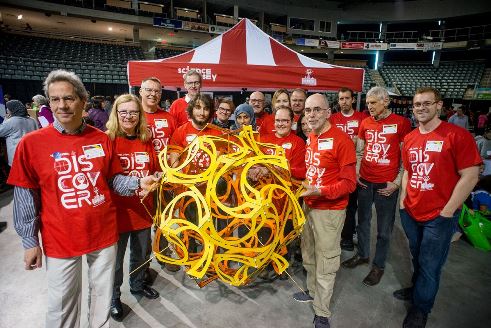
Putting it all together. (Courtesy: Garrett Elliott)
By Michael Banks
A sculpture inspired by the geometry of the neutrino detector at the Sudbury Neutrino Observatory (SNO) has been unveiled at Queen’s University in Kingston, Canada.
SNO, which operated from 1999 to 2006, was located 2.1 km underground in Sudbury, Ontario, and designed to detect neutrinos from the Sun through their interactions with a large tank of heavy water.
A scientific facility designed to foster collaboration in the Middle East is finally open after taking 15 years to build. The Synchrotron-light for Experimental Science and Applications in the Middle East (SESAME) was officially opened yesterday by King Abdullah II of Jordan in a ceremony at the lab’s site near Amman, Jordan. SESAME is a third-generation synchrotron light source and will be used by scientists in the region for a range of experiments from condensed-matter physics to biology.
The synchrotron, which has a relatively small 133 m circumference, features an 800 MeV pre-booster ring that sends a beam of electrons to the main storage ring that in turn boosts their energies to 2.5 GeV – a feat that was first achieved on 27 April – with the particles then producing intense and monochromatic beams of X-rays. Over the past year, construction accelerated with the core storage ring put together with magnets built by the CERN particle-physics lab near Geneva. Initially, two beamlines will be open for users, with more added at a later date.
Harmonic start-up
Swiss physicist Albin Wrulich, who chairs the SESAME Technical Advisory Committee, points out that SESAME is currently undergoing a “conditioning” phase that includes adjusting the pressure and cleaning the surface of the vacuum chamber. “The performance of the machine is excellent,” says Wrulich, adding that the local team did a “fantastic job” constructing the synchrotron. He says that the first two beamlines can now be turned on, making for a “harmonic” start-up.
SESAME has eight members – Cyprus, Egypt, Iran, Israel Jordan, Pakistan, the Palestinian Authority and Turkey – and the synchrotron’s proponents hope that it will foster regional scientific capacity and friendly collaboration among scientists from different countries. Physicist Chris Llewellyn Smith, the former director general of CERN who is ending his eight-year presidency of the SESAME Council today, says that in March SESAME received 55 experiment proposals for the first beamtime. “It shows that SESAME is not going to be underused,” he says. “There is a real demand out there.”
Llewellyn Smith adds that countries in the region whose researchers use SESAME should hopefully consider joining while researchers from countries with synchrotrons should invite regional researchers to join them or instruct local scientists as to synchrotron techniques. “SESAME, in common with all the synchrotrons of the world, will have an open-door policy,” he adds.
Future-proof
SESAME officials are even planning upgrades for the near-future. Wrulich says that there is already interest in upgrading the machine’s booster from 800 MeV to a 2.5 GeV, which would enable the storage ring to sustain a consistently intense beam. The Italian government has also come forward with financial support for a SESAME guest house, and Llewellyn Smith expects the building contract to be finalized soon.
Meanwhile, a European Union programme to support renewable-energy efforts in the Middle East has led Jordan to commit $7m of this aid to build a solar-energy source for SESAME. Llewellyn Smith says this is a breakthrough for SESAME as costs would steeply rise with added beamlines and usage, and expects the solar source, which will be connected to the Jordan grid, to be up and running in early 2018, making SESAME unique in that it will be powered entirely by renewables.
“It is a great satisfaction after many years to see what had really been just dreams or hopes overcome numerous barriers, and here we are,” says Llewellyn Smith. “It is only the end of the beginning, we don’t have all the beamlines we want, we don’t have all the facilities, but the machine is operating and science is about to start.”
A new and faster way of tracking eye movements has been unveiled by researchers in Belgium and the Netherlands. Rather than using high-resolution digital cameras embedded in screens or glasses, the low-cost technology instead detects changes in electric field next to the eye. The team says that it could be used to create eye-tracking systems that are much faster and much cheaper than existing devices.
Tracking the motion of a person’s eyes as they look around has a wide range of applications from medical testing to computer gaming. While conventional systems can locate a person’s gaze, they are not fast enough to track the high-speed motion of the eyes. In particular, it is very hard to follow the eye jumping rapidly from one position to another involuntarily when a scene or object is scanned – what’s known as “saccades”. One solution is to use faster and higher resolution cameras, but that’s a very expensive option.
Naturally electrical
Now, however, Gabriel Squillace and colleagues at the IMEC microelectronics research centre in Belgium and the Holst Centre in the Netherlands have taken a completely different approach by measuring the changes in electrical fields that occur as the eye moves. “Human eyes have a natural electrical potential,” explains Squillace.
The team integrated four electrical sensors developed at IMEC into eyeglasses. Two sensors monitor the eyes’ vertical motion and two sensors monitor their horizontal motion. The team also developed an advanced computer algorithm that translates signals from the sensor into the positions of both eyes. The sensors are also able to measure other aspects of eye activity such as the speed of movement and the frequency and duration of blinks.
Augmented reality
Squillace says that IMEC is now developing commercial devices that can track the position of an eye in real time at a fifth of the cost and four times faster than what’s currently on the market. “IMEC’s ultimate goal is to develop a solution that can track the eye’s most rapid movements, such as saccades, enabling seamless real-time tracking for augmented-reality and virtual-reality applications,” he says.
These devices are now being tested and allow users to interact with screens by moving the cursor with their eyes. Specific blinking patterns can also be used to initiate specific actions such as selecting files, drag-and-dropping icons, and opening and closing software applications.
Tiny ice crystals in Earth’s atmosphere create unexpected flashes of light in images of the planet taken from space. The bright glints were caught by NASA’s Earth Polychromatic Imaging Camera (EPIC) on board the Deep Space Climate Observatory (DSCOVR). Positioned between the Earth and the Sun, EPIC takes almost-hourly images of the sunlit planet. When studying these images, Alexander Marshak, DSCOVR deputy project scientist at NASA’s Goddard Space Flight Center, noticed occasional light flashes appearing over oceans. A closer look revealed these also happened over land, meaning they couldn’t be simply caused by sunlight reflecting off smooth water. Marshak and colleagues turned their attention to another water system on Earth – the ice crystals high in the atmosphere. The researchers catalogued 866 flashes over land between DSCOVR’s launch in June 2015 to August 2016. By calculating angles of reflection and combining with EPIC’s measurements of cloud height, the team concluded that the flashes were caused by sunlight reflecting off horizontally orientated ice crystals in high cirrus clouds (5–8 km). Marshak is now investigating whether the ice crystals are common enough to impact the amount of sunlight passing through the atmosphere, so as to incorporate it into computer models of Earth’s temperature transfers. Detecting similar glints on exoplanets could also provide information about their atmospheres. The work is presented in Geophysical Research Letters.
Quantum drum amplifies microwaves
A new type of electromechanical circuit for microwaves has been created by physicists in Switzerland and the UK. The device comprises a resonant microwave cavity that is coupled to a tiny mechanical oscillator that resembles a drum. The “micro-drum” is 30 μm in diameter and just 100 nm thick. The system is initialized by cooling the micro-drum so that it vibrates in its quantum-mechanical ground state – which is done by scattering microwave photons from the drum, each of which carries away a tiny amount of energy. The drum is coupled to the cavity such that the position of the drum modulates the resonant frequency of the cavity. Conversely, the cavity can affect the motion of the drum by exerting a force on it. As a result of these interactions, energy can be transferred between the drum and cavity. The device has several modes of operation, including one in which the drum is able to absorb microwaves from the cavity – acting as a dissipative reservoir. By tuning the interaction parameters, the device can also be operated as a microwave amplifier that operates just above the quantum limit for noise. In a different regime, the device can be operated as a microwave laser – or maser. Created by László Tóth, Nathan Bernier, Alexey Feofanov and colleagues at École Polytechnique Fédérale de Lausanne and the University of Cambridge, the device is described in Nature Physics. “There has been a lot of research focus on bringing mechanical oscillators into the quantum regime in the past few years,” says Feofanov. “However, our experiment is one of the first which actually shows and harnesses their capabilities for future quantum technologies.”
Scientists map comet’s charged particles
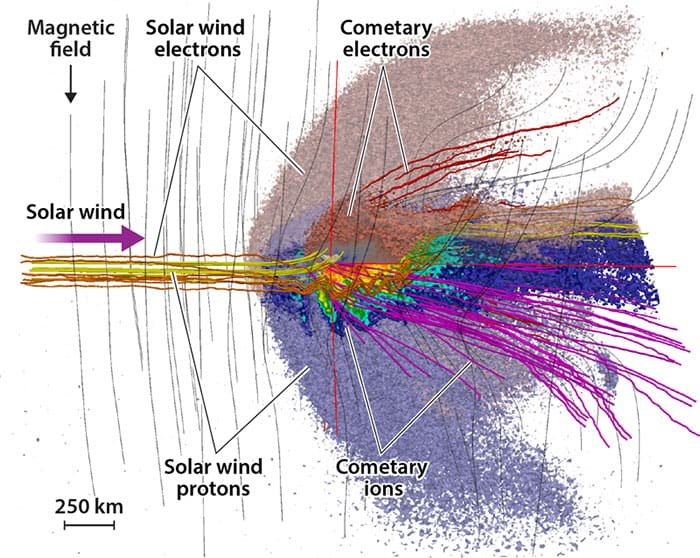
Solar power: simulation result showing the behaviour of various charged particles around the comet 67P/Churyumov–Gerasimenko. (Courtesy: J Deca et al./Phys. Rev. Lett.)
A detailed 3D map of how the solar wind interacts with the 67P/Churyumov–Gerasimenko has been produced by an international team of scientists, who have explained puzzling observations made by the Rosetta mission to the comet. In the above image created by the team, the solar wind of hypersonic charged particles approaches the comet from the left and interacts with the watery halo of the comet. Jan Deca of the University of Colorado Boulder, and colleagues in Russia, Sweden, France and Belgium, used 3D particle-in-cell (PIC) kinetic simulations to study the interaction of four components – electrons and ions in the solar wind, and electrons and water ions in the halo. They found that the interaction between the magnetic-field lines of the solar wind and the comet cause the solar-wind electrons to be deflected around the nucleus of the comet. The heavier solar protons, however, are not deflected as much as the electrons and tend to penetrate the nucleus. Beyond the comet, these protons are neutralized by electrons flowing from the comet. Meanwhile, the solar-wind electrons neutralize some of the water ions that flow from the comet and make up its tail. These charge-exchange processes also transfer momentum from the solar wind to the tail of the comet. Writing in Physical Review Letters, the team describes how it was also able to explain the unexpected existence of two distinct populations of electrons in the halo – warm electrons and hotter suprathermal electrons – which were discovered by Rosetta.