Flash Physics: Wavelets pioneer bags Abel Prize, astronomers find huge magnetic fields, modelling ice bridges

Wavelets pioneer Yves Meyer bags Abel Prize

Yves Meyer, who pioneered the wavelet transform that plays a central role in technologies as diverse as digital cinema and the LIGO gravitational-wave detectors, has won the 2017 Abel Prize. Awarded annually by the Norwegian government for excellence in mathematics, the prize is worth 6m Norwegian kronor (about $750,000). Meyer is a French citizen and holds an emeritus professorship at École normale supérieure Paris-Saclay. The wavelet transform decomposes a signal into a set of pulse-like mathematical objects called wavelets. Compared with similar techniques such as the Fourier transform, the wavelet transform is better able to resolve sharp features in the data such as spikes and edges. Since the late 1980s, wavelets have played a revolutionary role in signal-processing applications such as JPEG image compression. Wavelets have been used to study physical systems such as turbulence, whereby complicated fluid flow is decomposed into wavelets that interact with each other. Wavelets have also been used to improve images from the Hubble Space Telescope and analyse signals from the LIGO gravitational-wave detectors – allowing the latter to detect gravitational waves from coalescing binary holes. The prize will be presented to Meyer at a ceremony in Oslo on 23 May.

Astronomers find largest magnetic fields in the universe
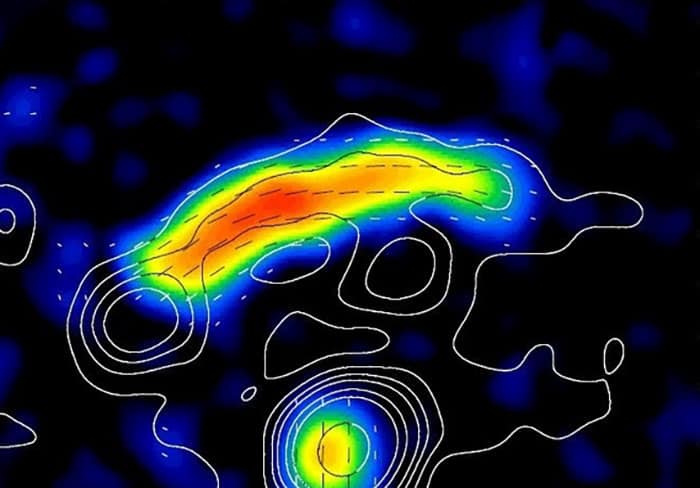
Relic of galaxy cluster CIZA J2242+53 - contour lines show intensity of radio emissions (3 cm wavelength), colours show distribution of linearly polarized radio intensity, dashed lines show orientation of magnetic field

The largest, ordered magnetic fields to be observed in the universe have been identified using the Radio Telescope Effelsberg in Germany. A team, led by Maja Kierdorf of the Max Planck Institute for Radio Astronomy in Germany, observed the magnetic fields extending over 5–6 million light-years on the periphery of galaxy clusters. Galaxy clusters are the largest, gravitationally bound structures in the universe. At around 100 times the diameter of the Milky Way, they contain galaxies, dark matter, hot gas and charged particles. When clusters collide, they cause a shock compression of the hot cluster gas and magnetic fields, resulting in arc-like features called relics that emit radio and X-ray radiation. While studying four galaxy clusters and their relics, Kierdorf and colleagues observed that the emitted radio waves were linearly polarized and that the plane of polarization is related to the wavelength. This “Faraday rotation effect” indicates that a highly ordered magnetic field exists between colliding clusters. It is thought this is caused by the field lines becoming highly ordered when compressed, which, when combined with the hot gas, causes the radio waves to polarize. The team highlights in Astronomy & Astrophysics that its findings show single dish telescopes, such as the Radio Telescope Effelsberg, are ideal tools for finding new relics. “Now we can systematically search for ordered magnetic fields in galaxy clusters using polarized radio waves,” says team member Rainer Beck.

Model describes how ice bridges are formed
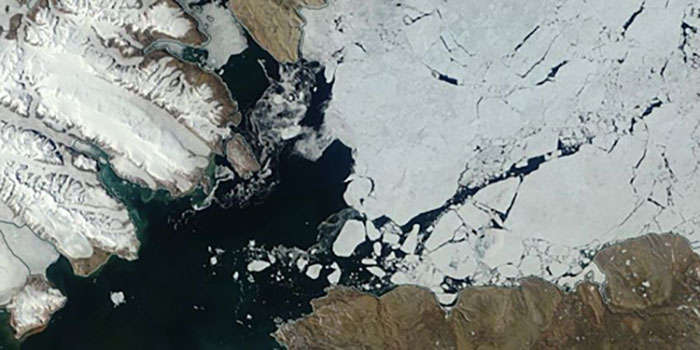
Satellite image of ice flowing in an Arctic strait

Every year, windblown ice forms ice bridges across some straits and channels in the Canadian Arctic Archipelago. As well as allowing the movement of wildlife such a polar bears, these ice bridges can prevent ice from moving out into the open sea where it can melt more quickly. Therefore ice bridges could have a significant effect on climate. Why these ice bridges form is not well understood, which inspired Bhargav Rallabandi, Howard Stone and colleagues at Princeton University to develop a mathematical model that describes the physics of ice being driven by wind along a long, narrow channel. The ice flow is inhibited by friction between the ice and sea water as well as by internal stresses in the ice flow that arise because it is constrained within a channel. The researchers have shown that ice-bridge formation is dominated by the internal stresses, which depend upon the thickness and compactness of the ice as well as the width of the channel. For a given channel width and wind strength, they were able to calculate critical values of ice thickness and compactness required for an ice bridge to form. As well as providing important information about the Arctic environment, the research could also boost our understanding of how granular materials flow through hoppers and other constricted geometries. The work is described in Physical Review Letters.


  • You can find all our daily Flash Physics posts in the website’s news section, as well as on Twitter and Facebook using #FlashPhysics. Tune in to physicsworld.com later today to read today’s extensive news story on the magnet-like nature of the brain.

US scientists battle with Trump administration

As the Trump administration’s governing priorities became more apparent through its actions and statements, US researchers’ sense of alarm has escalated. The administration’s revised executive order on immigration, its initial budget proposals, and its attitude towards climate change and the environment are all drawing criticism – much of it scathing – from the community. In addition to voicing complaints, scientists and scientific societies are preparing to reveal their feelings in a March for Science on 22 April in Washington DC – with close to 300 subsidiary marches to take place in other cities worldwide.

While the new executive order on immigration removes Iraq from the list of countries whose citizens are temporarily banned from the US, it still covers Iran, Libya, Somalia, Sudan, Syria and Yemen. It allows entry to individuals from those six nations with valid visas or green cards, which permit US residence. The order also allows immigration authorities to waive the ban on individuals on a case-by-case basis. However, two federal judges blocked the order’s provisions before they went into action and a long series of court hearings is likely.

A statement from the Institute for Advanced Study in Princeton, New Jersey, notes that the new order “continues to directly conflict with the [institute’s] founding principles and values, unwavering belief in non-discrimination and inclusion, and fundamental mission to provide a free and open environment for basic research in the sciences and humanities”. A statement from the Optical Society of America (OSA), meanwhile, asserts that while it welcomes the exclusion of Iraq, the order will “continue to pose a threat” to science and international collaboration. “Like its predecessor, [the order] hinders scientists and their work by restricting their ability to enter the US to study, attend conferences or pursue research interests,” the OSA says.

Scholars cut off

According to the Association of Public and Land-Grant Universities (APLU), more than 15,000 students from the countries in the revised order visited the US to study science in 2015 and 2016. “As an institution, we oppose the revised travel ban on the principles of justice and non-discrimination, and stand in unison for the advancement of knowledge without borders and prejudice,” says Peter McPherson, president of the APLU. “The pipeline of new students and scholars from [the six banned] countries, many of whom are in the midst of the college application process, is now cut off.”

President Trump’s proposed budget for the 2018 financial year, which begins on 1 October, is also worrying the US scientific community. While the document contains only broad details and Congress will almost certainly make changes to the budget, science appears likely to lose out. (See “Trump’s 2018 budget proposal concerns US scientists“) The proposal includes a reduction in spending on discretionary items of $54bn, which includes funding for such agencies as the Department of Energy (DOE), the National Science Foundation (NSF) and the National Institutes of Health (NIH).

“[The budget] means tremendous cuts in basic research, environmental research, energy and agriculture,” says John Holdren, who served as Barack Obama’s science adviser from 2009 to 2017. “[It] has the scientific community very worried.” Illinois Democratic congressman Bill Foster, the only physicist in Congress, is also fighting against large cuts to science. “The US has been at the forefront of innovation and progress largely due to investment in scientific research,” he told the House of Representatives Appropriations Committee recently. “Our scientific infrastructure requires long-term, sustained funding to ensure opportunities are not missed.” Foster and Illinois Democratic senator Dick Durbin have introduced a bill – with little chance of success – to increase the funding of five government research-related agencies by 5% annually.

If ever there was a case of the fox guarding the henhouse, this is surely it
Michael Mann, Pennsylvania State University

Climate satellites

The satellite division of the National Oceanic and Atmospheric Administration (NOAA) – which provides 90% of the data used in weather forecasts – stands to lose 22% of its current budget, or $513m. The Environmental Protection Agency (EPA) could lose 31.5% of its funding and Scott Pruitt, its new administrator, has exacerbated scientists’ suspicion of the Trump administration’s environmental agenda. Speaking to CNBC, he responded to a question on carbon-dioxide’s role in climate change with the comment: “I think that measuring with precision human activity on the climate is something very challenging to do, and there’s tremendous disagreement about the degree of impact. So no, I would not agree that [carbon dioxide] is a primary contributor to the global warming that we see.”

Pruitt has been no friend of the EPA, having sued it several times during his time as attorney general of Oklahoma. But he had rarely voiced his suspicion of anthropogenic climate change so starkly. “His latest statements merely confirm what I’ve said before,” Pennsylvania State University climatologist Michael Mann told Physics World. “Pruitt is an anti-science, anti-environmental zealot and a thinly veiled shill for fossil-fuel interests. If ever there was a case of the fox guarding the henhouse, this is surely it.”

Many scientists agree. Within two days of Pruitt’s making his comments on the CNBC television channel, his agency’s main phone number was flooded with protest calls. Several calls went to a voicemail box that was itself overwhelmed. As for Pruitt’s claim that carbon dioxide is not a primary contributor to climate change, Mann says: “Increasing carbon dioxide is most likely responsible for all of the warming we’ve seen over the past century, since natural factors were actually pushing us ever so slightly toward cooling.”

Data access

The new government’s early actions have given fuel to one further issue: concern about the accessibility of government data. The government is legally required to store all the data it gathers. But the disappearance of information from government websites has indicated to some scientists that data on now-sensitive topics such as climate change will become increasingly difficult to identify and download. Groups of scientists have begun to spend weekends archiving such data for their future colleagues.

Meanwhile, preparations continue for the March for Science, which will take place on 22 April – Earth Day. The event aims “to champion robustly funded and publicly communicated science as a pillar of human freedom and prosperity”. Nearly 300 satellite marches have been organized around the world and more than 50,000 individuals have offered assistance to the events, and close to 100 groups have endorsed the march. They include the American Physical Society (APS), whose steering committee voted unanimously to endorse the event last month.

United for science

“The March for Science champions robustly funded and publicly communicated science as a pillar of human freedom and prosperity,” a statement by the APS notes. “We unite as a diverse, nonpartisan group to call for science that upholds the common good and for political leaders and policymakers to enact evidence-based policies in the public interest.”

Despite the gloom among many researchers, the White House has offered some positive scientific news. In late February, president Trump signed two bipartisan bills designed to encourage women in scientific fields. The first calls on the NSF to “encourage its entrepreneurial programmes to recruit and support women to extend their focus beyond the laboratory and into the commercial world”. And the second directs NASA to “encourage women and girls to study science, technology, engineering and mathematics, pursue careers in aerospace, and further advance the nation’s space-science and exploration efforts”.

China outlines free-electron laser plans

By Michael Banks in Shanghai, China

There was a noticeable step change in the weather today in Shanghai as the Sun finally emerged and the temperature rose somewhat.

This time I braved the rush-hour metro system to head to the Zhangjiang Technology Park in the south of the city.

(more…)

Flash Physics: Molecular machines run in reverse, sterile neutrinos still not found, more funds for space-exploration institute

Molecular machines put into reverse by light

Artist's impression of the reversible nanomachine

A material that expands and contracts in response to light has been made using two molecular machines. One component is a Feringa molecular motor first developed by chemistry Nobel laureate Bernard Feringa and colleagues at the University of Groningen in the Netherlands. This motor rotates in one direction when exposed to ultraviolet light (UV). When connected to a network of polymers, the motors twist the polymer strands into braids. This causes the network to contract, thereby doing useable work. However, using these motors to create complex nanomachines is a challenge because the direction of the motor cannot be reversed. Now, Nicolas Giuseppone and colleagues at the University of Strasbourg in France have overcome this problem using a second molecular machine called a modulator that allows the braided polymers to unwind, causing the material to expand. The modulator only allows the strands to unwind when exposed to visible light, so the material can be contracted by exposing it to UV light and then expanded by switching to visible light. The team was also able to control the speed of the expansion and contraction by illuminating the material with combinations of UV and visible light. Giuseppone’s team is now trying to build devices powered by the molecular machines, which they describe in Nature Nanotechnology.

Sterile neutrino search comes up cold

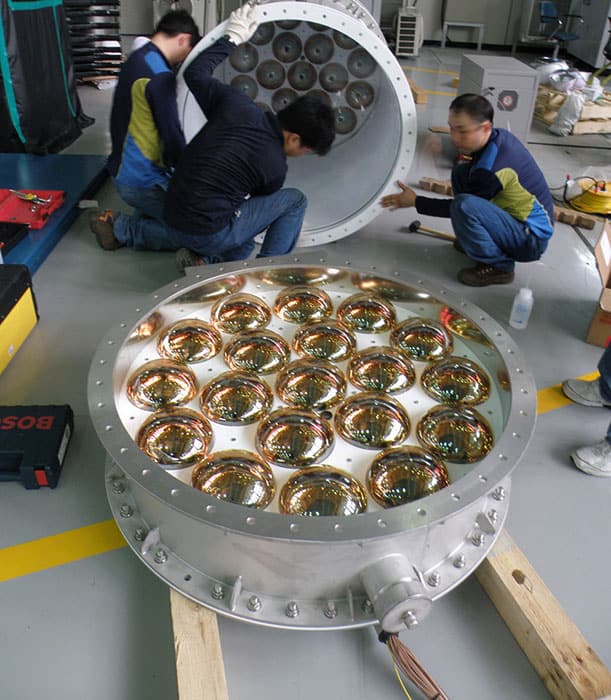
Photograph of physicists assembling the NEOS neutrino detector

A search for sterile neutrinos by the NEOS experiment in Korea has found no evidence for the hypothetical particles. Predicted by certain extensions of the Standard Model, sterile neutrinos – if they exist – transform into and out of standard neutrinos, revealing themselves via a greater- or lesser-than-expected rate of oscillation between the different types, or “flavours”, of neutrinos. Some past neutrino experiments have hinted that such discrepancies exist and therefore physicists are very keen on finding further evidence for sterile neutrinos – which are expected to interact extremely weakly, if at all, with ordinary matter. The NEOS detector is located just 24 m from the core of a nuclear power plant, which produces vast numbers of antineutrinos. By making a very careful measurement of the energy spectrum of the antineutrinos, physicists working on NEOS concluded that there is no evidence that oscillations involving sterile neutrinos were occurring. On a positive note, the team measured more antineutrinos with energies of about 5 MeV than predicted by theory. This excess, dubbed the “reactor antineutrino anomaly”, has also been seen by other experiments. The measurement is described on arXiv and will be published in Physical Review Letters.

NASA funds four teams to join space-exploration institute

NASA will fund four research teams across the US as part of the Solar System Exploration Research Virtual Institute (SSERVI). NASA created SSERVI to bring together US researchers and help them work with international teams. The virtual platform allows scientists to collaborate and solve questions that are fundamental to advancing research in lunar and planetary science, and human exploration of the solar system. Joining the existing nine members are the Network for Exploration and Space Science (NESS) at the University of Colorado Boulder, the Toolbox for Research and Exploration (TREX) at the Planetary Science Institute in Arizona, the Radiation Effects on Volatiles and Exploration of Asteroids and Lunar Surfaces (REVEALS) at the Georgia Institute of Technology, and the Exploration Science Pathfinder Research for Enhancing Solar System Observations (ESPRESSO) at the Southwest Research Institute in Colorado. Selected from among 22 proposals, the four teams will receive a combined total of $3–5m per year for the next five years. Each group will focus on a different topic. For example, TREX – which will receive $5.5m over the five years and is led by Amanda Hendrix – aims to develop tools and methods for exploration of airless bodies that are coated in fine-grain dust such as the Moon, Martian moons Phobos and Deimos and near-Earth asteroids. “TREX emphasizes fine grains because impact processing [at airless bodies] can produce extremely fine size particles – dust – that have critical effects, both operationally and scientifically, threatening surface operations and confounding and complicating interpretation of conventional remote sensing spectral data,” says team member Faith Vilas. The new teams join others from across the US including groups from John Hopkins University, Brown University and the University of Central Florida.


  • You can find all our daily Flash Physics posts in the website’s news section, as well as on Twitter and Facebook using #FlashPhysics.

Physicists learn how to put plasmons in a twist

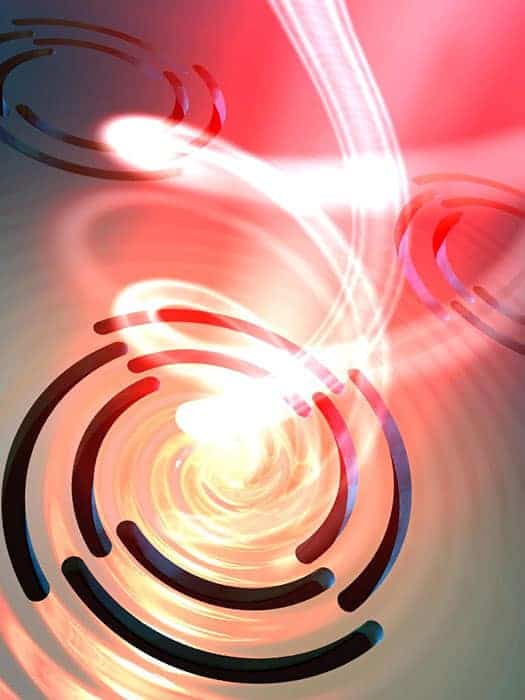
Artist's impression of light interacting with a gold surface

Plasmons in 10 different angular-momentum states have been created and characterized by physicists in Israel and Germany. Created by firing laser pulses at a specially designed gold surface, movies of the plasmons in motion were made with an electron microscope. The researchers believe their work could lead to the development of tiny devices that encode information in the angular momentum of the plasmons.

Plasmons, which are collective oscillations of electrons in metals that behave like quantum-mechanical particles, can be created by firing light at a metal target. They behave much like the photons that created them but have much shorter wavelengths and so could be used to create tiny “plasmonic” circuits that can process optical signals while taking up much less space than conventional optics.

Capacity boost

The new work builds on physicists’ ability to create beams of “twisted” light that carry orbital angular momentum. Information can be stored in the orbital angular momentum states of these beams and this has already been used to boost the capacity of prototype optical networks. What physicists at Technion and the Universities of Kaiserslautern, Duisburg-Essen and Stuttgart have now done is to come up with a way of creating “twisted plasmons” that could be used to boost the capacity of plasmonic circuits.

The plasmons were made by firing an ultrashort laser pulse – lasting just 13 fs – at a special target that is made from an atomically flat single crystal of gold. The team etched “Archimedes spirals” – with radii that are a linear function of the rotation angle – into the surface. These caused the excited electrons to swirl in one direction, creating plasmons with orbital angular momentum.

Motion pictures

The plasmons were characterized by firing a second laser pulse at the gold surface, which causes electrons to be ejected. These electrons were observed using an electron microscope, providing a snapshot of the collection motion of the electrons. The time evolution of the plasmons was traced out by varying the delay between the two laser pulses – allowing the team to make movies of the plasmons in motion.

Technion’s Grisha Spektor came up with the idea of varying the geometry of the Archimedes spirals, which resulted in the creation of plasmons in 10 different orbital angular momentum states.

As well as having the potential to increase how much information could be processed in plasmonic systems, the twisted plasmons could also prove useful for studying 2D systems such as topological insulators and ultrathin magnetics. Other applications could include the rotation of tiny particles in “plasmonic tweezers” and imaging on the nanometre scale.

The research is described in Science.

Chinese astronomers pin their hopes on LOT

By Michael Banks in Shanghai, China

It was a cold, rainy day here in Shanghai, so coming from the UK, I felt right at home.

Jumping into a Shanghai taxi to avoid the downpour, I headed to the Shanghai Astronomical Observatory, belonging to the Chinese Academy of Sciences, to meet astronomer Lei Hao.

(more…)

Flash Physics: STEM students’ teaching worries, bouncing rocks sculpt asteroid, gravity’s effect on photons

STEM students reveal misconceptions about teaching

Science, technology, engineering, and mathematics (STEM) students have misconceptions about teaching that may lead them to other careers. The American Physical Society (APS) surveyed nearly 8000 undergraduate and recent-graduate STEM majors. It found students underestimate the average annual salary of a US-based STEM teacher by nearly $17,000, believing it to be closer to $42,000 than the real figure of around $59,000. Students also thought that misbehaving pupils would be an aspect that teachers most dislike (rather than an unresponsive administration and non-teaching activities). The report says that both misconceptions could be reversed if STEM faculty members discuss teaching careers with students, including salary prospects and the positives and negatives of the job. “There appears to be a strong association between students expressing some interest in teaching and faculty who simply discuss it as a possibility, independent of whether they are favourable about it or not,” says contributor Michael Marder from the University of Texas at Austin in the US and executive director of UTeach. Other recommendations in the report include providing financial help to those pursuing teaching in STEM subjects and introducing support programmes to improve the community among STEM teachers. “[The survey] uncovered a lot of perceptions about teaching that we need to be very sensitive to at the undergraduate level,” says Rebecca Vieyra, K-12 programme manager at the American Association of Physics Teachers, who was not involved in the study. “We need to make sure that people see STEM teaching as a STEM career and not something that is outside of it or something that is below it.”

Bouncing rocks define asteroid’s surface

Telescope image of the asteroid Itokawa

The segregation of small and large rocks on the surface of the asteroid Itokawa can be explained by how particles strike the surface of the irregularly shaped object. Resembling a knobbly potato, Itokawa is just 540 m long. It has a surface that is demarcated by low-lying regions containing fine dust and small pebbles, and highlands that are dominated by large rocks as large as 40 m across. Now, Troy Shinbrot and colleagues at Rutgers University in the US and the Okinawa Institute of Technology in Japan have done computer simulations and experiments that suggest that this distinct landscape was created by differences in how different-sized particles behave when they strike the surface of the asteroid. The team looked at what happened to glass beads when they are dropped onto rocky surfaces. The work suggests that when a small particle strikes a large rock on the surface on an asteroid, it will bounce and then land on another region of the asteroid. However, if a small particle strikes a region that contains small rocks and dust, much of its kinetic energy will be absorbed and it will not bounce – but remain in that region. As a result, the regions of Itokawa that contain large rocks remain clear of smaller rocks, which tend to congregate in other regions. The work is described in Physical Review Letters.

Gravity’s effect on single photon could be measured

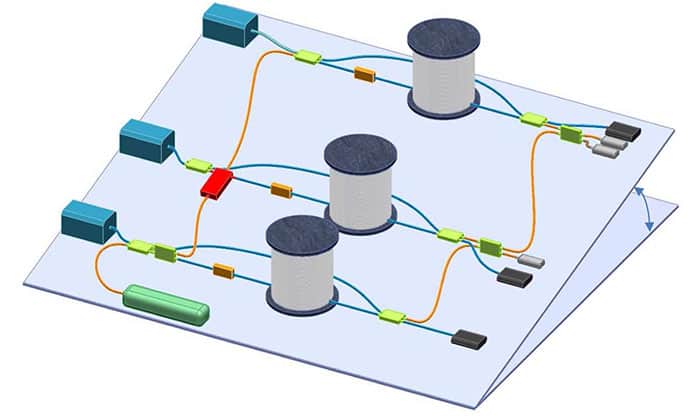
Diagram of the three-path Mach-Zehnder interferometer

A scheme to measure a gravitationally induced phase shift on a single photon has been proposed by physicists in Austria and the US. If built, the experiment would involve a variation on the conventional Mach–Zehnder interferometer (MZI), which splits light into two signals that take two different paths before being recombined at a detector. If a MZI is set-up so that the paths involve a change in elevation, light travelling along the paths would experience small changes in the Earth’s gravitational field. This results in a small shift in the relative phase of the light signals when they reach the detector. Unfortunately, a MZI that covers distances of several thousand kilometres would be required to see this phase shift. Now, Christopher Hilweg and colleagues at the University of Vienna and Massachusetts Institute of Technology have shown that it should be possible to see a phase shift in single photons using a variant of a MZI with three different paths. Instead of covering huge distances, each path would involve light travelling around a different spool containing about 100 km of optical fibre. Employing three paths allows the experiment to be operated in a time-varying mode that the team argues would reduce the influence of noise in the fibre on the measurement. By carefully shielding the interferometer from environmental noise such as thermal fluctuations – and by carefully aligning it to minimize the effects of Earth’s rotation – the team reckons it could measure a gravitationally induced phase shift on a single photon. The proposal is described in New Journal of Physics.


  • You can find all our daily Flash Physics posts in the website’s news section, as well as on Twitter and Facebook using #FlashPhysics. Tune in to physicsworld.com later today to read today’s extensive news story on twisted plasmons.

Physics World visits LIGO Livingston

By Tushna Commissariat and Sarah Tesh at LIGO Livingston, Louisiana, US

Being a journalist can be a busy and often stressful job, especially as deadlines loom fast and furious. But one of the best perks of the job is the chance to meet some amazing people and visit some of the best scientific facilities in the world. As most regualr readers of Physics World will know, we – Sarah and Tushna – have been in New Orleans, Lousiana for the APS March Meeting 2017. And it just so happens that about a two-hour drive away from New Orleans lies one half of one of the most advanced experiments in the world – the Laser Interferometer Gravitational-wave Observatory (LIGO) at Livingston.

(more…)

Google’s ‘supreme’ 20-qubit quantum computer

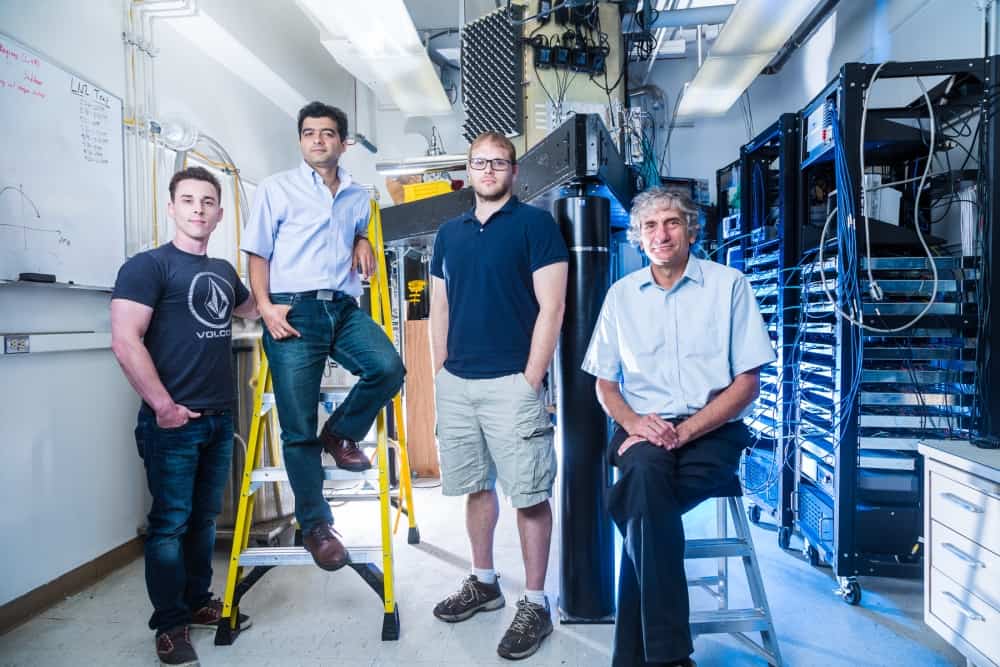
John Martinis (right) and some of his team.

By Tushna Commissariat in New Orleans, Louisiana, US

“We should have a 20-qubit chip ready very soon… in the next two months most likely,” says Google’s John Martinis to me as we lean against a wall in a relatively quiet corner of the sprawling convention centre in New Orleans. Martinis, a tall man with a mop of silver hair and an Alan Alda-esque manner, is very busy and I’m lucky to have caught him. Earlier that day, he gave one of the APS March Meeting‘s most popular talks on “quantum supremacy: checking a quantum computer with a classical supercomputer”. Martinis, whose team is based at the University of California Santa Barbara, spoke about how they are working towards developing a “scientifically and commercially useful quantum computer” made up of 50 qubits – a 7 by 7 array of superconducting qubits (each of which is coupled to its nearest neighbour) that can be programmed with a one or two-qubit gate – which has an error rate of about 0.1% and can actually do quantum computations.

(more…)

Physics reveals the mysteries behind art

Artists' secrets: Charles Falco describes how artists used lenses (Courtesy: Tushna Commissariat)

By Sarah Tesh in New Orleans, Louisiana, US

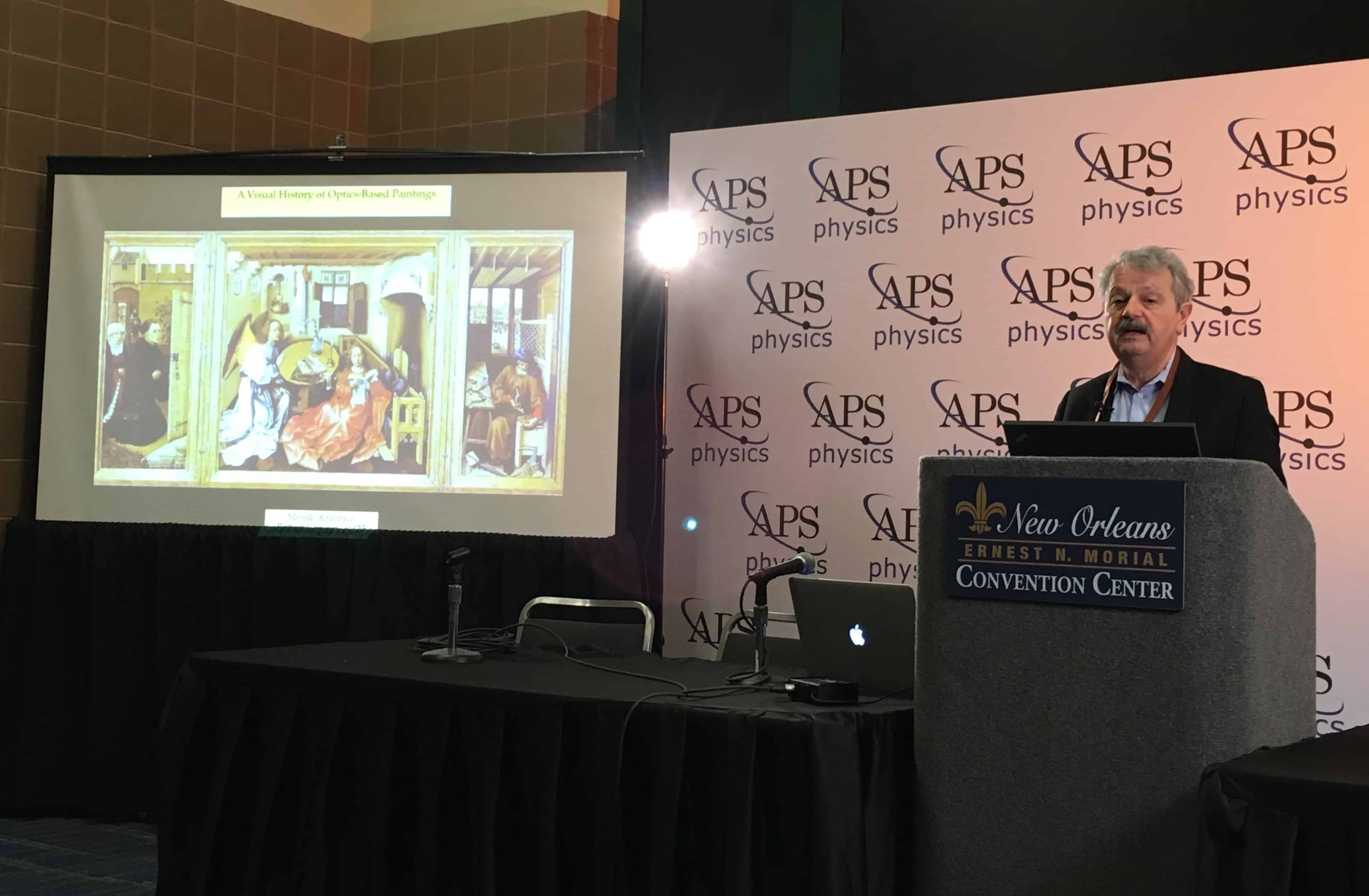
As a physicist who likes to sketch and paint, I love it when art and physics come together. I was therefore excited to see that the APS March Meeting had a variety of talks on the subject. Charles Falco from the University of Arizona in the US told us about his work with the famous artist David Hockney. On a trip to see the 15th century painting The Arnolfini Marriage by Jan van Eyck, Hockney decided that the chandelier was too detailed to have been done freehand. So Falco and Hockney began looking at the intricate parts of paintings by artists through the ages and found that they essentially cheated.

Through focal length and depth-of-field calculations, Falco showed that artists had used optical lenses to project the complicated parts onto the canvas before painting them. They suggest that this has been happening since the 1400s and is a technique used by artists such as Hans Holbein (who painted the iconic portraits of Henry VIII) and Johannes Vermeer (whose work includes Girl with a Pearl Earring). Obviously, they still possessed huge amounts of skill, but it definitely makes me feel a bit better about my own skill level.

(more…)

Copyright © 2026 by IOP Publishing Ltd and individual contributors