Flash Physics: Home computers find pulsars, 3D graphene could be stronger than steel, SESAME opens

Home computers help discover new pulsars

The Einstein@Home project has discovered 17 new gamma-ray pulsars within a sample of 118 unidentified pulsar-like sources. Tens of thousands of volunteers donated their idle computing time to help researchers analyse data from the Large Area Telescope (LAT) on board the Fermi spacecraft. Combined with newly improved search methods and Fermi-LAT data, an international team led by scientists at the Max Planck Institute for Gravitational Physics in Hannover has been able to identify 17 new pulsars. Pulsars result from extremely dense neutron stars that emit radio waves and gamma radiation because of their strong magnetic fields and fast rotation. When these beams point towards Earth as they rotate, they are seen as a pulse. However, detecting them is difficult and requires very fine resolution, years of data and huge amounts of computer power. The Einstein@Home project allowed the researchers to perform analysis within a year that would otherwise take more than a thousand years on a single computer. Thirteen of the new discoveries are presented in The Astrophysical Journal and the director of Einstein@Home, Bruce Allen, believes that many more could be pulsars in binary systems. Einstein@Home has also examined data related to gravitational waves and radio pulsars.

3D graphene could be stronger than steel

Researchers at the Massachusetts Institute of Technology (MIT) have proposed a new 3D graphene structure that if built could have 10 times the strength of steel with only 4.6% of the density. The team, led by Markus Buehler, has used bottom-up computational modelling and 3D-printed plastic models to investigate the mechanics of the proposed material and its unusual structure. Graphene is a 2D sheet of carbon atoms arranged hexagonally and is one of the strongest known materials. However, using it to create strong 3D structures is still a challenge. The MIT group did computer simulations from the atomic level to design the synthesis process, find the ideal structure and then understand its properties. The result was a 3D porous gyroid structure comprising compressed and fused graphene sheets. To help visualize the unusual structure, the team produced 3D-printed models and performed compression tests. The work is presented in Science Advances and the team says that if made, the 3D graphene could have many industrial applications.

SESAME synchrotron opens with first electron beam

Photograph of the SESAME synchrotron-light source

The SESAME synchrotron-light facility in Jordan has circulated its first electron beam. Operated jointly by Bahrain, Cyprus, Egypt, Iran, Israel, Jordan, Pakistan, the Palestinian Authority and Turkey, SESAME is the only third-generation synchrotron in the Middle East. It will use the electron beam to create high-quality beams of laser-like light for research in a wide range of fields, including physics, materials science, chemistry, biology and archaeology. “This is a very proud moment for the entire SESAME community,” says the Jordanian nuclear engineer Khaled Toukan, who is the director of SESAME. “SESAME is now opening for business.” Next, SESAME staff will ensure that beam can be stored in the synchrotron ring at an operating energy of 2.5 GeV. Then, the light emitted by the electrons will be channelled into two beamlines and used by SESAME’s first experiments this summer.

  • You can find all our daily Flash Physics posts in the website’s news section, as well as on Twitter and Facebook using #FlashPhysics. Tune in to physicsworld.com later today to read today’s extensive news story on an acoustic tractor beam.

Figuring out a handshake

In April 2008 I moved from the physics faculty at the Massachusetts Institute of Technology to a hedge fund in Manhattan with a box-seat view of the Great Recession. My 23rd-floor corner office near Times Square offered a full view of Lehman Brothers’ headquarters a few blocks away. The investment bank Bear Stearns had imploded a month before I arrived. Lehman Brothers collapsed in the cityscape through the window behind my monitor. A former treasury secretary occupied the office adjacent to mine. I had left the arcane world of particle physics for a world-class education on incentives in finance.

Throughout the financial sector, people get paid to take bets with other peoples’ money. Such gamblers stand to make a lot if they are right. But they stand to lose comparatively little if they are wrong. And investors lack the information needed to properly police those gambling on their behalf. This is all you need to know to confidently predict an unending series of financial crises that will call into question wealth you mistakenly think you have. Such a system inevitably self-organizes into a common bet. (Large markets in which nearly everyone is naturally on the same side – such as stock and real-estate markets – are particularly convenient for this purpose.) The common bet allows the gamblers to cash in for a few years, and provides them with herd protection when things fall apart.

Heads win big …

Halting financial crises therefore requires the elimination of such “heads win big, tails lose little” incentives. Any other purported fix is a joke. Regulation can push the problem around, but it cannot possibly fix an incentive system with such a deep structural flaw. The person managing your money gets paid well if they turn out to be right; they do not lose much if they eventually turn out to be wrong; and in the meantime that person collects a salary. Even if they know nothing, such a person has an incentive to place bets, an incentive to convince you they know something, and an incentive to genuinely convince themselves they know something. The last of these provides useful protection against any future charges of fraud.

How does any of this relate to science? Well, academics are incentivized to publish papers. The rewards are clear and present: publications and citations lead to grants, promotions and scholarly accolades. Penalties for being wrong are often comparatively fuzzy and distant. The scientist reaps rewards if they turn out to be right; they often do not lose much if they eventually turn out to be wrong; and in the meantime that person collects a salary. Even if they know nothing, such a person has an incentive to publish papers, an incentive to convince you they know something, and an incentive to genuinely convince themselves they know something. The last of these provides useful protection against any future charges of fraud.

This is all you need to know to confidently predict an ongoing replication crisis in academic science that calls into question “wealth” you mistakenly think you have: useful, accurate knowledge about how nature works. Halting the crisis requires a fundamental change to the underlying incentive. Any other purported fix is a joke. Regulation – in the form of peer review, transparency requirements and so on – can push the problem around, but it cannot possibly fix an incentive system with such a deep structural flaw.

This is uncomfortable to acknowledge. Most of us strongly prefer to assume people do the right thing, whatever their incentives. We prefer to think incentives do not matter, or at least do not matter much. In the financial sector, someone will eventually develop a compelling alternative to “heads win big, tails lose little” incentives. I do not know what that alternative will be, but it will probably be simple. It will involve material loss for those who turn out to be wrong. It will provide a welcome alternative for those of us who prefer to invest with people subject to carrots and sticks aligned with our interests.

Why do scientists not simply sell what they learn from their research?

In the case of science, the appropriate alternative occurred to me a couple of years ago, as I found myself wondering why scientists do not simply sell what they learn from their research. Selling information is tricky. If academic A wants to sell information to quant Q, A needs to convince Q that the information is useful (to Q) and accurate before revealing the information. This is usually hard to do, which is why scientists do not sell what they learn. It is not for lack of desire or potential customers – these are consequences, not causes. Instead, it is because there is no mechanism for doing so.

An overcomplicated system has expanded in the resulting vacuum: dissemination through journals; quality control through peer review; funding by taxpayers rather than directly by consumers; assessment of value by citation counts. This system cumbersomely and ineffectively compensates for an extraordinary historical oversight: nobody, apparently, had ever bothered to figure out some sort of handshake allowing A to sell information to Q.

After figuring out the necessary handshake, I built Kn-X (pronounced like the word “connects”), an online knowledge exchange through which A can finally sell information to Q. Kn-X is simple. It involves material loss for those who turn out to be wrong. It provides a welcome alternative for those of us who prefer to base important decisions on information from people subject to carrots and sticks aligned with our interests. It might even address a crisis or two. www.kn-x.com

Flash Physics: Gold theory and experiment reunited, fish in space, Brexit implications for universities

Theory and experiment reunited in gold

When it comes to the electronic properties of gold, there has been a long-standing discrepancy between theoretical predictions and observation. Now, an international team, led by Peter Schwerdtfeger at Massey University, New Zealand, has made significant progress in uniting the two by calculating the interactions between an unusually high number of electrons in gold atoms. Typically, properties such as ionization energy and electron affinity are predicted by accounting for interactions between three electrons. However, the electrons of heavy atoms exhibit relativistic properties. For gold, this causes the gap between outer electron orbitals to be smaller than expected. The result is inaccurate predictions. Schwerdtfeger’s team extended the calculations to take into account interactions between five electrons. Therefore their model more precisely accounts for electron correlation contributions as well as relativistic effects and quantum electrodynamics. They achieved a ten-fold improvement in the accuracy of their ionization energy and electron affinity calculations, as described in Physical Review Letters. The research could lead to a more thorough understanding of heavy element electronic properties can be now achieved.

Fish in space help us understand microgravity effects

Researchers have sent fish to the International Space Station (ISS). A team from the Tokyo Institute of Technology monitored the transgenic medaka fish via a video link in an attempt to understand the detrimental effects of microgravity on the body. Astronauts who have spent time in a reduced gravity environment experience a large reduction in bone mineral density, yet the molecular processes involved are not fully understood. Therefore, the group led by Akira Kudo sent chambers containing hatching fish larvae to ISS, where they were placed under a fluorescence microscope. Over eight days, the signals from cells that form and degrade bone (osteoblasts and osteoclasts) where constantly measured and compared to a control group on the ground. The findings, described in greater detail on medicalphysicsweb, suggested exposure to microgravity immediately altered bone structure and triggered bone loss. The experiment could help assess the health effects of long-term human space travel.

Brexit costs for UK universities outlined in report on international students

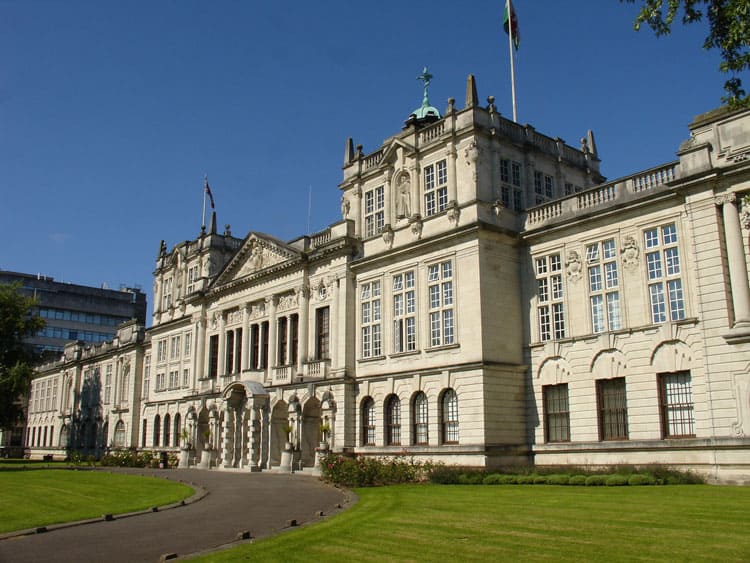
Photograph of the Main Building at Cardiff University

If the UK government requires students from the European Union (EU) to pay the same tuition fees as non-EU students after the country leaves the EU, then university enrolments from the continent could fall by over 31,000 – a 57% decline. So says a report by the Higher Education Policy Institute think tank and Kaplan International – a firm that teaches English to international students. EU students currently pay the same fees as their UK counterparts – up to £9250 per year – while students from outside the EU pay international rates, which can be as much as £35,000 per year depending on the course. The report finds that the decline in EU students would result in a loss of £40m to universities. The study also looked at the impact of a 10% decline in the value of the pound and found that this could increase the number of students studying in the UK from outside the EU by around 20,000 – an increase of 9% – in the first year alone, which would be worth over £227m in fee income. Yet, the report warns that if the UK government makes it harder for international students to study in the UK then it would not offset the loss from EU students and could cost the UK economy £2bn a year.

This time it’s different

On 20 January 2017 a man will be sworn in as president of the US who is on record, via Twitter, as having declared that global warming is “bullshit” and a “hoax”, and that vaccines cause autism.

On the surface, such pronouncements may not sound like special cause for alarm. After all, US presidents and presidential candidates before Donald Trump, from all political parties and persuasions, have downplayed or ignored scientific findings and their relevance for political action. George W Bush, for instance, hemmed and hawed evasively for two terms on whether the science of global warming was strong enough to warrant changes in US energy policy, and the issue clearly embarrassed him.

This time, however, things are different. First, Donald Trump’s dismissal of science is not evasive or sheepish but confident and proud. Second, his brazen dismissal of authority was an important part of his appeal to voters, who supported him over a candidate – Hillary Clinton – who said “I believe in science.”

I know I recently wrote about science and US politics and some readers might wonder why I’m bringing the topic up again. But what just happened is so far from business as usual – with such a huge potential impact on US science – that it would be irresponsible for anyone concerned with the state of science not to probe the implications.

Over the years, the US and other nations have assembled a huge research infra­structure that has made great contributions to human life, from providing an understanding of the origin and structure of the universe to increasing health standards and reducing air pollution. Still greater challenges lie ahead, such as finding ways to keep epidemics and climate change under control.

Never before has it been so urgent to incorporate the findings of this research infrastructure into policy decisions, nor so costly and dangerous to ignore such findings. Yet the soon-to-be US president is forthright about the fact that he does not care about those findings, at least regarding climate change. And his election shows that a large fraction of the US electorate does not care either.

It is true that, aside from his remarks on climate change, Trump has said little about science. But there is every reason to think he will be as prone to lies and distortions there as on such things as crime, immigration, Obama’s citizenship and Trump’s own election. There is also every reason to think that the electorate will continue to ignore his failure to take informed positions about climate change and other vital matters.

The 2016 US presidential election thus reveals that the traditional model of the authority of science is defunct. What was that model, why did it break down, what are the dangers and what can be done?

The traditional model

When I talk about “authority”, I don’t mean anything to do with authoritarianism, but simply the ability to have people voluntarily comply with a command or respond to the implications of an outcome. Authority comes in several kinds. A mentor, for instance, has authority because we accept that senior, experienced people have better knowledge. Similarly, the authority of a clerk in a motor-vehicle office comes from us accepting the legitimacy of the bureaucracy for which that person works.

The traditional model of the authority of science pictures it as having yet another source: the assumption that scientists are reliable guides to the world’s inner structure. Confidence that the world has an inner structure used to be anchored in religion and the belief that the world was God’s creation. The thrilling discovery at the dawn of modern science in the 16th and 17th centuries was that the contours of this inner structure did not have to remain mysterious to God’s creatures, but could be explored and, at least partly, understood. Governments supported scientists, their procedures and instruments, as it was assumed that many tasks of governing ultimately had to adapt to this inner structure.

When science fails to be authoritative, in this traditional model, one of three things is happening: the scientists are not communicating well; their message is not understood; or some other value is involved. A government may, for example, decide to ignore a report that genetically modified grain is safe because the report is unclear or over their heads – or because of metaphysical objections to transforming life forms or economic concerns about the impact.

Breakdown

The US has a solid scientific infrastructure and its spokespeople have communicated the dire implications of things like heightened global temperatures, rising sea levels and the perils of disease well. Trump and his followers are surely literate enough to understand this. When they dismiss scientific findings as a “hoax” and “bullshit”, they are not mishearing or poorly understanding the findings, nor seeing them as disconnected from social goals. Rather, they are straightforwardly rejecting them as interfering with social goals.

Such people may not be a majority of US voters, but they now hold the reins of power. The person they elected can sow the seeds for a world where more people than ever will distrust science, and expertise in general. In this world, people will feel empowered, for instance, to take as authoritative meteorologists who report the average temperature outside, but to reject meteorologists who report the average temperature outside all over the globe. They will feel free to reject evolutionary biology as a science, but free to accept medicines whose development depended on it.

Causes

The reason for the collapse of the traditional model of scientific authority has to do, I think, with US politicians exploiting a sense – among frustrated Americans – that the fruits of science are mainly serving wealthy corporations and special elites. Many of Trump’s statements are coded references to this sense. This can make scientific findings vulnerable to appearing to be just the opinion of one elite interest group. Several factors add to this vulnerability.

One is that the public never deals directly with scientific findings, but only as retailed – collected, reported and otherwise mediated by academies and publications. Such institutions are never neutral, and can be tainted by their own agendas or the agendas of those who support them. Daniel Sarewitz, a professor of science and society at Arizona State University, cites this as a major reason for the declining authority of what he calls “the scientific enterprise” (The New Atlantis 49 4). Trump and his followers have indeed accused climate-change researchers of such taint.

A second reason is that the abstract character of the scientific process and its results can make it seem an insular enterprise, remote and disconnected from everyday concerns. This seems to be what enables politicians, including Mitch McConnell, the Republican leader in the US Senate, to dodge incorporating scientific findings into their policy decisions by invoking the phrase “I am not a scientist.”

A third factor is that the very success of modern science and technology promotes a kind of magical thinking, encouraging people to believe they don’t need to make painful trade-offs in decisions about energy, nutrition and environmental conditions. Findings that suggest such trade-offs are necessary may make people feel like science is trying to take things away from them – imposing “job-killing restrictions” as Trump put it in the case of climate change.

Finally, the scientific infrastructure tends to withdraw from public view. As I’ve reported before, a US congressman once remarked, “Why do we need Landsat satellites when we have Google Earth?” The public can use products of science without seeing the processes that made them possible, making those processes appear superfluous.

Dangers

I know many people will think nothing needs to be done. Some will assume that the consequences will be minor, sure that Trump will backtrack and never do anything as unhinged as his insincere public commitments imply. Others will advocate doing nothing for fear of insulting and alienating the people to whom Trump appeals. Still others will be content to wait for the next election, regarding the traditional model of scientific authority as a natural thing that will shortly reassert itself, like a sturdy self-righting boat momentarily knocked over by a rogue wave.

But this time it is different. Yes, the traditional model of scientific authority and expertise is not entirely eroded; people will still consult engineers and go to doctors, and some science will thrive. Yet even if Trump pragmatically reverses his more incendiary promises, as he is sure to do, the transformation of scientific findings into opinions that can be set against other opinions with apparent equality will have done long-term damage to science policy. With Tweets now the argumentative coin of the realm in Trump’s world, the atmosphere in which science has to promote itself is corrupt. I see several dangers.

One involves what gets federal funding. What will look attractive is science relevant to the battlefield, marketplace or national symbolism (such as NASA creating manned space missions to Mars rather than climate-monitoring satellites). What will suffer is “unsexy” fundamental research and anything relevant to political issues, such as climate change, studies of gun violence, or other instances of what Trump has labelled “politicized science”. But this, of course, is the science we need most.

Another involves cultural repercussions. As veteran TV news anchor Dan Rather put it in a blog for Scientific American, “Science bolsters our global stature by its institutionalized respect for the truth, its evidence-based decision making, and its willingness to accept differing opinions when the facts dictate them.” I would even say that the right of free speech is worthless in the absence of evidence-based facts.

The critical point

I regret having to write again about science and US politics, but I don’t apologize. An atmosphere that’s bad for US science is bad for science everywhere. Like climate change itself, the collapse of the traditional model of science authority has human causes, and only humans can do something about it.

The standard fixes – improving science communication and bolstering scientific literacy – will no longer be effective. Nor will it help to champion science as a “cause”. This turns science into something that calls for allegiance rather than respects it as a process that helps illuminate problems and possible solutions. If you have to start worshipping your guides, you’re in trouble.

Instead, attempts to restore the authority of science will have to begin by abandoning the traditional model. They will require finding ways to discourage lazy and ideological thinking, to curb the human appetite for fake assertions, and to entice citizens to look past private interests and to regain an appreciation for the natural world – to counter, in short, the very things that Trump rode to the presidency.

“Science critics”, as I called them in my first column back in 2000, who constantly challenge inauthenticity, ridicule pretence and expose those who speak in code, will be needed. We must find new ways to do this work and to explain why we can’t rely on ideologies to cope with nature. We will also have to create new methods to exhibit the infrastructure of science and its effects.

Just as the current erosion of a sense of common humanity makes it more important to highlight why racism, sexism and xenophobia are so dangerous, so the collapse of the traditional model of scientific authority makes urgent the need for a greater appreciation for a sense of a common natural world, and how scientists study it.

What’s required, in short, is greater public exposure of the foundations of science. That’s how different it is this time.


Cuckoo forgeries – a bird’s-eye view

Why does your friend accessorize bright-purple curtains with a neon-pink carpet and lime-green cushions? Why did your partner misunderstand when you told them your plans for the evening and why that meant they should do the washing up? And who could possibly not like Marmite? It can be difficult to see another person’s point of view. Imagine how much harder it is to get inside the mind of an animal that sees, hears and smells differently from you and may even sense things – like electric or magnetic fields – that you can’t. Yet that’s what scientists researching animal behaviour must do. Fortunately they have sophisticated physics-based measuring kit and computer models to help.

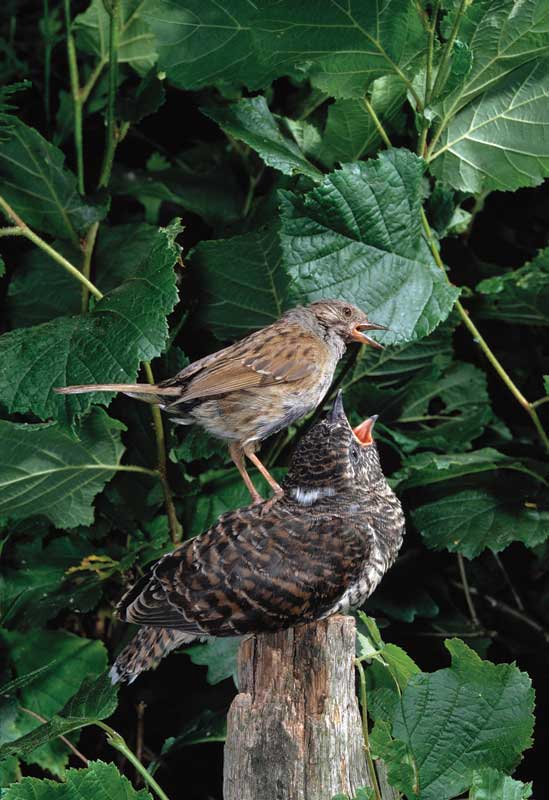
This approach has solved at least one mystery in the bird world, concerning the common cuckoo. Cuckoos are known for their devious ways. Rather than looking after a clutch of eggs themselves, female cuckoos lay a series of individual eggs in the nests of other birds. Sometimes the involuntary host spots the forgery and ejects the imposter. But the foster parent may well incubate the cuckoo egg along with its own. And when the cuckoo chick hatches it will turf out the host’s eggs or chicks, becoming the sole resident of the nest and receiving all the food the host brings.

When a cuckoo lays an egg in the nest of a brambling (a member of the finch family), that egg matches the – to human eyes – creamy grey-blue colour and large brown spots of the brambling’s own eggs. But races of cuckoo that prefer to invade dunnock nests lay cream eggs speckled with light brown. In our view, these cuckoo eggs are nothing like the dunnock’s own pale-blue eggs already in the nest, yet the dunnock foster parents hardly ever reject these cuckoo forgeries. What is going on? Do the dunnocks – brownish birds about the size of a sparrow – not see the difference that’s so clear to us? Or do they have some other reason for not shoving the intruder egg out of their nest?

Photograph of an adult dunnock bird feeding a cuckoo chick

“Sometimes [the cuckoo eggs] look very impressive to us but we don’t know how impressive they look to a bird’s eye,” says bird-vision expert Martin Stevens of the University of Exeter in the UK. According to Stevens, our misguided assumption that birds see like humans has held up our understanding of their biology. Instead of using their own senses, vision researchers must turn to technology to get the full picture. “There’s a whole part of their [birds’] world that we miss out on,” says Stevens. “You need a lot of specialist equipment to understand what sort of visual information is available to a bird. It makes it more interesting and more challenging.”

Avian eyes don’t work like ours. We have three types of the photoreceptors known as cone cells that lie in the light-sensitive retina at the back of our eyeballs. Each type contains a pigment that responds to a particular chunk of the visible light spectrum; together they span wavelengths from about 400 nm (violet) to 700 nm (red). Birds go one better. They have cones mostly sensitive to red, green or blue light as we do but also – depending on the species – a cone that responds either to ultraviolet (UV) light, which lies below 400 nm, or to violet light and a little UV light. They’re tetrachromatic to our trichromatic.

Many other animals, including some species of insect, reptile, amphibian and fish, also perceive UV light. Some humans may be tetrachromats too, and able to see more colours than the rest of us. But it’s not clear how these lucky individuals’ extra cones are wired up. Generally, human cones can detect a little UV but they’re not very sensitive. What’s more, the lenses in our eyes block most UV light from reaching our retinas, which means we miss out on a multitude of flower patterns and animal markings that are out of our league. The latest thinking is that we lost our ability to see UV light when our eyes evolved to work better in the dark.

Colouring in

Enough about us. What’s going on with the apparently unobservant dunnock? What does it see when it looks at its nest after a broody cuckoo’s paid a visit? To find out, in 2011 Stevens and colleague Mary Caswell Stoddard, who now studies bird colouration at Princeton University in the US, modelled the vision of this bird and 10 other species that are unwitting hosts to cuckoo chicks.

The pair examined eggs from 248 clutches that each contained one imposter laid by a member of one of the common cuckoo host-races (each race specializes in a target host species). The eggs, taken from the Natural History Museum’s collection in Tring in Hertfordshire, UK, were mainly collected between 1880 and 1910 (it’s now illegal in the UK to take eggs from the wild). Using a spectrophotometer, the researchers illuminated each egg with light spanning 300–700 nm at 1 nm intervals to build up a spectrum of the reflected light. For each egg, they measured the egg’s background colour and a colour spot (if there were any) at the top, middle and bottom of the shell.

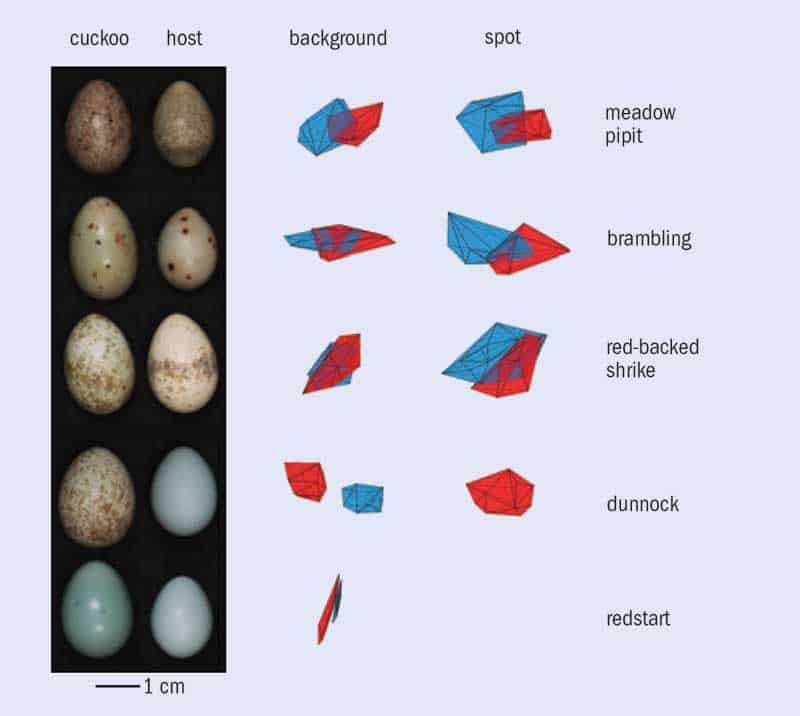
Comparison of cuckoo eggs with host eggs in a nest, with their background and spot-colour distributions in avian tetrahedral colour space

These reflectance spectra showed which wavelengths hit the foster-parent birds’ eyeballs. So far, so good – these wavelengths enter our eyes too and give us our own view of the egg’s colour. But this isn’t the full picture. What the bird sees depends on the sensitivity of its cones and of its rods (which work well for dim light but don’t see colour) to different wavelengths of light. And that sensitivity is different from ours. The researchers needed a bird’s-eye view of the wavelengths their spectrophotometer had recorded.

Unfortunately, biologists do not yet fully understand the visual system of the dunnock. The researchers therefore assumed that the foster-parent birds have the same sensitivity to different colours as the blue tit – one of a handful of well-studied species that can serve as a proxy. Other vision scientists have measured the sensitivity of the blue tit’s cone cells by shining narrow beams of light onto the visual pigment inside the cells and monitoring how much reflects back. “From doing that and related things, you can calculate how much light each type of photoreceptor absorbs in terms of different wavelengths,” Stevens says, adding that modern genetic techniques can also reveal the sensitivity of the cone cells by showing which pigment proteins are inside.

Then it was time to get mathematical. Knowing which wavelengths bounce off the egg onto a bird’s retina, which types of cone it has, and how sensitive they are to different colours, Stoddard and Stevens modelled what the bird sees. They represented its picture of what each egg looks like with a 3D shape inside “avian tetrahedral colour space” (figure 1). Mapping colours in such a space takes us – according to Stoddard – “one step closer to understanding the rich visual world birds experience, which includes the UV dimension”.

Bounded by a tetrahedron, each corner of this space represents the colour to which one of the bird’s four types of cones is most sensitive. A point completely in the middle of the tetrahedron would stimulate all four cones equally and appear grey or white, while a point at, say, the red corner would only stimulate the red cones and would look red.

The key to this experiment is that if the colour shape representing the bird’s view of its own egg overlaps in avian colour space with the shape representing its picture of a cuckoo egg, it’s likely that the bird can’t easily tell the difference. “Our findings reveal new information about egg mimicry that would be impossible to derive by the human eye,” write Stoddard and Stevens in a 2011 paper in Evolution (65 2004). The bird commonly known as the redstart, for example, has blue eggs, and the cuckoo version looks similar to a human but not to a redstart. In avian colour space, the shapes representing the eggs do not intersect, instead lying right next to each other.

Mimicry mystery

Even allowing for bird vision, Stoddard and Stevens found that cuckoos were doing a much better job of colour-matching the eggs of some host birds than others. The background colour of cuckoo eggs in brambling nests, for example, overlapped in avian colour space with that of brambling eggs by 30%. For the dunnock, the shapes for the background colour of a dunnock egg and a cuckoo egg laid in a dunnock’s nest did not intersect at all and there was a fair amount of space between them, suggesting a total lack of colour mimicry on the part of the cuckoo. In other words, the cuckoo and dunnock eggs produce totally different patterns of photoreceptor stimulation in a dunnock foster parent’s eye – so the bird should definitely be able to spot the forgery and do something about it.

The result showed that the dunnock sees what’s in front of its beak but it doesn’t take any action. Why, wondered Stoddard and Stevens, doesn’t the bird heave the fake out of the nest, saving its own offspring from an untimely end once the cuckoo chick hatches and does away with the dunnock’s eggs or chicks?

Stevens and Stoddard weren’t able to answer this question immediately but they did spot a trend in their colour-space results that helped solve the puzzle: foster parents from species that reject more cuckoo eggs tend to encounter fake eggs that look more like their own. So cuckoo races that choose these picky host parents have upped their game in this evolutionary arms race and now produce eggs highly similar to those already in the nest to avoid their trickery being detected. If the foster parent is less proactive, on the other hand, the cuckoo race that lays eggs in that species’ nests makes less effort.

“Cuckoos have an egg closer in both colour and pattern to the hosts when the host is more likely to reject,” says Stevens. “The dunnock, one of the most common hosts for the cuckoo, almost never rejects eggs and the cuckoo’s egg looks nothing like a dunnock’s.”

The redstart, whose own eggs and the cuckoo versions lay next to each other in avian colour space, rejects about 30% of imposters. The moderately picky meadow pipit, rejecting 18–48% of cuckoo eggs, shares about 15% colour space overlap with its cuckoo eggs. Eggs of the fusspot brambling, on the other hand, which rejects 90% of cuckoo eggs, have about 30% colour-space overlap. Meanwhile, cuckoo eggs laid in the nest of red-backed shrikes – a bird so fussy that it rejects almost all artificial cuckoo eggs – have the best background colour match of all, with a colour overlap of nearly 60%.

“It’s an exciting time because these vision models have really changed the way people think about brood parasites, and helped us to understand the information birds are using to make decisions when rejecting eggs,” Stevens says.

Fake it till you make it

It could be that the dunnock is only just out of the starting gates of the evolutionary arms race and hasn’t yet had time to work out what’s going on. (It’s tempting here to shoehorn in that old maxim: which came first, the cuckoo or the egg?) “Another species perhaps won the arms race and became so good at spotting foreign eggs that the cuckoo was forced to switch and find a new victim,” Stevens says. And the cuckoo picked the dunnock. But because this bird is so poor at spotting fakes, there’s no incentive for these cuckoos to get better at disguising their eggs. The brambling and its cuckoo, on the other hand, may have been battling for much longer, with the brambling upping its fussiness in defence of its own young and the cuckoo improving its pattern and colour matching in retaliation, over and over again.

Although this research has provided insights into the cuckoo egg-colour-faking mystery, others are yet to be resolved. Even if an egg forgery is a good colour match, why do foster parents seemingly fail to notice that it is larger and a different shape from their own? Perhaps it’s extra risky to reject a particularly big egg as it contains even more resources that might belong to the parent. But biologists don’t really know. When it comes to eggs, they’ve still got a lot on their plate.

Polarized vision

Photograph of Sahara Desert ants, which use polarized light to find their way home

How birds see is not the only vision puzzle in the natural world that’s been held back by our assumption that animals see the way humans do. One of the biggest challenges in biology is to understand more about many animals’ uncanny ability to perceive polarized light differently from how they see non-polarized light. Light from the Sun streams across space in entirely unpolarized form, but polarizes when it scatters off air molecules or larger particles, such as dust or smoke, in the atmosphere.

Even the humble ant does a much better job at detecting this polarization than our feeble efforts. When it comes to finding food, many species of ant use their antennae to track trails of pheromones – chemicals laid by other ants – to get from their nest to a food source and back. Out in the deserts of North Africa, however, where food is scarce, the pheromone trails fizzle out fast in the heat. Some species of desert ant therefore use the position of the Sun – along with sunlight that’s become polarized as it scatters in the atmosphere – to calculate in which direction they’ve been travelling. While their outward journey looks like a ragged ball of string, they take a straight bee-line back home, indicating they know exactly which direction to go.

Experiments in the late 1940s by the future Nobel-prize-winning zoologist Karl von Frisch revealed that bees also use polarized light to work out directions. By placing bees in a dark hive and letting them see just a small patch of Sun-free sky, von Frisch showed that polarized light holds the key to the strange “waggle dance” that bees perform on a honeycomb to tell their hive mates the direction and distance to a food source.

We now know that flies and beetles detect polarized light too, as do other insects, spiders and a heap of aquatic animals from octopus and cuttlefish to mantis shrimp. For animals, polarized light is a vital tool for everything from navigating their world to spotting predators, camouflaging themselves and communicating. It’s just a pity we can’t see what they can.

Ultra-low-cost, hand-powered centrifuge is inspired by whirligig toy

A human-powered centrifuge made of paper can generate centrifugal forces of 30,000 g and separate blood into its component parts in less than two minutes. Created by a team of biophysicists and bioengineers at Stanford University in the US, the “paperfuge” costs just $0.20 and is inspired by an ancient whirligig toy. The researchers say the device could be used for disease diagnostics in remote locations, where standard centrifuges are impractical.

Centrifuges spin tubes of biological fluids such as blood and urine at extremely high speeds. This is done to separate them into their individual components or concentrate parasites and pathogens, to enable further analysis, and is vital for diagnosing many diseases. “Centrifugation is at the heart of many diagnostics labs, and is used in many sample-preparation techniques in biology,” says Manu Prakash, whose lab at Stanford focuses on frugal science.

Commercial centrifuges are expensive and heavy, and require electricity. This makes them impractical in rural regions of the developing world where resources are limited. This has hindered the development of point-of-care diagnostics for key global health issues, such as malaria, HIV and tuberculosis, in the communities where they are most needed. Human-powered centrifuges have been developed from household items such as eggbeaters and salad spinners, but the centrifugal forces generated by these devices are low compared with laboratory centrifuges.

To address this issue, Prakash and colleagues thought about adapting spinning toys, such as yo-yos and spinning tops. When they looked a whirligigs – circular discs spun by pulling on strings passing through their centre – they realised they were rotating at speeds of up to 15,000 rpm.

Astonishing speed

To use a whirligig, you rhythmically pull on each end of a loop of string that passes through two holes in the centre of a disc. As the string coils and uncoils around itself, the disc spins at an astonishing speed. Variations of this simple toy have been found at archaeological sites all over the world, with some dating back to the Early Bronze Age, around 3300 BC.

Although whirligigs are ubiquitous, few people have studied their fundamental physics. The researchers created theoretical models of whirligigs so they could study key parameters, such as string radius and length, disc radius and the position of the holes, to optimize both the rotational speed and centrifugal force.

There is a significant need for centrifuges in low-resource settings
Rebecca Richards-Kortum, Rice University

The resulting device consists of two 10 cm-diameter discs of stiff waterproof paper, each with two 3 mm-diameter holes, spaced 2.5 mm apart, in the centre. The string is threaded through the holes and each end is tied around a wooden handle. One of the discs has two pieces of drinking straw, each sealed with glue at one end, glued to it to hold small tubes containing the biological fluids. Finally, the paper discs are held together with Velcro.

“Under a tree”

“This device is primarily designed to operate in field conditions, literally under a tree, places that lack traditional infrastructure such as roads or electricity,” Prakash told Physics World.

A high-speed camera showed that the human-powered centrifuge could reach rotational speeds of 125,000 rpm, generating centrifugal forces of 30,000 g. This is faster than many commercial centrifuges, yet the device costs just a fraction of a dollar to make.

In tests, the paperfuge could separate plasma from blood samples in 1.5 minutes, a task that took two minutes with a $700 commercial centrifuge. And it is capable of isolating malaria parasites from 30 μl of blood in 15 minutes, with comparable results to the commercial centrifuge, demonstrating that it could be used for infectious-disease diagnostics.

“A standard whirligig does not achieve the kind of specifications that we demonstrate in this paper,” Prakash told Physics World. “It’s only by truly understanding the physics of this old toy that we are able to achieve the level of functionality that can enable separation of samples to such an extent.”

Rebecca Richards-Kortum, a bioengineer and expert in health technology for low-resource settings at Rice University in the US, told Physics World that “there is a significant need for centrifuges in low-resource settings.”

Challenges remain

“The paperfuge is an important step forward, but I think challenges remain to successfully integrate it into the clinical workflow of more complex assays,” she says. “Many other diagnostics require safe transfer of plasma from the capillary tube to a paper or plastic device for subsequent analysis and it is not yet clear how to do this. Assay designers need to consider how to ensure that users correctly operate the device – will operators reliably spin all blood samples for the full 1.5 minutes?” She adds that “further considerations are needed to ensure user safety during the high-speed rotation of potentially infectious fluids.”

Prakash and colleagues are currently testing the paperfuge in rural Madagascar, to see if it can be used for malaria diagnostics. They describe their findings in Nature Biomedical Engineering.

Flash Physics: SpaceX resumes space flights, Xenocs buys SAXSLAB, SNOLAB bags C$26m

SpaceX to resume space flights

The US Federal Aviation Administration has cleared the aerospace company SpaceX to resume space flights following an explosion of one of its Falcon 9 rockets on 1 September. The accident, which happened just before launch during a pre-launch “static fire test”, also destroyed a $200m Israeli communications satellite. SpaceX now aims to launch a rocket carrying an Iridium Communications satellite – the firm’s first launch since August. That was due to happen yesterday, but was postponed until 14 January at the earliest by the firm due to bad weather. SpaceX is reported to have a backlog of more than 70 missions for NASA and commercial customers.

Xenocs buys X-ray-scattering specialist SAXSLAB

Photograph of Xenocs chief executive officer Peter Hoghoj

Xenocs, a nanomaterials analysis company based in France, has bought SAXSLAB, which produces X-ray-scattering equipment. Both companies specialize in small- and wide-angle X-ray-scattering equipment. Peter Høghøj, chief executive of Xenocs, said that the acquisition will “strengthen our [Xenocs] ability to provide innovative solutions”. SAXSLAB was founded in 2004 and has bases in both Denmark and the US, thereby broadening Xenocs’ global presence. SAXSLAB founder Karsten Joensen and former director Søren Skou will manage Xenocs’ US and Denmark offices, respectively. Meanwhile, Scott Barton will become responsible for sales in North America as SAXLAB transfers its business from US-distributor Molmex Scientific to the Xenocs’ US office. The acquisition involved Xenocs buying 100% of SAXSLAB shares in an all-cash transaction.

SNOLAB bags C$26m in operational funding

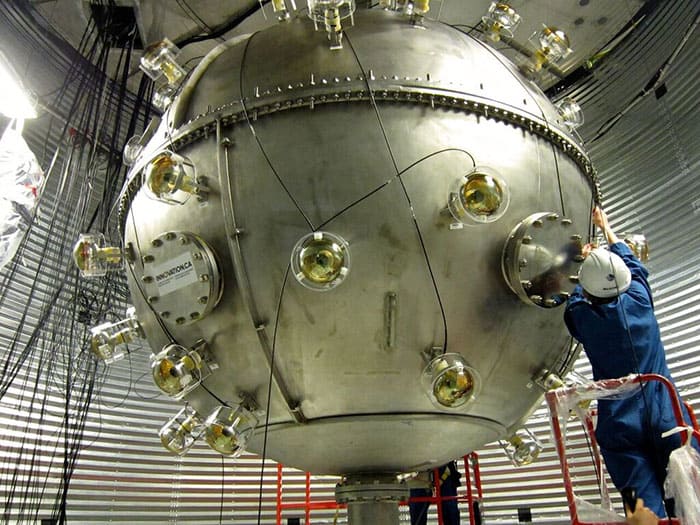
Photograph of SNOLAB's DEAP-3600 dark-matter detector

The SNOLAB underground physics laboratory has secured a C$26m infrastructure grant from the Canada Foundation for Innovation (CFI). Located 2 km below the ground in a working nickel mine in Sudbury, Ontario, SNOLAB is home to seven physics experiments including the DEAP-3600 dark-matter detector and the SNO+ neutrino detector. According to Nigel Smith, director of SNOLAB, the money will partially fund the operation of the lab for the next three years – including the salaries of 96 staff and supporting the operations and maintenance of the facility. The rest of the cost will be borne by the Province of Ontario and Vale, which operates the nickel mine. Completed in 2011, SNOLAB is an expansion of the Sudbury Neutrino Observatory (SNO), which in the early 2000s made crucial measurements leading to the confirmation of neutrino oscillations. This breakthrough led to SNO’s then director Art McDonald sharing the 2015 Nobel Prize for Physics. The CFI is funded by the Canadian government and will pay for up to 40% of a project’s research-infrastructure costs.


  • You can find all our daily Flash Physics posts in the website’s news section, as well as on Twitter and Facebook using #FlashPhysics.

Stephen Hawking turns 75 with commemorative tome

By Michael Banks

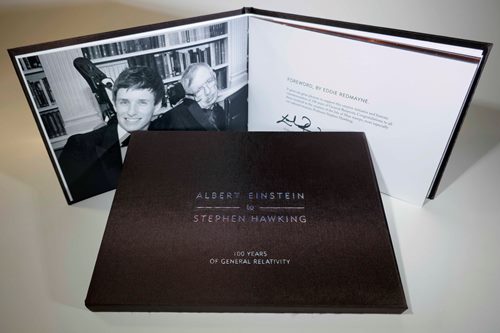
What better way to celebrate Stephen Hawking’s 75th birthday than a limited edition commemorative book?

To mark the occasion, the Isle of Man Post Office has released Albert Einstein to Stephen Hawking: 100 Years of General Relativity – a 32-page glossy tome that features quotes from the two famous physicists.

(more…)

New super-resolution microscope combines Nobel-winning technologies

A new type of super-resolution microscopy developed by researchers in Germany, Argentina and Sweden combines the merits of two Nobel-prize-winning techniques, attaining nanometre-scale resolution more quickly and with fewer emitted photons than previously possible.

The resolution limit of traditional optical microscopy is set by the Rayleigh criterion: if two features are separated in space by less than half a wavelength, diffraction will blur the light too much for the features to be distinguished. Super-resolution microscopy techniques surpass this limit by selectively exciting individual fluorescent groups (fluorophores) on molecules while their neighbours remain dark.

Single-molecule microscopy techniques, for which Eric Betzig and William Moerner each shared a third of the 2014 Nobel Prize for Chemistry, switch fluorophores on and off randomly and use the arrival positions of the emitted photons at a camera to reconstruct the location of each fluorophore. However, the photons are diffracted as they escape, leaving some uncertainty about where a single photon originated. Detecting many photons from the same fluorophore can reduce this uncertainty, but to get to single-molecule (nanometre) resolution requires tens or even hundreds of thousands of photons, and most fluorophores degrade (or bleach) before they emit this much light.

Doughnuts of light

Stimulated emission depletion (STED) microscopy, which won Stefan Hell the remaining third of the Nobel prize, uses two beams of light. The first illuminates the sample with a focused beam, turning fluorophores on. The second beam is focused to a doughnut shape in the sample and suppresses the fluorescence everywhere in the focal region – except at the doughnut’s central hole. By scanning the beams jointly over the sample, the spatial distribution of all the fluorophores can be determined. Unfortunately, to suppress fluorescence perfectly except in one single-molecule-sized spot would require a doughnut-shaped beam powerful enough to destroy the sample. Both techniques, therefore, struggle to obtain molecular-scale resolution.

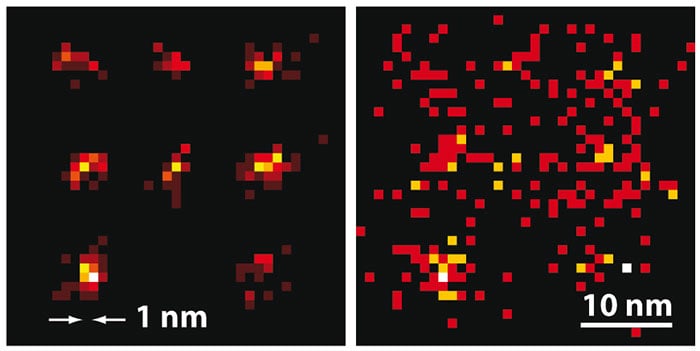
MINFLUX image of an array of fluorophores

Now, Hell and colleagues at the Max Planck Institute for Biophysical Chemistry in Göttingen and several other institutes have developed a new technique called maximally informative luminescence excitation probing (MINFLUX). They switch individual molecules on as in single-molecule microscopy, but for determining the molecules’ position, they scan a single, doughnut-shaped beam across the sample, as in STED microscopy.

When their photodetector records a signal, the researchers know that a fluorophore is nearby. As the beam is doughnut-shaped, with zero intensity at its centre and increasing intensity further away, the intensity of the fluorescence can reveal the intensity of the light incident on the fluorophore and, therefore, how far the fluorophore is from the focus of the beam.

Beam structure

By aiming the beam at four points near the fluorophore and recording the fluorescence intensity each time, the researchers can easily work out how far the fluorophore is from each point and deduce its location with nanometre-scale precision. “In single-molecule microscopy, the co-ordinate system is given by the pixels of the camera,” explains Hell, “Here, it’s the structure of the beam that defines position.”

It’s a very clever idea and it’s remarkably simple
Adam Cohen, Harvard University

The researchers used MINFLUX to map the positions of fluorophores tagged onto specially shaped sequences of DNA called DNA origamis, and thus to calculate their shapes. In the first experiment, using fluorophores separated by 11 nm, the researchers needed only 50 s of imaging time to locate all those that emitted at least 500 photons in total with an average spatial uncertainty of 2.1 nm. Then, using fluorophores only 6 nm apart, they identified those emitting more than 1000 photons to within around 1.2 nm in 120 s.

Twice as good

These precisions are both twice as good as the maximum precisions theoretically achievable using single-molecule microscopy with the same numbers of photons. The researchers also tracked single molecules inside living bacteria – something only possible because of the faster speed of MINFLUX.

“MINFLUX is a truly remarkable breakthrough with a highly innovative method design,” says Xiaowei Zhuang of Harvard University in the US – one of the inventors of single-molecule super-resolution microscopy. “It’s amazing ability to localize molecules at an ultra-high precision with such a low photon number will greatly benefit our understanding of molecular interactions inside cells.”

Adam Cohen, also at Harvard, agrees: “It’s a very clever idea and it’s remarkably simple,” he says. “People have been trying to track molecules for a variety of different applications for the last 15 or so years, and this relatively simple concept will improve that quite a bit, at least under some circumstances.” He sees a potential issue with the use of the technique in more complex cellular structures, however: “If you start to get stray photons coming not from your molecule but from other sources, those stray photons will throw off the precision of the tracking,” he explains. “As you get to having more and more fluorophores in your sample, it becomes increasingly difficult to ensure that all but one of them will be off.”

The research is described in Science.

Improved battery capacity? Sounds like my cup of tea

There are some strange uses for a spent tea bag after it’s made your cuppa, but work published in Scientific Reports really takes the biscuit. A group of researchers in Korea have managed to demonstrate an enhanced carbon anode structure from waste tea leaves that could be a path to cheap, high-capacity lithium ion batteries.

Lithium ion batteries power everything from mobile phones to electric cars. They normally consist of a lithium cathode and a graphite anode in an organic solvent. The graphite anode is cheap, stable and has a suitable electrochemical potential, but it poses a fundamental limit to battery capacity in terms of how many lithium ions it can absorb. If lithium ion batteries are to meet the growing demands for an energy storage solution that can power efficient vehicles and allow renewable energy to displace fossil fuels, then a better anode material must be found.

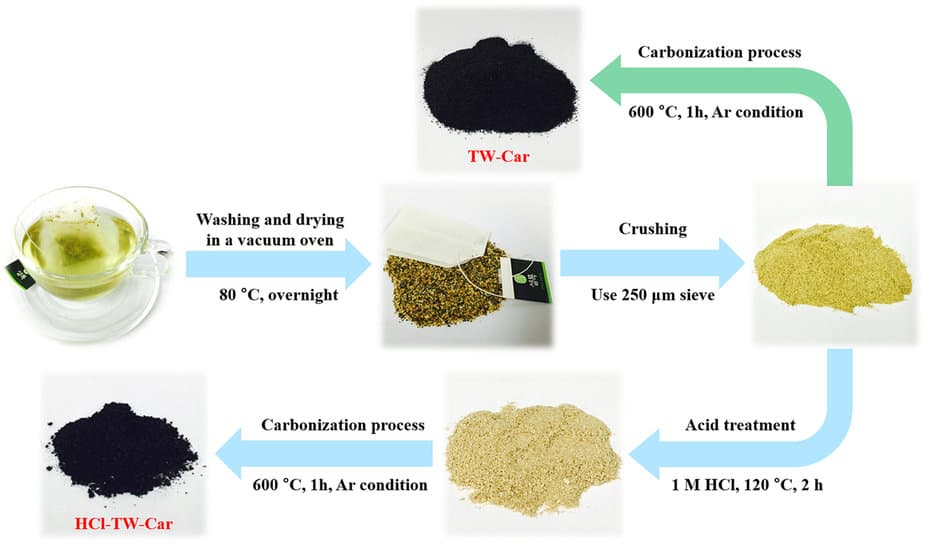
Synthesis process of the two types of carbon synthesised from tea leaves. Credit: Scientific Reports

Some of this work towards better anode materials focusses on developing a porous carbon anode that can maintain the chemical advantages of graphite while benefiting from the higher surface area of the porous nanostructure to improve on its capacity limitation. These methods are held back from mass production by the need for high-quality carbon and complex manufacturing processes. However a recent study led by Dong-Wan Kim at Korea University demonstrates how an appropriate porous carbon structure can be made cheaply through a simple series of steps applied to waste tea leaves.

The added acid advantage

Kim and colleagues at Korea University and Korea Institute of Science and Technology, compare two methods. In both, the tea is washed, dried, crushed and carbonized, but one also includes an acid treatment step with hydrochloric acid. They found that the acid treatment step improved the material in a number of ways.

The acidification process seemed to remove unwanted impurities. Traces of several metals amounting to 1% by weight in the untreated sample were not found at all in the acidified sample. What’s more the structure of the pores was different. The unacidified sample had low porosity with relatively large pore size (average 5.69 nm). The acidified carbon had a hierarchically porous structure with a mixture of larger and smaller pores, higher porosity and an average pore size of 2.48 nm. This had the effect of increasing the surface area by almost a factor of 100.

Scanning electron microscopy (SEM) Images of the carbon structures. Credit: Scientific Reports

To compare the electrical performance of the two prospective anode materials, Changhoon Choi – the Korea University researcher who performed and analysed the experiments – used them to make lithium ion coin cells. The acid-treated material showed capacities of 479 mAhg-1, higher than the upper limit of 372 mAhg-1 for graphite anodes and the capacity of 270 mAhg-1 for the sample with no acid treatment. After 200 charging and discharging cycles both types of cell showed stable efficiency of charge transfer above 98.5 %, indicating that the reversibility of this electrode is very good and highlighting what good use can be made of an abundant resource – waste tea leaves.

Copyright © 2026 by IOP Publishing Ltd and individual contributors