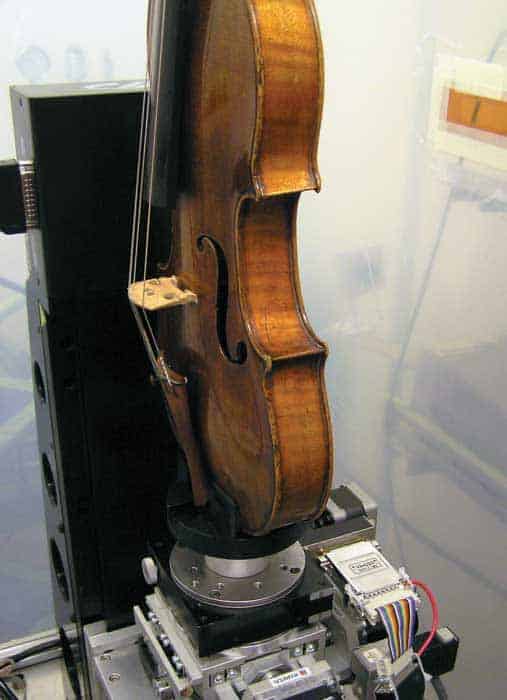
Scientists studied this 250-year-old violin in an X-ray beamline at Italy’s Elettra synchrotron. (Courtesy: Elettra)
You can hardly blame the Norwegian musician Peter Herresthal for never letting anyone else play his 250-year-old violin. He bought it at an auction, with the help of a sponsor, for an eye-watering half a million dollars. “I don’t even let it out of my sight,” Herresthal told me. So for him to hand over the violin in October 2010 to a team of scientists at the Elettra synchrotron in Trieste, Italy – and then let them enclose it inside an X-ray beamline for two days – was a stupendous display of trust in science.
Operational since 1993, the Elettra facility has 27 different X-ray beamlines that are put to different uses. One beamline, known as SYRMEP (SYnchrotron Radiation for MEdical Physics), is often used by scientists to non-invasively examine archaeological specimens and ancient artefacts, including flutes and paper-pipe organs. These studies inspired a team of Elettra scientists to image a working violin – a cheap student model – with synchrotron light.
The resulting 3D images of the instrument – along with detailed information about its composition and manufacture – emboldened the researchers to seek a historically significant violin to image. Their thoughts immediately turned to the legendary “Cannon” violin that once belonged to the virtuoso Niccolò Paganini (1782–1840). One of the most famous instruments in the world, it was named after the explosive sounds Paganini could create with it.
Paganini’s Cannon is an Italian national treasure and is displayed in an earthquake-proof case in Genoa’s Palazzo Tursi; on the rare occasions it’s moved, it is ferried around in an armoured car. When the Elettra scientists approached its curator Alberto Giordano, he unsurprisingly didn’t feel comfortable lending it. Giordano, however, thought of his friend Herresthal, who had recently bought another historic violin, made in 1753 by the Piacenza instrument builder Giovanni Battista Guadagnini.
Herresthal was using the quality sound of the antique instrument to cement his reputation as a foremost expositor of contemporary violin music and also appeared reluctant. Although Giordano explained the procedure and assured Herresthal that the X-rays wouldn’t damage or alter the wood, Herresthal had other concerns too. “The violin’s wood is old and fragile,” he told me. “But the climate where I live in Norway is dry, and when you take the violin to a place with a different climate it affects the response.”
Herresthal eventually consented to the project but only after the Trieste scientists agreed to build a specially created environmental system that could control a sample’s temperature and humidity. And so it was that in October 2010 Herresthal and his wife put the violin in the back of their car and drove the 160 km down the autostrada from Venice, where he’d been teaching, to Trieste. Once there, a team of half a dozen scientists showed him the synchrotron and described how it works.
“They explained the technique, but I don’t know if I can explain it back!” Herresthal recalls. Staff then showed him the two-stage climate monitoring and control system they’d built. The first stage contained a humidifier and air conditioner designed to bring the climate to the target range of 55% relative humidity and 25 °C. The second consisted of a more precisely controlled environment inside a 50 × 50 × 130 cm Plexiglas box, equipped with an alarm that would ring in the control room should the humidity or temperature change.
Still, Herresthal’s first glimpse of Elettra’s experimental hall was a shock, crammed as it was with silver-foil-wrapped equipment and serviced by an overhead crane. “It looked like a scene from a James Bond movie just before everything blows up,” he says. “I remember how excited the scientists all were, but I was still worried.” Indeed, when Giordano asked Herresthal to remove his violin’s fittings to improve the imaging, Herresthal refused. He also said no when Giordano asked if the strings could be removed. “Hands off!” Herresthal recalls saying, worried about an upcoming performance in Kentucky. “If you remove the strings, the bridge can fall down.”
The scientists compromised, re-thinking their imaging plans. They mounted the violin on a support, closed off the experimental area from direct view, and began work. Two days later, they had a 3D digital image of the violin, resolving details down to 50 µm, presenting it in a way Herresthal could understand. “The images were remarkable,” he admits. “You could see all the repairs; I even saw a drop of glue.” When I asked Herresthal if the imaging changed his views about the violin, he agreed it had, saying it made him more confident. “It showed me there were no cracks and the repairs had been done well,” he says. “Sometimes you are tempted to open a violin to try to improve it; I’ll keep mine closed.” He also reckons violin imaging will change the market. “It won’t be possible to hide that a historic violin has cracks, or is heavily restored, or is made with composite materials.”
The critical point
One moment in this episode encapsulates what made the trust between Herresthal and the scientists possible, an encounter in which his respect for the scientists, and theirs for him, became most transparent. It took place after the first day, when the scientists had to stop to adjust the violin’s position. They asked Herresthal if he wanted to test it before they carried on.
Herresthal, still worried, said yes. If anything were awry he would refuse to let them continue. He picked up the violin, raised the bow, and started to play. Music filled the experimental hall – some scales, followed by snippets of a piece by a Danish composer that Herresthal was planning to perform in Kentucky.
Satisfied with the sound, Herresthal smiled. He handed them back the violin. and said: “Go ahead.”
The environment is a shared resource, and in recent years the question of how to moderate the impacts of human activity on the air, water and land has become increasingly important. One of the characteristics that has received the most attention in this effort is the “greenness” of our energy supply. Yet the term “green” seems not to be well understood and it is not consistently applied. Some sources define a “green” energy source as one with a low environmental impact, but that merely shifts the question towards defining impact. There is currently a lot of focus on greenhouse gases (GHGs), and many definitions seem to view “low impact” and “low-GHG emissions” as synonymous. Alternative definitions, however, include other types of environmental effects, such as particulate air pollution, use of water or the generation of waste products.
This confusion and multiplicity of definitions has particular implications for considering what the term “green” might mean for the nuclear-energy industry. Nuclear power is sometimes characterized as producing no GHGs, and while this is not completely true, it is certainly accurate to say that GHG emissions from nuclear power generation are much lower than those of fossil-fuel-based power sources.
Another characteristic of interest is the sustainability of different energy sources – that is, whether the supply could be “used up” over time. Simplistically, it would appear that both fossil fuels and uranium for nuclear power, being mined from the ground, are finite and will eventually be used up, while “renewable” resources such as wind and sunlight are effectively infinite. However, this viewpoint ignores the fact that the systems required to extract energy from sunlight and wind use mined materials as well.
Likewise, some consider the fact that nuclear power produces long-lived waste as proof that it is not “green”, yet a similar argument could be applied to the wastes generated in producing the components required for solar or wind power generation. All of these arguments – plus others relating to as-yet-untapped possibilities, such as reprocessing used nuclear fuel to extract more energy from it; using a thorium fuel cycle instead of (or in addition to) uranium; or even extracting uranium from unconventional resources, such as sea water – must be taken into account when deciding whether nuclear energy counts as “green”.
Cradle to grave
Unlike fossil fuels, which are all carbon-based and thus produce carbon dioxide when burned, “burning” uranium fuel produces no GHGs. However, other parts of the nuclear fuel cycle, including mining, extraction and enrichment of uranium, do produce some GHGs. This fact has been recognized in many analyses. What is less well recognized is that generating power from wind and sunlight also produces some GHGs.
1 Start to finish The life cycle of an energy-producing system can be split into three stages: the ‘front end’ (that is, steps before energy generation), ‘operations’ and the ‘back end’ after the system has reached the end of its useful life. With fossil fuels, most of the greenhouse gases (GHGs) come from combustion during the ‘operations’ phase, while for nuclear power and renewable energy sources, most of the GHG emissions come from the front end. For renewable energy sources, component manufacturing and facility construction produce the bulk of GHGs, while for nuclear power, enrichment accounts for more than half of the total GHG emissions.
This needs to be considered in any analysis of “greenness”, but often, it is not. The US Environmental Protection Agency (EPA) is one of many organizations to make this mistake. The EPA definition of green power is “electricity produced from solar, wind, geothermal, biogas, eligible biomass and low-impact small hydroelectric sources”. Thus, on their website it says that, “Although nuclear power generation emits no greenhouse gases during power generation, it does require mining, extraction and long-term radioactive waste storage.”
The EPA does not make a similar statement for solar or wind power. Yet, although solar and wind power – like nuclear power – emit no greenhouse gases during power operation, they also require raw materials to be mined, extracted and processed. In fact, because of the diffuse nature of wind and solar energy, more materials are required to construct and manufacture the structures and components for power production, per unit of energy generated, than are required for other energy sources. In addition, wind turbines use rare-earth metals, which are in limited supply, and the manufacture of solar photovoltaics involves the use of highly toxic materials.
Instead of simply identifying specific energy systems as “green” or “not green”, a better way to assess the “greenness” of energy sources is to examine the full set of environmental impacts from “cradle to grave”. This life-cycle assessment gives a more accurate idea of the total GHGs from any source. It makes it clear that all energy sources generate some GHGs, although the parts of the fuel cycle responsible for the emissions are different for each energy source (see “Start to finish”, above).
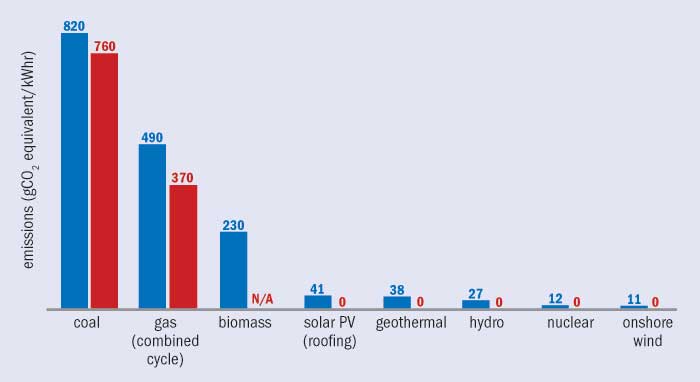
Another issue that must be addressed in evaluating GHG emissions is that different researchers have computed different levels of emissions. In 2013 the US National Renewable Energy Laboratory (NREL) reviewed a large number of studies and determined that the variation can be attributed to such factors as differences in the exact choice of designs assumed for each study, different operating assumptions and different evaluation methods. Despite these variations, however, all evaluations of the total life-cycle emissions show coal having significantly greater emissions than any other energy source (see “Measuring up”, above). Natural gas is the best of the fossil fuels in this respect, but it still produces significant emissions. Solar, wind, geothermal, hydro and nuclear power all generate only a small fraction of the GHGs of the larger emitters, with nuclear power usually ranking among the lowest emitters. Hence, if the measure of greenness is based on the emissions over the whole life cycle, nuclear power should be categorized as being similar to wind and solar power.
Waste not
In terms of non-GHG impacts, nuclear power and the renewable energy sources do not generate the particulates that are associated with coal burning, nor do they generate some of the other emissions associated with fossil fuels, such as methane, sulphur or nitrous oxides, organic compounds or toxic heavy metals. The nuclear-energy industry does, however, produce nuclear waste that must be sequestered for thousands of years before the radioactivity decays. The industry is often criticized for this, and its “green” credentials questioned on this basis. However, the volumes involved are small and waste repositories are being developed to ensure that the waste remains sequestered from the environment.
It is also worth noting that other energy sources are not waste-free. Coal produces large volumes of solid waste, in addition to the airborne emissions, but even renewable-energy sources produce waste. Frequently, the toxicity of this waste is an issue, but in some cases even the sheer volume of waste creates challenges. For example, solar energy requires large arrays of solar panels, which degrade over time and must be replaced. For a small country such as Japan, the question of what to do with all these spent panels is already becoming a problem.
2 Measuring up A comparison of direct greenhouse-gas emissions (red bars) and full-life-cycle emissions (blue bars) produced by different energy technologies. Although biomass is essentially a carbon-based fuel, and thus generates large quantities of carbon dioxide when it is burned, it also absorbs carbon as it grows. After including the environmental impacts of mining, extraction and enrichment, the greenhouse-gas emissions from the full nuclear fuel cycle are revealed to be on a par with those of sources like wind and solar power, while all three are much less than those of fossil fuels. (Source: Annex III: Technology-cost and performance parameters. In Climate Change 2014: Mitigation of Climate Change. Contribution of Working Group III to the Fifth Assessment Report of the Intergovernmental Panel on Climate Change.)
The environmental impacts of mining are often mentioned as a consequence of using fossil or nuclear fuels. However, the volume of the resource needed for nuclear power operations is much less than that needed to burn fossil fuels, and this translates to a lower level of environmental impacts from extraction. Moreover, as already noted, renewable energy sources require the mining of large volumes of structural materials, as well as the mining of toxic materials. Although the environmental impacts are a lot smaller than for coal, there are some measurable impacts associated with these mining operations.
A detailed assessment of other types of environmental impact is beyond the scope of this article. A full comparison of energy sources would include such factors as land use, which is greater for solar power and wind than for other sources (although some solar and wind sites can be used for other purposes, such as agriculture in the case of wind farms); impacts on birds and bats (a concern for wind farms); accidents (serious accidents at nuclear power plants can contaminate surrounding areas); earthquakes (from hydroelectric dams and fracking for oil and gas); and impacts associated with disposing of wastes from the various energy sources (building and operating disposal facilities, transporting wastes, and so on).
No free lunch The real truth is that no energy source is completely green. Perhaps it is more accurate to say that there are shades of green. By that measure, nuclear power is very close to the same shade of green as that of most renewables.
But evaluating energy supply options is an incredibly complex and multi-faceted exercise, and while greenness is important, it must be viewed in the context of other considerations. Decision-makers must weigh the GHG and other emissions from each energy source against such measures as cost; short- and long-term resource availability; the reliability of the overall energy supply 24 hours a day; and the security of the energy supply against interruptions by weather or by foreign suppliers.
These evaluations are not static. Resource discoveries and actions by foreign governments can affect supply, while technology developments and government decisions can affect a host of measures, including costs, availability, emissions and other measures. This article has considered only current energy-supply technologies, but a breakthrough in some areas could alter the comparative data significantly. One example of such a breakthrough would be “clean coal” technology – that is, some way of extracting the GHGs from coal emissions before they are released to the environment, and sequestering them from the environment permanently and reliably. Since this type of development can’t be counted on at the current time, it is not considered in the comparative data used in this article. If it later proves to be technically feasible and economic, it could alter the discussion radically. So, too, could the development of fusion energy, or cheap energy storage for renewables.
At present, though, no single energy source excels in all measures. Each has some pros and cons, and most rational national policies seek to diversify their energy portfolios in order to take advantage of the benefits different energy-supply technologies offer and to ameliorate any disadvantages. Although nuclear power has some challenges – notably waste disposal – it appears to be one of the most attractive sources in terms of a small environmental footprint, reliable energy generation, security of the energy supply, and other important measures. Hence, the short answer to the question raised in this article’s title is that nuclear energy is indeed green, and it offers several other advantages as well. It should, therefore, be considered in this light in decision-making on future energy-supply options.
Adding nanoparticles to the surface of tumour cells could make them more susceptible to treatment with particular cancer drugs, according to new research at MIT. The study showed that nanoparticles tethered to the cell surface can increase the effects of forces exerted on the tumour cells by physiological fluids flowing within the body, which makes the cells much more vulnerable to attack by certain therapeutics.
Scientists have recently been exploring the physical properties of tumours and their microenvironment, with recent research showing that tumours can exploit the forces in their surroundings to enhance their survival and promote the progression of the cancer. But researchers at MIT believe that increasing the forces exerted on tumour cells can make certain therapeutics more effective in killing cells and controlling the cancer.
The study, which was led by Robert Langer, used an experimental drug known as TRAIL (a TNF-related apoptosis-inducing ligand), which exerts a cytotoxic effect on tumour cells without damaging healthy cells. TRAIL also avoids many of the debilitating effects of more commonly used therapies.
The researchers found that when used to target tumour cells, TRAIL was more successful in killing cancerous cells once they had been exposed to the shear forces generated by physiological fluids such as blood flow in the body (Nat. Commun.8 14179). The MIT team set out to optimize the forces required for cell death, and they found that increasing the force on the cells made them more susceptible to TRAIL.
Nanoparticles strengthen forces
To produce these forces, Langer and his colleagues have pioneered the use of nanoparticles made from biodegradable polymers known as PLGA (poly(lactic-co-glycolic acid)). When injected into the bloodstream, the nanoparticles attach to the tumour cell surface and increase the force on the cell from the flow of physiological fluids.
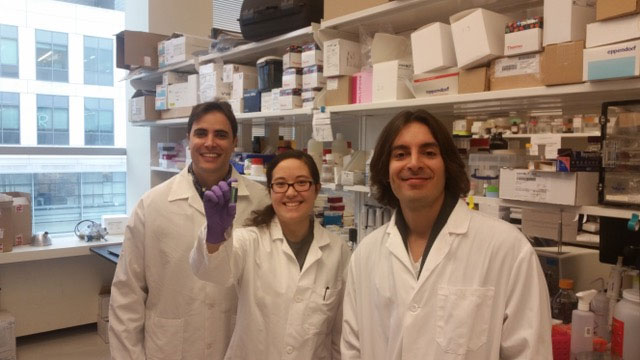
Members of the MIT research team: Michael Mitchell, Amanda Chung, and Pedro Guimaraes
The nanoparticles are coated with PEG (polyethylene glycol), which is tagged with a specific ligand that interacts with proteins found on the surface of the tumour cells. These ligands, and therefore the nanoparticles, are attached to the tumour cell like a ball tied to a string. The shear forces from the flow of physiological fluids cause the nanoparticles to bump and bash the tumour cells, causing them to become more susceptible to the effects of the therapeutics.
The MIT team found that attaching the nanoparticles to tumour cells prior to treatment with TRAIL killed metastatic tumours and reduced the progression of tumours in mice. The researchers also found that the treatment appeared to be specific to tumour cells and that healthy cells remained unaffected. Nanoparticle size and quantity were also found to have an effect on cell death. Larger particles, around one micrometre across, and a higher quantity of particles were found to have the most positive effect.
The researchers believe that the mechanism the nanoparticles induce on the tumour cells may cause the molecules surrounding the tumour cells to compress, enabling the therapeutics to interact more efficiently with receptors on the cell surface.
Langer and his research team are now exploring the possibilities of using this technique in combination with other drugs. This is a key strategy to prevent drug resistance in cancer treatment since tumours often regrow and become unaffected by drugs that had previously been effective. The MIT team is particularly interested in drug combinations that induce cytokines, which stimulate signalling chemicals that trigger an immune response to the site that helps destroy the tumour.
Horseshoe bats wiggle their ears and noses to boost their ability to navigate using ultrasound. That is the conclusion of Rolf Müller of Virginia Tech and colleagues, who have done mechanical and computer simulations that show that the wiggles could improve the bats’ ability to resolve direction by up to a factor of 1000. A horseshoe bat emits ultrasound from its nose and detects the reflected signal using its ears. The creature’s nose and ears have complex external structures – called noseleaves and pinnae, respectively – that diffract sound waves upon emission and reception. Bat experts also know that the shapes of the noseleaves and pinnae can change rapidly and that this has an effect on the sound used for echolocation. To understand why, Müller’s team created robotic models of noseleaves and pinnae and measured their acoustic properties when they were wiggled to mimic living bats. When combined with computer simulations, the measurements suggest the wiggling can result in a 100–1000 fold improvement in direction resolution over what can be achieved with static noseleaves and ears. Writing in Physical Review Letters, the researchers point out that very little is known about how bats use echolocation to navigate in complex natural environments. They suggest that a better understanding of the dynamic nature of the noseleaves and pinnae could boost our understanding of these incredible creatures and also lead to navigation technology inspired by bats.
Pressure helps supercooled water flow
The viscosity of supercooled water decreases by 42% when under pressure, according to scientists in France. Usually liquids become thicker when pressure is increased, but more than a century ago the opposite was observed to happen for water below 32 °C. This occurs because the application of pressure breaks the intermolecular hydrogen bonds that provide the water with its unusual properties. As the network of hydrogen bonds increases with cooling, the effect of pressure should be stronger. Frédéric Caupin and colleagues at the University of Lyon have studied this phenomenon in supercooled water – liquid water below the freezing point – which is a difficult feat as the liquid is liable to crystallize. Using a time-of-flight viscometer, the team measured water flow for temperatures down to –29 °C and pressures up to 3000 atmospheres. Finding that the viscosity decreased by nearly a half, Caupin and colleagues propose a model that treats water as a mixture of two species – a high-density “fragile” liquid and a low-density “strong” liquid. As described in PNAS, the ratio of these fluids explains water’s unusual thermodynamic and dynamic properties.
BELLE II detector rolls into collision point
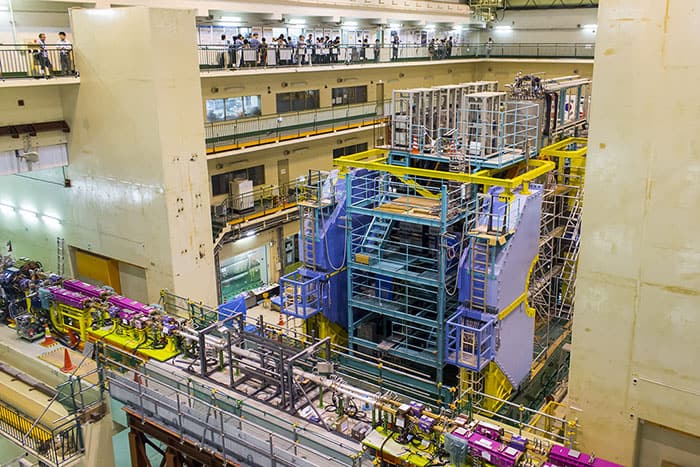
Starting point: BELLE II before it started its voyage. (Courtesy: KEK)
The BELLE II particle detector has been moved 13 m from its place of assembly to a collision point on the SuperKEKB collider in Japan. The SuperKEKB accelerator is an electron–positron collider that is designed to create large numbers of B-mesons. It is a major upgrade to the KEKB collider, which operated in 1998–2010 and included the Belle detector. In 2001, Belle discovered the existence of charge–parity symmetry violation (CP violation) with B-mesons. This confirmed the theoretical prediction of Makoto Kobayashi and Toshihide Maskawa, who shared the 2008 Nobel Prize for Physics for that work. SuperKEKB will achieve a collision rate that is about 40 times higher than KEKB, and BELLE II is designed to collect much more data than Belle and operate at a much improved measurement precision. Standing 8 m tall and weighing 1400 tonnes, BELLE II is expected to start taking data in 2018. It will do further studies of CP violation as well as perform searches for physics beyond the Standard Model.
You can find all our daily Flash Physics posts in the website’s news section, as well as on Twitter and Facebook using #FlashPhysics.
A $12 device that can measure the mass of microgram-sized objects in fluid has been developed by researchers in the US. The sensor is driven by a piezoelectric speaker and measures the change in the resonant frequency of a glass tube as the object passes through it. The team used the device to measure mass changes in several biological samples and says that the sensor has applications in a wide range of fields, such as developmental biology, toxicology, materials science and plant science.
Mass is an important physical measurement that can provide crucial information about the nature of an object. However, weighing microgram-sized biological samples such as embryos in liquid, can be very tricky indeed. While mass measurements can offer valuable insights into the biological state and health of such specimens, they cannot be easily made with standard laboratory equipment.
Nanogram resolution
To tackle this shortcoming, William Grover and colleagues at the University of California, Riverside, have created a simple mass sensor from off-the-shelf electronics and a short length of glass tubing bent into a “U” shape. The glass tube is attached to a small speaker and the bottom of the “U” passes through a photointerrupter – a device that uses an LED and a light sensor to detect the presence, or not, of an object. This simple set-up cost around US$12, yet can determine the mass of a microgram-sized object with a resolution of a few hundred nanograms.
It provides a pretty complete picture of the physical properties of a sample
William Grover, University of California, Riverside
The speaker keeps the glass tube vibrating at its resonant frequency using a simple feedback circuit from the photointerrupter, which detects the oscillation rate. As the object being weighed is pumped through the tube it changes the tube’s resonance frequency. This change is detected by the photointerrupter and can be used to calculate the objects mass, volume and density.
“If the object has a different density than the fluid, then it will change the sensor’s mass when it flows through,” explains Grover. “If the object is denser than the fluid around it, it’ll make the sensor slightly heavier and that makes the sensor’s frequency go down. If the object is less dense than the fluid, it makes the sensor slightly lighter and that makes the sensor’s frequency go up. By measuring these frequency changes, we measure the buoyant mass of the object.”
Germinating seeds
The sensor was calibrated with microbeads of known mass. The team then demonstrated that it can measure changes in the mass of zebra-fish embryos – a common model for embryological development studies – as they react to toxins. The device was also used to measure the degradation rates of nano-sized biomaterials used in medical implants, as well as mass and density changes in germinating seeds.
“It’s fundamentally a mass sensor, so at the most basic level it can weigh tiny objects in fluid,” says Grover. “But by using a method that Archimedes first described over 2000 years ago, we can also use it to measure the volume and density of the objects. So it provides a pretty complete picture of the physical properties of a sample.”
Grover expects the sensor to have many applications, but he is especially interested in using it to “study the development of organisms, measure biodegradable materials, and monitor the environment”. The new device is described in PLOS ONE.
Nitrogen-vacancy (NV) centres on two different diamonds have been coupled coherently by physicists in Austria. NV centres occur whenever two neighbouring carbon atoms in diamond are replaced by a nitrogen atom and an empty lattice site. NV centres are being used to develop quantum technologies because they have spin states with very long quantum-coherence times, even at room temperature. Another important benefit of NV centres is that they interact with both light and microwave radiation and could therefore act as a transducer between quantum devices based on the two types of radiation. Now, Johannes Majer and colleagues at the Technical University of Vienna have created quantum-coherent interactions between NV centres in two different pieces of diamond separated by about 5 mm. The diamonds are placed on two different microwave cavities, which are connected by a microwave-resonator transmission line. A static magnetic field is applied to the system and this tunes the transition energies of the NV spins to correspond to the microwave energy of the cavity – causing the NV spins to couple to the cavity. Because microwave radiation can travel through the transmission line between the two cavities, the NV centres in both diamonds can be coupled to each other. The team showed that when the crystalline structures of both diamonds are aligned, then the NV centres in both diamonds are coupled in a quantum-coherent manner. “This interaction is mediated by the microwave resonator in the chip in between; here, the resonator plays a similar role to that of a data bus in a regular computer,” says Majer. The coupling can also be switched off, allowing the NV centres of each diamond to be manipulated independently. While the researchers were not able to show that the NV centres on different diamonds were entangled quantum-mechanically, they write in Physical Review Letters that achieving and measuring entanglement could be an “interesting future challenge”.
Martian metals unlike Earth’s
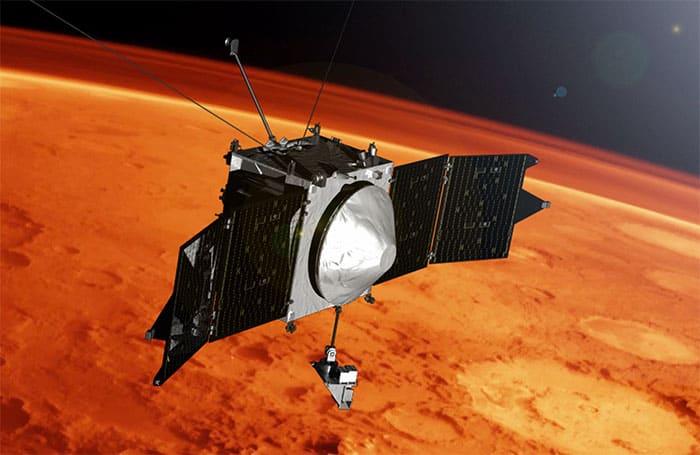
Alien behaviour: Mars’ ionosphere has a structure unlike Earth’s. Artist’s concept showing MAVEN spacecraft over Mars. (Courtesy: NASA’s Goddard Space Flight Center)
Metal ions in Mars’ atmosphere have been directly detected for the first time, and the distributions are distinctly different to those on Earth. Scientists have extensive knowledge of Earth’s ionosphere – a region of high-energy electrons, ions and charged molecules in the upper atmosphere, resulting from the ionization of meteorite dust entering at high speed. Due to Earth’s magnetic fields, gravity and ionospheric winds, the metallic ions – mainly magnesium (Mg+) and iron (Fe+) – are forced into layers. Investigations into the ionospheres of other planets have been modelled upon Earth’s example and have been reliant upon indirect measurements from Earth or satellites. But now, NASA‘s Mars Atmosphere and Volatile Evolution (MAVEN) mission has not only made the first direct detection of ions on a planet other than Earth, but also found that they behave differently. MAVEN’s spectrometer has detected sodium (Na+), Mg+ and Fe+ continuously over the last two years, implying the ions are a permanent feature. But rather than Earth’s distinct layers, there is no separation of the light Mg+ and the heavy Fe+ with increasing altitude as expected because of gravity. Instead the metals are mixed with the neutral atmosphere at altitudes where no mixing process is expected. Joseph Grebowsky of NASA’s Goddard Space Flight Center in the US and team suggest this is because Mars only has localized magnetic fields in certain regions of the crust and so layering only occurs there. The aim of the MAVEN mission is to investigate how Mars lost most of its air, and the new results, published in Geophysical Research Letters give a new insight into predicting the atmospheres of other planets.
Canadian science panel calls for increased spending
Canadian science requires a billion dollar increase to avoid falling behind other nations in basic science. That is the main conclusion of a report released yesterday by a nine-strong panel led by David Naylor, former president of the University of Toronto, which also included the Nobel laureate Art McDonald and Blackberry co-founder Mike Lazaridis. The panel say that Canada needs to invest an additional C$1.3bn over the next four years to boost the science base – taking the county’s science budget to C$4.8bn – recommending that about C$500m of that increase should be diverted to basic research. The panel also calls on the government to set up a National Advisory Council on Research and Innovation that would advise the Canadian government on research priorities and also “provide broad oversight of the federal research and innovation ecosystem”. The Fundamental Science Review was commissioned last year by science minister Kirsty Duncan to review the state of science in Canada. The publication of the report comes after the Canadian government disappointed scientists last month with a flat budget for science in 2017.
You can find all our daily Flash Physics posts in the website’s news section, as well as on Twitter and Facebook using #FlashPhysics. Tune in to physicsworld.com later today to read today’s extensive news story on a $12 sensor that can weigh microgram-sized objects.
The explosive collision of newly born stars has been captured by astronomers in unprecedented detail. John Bally of the University of Colorado Boulder in the US and colleagues used the Atacama Large Millimeter/submillimeter Array (ALMA) in Chile to observe the Orion Molecular Cloud 1 (OMC-1), located within the constellation of Orion 1350 light-years away. OMC-1 is an active star-formation factory – a massive, dense cloud of gas. As it collapses under its own gravity, OMC-1 produces stars and – in the densest regions of the cloud – protostars. Astronomers suggest that several protostars began to form about 100,000 years ago and, before they could escape their stellar nursery, gravity started to pull them together. A mere 500 years ago, two of the protostars collided, producing a dramatic and powerful explosion with as much energy as the Sun emits in 10 million years. The collision caused gas, dust and the other nearby protostars to be propelled out into space at over 150 km/s. The resulting cosmic firework in OMC-1 was first observed in 2009, but the latest high-resolution ALMA images have revealed details about the distribution and motion of carbon monoxide within the streamers. The results, published in the Astrophysical Journal, may provide greater understanding of how such events impact star formation. It is thought that although protostar collisions are relatively short-lived (lasting only centuries), they are probably fairly common and may regulate stellar formation in massive molecular clouds.
Wind creates rogue waves in the lab
Wind-driven rogue waves have been created in an experimental water tank for the first time. Rogue waves are huge walls of water that can emerge without warning on a relatively calm ocean. Long a part of seafaring lore, it has only been very recently that physicists have begun to study these dramatic events. Previous studies used paddles to create rogue waves in water tanks, and have shown that they can occur as a result of nonlinear self-focusing of smaller waves. However, ocean waves are created by the wind, and so these paddle-driven rogue waves may not offer a realistic model of the phenomenon. Now, an international team led by Alessandro Toffoli at the University of Melbourne in Australia has looked at the more realistic role of wind in rogue-wave formation using an annular water tank. The tank has an outside diameter of 5 m, an inside diameter of 1 m and a depth of 46 cm. Turbines drive the water around the tank and two large fans create a wind blowing over the surface at 16 km/h. The circular flow eliminates an important limitation of wind studies in linear wave tanks – the tanks are too short for wind-blown rogue waves to emerge. With water and air flowing in a circle, the distance that the wind travels over the water is essentially unlimited. After switching the experiment on, it takes about 30 min for that tank to reach a stable state in which most of the waves are about 5 cm tall. However, the team also observed rogue waves that were about 2.2 times higher than the stable waves. Most of the rogue waves appeared just before the tank reached the stable state. In general, taller than average waves became more common in the tank at this time – with their frequency falling after the steady state was reached. This suggests that strong nonlinear interactions are present in the tank at that time, affirming the findings of previous studies. The study is described in Physical Review Letters.
Ion-trap pioneer Hans Dehmelt dies at 94
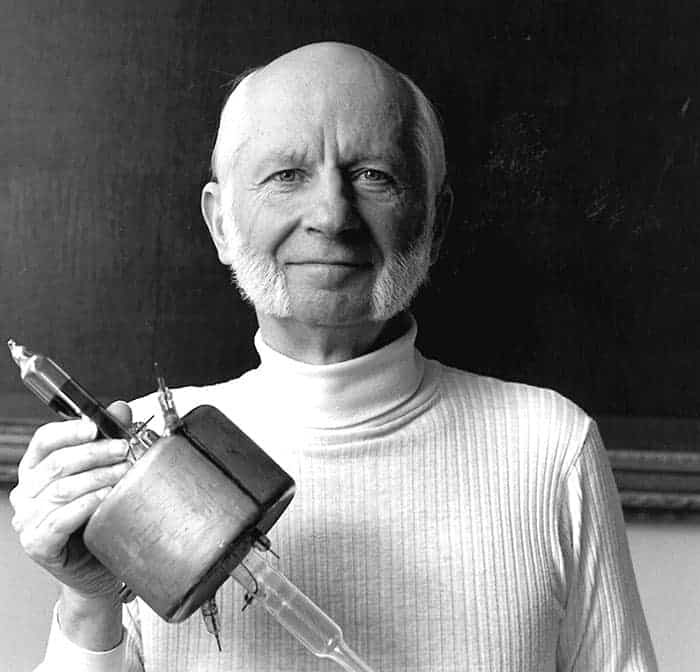
Hans Dehmelt: 1922–2017. (Courtesy: University of Washington)
Hans Dehmelt, the German-born US physicist who shared the 1989 Nobel Prize for Physics for the development of ion traps, has died at the age of 94. Dehmelt was born in Germany in 1922 and gained a Master’s degree in physics in 1948 and a PhD in 1950 from the University of Göttingen. In 1952 he then went to Duke University in the US, before moving to the University of Washington in 1955, where he remained for the rest of his career until retiring in 2002. It was during his time in the US that Dehmelt developed the Penning trap that used magnetic and electric fields to trap ions and electrons, allowing them to be studied to high precision. Today, such traps are used to study to properties of antimatter, such as antihydrogen. For this breakthrough, Dehmelt shared half the 1989 Nobel prize together with Wolfgang Paul from the University of Bonn, while US physicist Norman Ramsey was awarded the other half for his work probing the structure of atoms to high precision.
You can find all our daily Flash Physics posts in the website’s news section, as well as on Twitter and Facebook using #FlashPhysics.
I’ve always had a passion for maths, but I lost most of my sight when I was nine years old. I grew up in Tunisia and went to a blind school there for a few years before my parents decided to come back to the US. My mom is African-American and my dad is from Tunisia. When we came to the US, I went to a regular high school and in my senior year I took physics and immediately fell in love with the subject. I had a fantastic teacher who never saw my physical limitations in terms of my sight. He never said “Oh no you can’t do this lab,” or “You shouldn’t do physics,” and this was crucial. I was a young person and I knew I would have to prove myself as a legally blind person.
What were some of the challenges you faced as a blind person in physics?
It was when I went to the College of William and Mary in Virginia to study physics that I really encountered difficulties. For the first time I found it tough trying to make my coursework accessible to me. I was the first blind person to study physics there so the books weren’t on tape, I had to find readers to record the coursework. There seemed to be all of these issues that I had to worry about that my colleagues didn’t even think about. This puts you a little behind. My peers could just pick up a book or go to the library to get information while I didn’t have that flexibility. As I would be listening to audio, something like turning back to page 10 wasn’t as easy for me as it was for a sighted person. This forced me to memorize as much as I could. I would memorize all the formulae and equations and in the long term this made physics easier for me. I think the biggest thing though was dealing with other people’s perceptions about what blind people can and can’t do. The first thing that people see is my disability. After that, they notice that I am a woman and also African-American so it’s like a three-strike situation. This was the reality, especially as I was in a predominantly white male department, so it was really hard for me to feel like I belonged. But I had a drive that came from within me – an ability to envision possibility.
How did you get into media and films?
When I was doing my PhD at the University of Maryland I applied for an American Physical Society Mass Media Fellowship, and when I got it, it was the most fantastic experience. They assigned me to CNN in Atlanta. Although the programme was meant to be only 10 weeks, I ended up doing more than three months and I even took a semester off my PhD because I wanted to focus on the fellowship. I had the opportunity to learn all about science communication and I found that I was really interested in the media. People often assume that as a blind person, you would not want to be in front of the camera, but that was what interested me most, along with producing media content. My time at CNN was great and I even got to meet then chief executive Tom Johnson. He was on the advisory board of the School of Journalism in Maryland and he took me under his wing. When the fellowship ended I continued to produce out of the Washington bureau, where I was a special science correspondent. I was the first blind on-air producer for the network and I really wanted to show that it didn’t take sight to do this. Who cares if my eyes don’t align properly to the camera lens – you should be paying attention to the content I am delivering. I then set up Aziza Productions, making short films for science-based non-profit organizations and focusing on minority communities in science.
Was it hard finding work after your fellowship?
As blind people we have to be part of changing the attitude that the general public has about us. Even today in the US, 70% of working-age blind people are unemployed. This is something I dealt with when I came out of my PhD and was trying to find work. You may have the credentials and the necessary skills and experience, but unfortunately people just see the blindness. There are many environments where people aren’t used to seeing blind people – physics was one and television was another. People think that it takes vision to do the work, but you could say that about any job. For me vision is a mindset, an attitude, and for that I don’t need sight. Of course it has been challenging and there have been roadblocks, but I have managed just fine without sight. I hope that my story inspires others with disability, especially in physics. The main barrier is dealing with people, not doing the physics.
How has your physics background been helpful in your media work?
I’m passionate about science and I love talking about it. My physics training helps me better communicate it because you have to understand it in order to effectively explain it to the general public. I also love working with people and storytelling, so journalism was an obvious path, but science was my first love.
What are you working on now?
I’m working on a documentary film called Seeking Vision. It’s about overcoming odds and not being able to see with your eyes. A little over 10 years ago I had my fifth brain operation and because I knew I wanted to produce a film that will connect with people, I had my camera crew in the operating room filming for nearly three hours of a seven-hour surgery. Although the hospital was worried about liabilities, my neurosurgeons allowed it. I want to show the reality of being blind and that we can do more than answer phones.
Do you have any advice for today’s students, especially those with any disabilities?
I like referring to the concept of disabilities as “different abilities”. I tell my sighted colleagues that while they see with their eyes, I do the same with my fingers while reading braille and with my ears while listening to audio. What drives me is my vision and my goals, both of which come from within. It’s important to know who you are and what you are capable of, so hold on to that vision.
In the above video Brian Anderson of Brigham Young University shows how the acoustic concept of “time reversal” can be used to knock over a series of LEGO figures using sound. The idea is that sound waves are broadcast into an environment and captured by a sensor at a specific location. The signal is then used to work-out how the sound waves bounced about before reaching the location and this information is then used to target that specific location with subsequent sound waves. In the demonstration, sound knocks over 29 LEGO figures one-by-one. It’s very impressive and entertaining as well.
Bell correlations – a hallmark of an entangled quantum system – have been spotted in an ensemble of 500,000 rubidium-87 atoms. The atoms were prepared in spin-squeezed states by physicists at Stanford University in the US and the correlations measured to a whopping statistical significance of 124σ.
In quantum mechanics, entangled particles have much stronger correlations than are allowed in classical physics – a property that can be exploited in quantum technologies including cryptography. In 1964 the physicist John Bell famously calculated an upper limit on how strong these correlations could be if they were caused by classical physics alone – what has become known as Bell’s inequality. Correlations stronger than this limit, Bell reasoned, could occur only if the particles are entangled.
In this latest work, Onur Hosten, Mark Kasevich and colleagues have measured these strong Bell correlations in an ensemble of 500,000 cold rubidium-87 atoms that are trapped by laser light. The atoms are put into an entangled state using a process called spin squeezing. The uncertainty principle dictates that the uncertainty in a measurement of the z-component of the total spin of the system multiplied by the uncertainty in the y-component must be larger than a certain value. Reducing (or squeezing) the uncertainty of the z-component increases the uncertainty of y-component, putting the system into a spin-squeezed state.
Not a fluke
It turns out that the technique used by Hosten and colleagues to create a spin-squeezed state in their atomic system also puts the atoms into an entangled state. The team then characterized this state by measuring two quantities. One is related to the total spin of the atoms in the z direction and the other is related to the total spin of the atoms in a direction n, which is in the z–x plane. Correlations between these two quantities can be expressed in terms of a Bell-like inequality. The team found that for certain values of n, the inequality was violated – showing that entanglement is present in the system. For some values of n, the statistical significance of the violation was 124σ, making it extremely unlikely that the measurement was a random fluke.
Kai Bongs of the University of Birmingham in the UK describes the work as “a very nice experiment done on a fantastic system”, and points out that the Stanford team has taken the atomic ensemble “deep into the quantum domain”. However, Bongs, who works in the field of quantum sensors, says that practical applications of the Bell correlation measurements are not obvious. Hosten concurs: “We do not know any immediate practical applications of the Bell correlation measurements. However the spin-squeezed states have immediate applications in improving the precision of atomic clocks and atom interferometers.”
Hosten points out that the team’s study differs from conventional Bell experiments because it does not look at correlations between measurements made at two different places. If the system could be adapted for atom interferometry – whereby the atoms can follow two different paths – it could be used to further test the predictions of quantum theory. The measurements are described in Physical Review Letters.