Flash Physics: Shrinking gels, masculine culture discourages female physicists, Carlos Frenk bags Born medal

Study explains why some materials shrink under stress

When a conventional soft material is placed between two surfaces that then move across each other in opposite directions, the material tends to bulge out at right angles to the motion of the surfaces. However, there are some gel-like materials such as blood clots that do the opposite when under stress – and understanding why has puzzled physicists for some time. Now, Daniel Bonn at the University of Amsterdam and colleagues have performed calculations and experiments that they say can explain the phenomenon. Materials that shrink under stress tend to comprise networks of filaments that also contain water. When the team modelled such materials they found that when the gaps between the filaments were small, the water could not easily move within the gel – and the materials bulged when stressed. When the pores are larger, however, the water can flow more easily when stressed. This allows the network to shrink in the directions perpendicular to the stress as the water flows away from the stressed regions. The team was also able to observe this behaviour in the lab and the results – which are reported in Physical Review Letters – could prove useful to scientists developing artificial tissues.

Women discouraged by masculine culture in physics

Photograph of a woman working with equations

An analysis of more than 1000 papers on gender disparity in science, technology, engineering and mathematics subjects has revealed three main reasons why women are underrepresented in those subjects at undergraduate level in the US. The research, led by Sapna Cheryan, a psychologist at the University of Washington in Seattle, found that the key factors are a lack of sufficient early experience in these subjects, the existence of masculine cultures and gender gaps in self-belief. The research focused on the six science and engineering fields with the highest numbers of undergraduate degrees: biology, chemistry, mathematics, physics, engineering and computer science. In the US, biology, chemistry and mathematics are studied by almost equal numbers of men and women, while physics, engineering and computer science are male dominated, with less than 20% of undergraduate degrees being awarded to women. The analysis revealed three overarching reasons why women participate less in physics, engineering and computer science, the most significant of which was the existence of masculine cultures. Cheryan says that there are three main characteristics of the masculine cultures they identified: male-oriented stereotypes about the people in these fields, negative stereotypes about women’s abilities and few female role models. “These signal to girls and women that they do not belong to the same extent as their male peers,” Cheryan told Physics World. The research is described in Psychological Bulletin.

Cosmologist Carlos Frenk wins 2017 Max Born Medal

Dark-matter medallist: Carlos Frenk has won the 2017 Max Born Medal

The 2017 Max Born Medal for outstanding contributions to physics has been won by the cosmologist Carlos Frenk. Originally from Mexico, Frenk is director of the Institute of Computational Cosmology at the University of Durham in the UK. He bagged the medal for his pioneering work on the theory of cold dark matter (CDM), which explains the formation of galaxies and other large structures in the universe. The medal is given jointly by the Institute of Physics and the German Physical Society and includes a prize of €3000. In odd-numbered years the award is given to a physicist based in the UK or Ireland and presented in Germany. In even-numbered years the winner is based in Germany and travels to the UK or Ireland to accept the prize. In 2015 Frenk was a consultant on The World Machine, which was a science-themed sound-and-light show projected onto the façade of Durham Cathedral. He speaks about that experience in “The cathedral and the cosmos“.


  • You can find all our daily Flash Physics posts in the website’s news section, as well as on Twitter and Facebook using #FlashPhysics. Tune in to physicsworld.com later today to read today’s extensive news story on how physics research is improving in China.

Inspiring young physicists, telescope buyer’s guide, time-travelling pyramid builders

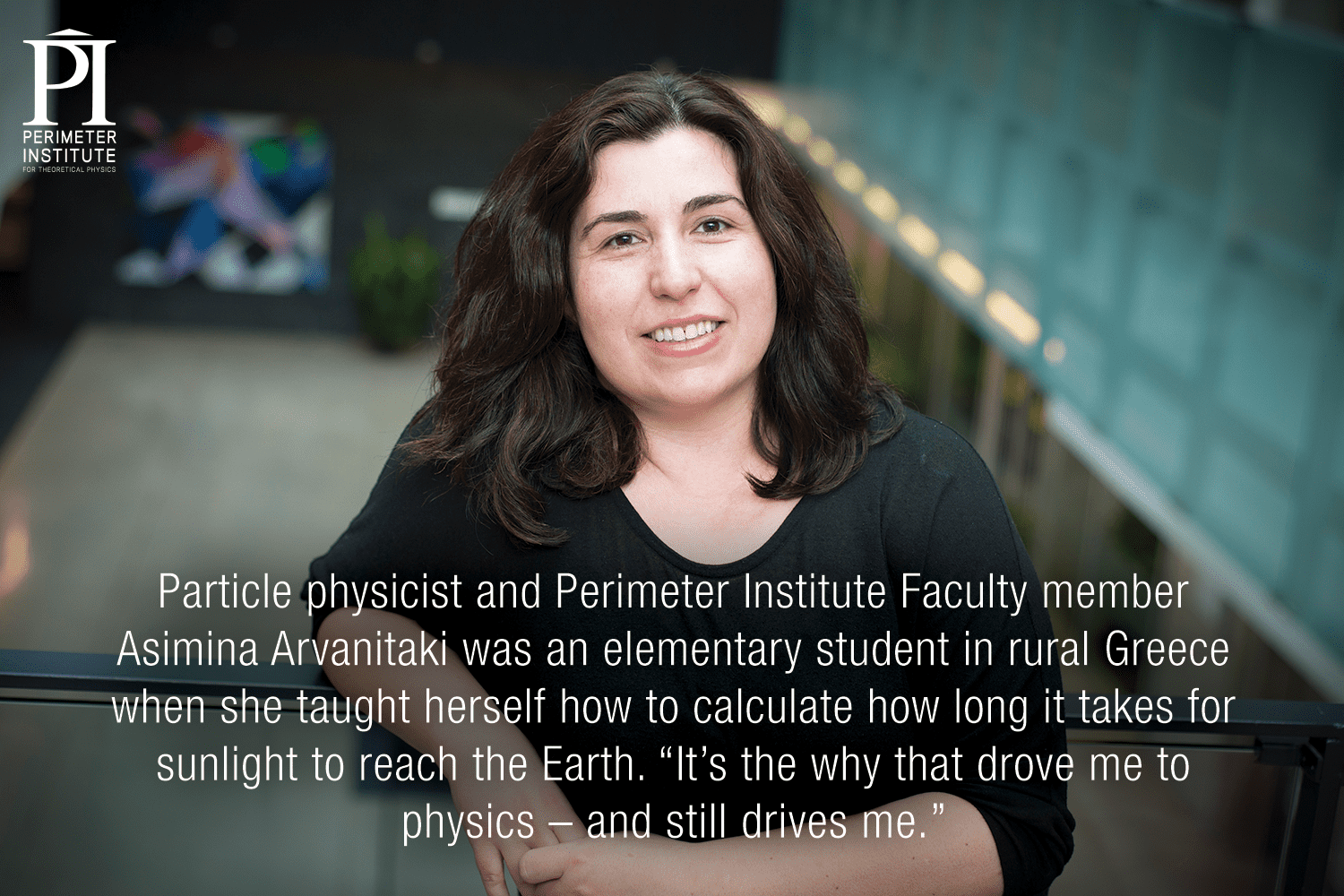
Sunlight calculator: Asimina Arvanitaki (Courtesy: PI)

By Hamish Johnston

Have you ever wondered what inspires talented physicists to pursue careers in physics? To try to answer that question, the Perimeter Institute for Theoretical Physics (PI) in Canada has produced a set of tiles that explain how some famous physicists – and some up-and-coming stars – became hooked on physics at a young age. An early love of back-of-the-envelope calculations seems to have set the stage for the PI’s Asimina Arvanitaki as she explains in the above tile. Can you guess which Nobel laureate used to stare at a clock pendulum for hours to try to figure out how it worked? The answer to that teaser and much more can be found in “How great scientists get hooked on science”.

(more…)

Do physicists avoid reading papers with lots of equations?

Including large numbers of mathematical equations in a research paper could impede the effective communication of the physics it describes. That is the controversial conclusion of a study of citation numbers by researchers from the University of Exeter in the UK, who advocate for the more accessible reporting of theoretical research. However, some physicists disagree with their analysis and conclusion.

Mathematics plays a fundamental role across the breadth of the sciences, underpinning the development of theoretical concepts. However, evolutionary biologists Tim Fawcett and Andrew Higginson noticed that many experimental biology papers seemed to lack a solid theoretical basis. They also found that theoretical biology papers were often neglected by the research community and that many evolutionary biologists confessed to being deterred by equation-dense papers.

These observations inspired the duo to look into how maths is presented in 649 papers from three major ecology and evolution journals. Using generalized linear models to analyse how often papers are cited, they found a negative correlation between a paper’s equation density and the number of citations it received. Indeed, there were 28% fewer citations on average for each additional equation per page.

Valuable papers may be ignored if they are not made accessible
Andrew Higginson, University of Exeter

No effect in physics

This result raised an important question: could this trend be fixed with improved mathematics training for biologists, or does it also exist in fields with a traditionally greater reliance on math, like physics? This was investigated in 2015 by the physicist Jonathan Kollmer of the Friedrich-Alexander University Erlangen, Germany, and colleagues. They found no evidence for the correlation in the citations of 1000 papers that appeared in Physical Review Letters (see “Are physicists afraid of mathematics?“). In that same study, Kollmer and colleagues also questioned the original analysis of biology citations by Fawcett and Higginson.

Now, Fawcett and Higginson have done their own analysis of Physical Review Letters papers and come to a different conclusion. They found an average 6–8% decrease in citation frequency for each additional equation per page. The duo suggest that this indicates that there are real and widespread barriers to the communication of mathematical work – independent from the levels of mathematical training, or any stigma about doing well in mathematics.

“Ideally, the impact of scientific work should be determined by its scientific value, rather than by the presentational style. Unfortunately, it seems valuable papers may be ignored if they are not made accessible,” says Higginson. “This presents a potentially enormous barrier to all kinds of scientific progress.”

Fawcett adds: “It takes time to scrutinise the details of a technical article – even for the most distinguished physics professors – so with many competing demands on their time, scientists may be choosing to skip over articles that take too much effort to digest.”

More explanatory text

But what might be done to address this communication issue? The researchers recommend both the use of more explanatory text to support equation-heavy theoretical papers, along with the relocation of non-essential equations – such as those describing the intermediate steps to solutions – to appendices where they will not affect the equation density of the main text.

This question can hardly be addressed by conducting purely correlative studies as they give no insight about any causal relationship
Jonathan Kollmer, Friedrich-Alexander University Erlangen

“Physicists need to think more carefully about how they present the mathematical details of their work, to explain the theory in a way that their colleagues can quickly understand,” says Fawcett.

“Anecdotally, I could well believe that the finding of a negative correlation between mathematical density and citations rates is real,” comments John Rayner – a physicist and science communication researcher at the Australian National University, who was not involved in this study. He adds: “If utility and clarity are the hallmarks of a high citation rate, then the circumspect use of mathematics can only help.”

Kollmer, however, remains unconvinced. “This question can hardly be addressed by conducting purely correlative studies as they give no insight about any causal relationship,” he says. Several reasons could account for such a correlation, he adds – such as the population differences between more theoretical and experimental research areas – and the correct explanation “cannot be evidenced by pure statistical analysis but would need sociological and more elaborated research”.

Fawcett and Higginson are now using the citation results to explore how the influence of theory spreads through scientific literature across different disciplines, along with investigating the root of mathematical anxiety, and the impact of promotion and funding criteria on the behaviour of scientists.

Fawcett and Higginson’s study is described in the New Journal of Physics and Kollmer and colleagues have since published a reply in the same journal.

Flash Physics: Optical clock in space, Richard Garwin wins presidential medal, lighting the cosmic web

First optical clock in space could improve GPS

The first optical clock to be operated in space has been launched by Matthias Lezius and colleagues at the Germany-based Menlo Systems. Based on a frequency-comb laser system, the optical clock operates at a frequency that is about 100,000 times higher than that of the microwave-based atomic clocks that are currently used on global-positioning-system (GPS) satellites. The optical clock is about 22 cm in size and weighs 22 kg. Its power consumption is about 70 W, which makes it suitable for satellite applications. Although this prototype optical clock can only operate at about one tenth the accuracy of today’s GPS atomic clocks, Lezius’ team is now working on a new version of the clock that promises to improve this accuracy by several orders of magnitude – which could boost the accuracy of GPS. The current clock was tested on board a research rocket that flew a 6 min parabolic flight. The next version of the optical clock is scheduled for testing in 2017. The research is described in Optica.

Physicist Richard Garwin wins US Presidential Medal of Freedom

The physicist and advocate of strategic nuclear-arms reduction Richard Garwin will receive a Presidential Medal of Freedom from US president Barack Obama. Garwin, who is 88, was a PhD student of Enrico Fermi at the University of Chicago before designing the first hydrogen bomb in 1952 under Edward Teller at Los Alamos National Laboratory. He then moved to IBM’s Thomas J Watson Research Center, where he is an IBM fellow emeritus. At IBM he worked on a broad range of topics including condensed matter, particle physics and gravitation. He also applied his skills to the development of touch screens, laser printers and intelligence-gathering technologies. Garwin served as a scientific adviser to presidents Kennedy, Johnson and Nixon, which is when he developed his long-standing interest in nuclear non-proliferation (see video). The medal is the highest civilian honour in the US and it will be given to Garwin and 20 other winners at a ceremony at the White House on 22 November.

Fast radio burst lights up cosmic web

The radio pulse FRB 150807

A brilliant burst of radiation known as a fast radio burst (FRB) that has travelled over a billion light years has unexpectedly revealed information about the cosmic web – the large-scale structure of the universe. A team led by Ryan Shannon at the International Centre for Radio Astronomy Research (ICRAR) and Vikram Ravi of the California Institute of Technology says that the latest FRB – one of 18 to be detected to date – is one of the brightest seen. The flash was captured by CSIRO’s Parkes radio telescope in New South Wales, Australia. FRBs are extremely rare, short but intense pulses of radio waves, each only lasting about a millisecond. “This particular FRB is the first detected to date to contain detailed information about the cosmic web – regarded as the fabric of the universe – but it is also unique because its travel path can be reconstructed to a precise line of sight and back to an area of space about a billion light-years away that contains only a small number of possible home galaxies,” says Shannon. The cosmic web is very difficult to spot because most of the plasma and gas it contains is very faint. It is usually detected when large sections of it are lit up briefly, for example by a bright quasar or a FRB. This particular flash reached the Parkes radio telescope mid last year and is described in Science.


  • You can find all our daily Flash Physics posts in the website’s news section, as well as on Twitter and Facebook using #FlashPhysics. Tune in to physicsworld.com later today to read today’s extensive news story on why some physicists do not like mathematics.

Texas gravitational-wave research centre returns misused funds

The University of Texas Rio Grande Valley (UTRGV) in the US has had to repay almost $5m in research grants that were allegedly misused by the Center for Gravitational Wave Astronomy (CGWA). The UTRGV, which opened in August 2015, is repaying the grants that were given to the CGWA when it was part of the University of Texas at Brownsville (UTB).

The state of Texas created the UTRGV by consolidating the UTB with the University of Texas–Pan American in Edinburg, and the UT Regional Health Center in Harlingen, which were dissolved after the new university started operation. At its founding, the UTRGV assumed all the assets and liabilities of the universities it replaced.

Crucial role in LIGO

Founded in 2003, the CGWA played a significant role in developing the basic technologies, instrumentation and algorithms involved in the first detection of gravitational waves in September last year by the Laser Interferometer Gravitational-wave Observatory (LIGO) in Washington and Louisiana.

But according to The Monitor – a local Texas newspaper – an internal audit carried out by the University of Texas as part of the closure of UTB discovered that the centre had misused nearly $2m in research grants from NASA, the National Science Foundation, and the Department of Defence over a period of six years.

Another audit revealed apparent misuse of almost $3m in grants from the Texas government from 2012 to 2015. The auditors indicate that the grants had been used to pay faculty members who were teaching rather than carrying out research.

Unexpected hole

The $5m repayment leaves an unexpected hole in the UTRGV’s $478m annual budget. “In connection with audits conducted last year at both legacy institutions, issues with expenditures related to grants and to benefits proportionality were identified at the University of Texas at Brownsville,” the UTRGV noted in a statement to Physics World. “Those findings resulted in UTRGV returning almost $5m to the appropriate state and federal agencies. UTRGV is currently evaluating the impact, if any, these repayments will have on future operational decisions.”

Just how the misuse of the grants occurred, however, remains unexplained. “While my department, along with the university, continues to evaluate the situation, I have been asked not to comment until the facts have been established,” physicist Mario Díaz, who is director of the CGWA, told Physics World.

American angst

By Matin Durrani

Like many people, I’m fearful of the imminent Donald Trump presidency, given the many sexist, racist and otherwise unpleasant remarks he made during the US election campaign. However, his slogan – “Make America great again” – proved powerfully effective for many voters. Who, after all, could disagree with renewed domestic glory? Sadly, Trump’s plans for achieving that goal – what little we know of them – are based on such ill-informed and ignorant views that he could damage America’s long-standing leadership in many areas, including science.

(more…)

What are the conditions for life to exist on distant planets?

Whether or not we are alone in the universe is one of the most profound questions that humanity can ask. In this short video David Kipping, an astronomer at Columbia University in the US, takes a fresh look at the conditions required to support life. Specifically, Kipping takes issue with the definition of the so-called “habitable zone” – the band surrounding a star within which water could exist in liquid form on the surface of a planet. Kipping points out that the requirements for life are complex and this definition is based on the fact that all known life forms here on Earth require water. What if that is not universally true?

This video is part of our 100 Second Science series, in which researchers give concise presentations covering the spectrum of physics.

Flash Physics: Spider inspires structural colour, the roundest star, quantum simulator is very fast

Spider and flowers inspire new structural colour

A blue spider has inspired researchers to create a new material with structural colour that does not change with the viewing angle. Materials with structural colour get their hues from the interference of reflected light from tiny structures. Some structural colour – such as seen on the feathers of some birds or the reflection from a CD – is iridescent, which means that the observed colour changes with the angle of observation. Other naturally occurring structural colour remains constant irrespective of the observer, and it is this type of structural colour that researchers have struggled to recreate in the laboratory. Now, Radwanul Hasan Siddique and colleagues at the Karlsruhe Institute of Technology in Germany have teamed up with researchers in the US and Belgium to create a material that has a structural colour that is the same when viewed over 160°. Resembling an array of tiny flowers – each about 15 μm across – the material has a hierarchical structure that has translational and rotational symmetries at a number of different length scales (see image above). This geometry ensures that there are no special directions in how light is reflected. The material was inspired by the blue tarantula, which has non-iridescent structural colour. The material is described in Advanced Optical Materials and its colour can be adjusted by changing the size of the flowers. The researchers believe it could be an important step towards creating non-toxic, vibrant and durable colours for textiles and other applications.

Astronomers spot the roundest natural object in the universe

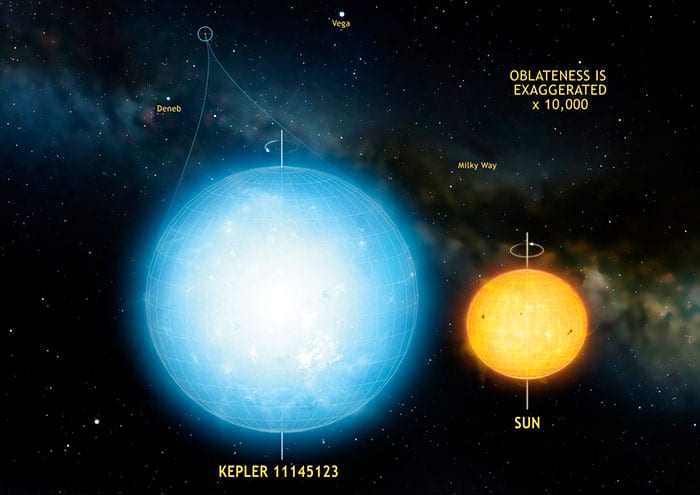
The star Kepler 11145123 is the roundest natural object ever measured in the universe

Consider a spherical star in the vacuum of outer space. Thanks to recent observations made by a team of researchers at the Max Planck Institute for Solar System Research (MPS) and the University of Göttingen, both in Germany, this may no longer be a hypothetical scenario. Most stars are not perfect spheres – their shape is determined by their rotation speeds: the faster the rotatation, the more oblate the shape. But as stars appear to us as mere points on the sky, their shapes are difficult to measure. Now, a team led by Laurent Gizon at MPS has, for the first time, measured the oblateness of a star, with unprecedented precision. Gizon and colleagues used “asteroseismology” or the study of the oscillations of stars. The applied the method on a slowly rotating star (Kepler 11145123), which is some 5000 light-years from Earth. They found that the difference between the equatorial and polar radii of the star is only 3 km – a very small amount compared to the star’s mean radius of 1.5 million km. Kepler 11145123 rotates at one third the angular velocity of the Sun, which rotates once every 27 days. The distant star also supports only sinusoidal oscillations, meaning its periodic expansions and contractions can be detected via its luminosity. NASA’s Kepler mission observed the star’s oscillations continuously for more than four years and found the virtually negligible difference in radius. “This makes Kepler 11145123 the roundest natural object ever measured, even more round than the Sun,” says Gizon. The work is described in Science Advances.

Quantum simulator is very fast

A team of physicists is claiming the record for the world’s fastest quantum simulator. The system involves cooling an ensemble of about rubidium-87 atoms to a temperature of about 70 μK. The atoms are then put into highly excited Rydberg states by firing an ultrashort 10 ps (10–11 s) laser pulse at the ensemble. Rydberg atoms have very large radii and therefore will interact very strongly with each other. This ensemble can then be used to simulate strongly correlated quantum systems such as electrons in superconductors and magnets. In the team’s experiment, a first pulse is followed by a second 10 ps pulse, which is used to measure how the atoms are interacting with each other. The time delay between the pulses can be controlled on the 10 as (10–17 s) scale and this allowed the researchers to observe a coherence oscillation in the gas with a period of 1 fs (10–15 s). The research is reported in Nature Communications and has been done by an international team that included Nobuyuki Takei and Christian Sommer of the National Institutes of Natural Sciences in Okazaki, Japan.


  • You can find all our daily Flash Physics posts in the website’s news section, as well as on Twitter and Facebook using #FlashPhysics.

How weather became a science

Meteorology was not always a science. In 1846 François Arago, director of the Paris Observatory and permanent secretary of France’s prestigious Académie des Sciences, declared “Whatever may be the progress of sciences, never will observers who are trustworthy, and careful of their reputation, venture to foretell the state of the weather.” Arago and his fellow 19th century “gentlemen scientists” considered weather forecasts no different from prophecies delivered by soothsayers – an attitude that damaged the reputation of many who were sincerely trying to understand how the atmosphere worked.

Shortly after the turn of the century, however, meteorology began to modernize. This era, from around 1900 to 1960, is the focus of James Fleming’s book Inventing Atmospheric Science. Fleming is a historian of science and technology at Colby College in Maine, US, and also the founder and first president of the International Commission on the History of Meteorology. Following an undergraduate degree in physics and a Master’s in atmospheric science, he has become one of meteorology’s most influential historians. His many well-researched and compelling books include a biography of Guy Stewart Callendar, who first demonstrated the effect of carbon-dioxide emissions on the climate (The Callendar Effect, 2007) and a history of “weather engineering” schemes and their false promises (Fixing the Sky, 2010). Although modern meteorology had many important forebears, in Inventing Atmospheric Science Fleming singles out three and wraps a surprisingly coherent narrative around them.

The first of Fleming’s inventors is Vilhelm Bjerknes (1862–1951), an ambitious Norwegian physicist who began his career by pursuing his father’s research interests in fluid dynamics. During the First World War, while seeking to help his native country survive food shortages, Bjerknes realized that physics had immense practical value for weather forecasting: at its heart, meteorology was simply an initial value problem. But Bjerknes did not just apply his physical insight to develop a weather-forecasting service in Bergen. He was also adept at the practical aspects of running such a service (obtaining data, issuing forecasts); politically astute enough to gain national support and resources; and skilled enough to manage a research group.

This group made several important discoveries, including the “polar front”, a globe-girdling region of enhanced temperature gradient that drives much of the weather of the mid-latitudes. Group members also crafted a conceptual model for the evolution of extratropical cyclones. Both developments, Fleming writes, served as vehicles for Bjerknes’s ambition. While there are other books and articles about Bjerknes (notably Robert Marc Friedman’s Appropriating the Weather), Fleming succeeds in shedding new light on his subject, including details on the friction between the Bergen group and a rival Austrian school, and also an account of the American Weather Bureau’s resistance to the Bergen methods.

One of Bjerknes’s most renowned group members was Carl-Gustaf Rossby (1898–1957), the second figure in Fleming’s study. After studying in Bergen, Rossby came to the US on an American–Scandinavian Foundation fellowship. Instructed to bring the Bergen methods to the Weather Bureau (now the National Weather Service), Rossby proved not only an excellent researcher (he developed the Rossby wave equation to calculate the motion of undulations in the jet stream), but also an inspirational leader. After leaving the Weather Bureau, he founded the first graduate school in meteorology at the Massachusetts Institute of Technology; chaired the newly formed Institute of Meteorology at the University of Chicago; and founded two extant scientific journals: the American Meteorological Society’s Journal of Meteorology (now Journal of the Atmospheric Sciences) and the Stockholm International Meteorological Institute’s Tellus. Rossby was also instrumental in working with the teams that produced the first computerized weather forecasts on two continents. This chapter of the book is the shortest of the three; however, I had the sense that more depth was needed to explain how Rossby accomplished all these things with such apparent ease.

A five-minute visit with Rossby was all it took to inspire Fleming’s third protagonist to study meteorology. Harry Wexler (1911–1962) rapidly advanced in his career to become head of research at the Weather Bureau. Despite dying at the young age of 51, Wexler was involved in some of the biggest advances in atmospheric science, including weather radar, computerized weather prediction and satellites. In his short life, he also became the first meteorologist to fly into a hurricane; was appointed chief scientist of the International Geophysical Year in 1957/8; and established the carbon-dioxide measurements at Hawaii’s Mauna Loa volcano, which have been crucial in demonstrating the influence of human activities on the atmosphere. This chapter is probably the one that most meteorologists will appreciate. Wexler is the least known of the three, yet his contributions on such a range of topics were significant. Kudos to Fleming for finally telling Wexler’s story.

Bringing Inventing Atmospheric Science to a close, Fleming argues that 1957 was the turning point when atmospheric science became “big science”, less focused on individuals and more run by committees and national research organizations. Here, the emphasis is on the US with its national investment in science and the creation of the National Center for Atmospheric Research in Boulder, Colorado. This part of the story is especially germane because Bjerknes, Rossby and Wexler were each masters of building structures and leading organizations, and it is these structures that would become critical to the subsequent evolution of atmospheric science as its own discipline, as Fleming adeptly argues.

Although we learn a lot about the accomplishments of these three giants, Fleming delivers few insights into what they were like as people. Personal stories and their non-science lives are rarely described, which makes Inventing Atmospheric Science relatively short (only 226 pages of text in the chapters). Some of the terminology (and many of the more peripheral actors) described in the book might not be recognizable to a non-atmospheric scientist, but that shouldn’t diminish the book’s readability. Almost anyone with a background in science – and especially those interested in the foundations and evolution of a discipline – should be able to understand most of the book. This book also introduces physicists to some of the great scientist–leaders who created the field of atmospheric science. Indeed, few other disciplines can claim to have undergone such a radical change, from soothsaying in the 1800s to the rigorous field of predicting the future that is modern atmospheric science.

  • 2016 The MIT Press £22.95/$31.00hb 312pp

New aeroplane wing changes shape to boost performance

A new type of composite wing that can change its shape according to flight conditions has been made from a lattice of small, lightweight components. This morphing ability could allow for more aerodynamic, manoeuvrable and fuel-efficient aircraft that are also simple to construct. Described as a “digital-material” approach to aeronautical design, the technology was developed by a collaboration involving NASA and several US universities, and could be applied to a variety of other structures from bridges to wind turbines.

Most aeroplanes have fixed wings that are fitted with ailerons, which are hinged control surfaces used to manage the lift and roll throughout the flight. The shape of fixed wings, however, is always a compromise in efficiency with different wing configurations being more suitable for different speeds and flight paths. Because of this, the concept of a wing that could change shape during flight has always been something of a holy grail for aircraft engineers – not the least because this could lead to much greater fuel efficiency.

Attempts to achieve this, however, have been unsuccessful. This is largely because the typical approach to wing deformation relies on the use of mechanical control structures that are simply too heavy to improve the overall efficiency of the wing. This new morphing design takes a different approach in which the entire wing becomes the deformation mechanism. Motors in the aircraft fuselage apply a pressure to each wing, which then twists uniformly along its length.

Lightweight lattice

The morphing wing is made from a lattice of lightweight, flexible, centimetre-scale, carbon-fibre-reinforced polymer components. These are assembled, like a child’s construction set, into larger structures. While each component is strong and stiff, the overall flexibility of the structure can be tuned by varying its overall shape, as well as the shape and exact composition of its individual components. The wing is completed with an outer skin of overlapping, flexible polyimide pieces that cover the lattice structure – much like scales on a fish.

The digital-materials approach “presents a general strategy for increasing the performance of highly compliant – that is, ‘soft’ – robots and mechanisms,” says team-member Kenneth Cheung, who is an engineer at NASA’s Ames Research Center in California.

Testing the wing design in a wind tunnel, the researchers found that the new wings can both match the aerodynamic properties of a conventional, fixed wing and deform in such a way that replaces the need for trailing-edge ailerons – but with only a tenth of the weight of a fixed wing. Following these tests, the researchers developed a small, unmanned aircraft, which has demonstrated excellent manoeuvrability (see image above). While such craft could pave the way for enhanced drones, the wing designs could also be scaled up for larger aircraft, Cheung says.

Made by robots

While the wings used in the studies so far have been assembled by hand, the team is also collaborating on the design of miniature robots that could assemble – and even examine and repair – such structures automatically. The wing’s composite nature should allow for simpler construction and repair processes – and could even allow the wing to be broken down into its component parts and re-used for some other purpose.

“Digital materials and fabrication are a fundamentally new way to make things and enable the conventionally impossible,” says Gonzalo Rey, chief technology officer for the aerospace-engineering company Moog, who collaborates with the researchers. The concept, he adds, has far broader potential, and could extend to such structures as flexible robots, bridges and skyscrapers, “providing not only improved performance and survivability, but also a more sustainable approach by achieving the same strength while using, and reusing, substantially less raw material”.

Other potential applications for digital materials include the in-situ fabrication of wind-turbine blades and space structures – both of which are expensive and logistically complicated to transport in their completed form to their place of operation.

New concept

Jianguo Zhao – a mechanical engineer at the Colorado State University, who was not involved in this study – says that the idea of using lightweight, tuneable cellular solids is a new concept in this area. He adds: “I am looking forward to see if the group can [use] this technology to fabricate airplanes with morphing wings that can fly freely, which might transform the traditional way to design and manufacture aircraft.”

The researchers are now working to better understand the failure modes of their digital materials, with a mind to optimizing their robustness. They are hoping to develop and test a complete aircraft that is designed from the top down with their new construction strategy – along with exploring the potential to develop various other modular structures and integrated robotics.

The research is described in Soft Robotics.

Copyright © 2026 by IOP Publishing Ltd and individual contributors