Flash Physics: New solar-energy model, Persis Drell named Stanford provost, gas sensors in a jiffy

Solar-energy computer model available to public

A computer model that predicts the energy output of solar-energy systems has been made freely available to the public by its creators at the Solar Energy Institute of the Technical University of Madrid, Spain. When a solar-energy system is installed at a specific location, precise local information about annual solar-radiation levels and ambient temperatures are needed to make accurate predictions of how much energy will be generated. Often this information is not available for new sites, which is where the software comes in. The online version of the software is called SISIFO and it uses available meteorological and other information to predict energy output for timescales as short as seconds, which allows the real-time performance of a facility to be predicted. Its creators say that the model has been compared with data from more than 200 weather stations and the deviations have been found to be less than 2%.

Physicist Persis Drell named next Stanford provost

Photograph of Persis Drell

Physicist Persis Drell will be the next provost of Stanford University in the US. Drell is the current dean of the Stanford School of Engineering and was previously director of the SLAC National Accelerator Laboratory. Her appointment, recently announced by Stanford president Marc Tessier-Lavigne, will take effect on 1 February 2017. The provost serves as the chief academic officer and chief budgetary officer for the university and works in close partnership with the president to provide overall leadership for the campus. “Persis is a bold, visionary, inclusive and collaborative leader who has demonstrated the capacity and versatility to quickly master complex leadership roles,” says Tessier-Lavigne. He adds that Drell is an “enthusiastic and dedicated citizen of the Stanford community, widely known for her warmth and spirit”. Drell, 60, grew up on the Stanford campus – her father was well-known theoretical-physicist Sidney Drell – and was the first woman to head SLAC as well as the first to be dean of the Stanford School of Engineering. “For me, this is about helping our students achieve their potential to lead fulfilling lives and have an impact on the world,” says Drell. She adds that she will support “our faculty in doing the brilliant research and teaching that also have an impact on the world, and addressing issues important to our community, including moving toward a professoriate that reflects our student body”.

Production time cut for nanostructure gas sensors
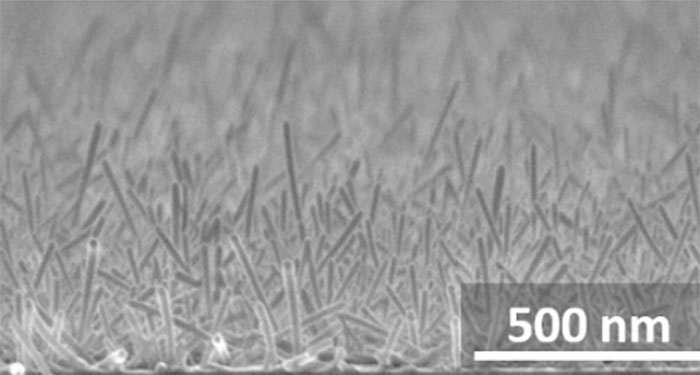
An array of molybdenum-trioxide nanorods

A simple and quick way to produce gas sensors based on tiny nanostructures has been developed by researchers in Japan. Gas sensors based on semiconductor nanostructures have been around for a while and are used in a range of applications including analysing human breath samples. They work by detecting the changes in electrical conduction that occur when molecules of interest adhere to the surface of a superconductor. The sensitivity of such a detector increases with the surface area available for adhesion and surfaces patterned with nanostructures offer an extremely large surface area. However, creating nanostructure patterns involves a number of complicated and time-consuming manufacturing steps. Now, Tohru Sugahara and colleagues at Osaka University have cut the time needed to make nanostructured sensors for detecting volatile organic compounds (VOCs) by a factor of 10. Their one-step fabrication process involves placing a precursor material on a substrate and heating it to produce an array of molybdenum-trioxide nanorods. The researchers say that they are able to create VOC sensors with responses comparable to “top-of-the-line” sensors made using traditional methods.


  • You can find all our daily Flash Physics posts in the website’s news section, as well as on Twitter and Facebook using #FlashPhysics. Tune in to physicsworld.com later today to read today’s extensive news story on a new type of aeroplane wing.

Gold nanospheres confine light to smallest volume ever

Light has been confined to volumes smaller than the size of a single atom for the first time. The feat, which seemed completely impossible even just a few years ago, has been achieved by researchers in the UK and Spain. They say that the “picocavity” that confines the light can be thought of as the world’s smallest magnifying glass. It could be used to study how light and matter interact at tiny scales and even to observe individual chemical bonds forming and breaking between atoms. The technique could also be used to make new optomechanical data-storage devices in which information can be written and read by light and stored in the form of molecular vibrations.

For a long time, scientists thought that visible light could not be focused to a spot that is less than half its wavelength – the so-called diffraction limit. In recent years, however, they have learnt how to use nanostructured metals like gold and silver that support surface plasmons (oscillations of electrons at the metal surface) to confine optical fields to much smaller spaces than their wavelength in free space would allow.

Now, a team led by Jeremy Baumberg at the University of Cambridge in the UK has used gold nanoparticles to make the world’s tiniest optical cavity. This cavity is so small that only a single atom can fit in it. “We will never do any better than this,” says Baumberg.

A nanoparticle-on-mirror

The researchers made their cavity in two steps. First, they made a sandwich structure that they called a nanoparticle-on-mirror. To do this, they lay down a flat mirror of gold and then coated it with a layer of molecules that like to stick to it. On top of this, they scattered gold particles that are 80 nm across and nearly spherical.

“This structure confines light with a specific red colour that is resonantly trapped in the gap between sphere and mirror,” explains Baumberg. “However, the light confined here is still a hundred times larger than we want.

“The next stage is more magical,” he continues. “We have been trying to understand how these samples behave, so we cooled them down to liquid-helium temperatures (10° above absolute zero) to try and stop all motion of molecules and atoms. Then, when we shone laser light on them, we noticed a peculiar thing.

“Occasionally, the light scattered from molecules became thousands of times stronger for many seconds, before disappearing. We found that what happens is that individual molecules from the gold are pulled by the light out of the bulk facet to sit on the surface. These atoms stuck on the flat surface act a little like lightning rods (but for light, not static electric fields) and trap light just above their tip. The trapped light has a volume of less than 1 nm cubed, so we call it a picocavity.”

Observing single bonds

Since the volume of this cavity is so small, it takes light almost no time to circulate around it, he adds. This increases all of the interactions between the light and the objects inside – in this case, biphenyl-4-thiol molecules. “It is also so small that it preferentially interacts with just a single bond within a molecule, allowing us to study it better. We can see that as we shine more light on it, we set the bond vibrating harder, and the molecule starts to deform.”

According to the team, which includes researchers from the Center for Materials Physics in San Sebastian in Spain, the new cavity could be used to study how molecules and metal atoms behave at very short length scales. This is very hard to do under ambient conditions with electron microscopy, for example. “Here, we directly see their motion in real time,” Baumberg tells nanotechweb.org. “We hope that this will allow us to understand how chemical reactions work for molecules attached to surfaces,” explains Baumberg, adding “This is of major importance for all the chemicals we use as a society today, since they are made using catalysis at a metal surface.”

Changing colour

Baumberg also points out that the ultrasmall-sized cavities “provide us with a way of making optoelectronic switches that change colour when we inject just a tiny amount of energy into the picocavity – either by light or electricity”.

Writing in Science, the researchers say they are now busy looking at what happens when they increase the laser power and how they can start to bend and break the molecules. “We are also trying to understand how light moves around the gold atoms and if we can control this with much more precision, to build objects on the nanoscale,” says Baumberg.

Flash Physics: Asteroid missions, mathematical physicist bags C N R Rao Prize, ultrashort electron emission

“Small-body scientists” call for more asteroid missions

More than 100 planetary scientists have signed a letter calling for more space missions to study asteroids and other near-Earth objects. The “small-body scientists” emphasize the need for the Asteroid Impact Mission (AIM), which is currently a proposal being evaluated by the European Space Agency (ESA). AIM has been proposed for inclusion in the Asteroid Impact and Deflection Assessment (AIDA) mission, which could be launched in 2020 by ESA and NASA. AIM would travel to a binary asteroid system called Didymos, where it would study the smaller asteroid in the system. This smaller asteroid is about 150 m across and is of interest to scientists because it is about the same size as most asteroids that could potentially strike Earth. AIM would also stick around to watch as the Double Asteroid Redirection Test (DART) – also part of AIDA – smashes into the smaller asteroid to see if it is possible to deflect an asteroid on a collision course with Earth. The signatories point out that we currently know of more than 1700 asteroids that are considered hazards because they could collide with Earth. “Unlike other natural disasters, this is one we know how to predict and potentially prevent with early discovery,” they write.

Mahouton Hounkonnou bags 2016 C N R Rao Prize

Mahouton Norbert Hounkonnou, a professor of mathematics and physics at the University of Abomey-Calavi in the Republic of Benin has won the 2016 C N R Rao Prize for Scientific Research. The prize, which is awarded by The World Academy of Sciences (TWAS) in Italy, recognizes Hounkonnou’s “outstanding level” of research in mathematics and his sustained commitment to mathematics education. He was given the prize “for his incisive work on noncommutative and nonlinear mathematics and his contribution to world-class mathematics education”. Hounkonnou’s research has seen applications in a variety of fields including physics, oceanography, health, the management of water and ecosystems, climate studies and energy policy. The prize was announced yesterday during the opening ceremony of the 27th General Meeting of TWAS. The prize – which is named after and provided by TWAS founding fellow and chemist C N R Rao – aims to recognize high-impact scientific work done by researchers from Least Developed Countries. “For me it is an important recognition of more than 20 years of research activity,” says Hounkonnou. “At the same time, it is a sort of encouragement and motivation to continue in the same direction, doing good research and promoting younger people in science,” he adds.

Laser pulses control electron emission with femtosecond timing

Artist's impression of the electron switching mechanism

A method for switching a source of electrons on and off on the femtosecond (10–15 s) timescale has been developed by Michael Förster of Friedrich-Alexander University in Germany and colleagues. It involves firing two laser pulses at a nanometre-sharp metal tip to excite electrons out of the metal. One pulse is relatively bright and at frequency ω, whereas the other is relatively dim and at frequency 2ω. There are two different ways that electrons in the tip can absorb energy from the pulses and be emitted into the vacuum. Quantum interference between these two pathways can either switch the emission on or off, depending upon the phase difference between the ω and 2ω light. Förster and colleagues report that electron emission can be switched off in 10 fs or shorter by adjusting the phase difference. Electron sources based on the effect could find use in ultrafast electron microscopes, tabletop particle accelerators and intense sources of X-rays. The technique is described in Physical Review Letters and could also be used to measure the phase difference between laser pulses.


  • You can find all our daily Flash Physics posts in the website’s news section, as well as on Twitter and Facebook using #FlashPhysics. Tune in to physicsworld.com later today to read today’s extensive news story on the “world’s smallest magnifying glass” .

Schistosomiasis parasite moves using an unusual swimming stoke

The parasite that causes the tropical disease schistosomiasis exploits a unique elasto-hydrodynamic coupling that allows it to swim extremely efficiently, according to a team of researchers in the US. The parasite’s larva relies on being a good swimmer to infect humans, so the team hopes that its findings will lead to interventions that hinder its movement and reduce infections.

Schistosomiasis is a parasitic disease caused by blood flukes of the genus Schistosoma. According to the World Health Organization, an estimated 258 million people, mainly in Africa, required treatment for the disease in 2014, although only 20 per cent of those received it. Like most neglected tropical diseases, schistosomiasis mainly affects people living in poverty.

Infections occur when people enter water that contains the free-swimming larval stage of the parasite, which is released by freshwater snails. The larvae look for humans, pierce their skin and then migrate to blood vessels where they develop into adults. Adult females then release eggs that either pass out of the body – in faeces or urine – and infect snail hosts or become trapped in body tissue, causing disease.

Poverty trap

Common symptoms of schistosomiasis include abdominal pain, diarrhoea and blood in stools and urine. It has a significant economic impact because chronic infection can affect people’s ability to work, trapping families in poverty, and childhood disease can impact learning, as well as causing anaemia and stunted growth. An estimated 20,000 people die every year as a result of schistosomiasis. Although treatment is available, people are often re-infected because they cannot avoid contact with contaminated water.

The larvae only have 12 h to find a human – or else they perish, because they cannot feed
Grace Presley

Manu Prakash, a bioengineer at Stanford University, told Physics World that once the larvae leave a snail “they only have 12 h to find a human – or else they perish, because they cannot feed”. “This insight told us that swimming efficiency and mechanisms must be important for the disease infection cycle.” To help them understand how the parasite larvae swim, Prakash and his colleagues studied live specimens using high-speed cameras that collected up to 2000 frames per second, and built mathematical and robotic models of the larvae.

The larvae are around 500 μm long and have a head and a slender tail that splits into a two-pronged fork at the end. This unusual fork is not seen in any other well-studied swimming micro-organisms. The researchers identified three different swimming gaits, each with different positioning of the fork. The most significant of these was a tail-first technique that the parasites used to swim upward against gravity, to get them closer to the water’s surface where they are more likely to find a human host. For most of this stroke, the fork sits perpendicular to the rest of the tail, creating a “T” shape.

Symmetry breaking

Because of its small size, the parasite is a low Reynolds-number swimmer, which means that viscous forces dominate its motion and inertial forces are not important. When the researchers studied the “T-swimming” technique, they discovered that the parasite uses an unusual method to break time-reversal symmetry.

During this gait the larvae beat their tails from side-to-side, while maintaining an increased flexibility at the joint at each end. According to the researchers, this creates an unusual elasto-hydrodynamic effect “where the tail provides the energy for propulsion but no thrust, while tail-head and tail-fork joints act as passive torsional springs providing all the thrust”. Prakash explains that the “tail acts as a torsional elastic joint” and there is an elasto-hydrodynamic coupling with “the elasticity of this torsional spring balancing the hydrodynamic drag force that acts on the fork”.

Low-energy mechanism

This creates a very simplistic, low-energy mechanism where the only control comes from tuning the flexibility of the joints. The mathematical models and robot larvae that the team built show that the joint stiffness ratios used by the parasite larvae provide the most efficient swimming stroke possible.

Prakesh told Physics World that his team is now looking to exploit its understanding of the larva’s swimming technique to tackle schistosomiasis transmission. Indeed, the researchers have just returned from a field trip where they were looking at how the parasite larvae swim and find hosts in open-water bodies. The research is described in Nature Physics.

Flash Physics: IOP honours six physicists, APS retracts Trump statement, quantum physicists advise World Economic Forum

Institute of Physics names six new honorary fellows

The director-general of CERN Fabiola Gianotti and James Hough of the University of Glasgow – who played an important role in the recent detection of gravitational waves – have been named honorary fellows of the Institute of Physics (the IOP). The fellowship is the highest honour bestowed by the UK-based IOP and this year’s new fellows also include former IOP president (2013–2015) Frances Saunders, who lead the UK’s Defence Science and Technology Laboratory in 2007–2012. Optics-pioneers John Pendry of Imperial College London and Wilson Sibbett of the University of St Andrews also gain honorary fellowships, along with Neil Turok, who is director of the Perimeter Institute in Canada and founder of the African Institute for Mathematical Sciences in South Africa. The fellowships will be conferred on 29 November.

American Physical Society retracts Trump statement

Following criticism from some of its members, the American Physical Society (APS) has retracted a press release – which it issued on 9 November – urging president-elect Donald Trump to “strengthen scientific leadership” (an archived copy can be viewed here). The statement urged the incoming Trump administration to “incorporate the necessary policies that will enable our nation to reclaim its scientific leadership, which it has lost during the past decade”. Some APS members expressed concern about the tone of the release, which said that the “APS believes that such policies will help the Trump administration achieve its goal captured by its slogan, ‘Make America Great Again'”. The nature of these policies remains unclear. In September the APS reached out to both the Trump and Clinton campaigns with a series of five questions on topics of interest to the physics community. The society received responses only from the Clinton campaign. The now-retracted release also highlighted the fact that the US was ranked 10th worldwide in “overall innovation” by the Information Technology and Innovation foundation, mainly due to lack of funding for research. The Retraction Watch website, which reported on the statement the day it was withdrawn, has also published a round-up of the criticism levelled against the release by physicists on social media, as well as some support for the statement.

Three quantum physicists named to World Economic Forum computing council

Photograph of Andreas Wallraff

Three quantum computing experts have been named to The Future of Computing council of the World Economic Forum. Vlatko Vedral of the University of Oxford, Andreas Wallraff of ETH Zürich and Jeremy O’Brien of the University of Bristol have joined the 19 person council. According to the World Economic Forum – which is a not-for-profit foundation – the council will sit for two years and “will explore how developments in computing could impact industry, governments and society in the future, and design innovative governance models that ensure that their benefits are maximized and the associated risks kept under control”.


  • You can find all our daily Flash Physics posts in the website’s news section, as well as on Twitter and Facebook using #FlashPhysics. Tune in to physicsworld.com later today to read today’s extensive news story on how microorganisms swim.

Mars mission gains currency in India, nuclear obliteration and a super-duper moon

The Reserve Bank of India's new Rs2000 banknote features the country's first interplanetary spacecraft, Mangalyaan (Courtesy: Ronnie Commissariat)

By Tushna Commissariat, James Dacey and Hamish Johnston

Nearly three years after it was successfully launched into orbit around Mars, India’s Mangalyaan orbiter has begun a new type of circulation – on a newly issued Indian banknote. Earlier this week, Indian prime minister Narendra Modi unexpectedly announced that the country’s ubiquitous Rs500 and Rs1000 notes would no longer be legal tender, effective immediately. New Rs500 and Rs2000 notes have instead be issued, the latter featuring the spacecraft.

(more…)

Loops of ribbon inspire physicists

A simple study of how loops of ribbon respond when tightened has revealed a variety of different behaviours, according to physicists in Japan. Their results could help to explain biological phenomena such as how proteins interact with DNA or how pea-tendrils climb.

“The ribbon shape is very common,” says Hirofumi Wada, a physicist at Ritsumeikan University in Japan. Ribbon-shaped phenomena range from helical bacteria to proteins and nanomaterials. “To study many biological problems, we have to understand more deeply the basic properties of ribbon-like objects,” he says.

The experiment performed by Wada and colleagues was straightforward: put a loop in a paper ribbon, clamp it at both ends and pull on the loop to see what happens. “We thought in the beginning that somebody had already done it,” Wada says. “Somebody should have already done it.”

Non-intuitive behaviour

Although a ribbon appears simple, its behaviour is actually considerably more complicated than a 1D wire, explains Julien Chopin of ESPCI in France, who was not involved in the research. Unlike a wire, a ribbon has an extra dimension – its width. While bending a ribbon like a wire is easy, it is difficult to bend it along this extra dimension. Chopin says this extra constraint on the ribbon’s geometry results in complicated, non-intuitive behaviour.

In real life, all filaments have some width, so it is not always clear whether a flat, long filament behaves more like a 1D wire or a 2D ribbon. Wada and his colleagues found the parameter that classified a looped filament as ribbon-like rather than wire-like is the ratio of the filament’s width to the height of the loop.

It’s fun for basically anybody, not just scientists
Hirofumi Wada, Ritsumeikan University

They found that depending on the loop’s initial configuration, pulling on it could result in three different geometrical shapes. The loop could shrink until it formed a “kink”, which creased the paper. The loop could also form two types of twisted shapes called a “helicoid” and a “pop-out”, both of which do not crease the paper. By performing this experiment thousands of times with thousands of paper ribbons, they found which geometrical conditions would result in the crease, the helicoid or the pop-out.

The researchers also discovered that the loop’s behaviour depends only on the geometry of the ribbon and not its material. “However, at the same time, we are not yet sure whether this property is really universally applicable,” says Wada.

Scale models

These macroscopic ribbons serve as a practical scale model for studying the physics of microscopic ribbons. Although they are much larger than structures found in bacteria or nanostructures, paper ribbons are much easier to control and manipulate. “With this kind of macroscopic experiment, you can measure almost anything easily,” Chopin says. “You can build an understanding of microscopic ribbons from them.”

Furthermore, Wada says, paper is cheap. “Also, it’s fun for basically anybody, not just scientists,” he adds. Wada keeps several ribbon-shaped toys in his office, such as a helical rainbow streamer dangling from his office ceiling.

The team’s next step is to try the experiment with different materials to better understand how elasticity affects the pulled-loop’s geometry. The researchers have already begun similar experiments to study loops using rubber bands.

The experiments are described in Physical Review Letters.

Flash Physics: Supernova monitor for Super-Kamiokande, Brookhaven technologies bag R&D 100 Awards, quantum-liquid droplets spotted in ultracold gas

Supernova monitor for Super-Kamiokande observatory

Supernovae are not a common occurrence in our galaxy. While this is most likely a good thing for our continued survival, the Super-Kamiokande neutrino detector in Japan aims at detecting neutrinos that are produced during these super-energetic celestial explosions. Only three or four supernovae happen in our galaxy every century, meaning that researchers want to be prepared for when one of these takes place. Now, a new computer system has been installed at the underground Japanese lab that will monitor local supernovae (relatively speaking) in real time and inform the scientific community of the arrival of neutrinos. “It is a computer system that analyses the events recorded in the depths of the observatory in real time and, if it detects abnormally large flows of neutrinos, it quickly alerts the physicists watching from the control room,” says Luis Labarga Echeverría, a physicist at the Autonomous University of Madrid in Spain and a member of the collaboration. With the new monitoring system, collaboration members will be able to assess the significance of an incoming signal within minutes and see whether it is actually from a supernova within the Milky Way. If it is, they can issue an early warning to all interested research centres around the world, as well as the celestial co-ordinates of the source of the neutrinos. This gives observatories around the globe a chance to point all of their instruments towards the source. Neutrinos are of fundamental interest to physics, while also providing us with invaluable information about the death of stars and the formation of black holes. The research is published in the journal Astroparticle Physics and a preprint is available on arXiv.

Brookhaven technologies bag three 2016 R&D 100 Awards

The US Department of Energy’s (DOE) Brookhaven National Laboratory has bagged three awards at the 2016 R&D 100 Awards, which annually recognize the 100 most innovative technologies and services of the past year. The three award-winning technologies include the hard X-ray scanning microscope with multilayer Laue lens nanofocusing optics (a joint award with DOE’s Argonne National Laboratory), the MoSoy catalyst, and nanostructured anti-reflecting and water-repellent surface coatings. The custom-built X-ray microscope – developed by physicists Evgeny Nazaretski and Yong Chu, and team – has a spatial resolution of better than 15 nm – equivalent to 50,000 times smaller than a grain of sand. The only one of its kind, this microscope is also the recipient of a 2016 Microscopy Today Innovation Award. The MoSoy catalyst is a novel catalyst derived from using olybdenum (Mo) and renewable soybeans (Soy). This catalyst produces hydrogen in an environmentally friendly, cost-effective way, eliminating the need for expensive metal catalysts such as platinum to speed up the rate at which water is split into hydrogen and oxygen. The nanotextured “coatings” or etchings were fabricated at Brookhaven’s Center for Functional Nanomaterials (CFN) – the textured surfaces absorb all wavelengths of light from any angle and also repel water extremely efficiently. “It is an honour for Brookhaven Lab to be recognized as among the institutions where innovative research and development is taking place,” say’s lab-director Doon Gibbs. “Our three winners this year illustrate the wide range of scientific discovery happening at Brookhaven.”

Droplets of quantum liquid spotted in ultracold gas

False-colour image of a quantum droplet

Droplets of a dilute “liquid” have emerged from a gas of ultracold atoms created by Tilman Pfau and colleagues at the University of Stuttgart in Germany. The team cooled dysprosium atoms to a few billionths of a degree above absolute zero. The atoms were trapped using light and magnetic fields, which were fine-tuned to create a repulsive short-range interaction between the atoms. There is also a long-range attractive magnetic interaction between dysprosium atoms, and together these interactions are similar to the forces between molecules in a conventional liquid. Pfau and colleagues found that tiny droplets condensed out of the gas when it was chilled. The droplets contained a few thousand atoms and the researchers found that a minimum number of atoms is required to stabilize a droplet. Describing its work in Nature, the team was also able to use quantum mechanics to calculate the critical number of atoms required to form a droplet – which was 600–800, depending upon the applied magnetic field. Although the droplets have densities that are 10–8 that of liquid_helium droplets, the team says that its droplets could provide insight into much denser quantum liquids and even atomic nuclei.


  • You can find all our daily Flash Physics posts in the website’s news section, as well as on Twitter and Facebook using #FlashPhysics. Tune in to physicsworld.com later today to read today’s extensive news story on the physics of creasing ribbons.

Flash Physics: Starving black hole dims active galaxy, Australian and Chinese particle-physics labs come together, rapidly cooled freestanding graphene

Active galactic nuclei dims due to starving black hole

Over the past 30 years, astronomers have been studying a distant “active galaxy” that sporadically brightens and dims. Dubbed Markarian 1018, the galaxy has perplexed researchers as it shifts between bright and dim phases, which has rarely been seen before. By observing this galaxy in detail using a variety of telescopes including NASA’s Chandra X-ray Observatory, ESO’s Very Large Telescope (VLT), and others, astronomers have now concluded that the dimming occurs when the supermassive black hole at the heart of the galaxy is deprived of fuel (in the form of infalling matter) to illuminate its surroundings. “Active galactic nuclei” or AGN are some of the brightest objects in the universe and are classified into two types, depending on the light they emit – one type of AGN tends to be brighter than the other. Some AGN have been observed to change once between these two types over the course of only 10 years. But Markarian 1018 has changed type twice – from a faint to a bright AGN in the 1980s and then back to a faint AGN within the last five years. Indeed, during the second change the AGN became eight times fainter in X-rays between 2010 and 2016. The researchers were finally able to show that the active galaxy had faded because the black hole was being starved of infalling material – this also explains the fading of the AGN in X-rays. The lack of fuel could have been caused via interactions with a second supermassive black hole in the system. The research is described in two papers, published in the journal Astronomy and Astrophysics.

Australian and Chinese particle-physics institutes come together

The Australian ARC Centre for Particle Physics at the Terascale (CoEPP) and the Chinese Institute of High Energy Physics (IHEP) have signed a memorandum of understanding to establish scientific exchange, collaboration and co-operation between the two organizations, at a ceremony held in Beijing yesterday. “Today we established the formal collaboration. It will benefit to the development of high energy physics in both countries, especially to the future large science facilities,” says IHEP director Yifang Wang. The agreement hopes to encourage scientists from both institutions to share their expertise and collaborate on a number of initiatives, with a special focus on the planned Circular Electron Positron Collider (CEPC). “This formalization of a partnership with IHEP is a great step for Australia. We share a great many research interests and I look forward to many years of successful collaboration with our colleagues at IHEP,” adds CoEPP director Geoffrey Taylor.

Freestanding graphene made by rapid cooling

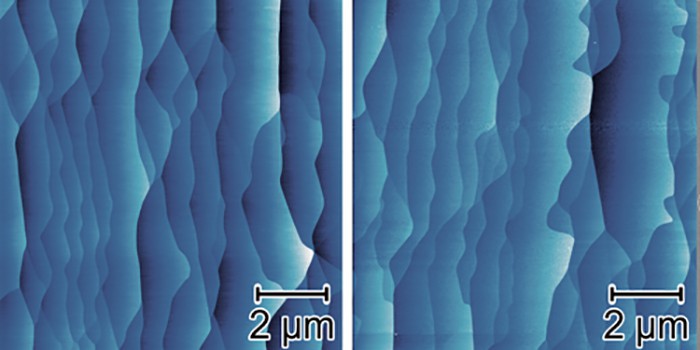
Atomic force microscope images of graphene on silicon carbide

A new technique for making freestanding graphene has been developed by Wataru Norimatsu and colleagues at Nagoya University in Japan. Graphene is a sheet of carbon one atom thick that has a range of properties that are technologically significant. It can be created by heating a piece of silicon carbide so that silicon atoms are removed from the surface, leaving behind carbon atoms that form graphene. An important shortcoming of this method is that bonds between carbon atoms in the graphene and silicon atoms in the substrate have a detrimental effect on the desired electronic properties of the graphene. Now, Norimatsu and colleagues have come up with a way of breaking the bonds to create freestanding graphene. Silicon carbide is first heated to over 1000 K to create graphene and then the sample is plunged into liquid nitrogen to cool it rapidly to 77 K. Graphene expands when cooled, whereas silicon carbide contracts. This breaks the bonds between the graphene and the substrate, leaving high-quality graphene, as described in Physical Review Letters.


Newton's apple pips to form UK orchard

By Matin Durrani

Today is not only World Science Day for Peace and Development (come on, don’t tell me you didn’t know) but also the world’s first ever International Science Center and Science Museum Day, which goes by the clunky acronym ISCSMD.

The grandiosely titled day seeks to “create new ways for our institutions to proactively address global sustainability while reaching increasingly diverse audiences”.

Building on UNESCO’s theme of “science for peace and development”, outcomes from the day’s events and discussions will be presented at the Science Centre World Summit 2017 in Tokyo next November.

(more…)

Copyright © 2026 by IOP Publishing Ltd and individual contributors