US board gives student assistants unionization rights

The United States National Labor Relations Board (NLRB) ruled last week that graduate students in private universities and colleges, who work as teaching or research assistants, are statutory employees of their institutions who have the right to join unions. The decision, made in response to a plea by graduate students at Columbia University, overturns a 2004 decision that denied the students union rights. Groups of student assistants have already reacted to the decision by filing for certification of local unions to represent them.

Tremendous victory

“Graduate employees deserve a seat at the table and a voice in higher education. Collective bargaining can provide that,” says Howard Bunsis, who chairs the American Association of University Professors’ Collective Bargaining Congress. “This is a tremendous victory for student workers.” Not surprisingly, representatives of private universities disagree. “We are disappointed that [the decision] has overruled years of precedent finding that graduate students are not employees for unionization purposes,” says Stanford University spokesman Brad Hayward.

The issue before the board focused on the relevance of the work that student teaching assistants carry out to their overall education. Students argued that their teaching duties are independent of, and can actually detract from, their research. “I took a lot of my time preparing lectures,” Mickey McDonald, a Columbia physicist who has just defended his doctoral research on ultracold molecules, told physicsworld.com. “And grading undergraduates’ lab reports can take up to 15 hours per week.” The ability to join unions, students added, will allow them to negotiate liveable stipends and working hours. They also pointed out that teaching assistants at state universities can already unionize, because they are protected by local state laws, and that the private New York University voluntarily unionized in 2013.

Influencing issues

Columbia University authorities countered that teaching assistantships give graduate students the skills and expertise they will need in future careers as researchers and teachers. Participation in collective bargaining, they added, could destroy the traditional mentor–student relationship. Indeed, they raised the possibility that student-assistants’ unions could influence issues beyond students’ economic situations – by trying to negotiate class sizes taught by teaching assistants, for example, or the details of examinations they mark. Prominent research universities such as Harvard, MIT and Princeton supported the Columbia arguments in “friends-of-the-court” briefs.

Graduate employees deserve a seat at the table and a voice in higher education. Collective bargaining can provide that

Howard Bunsis, chair, American Association of University Professors' Collective Bargaining Congress

In its 2004 decision on a case brought by Brown University student assistants, the NLRB largely agreed with those arguments. The board rejected the idea that student assistants could be considered employees of their universities because they “are primarily students and have a primarily educational, not economic, relationship with their university”. Last week’s decision rejected that thinking by a three-to-one majority. The 2004 decision, the board commented, had “deprived an entire category of workers of the protections of the National Labor Relations Act without a convincing justification”.

Pros and cons

Krista Freeman, a graduate student in physics at Carnegie Mellon University, who chairs the American Physical Society’s Forum on Graduate Student Affairs, welcomes the decision. “Many aspects of graduate student life are unsavoury and uncertain, and collective bargaining power could go a long way to correcting these issues,” she says. “This can only lead to healthier, happier and more financially stable students.”

Universities remain unconvinced. In a letter to the Columbia University community following last week’s decision, provost John Coatsworth speaks of the potential benefits and drawbacks of having student assistants’ interests represented by the United Auto Workers (which now focuses on employees beyond the car industry). “I am concerned about the impact of having a non-academic third party involved in the highly individualized and varied contexts in which faculty teach and train students in their departments, classrooms and laboratories,” he writes. Harvard University agrees. “We continue to believe that the relationship between students and the university is primarily about education, and that unionization will disrupt academic programmes and freedoms, mentoring and research at Harvard,” an official statement notes.

Nevertheless, the move to unionize has already started. On Monday, graduate students in 10 Yale University departments, including physics, geology and geophysics, and mathematics, filed a petition to the NLRB requesting certification of a local union to represent them.


Why use silicon qubits for quantum computing?

Computers based on quantum processes have the potential to be exponentially more powerful than today’s computers. At present, research groups across the world are exploring various different approaches to creating quantum computers – a difficult technological challenge given the delicate nature of quantum systems. In this video, Andrea Morello explains the approach taken by his group at the University of New South Wales in Australia, which is inspired by classical computing. It involves encoding data into the spins of phosphorous atoms embedded within silicon microchips.

This video is part of our 100 Second Science series, in which researchers give concise presentations covering the spectrum of physics.

Seismic ‘weather bomb’ lights up Earth’s interior

A powerful extratropical cyclone east of Japan in January 2013

A new type of rare deep-Earth tremor, created by fast-developing ocean storms, has been detected by researchers from Japan. The signals from this kind of faint Earth tremor – known as an “S-wave microseism” – may provide geophysicists with a new tool to study not only oceanic storms but also the Earth’s interior.

First observed in the 1940s, microseisms are faint Earth tremors generated by the sloshing of ocean waves on the sea floor during storm events. The strongest microseisms are generated by the interaction of directly opposing wave systems. These create pressure excitations that travel almost unattenuated to the sea floor because of the nonlinear effects of the fluid – unlike with normal ocean surface waves, which decay with depth.

Seismic signals

Microseisms – which are observed globally – may either travel across the surface of the Earth, or through its interior as body waves. Like the seismic waves generated by earthquakes, these body waves may either be compressional (P-waves) or transverse (S-waves) – although until now, because of their larger amplitude, only the former had been observed – and, unlike surface-wave microseisms, can be tracked back to their point of origin.

In their study, Kiwamu Nishida of the University of Tokyo and Ryota Takagi of Tohoku University looked at a special kind of small, fast-developing extra-tropical cyclone colloquial dubbed a “weather bomb”. Seismic signals from one of these storm events – which developed in the North Atlantic between Iceland and Greenland in the December of 2014 – were recorded on the Japanese High Sensitivity Seismograph Network. The researchers found signals not only of P-wave but also S-wave microseisms, both in vertically (SV) and horizontally (SH) polarized forms. While modelling had only predicted the creation of SV waves, the researchers believe that the SH waves may be generated by the repeated reverberation of shear waves in poorly layered shallow sediments on the ocean floor.

The discovery of S-wave microseisms may offer a new way of understanding the nature of these couplings between the atmosphere and deep Earth. “The energy ratio between P- and S-wave microseisms is crucial for inferring the excitation mechanism,” says Nishida. For example, he explains, “excitation sources on the sea surface excite P-waves dominantly, whereas excitation sources on the seaf loor excite larger S-waves.”

Crustal analyses

At the same time, the shorter wavelengths of S-wave in comparison to P-wave microseisms make them more sensitive to temperature, pressure and resultant composition changes within the Earth – potentially allowing for more detailed analyses of crust and upper-mantle structures.

“The excitation of transverse surface waves – Love waves – had been established before, but because of the small amplitude of body waves compared to surface waves, the observations of Nishida and Takagi are a surprise,” says Roel Snieder, a geophysicist at the Colorado School of Mines, who was not involved in this study. “Since array techniques are in general quite robust, their detection of SH waves is convincing.”

With their initial study complete, the researchers are now looking to develop new methods to use body-wave microseisms to explore the nature of the Earth’s interior beneath oceanic storms. To this end, they are presently compiling a catalogue of storm events, similar to the weather bomb already examined, for use in such studies.

The research is described in the journal Science.

A physics tour of Beijing

Dusk falls on Beijing

By Hamish Johnston in Beijing 

It’s a lovely warm evening here in Beijing. I have just arrived for an action-packed visit in which I will have a chance to meet some of China’s top physicists and science policy makers.

Over the next few days I’m looking forward to meeting people at the Chinese Physical Society (CPS),  the China Association for Science and Technology (CAST), the Ministry of Science and Technology of China (MOST), the National Natural Science Foundation of China (NSFC) and more.

(more…)

Nonlinear optical quantum-computing scheme makes a comeback

A debate that has been raging for 20 years about whether a certain interaction between photons can be used in quantum computing has taken a new twist, thanks to two physicists in Canada. The researchers have shown that it should be possible to use “cross-Kerr nonlinearities” to create a cross-phase (CPHASE) quantum gate. Such a gate has two photons as its input and outputs them in an entangled state. CPHASE gates could play an important role in optical quantum computers of the future.

Photons are very good carriers of quantum bits (qubits) of information because the particles can travel long distances without the information being disrupted by interactions with the environment. But photons are far from ideal qubits when it comes to creating quantum-logic gates because photons so rarely interact with each other.

One way around this problem is to design quantum computers in which the photons do not interact with each other. Known as “linear optical quantum computing” (LOQC), it usually involves preparing photons in a specific quantum state and then sending them through a series of optical components, such as beam splitters. The result of the quantum computation is derived by measuring certain properties of the photons.

Simpler quantum computers

One big downside of LOQC is that you need lots of optical components to perform basic quantum-logic operations – and the number quickly becomes very large to make an integrated quantum computer that can perform useful calculations. In contrast, quantum computers made from logic gates in which photons interact with each other would be much simpler – at least in principle – which is why some physicists are keen on developing them.

This recent work on cross-Kerr nonlinearities has been carried out by Daniel Brod and Joshua Combes at the Perimeter Institute for Theoretical Physics and Institute for Quantum Computing in Waterloo, Ontario. Brod explains that a cross-Kerr nonlinearity is a “superidealized” interaction between two photons that can be used to create a CPHASE quantum-logic gate.

This gate takes zero, one or two photons as input. When the input is zero or one photon, the gate does nothing. But when two photons are present, the gate outputs both with a phase shift between them. One important use of such a gate is to entangle photons, which is vital for quantum computing.

The problem is that there is no known physical system – trapped atoms, for example – that behaves exactly like a cross-Kerr nonlinearity. Physicists have therefore instead looked for systems that are close enough to create a practical CPHASE. Until recently, it looked like no appropriate system would be found. But now Brod and Combes argue that physicists have been too pessimistic about cross-Kerr nonlinearities and have shown that it could be possible to create a CPHASE gate – at least in principle.

From A to B via an atom

Their model is a chain of interaction sites through which the two photons propagate in opposite directions. These sites could be pairs of atoms, in which the atoms themselves interact with each other. The idea is that one photon “A” will interact with one of the atoms in a pair, while the other photon “B” interacts with the other atom. Because the two atoms interact with each other, they will mediate an interaction between photons A and B.

Unlike some previous designs that implemented quantum error correction to protect the integrity of the quantum information, this latest design is “passive” and therefore simpler.

Brod and Combes reckon that a high-quality CPHASE gate could be made using five such atomic pairs. Brod told physicsworld.com that creating such a gate in the lab would be difficult, but if successful it could replace hundreds of components in a LOQC system.

As well as pairs of atoms, Brod says that the gate could be built from other interaction sites such as individual three-level atoms or optical cavities. He and Combes are now hoping that experimentalists will be inspired to test their ideas in the lab. Brod points out that measurements on a system with two interaction sites would be enough to show that their design is valid.

The work is described in Physical Review Letters. Brod and Combes have also teamed-up with Julio Gea-Banacloche of the University of Arkansas to write a related paper that appears in Physical Review A. This second work looks at their design in more detail.

Testing the brain’s ‘physics engine’, lawnmower aurora alert and more

https://youtu.be/1vwa8-wUJIo


By Hamish Johnston and Tushna Commissariat 

You may not know it, but apparently you have a dedicated region in your brain that is your “physics engine”. At least that is what cognitive researchers from Johns Hopkins University are suggesting after they have pinpointed a specific region of the human brain that intuitively understands physics – at least when it comes to predicting how objects behave in the real world. According to the team, the engine is kick-started when we observe physical events as they happen and is “among the most important aspects of cognition for survival”. Surprisingly, the region is not located in the brain’s vision centre, but is actually the same area we tap into while making plans of any type. In the video above, the team has created a little game for you to test your engine’s horsepower – go ahead and tell us how you did.

What physicist can resist making a back-of-the-envelope calculation to test an outlandish claim, especially if it involves a race between a car and gravity? In his recent Forbes blog, physicist Chad Orzel has sharpened his pencil to try to work out whether the Tesla Model S can accelerate to 100 km/h on the track in less time than it would if it was dropped from a height. The car is electric, which means that it should be much faster off the mark that a conventional vehicle. But, “Can a Tesla Model S really accelerate faster than gravity?”.

What’s the difference between a dazzling display of the aurora borealis and a lawnmower? Not much, it seems, if you use a geomagnetic sensor operated by AuroraWatch at the University of Lancaster in the UK. On Tuesday the organization sent out a “red alert” to its e-mail subscribers telling them to look out for a big show of the northern lights. But alas, the apparent huge spike in geomagnetic activity seen in the AuroraWatch sensors was actually caused by the operation of a nearby lawnmower. Can you imagine what would happen if someone accelerated nearby in a Tesla Model S? You can read all about it here: “Red alert cancelled”.

Nobel laureate James Cronin dies at 84

Photograph of James Cronin

American nuclear-physicist James Cronin, who shared the 1980 Nobel Prize for Physics with Val Fitch, died on 25 August, at the age of 84. Cronin and Fitch – who died in February last year – were awarded the prize for their 1964 discovery that decaying subatomic particles called K mesons violate a fundamental principle in physics known as “CP symmetry.” The research pointed towards a clear distinction between matter and antimatter, helping to explain the dominance of the former over the latter in our universe today.

Born in Chicago, Illinois, on 29 September 1931, Cronin completed his BSc in 1951 at the Southern Methodist University in Dallas, where his father taught Latin and Greek. Cronin moved to the University of Chicago, where he graduated with a PhD in physics in 1955. While there, Cronin benefited from being taught by stalwarts of the field, including Enrico Fermi, Maria Mayer and Subrahmanyan Chandrasekhar.

After his doctorate, Cronin worked as an assistant physicist at the Brookhaven National Laboratory (BNL) until 1958, when he joined the faculty at Princeton University, where he remained until 1971. He then returned to the University of Chicago to become professor of physics. Cronin met Fitch during his time at BNL and it was Fitch who brought him to Princeton. While there, the duo aimed to verify CP symmetry using BNL’s Alternating Gradient Synchrotron (AGS) by showing that two different particles did not decay into the same products.

Verified violation

They planned on doing this by colliding proton beams into a metal target to produce many millions of short-lived and long-lived K mesons. The former would always decay into two pi mesons, while the latter would not. Instead, to their surprise, they spotted a “suspicious-looking hump” in the data, which showed that, on occasion (in 0.2% of the cases), the long-lived variety also decays into two pi mesons, thereby violating CP symmetry.

In recent years, Cronin was instrumental in the development of the Pierre Auger Project, which he conceptualized in 1992 with fellow physicist Alan Watson. The $50m cosmic-ray observatory is based in Argentina, and is designed to pick up ultra-high-energy cosmic rays as they travel at near-light speeds through the Earth’s atmosphere, producing “air showers” of other particles as they interact with atmospheric nuclei. It is currently the world’s largest cosmic-ray detector, with a 3000 km2 collecting area. Despite the fact, the observatory announced in December last year that it is set for a $14m upgrade, which will allow for more precise measurements of the mass of particles that make up cosmic rays, as well as trying to pinpoint their original source.

Giant two-atom molecules are the size of bacteria

Enormous two-atom molecules about the size of ordinary bacteria have been made by two chemists in Switzerland. Comprising two caesium atoms, each “macrodimer” is about 1 μm in length – which is almost 10,000 times larger than common diatomic molecules such as oxygen. Although macrodimers were first spotted in 2009, this time the scientists were able to study the molecules more directly. They were also able to flesh out the existing theory describing these short-lived molecules and predict which types would have longer lifetimes. This allowed them to create macrodimers that could last about 1 μs before breaking apart into ions.

The macrodimers are so large because their constituent atoms are also huge – with each atom having an outermost electron that is excited into a far-flung atomic orbital. These are known as Rydberg atoms, and at room temperature they only exist for a very short time. This is because the outer electron is so weakly bound to the rest of the atom that collisions from nearby particles can easily knock it out of the atom. To minimize these collisions and extend the lifetime of the Rydberg atoms so molecules could be made, Heiner Saßmannshausen and Johannes Deiglmayr of the Swiss Federal Institute of Technology (ETH) in Zurich, Switzerland, created Rydberg atoms at extremely low temperatures.

They began with a diffuse cloud of caesium atoms that had been laser-cooled to below 40 μK. The average separation between atoms in the cloud was about 1 μm. The duo then used pulsed laser light to excite a small fraction of the caesium atoms into Rydberg states in the 44th energy level. Then they pulsed the gas cloud with a second laser, which had a photon energy slightly less than that required for caesium’s transition to the 43rd energy level. That difference in energy is equal to the binding energy of the macrodimer. That is the amount of energy that two caesium atoms in the 43rd and 44th energy levels would lose by joining together as a macrodimer.

Ions of distinction

This pulse excited pairs of atoms simultaneously into a state in which the two atoms behaved collectively as a molecule. To confirm that it had indeed created macrodimers, the team looked for the caesium ions that formed when the huge molecues break apart. The researchers found that these ions have distinctive properties that are predicted by a macrodimer model, which allowed the duo to conclude that they had indeed made the giant molecules.

The orbital overlap is basically zero

Heiner Saßmannshausen, ETH Zurich

The atoms in the micron-sized molecule interact with each other via van der Waals forces. This is a relatively weak interaction that arises when the outer electron of one atom deforms the shape of the other atom via electrostatic forces. This deformity can result in either attraction or repulsion between the two atoms, depending on the distance between them. This exotic molecular “bond” is different from the usual bonds that hold molecules together, such as covalent and ionic bonds, in which atoms in close proximity share or give up electrons to each other. “In our case, the atoms are really completely separated,” Saßmannshausen says. “The orbital overlap is basically zero.”

“This is a great achievement,” says Robin Côté, a theoretical physicist at the University of Connecticut, who was part of the team that first predicted the existence of macrodimers in 2002. This latest work expands on that prediction, which was based on a much simpler model.

Quantum gold mine

Côté says the work heralds a gold mine of new quantum-mechanical phenomena on a different scale. “The fact that these macrodimers exist is amazing,” he says. “It’s amazing that quantum mechanics is relevant between objects a micron apart. This is a new type of molecule that you could not observe under normal conditions.”

Côté and collaborators are already on to the next step: modelling a three-atom micron-scale molecule. In 2013, they published a paper predicting the existence of these macrotrimers, still yet to be created in the lab. In addition, he says that because macrodimers provide a new way to control two atoms at once, they could be used in quantum-information applications. “What’s next? Who knows?” he says. “There’s plenty of possibilities. Whenever you get a new toy, there are plenty of interesting new things to think about.”

The macrodimers are described in Physical Review Letters.

  • There is much more about the fascinating world of Rydberg atoms in this feature article by Keith Cooper: “The rise of Rydberg physics“.

Nuclear power’s ups and downs

Photo taken from the bottom of a cooling tower, with red and orange machinery in the foreground, steep grey walls, and a circle of clear blue sky, into which a small puff of cloud is escaping

As the First World War began, the British foreign secretary Sir Edward Grey reportedly declared “The lamps are going out all over Europe.” Judging by recent predictions of a gap between the UK’s supply of electricity and future demand, perhaps we should replace “Europe” with “Britain”. Nuclear power stations provide more than 20% of the UK’s electrical generation capacity, but most will close by the mid-2020s; only one new nuclear power station has been ordered since 1980; and plans to build more are still not finalized. The reasons for the ambivalent attitude to nuclear power are a combination of technology, politics and economics. In his book, The Fall and Rise of Nuclear Power in Britain, Simon Taylor – from the University of Cambridge’s Judge Business School – concentrates mainly on the latter.

Taylor begins by reviewing the period between 1945 and 2002, which he calls “the years of hope and disappointment”. During this period governments dithered and plans for future nuclear power stations grew and diminished. The claims of nuclear proponents – mainly scientists and engineers developing the plants – were highly optimistic, and cost estimations were confused by somewhat dubious accounting methods (for example, R&D costs were ignored). Indeed, government plans were initially determined more by the UK Atomic Energy Authority (UKAEA) than by the Central Electricity Generating Board, which was much more sceptical even though two of its heads were ex-UKAEA chairpersons. This should, perhaps, have been a warning sign.

The problems for the UK nuclear industry can be traced to the decision, after the Second World War, to develop air-cooled, graphite-moderated piles to produce plutonium for nuclear weapons. The UK had also been considering the possibility of nuclear-generated electricity, since politicians were told that coal was becoming scarce (after it was found to be more plentiful, the arguments moved from economics to security and diversity of supply). So, when the plutonium piles were found to be less efficient than hoped, the supposed coal shortage and the desire for nuclear weapons came together, leading to the birth of the Magnox reactor programme.

These CO2-cooled, graphite-moderated reactors used natural uranium fuel and operated successfully for decades: the last closed in December 2015. However, they were “developed” over the years, which, as Taylor notes, “reduced the chance of economies of scale”, as different designs were built by different consortia on different sites. Most of them overran both in time and cost. Following on were the advanced gas-cooled reactors (AGR), which were CO2-cooled, graphite-moderated but used enriched fuel and are the main type in use in the UK today.

A major problem was that the UK chose not to pursue what was, by the 1970s, rapidly becoming the global design choice: the light-water reactor (LWR). This US-developed design uses low-enriched fuel and either pressurized water or boiling water as both coolant and moderator, and US economic power meant the UK’s gas-cooled designs lost out in global competition. The last AGRs were ordered in the late 1970s, and by then the UK’s nuclear industry was already beginning to look very fragile: even in 1965 there were warnings that AGRs were not the economic choice.

As Taylor shows in the book, these problems came to a head in the 1980s, when the Conservative government privatized the electricity generation industry, exposing the nuclear sector’s financial and operational weaknesses. Only one new nuclear power station, the pressurized-water reactor at Sizewell B (Britain did, at last, catch up with global thinking on design), was planned and built in this period; it was supposed to have been the first of 10. Several attempts to privatize nuclear power stations ended with the government retaining responsibility for the Magnox reactors and, later, rescuing the privatized British Energy, which operated the AGRs. Also, in the early 1990s, the price of coal was artificially increased to protect its industry, meaning “nuclear had to bear the cost”. The extent of coal’s influence on nuclear power, in terms of availability, political influence, economics and now carbon emissions, is an intriguing theme running through the book.

The Labour governments that followed from the late-1990s were initially rather circumspect about nuclear power, partly due to ministers who saw it as a threat to Labour’s traditional coal industry base. However, by 2005 increasing pressure to reduce greenhouse gases and fossil fuel use produced a change of heart. A series of policy decisions (including, significantly, the Climate Change Act of 2008, which required a steady decrease in carbon emissions) led to the next stage: new nuclear power.

Taylor concentrates on the economic and political activities from 2002 through to 2015, when his book was completed. During this period the path for new nuclear power stations was eased somewhat via changes to planning controls and siting decisions. A system for private companies to submit designs to regulatory bodies before offering them to the operators was also introduced, reducing commercial risks. These designs were of foreign origin, though, because in this period the UK ceded control of its nuclear power industry to other countries. In particular, British Energy was sold to EDF, which is about 85% owned by the French government.

Although the government’s mantra has long been “no subsidies”, events such as the 2008 financial crash and the meltdown at Japan’s Fukushima Daiichi reactor made this impractical. To date, EDF’s plan to construct European pressurized-water reactors (EPRs – the only new design with UK regulatory approval) has received several government financial guarantees, including a guaranteed price for electricity for 35 years; government debt guarantees on construction loans; and indemnity against future policy changes. These are subsidies by other names, and required EU approval; their costs will be borne by consumers. Even with such support, EDF’s project still needed additional financing from Chinese partners. As part of the deal, these companies will receive assistance in getting regulatory approval for a Chinese-designed LWR. Similar guarantees will, no doubt, be expected by the two other potential operators, HORIZON and NuGen, which are also foreign owned and considering different designs, respectively a Japanese boiling-water reactor and a US pressurized-water reactor, assuming regulatory approval is granted.

Given all these difficulties, it is natural to consider whether alternative power sources could take nuclear’s place. But while Taylor expresses some doubts about the costs of nuclear power stations, dubbing EDF’s EPR “the world’s most expensive power station”, he finds the alternatives wanting.

His closing comment that “reliable sources of low-carbon power…[are needed]…that avoid dependence on foreign gas and which offer heat and light on a cold, still winter’s night” is worth repeating. Nuclear power is the only proven, low-carbon technology that can do this, but it needs government help. Since the book was written, new threats to EDF’s plans have surfaced. EDF and the French government seem supportive – albeit with a few dissenters, including EDF’s financial director, who resigned in March because he believed the project could jeopardize the company’s future. However, the final decision to build has still not been made and it will not occur until September at the earliest after a consultation with the French unions. All three potential new-build operators are targeting the mid-2020s for first operation.

Taylor’s book is an excellent summary of the technological, economic and political tribulations of nuclear power in the UK up to 2015. If I have one quibble it’s in the title: “fall and rise” hardly does justice to the rollercoaster ride that has been the history of nuclear power in the UK.

  • 2016 UIT Cambridge £19.99pb 256pp

Rocky planet found in habitable zone around Sun’s nearest neighbour

In a breakthrough discovery, clear evidence of at least one planet orbiting Proxima Centauri, the closest star to our Sun, has been found by the international Pale Red Dot collaboration. The exoplanet – dubbed Proxima b – has a minimum mass of about 1.3 times that of the Earth and is therefore most likely a terrestrial planet with a rocky surface, and has a short orbit of around 11.2 days. Our newly found neighbour also lies within its star’s habitable zone, meaning that it could, in theory, sustain liquid water on its surface, and may even have an atmosphere. The team suggests that the system may even contain another larger exoplanet that is much further away, or smaller companion planets, but the evidence for these is currently not conclusive.

Proxima Centauri was first spotted in 1915 by the Scottish astronomer Robert Innes, and is a red-dwarf star that is merely 4.2 light-years away from the Sun, in the constellation of Centaurus. It is too dim to be seen with the naked eye and lies relatively close to the bright Alpha Centauri binary star system. Thanks to its proximity to us, we can clearly resolve the star’s angular diameter, which is about one-seventh that of the Sun, while the star’s mass is about an eighth of the Sun’s.

Planets ahoy

Red dwarfs are small, cool, main-sequence stars, usually with a surface temperature of less than 4000 K. They abound in our galaxy, but are often difficult to observe, thanks to their low luminosity. But they are the most common stars in our stellar neighbourhood and at least 20 out of 30 of our nearest neighbours are red dwarfs. Of these stars, many are known to host exoplanets, and previous studies have found that almost 40% of red dwarfs have a “super-Earth”-class planet – with masses that are between 2 and 10 times that of the Earth – orbiting in the star’s habitable zone.

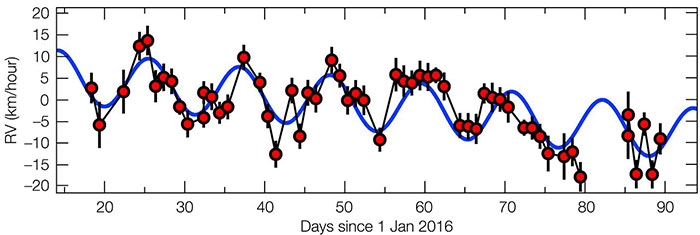
One of the methods currently used by astronomers to detect potential exoplanets is known as the “radial-velocity technique”, where they pick up tiny shifts in the wavelength of starlight caused by the presence of an exoplanet. These changes are derived from shifts in the parent-star’s spectral lines caused by the Doppler effect. While this method works very well for enormous planets in close orbit to the stars, it is extremely hard to pick up Earth-sized planets. Fortunately, red dwarfs are so small that their “wobble” is much easier to detect with our current technology.

Although there have been hints of a possible exoplanet in orbit around Proxima Centauri for the past 15 years, the signal was not convincing enough and appeared to have some strange deviations. We still do not fully understand the dynamics of red dwarfs and how they change over different timescales, and as a result, researchers could not tell for sure if the previously detected signals from Proxima Centauri were truly from a planet or due to some variability introduced during the star’s 88 day rotation, such as by a star spot, which also introduces a wobble.

Planetary signal?

Since 2013, the Pale Red Dot campaign has worked towards getting enough clear observations to tell for sure if the star hosted a planet. A way to do this was to carry out a long and continuous observational study of the star, and earlier this year, the team carried out a study of the star using the European Southern Observatory’s High Accuracy Radial velocity Planet Searcher (HARPS) spectrograph at the La Silla Observatory in Chile, together with three other telescopes around the world.

According to project co-ordinator Guillem Anglada-Escudé, from Queen Mary University in the UK, such a long observing mode is normally not allowed by ESO for a variety of reasons. But after a lot of “convincing” by the collaboration, they were allowed to study the star for 20 minutes every night for a two-month period, from 19 January to 31 March 2016.

Plot showing the 'wobble' of Proxima Centauri, from data taken in 2016

To ensure that the signal was in no way a false one created by Proxima Centauri, which is an active star, the team also carefully monitored its changing brightness during the campaign using telescopes at the San Pedro de Atacama Celestial Explorations Observatory in Chile and the Las Cumbres Observatory global network.

According to team-member Pedro Amado from the Instituto de Astrofísica de Andalucía in Granada, Spain, this continuous monitoring of at least five cycles of the stellar signal was crucial for the conformation. By analysing the 2016 data together with Doppler measurements collected by two ESO telescopes between 2000 and 2014, the team can confirm the existence of at least one planet in orbit around our neighbouring star.

Flashy star

The observations showed that Proxima Centauri approaches and recedes from the Earth at around 5 km/h and the pattern regularly repeats with a period of 11.2 days. By analysing the Doppler shifts, the researches determined that the planet has a minimum mass of 1.3 times that of the Earth and orbits Proxima Centauri at a distance of about 7 million kilometres – only five per cent of the Earth–Sun distance. The researchers deduce that the planet is terrestrial thanks to its Earth-like mass. It is also most likely tidally locked, but whether it has a synchronous rotation – i.e. the same side is always in the light or dark, like our Moon – is impossible to tell.

Although Proxima b orbits much closer to its star than Mercury does to the Sun, its parent star is much fainter than ours. This means that Proxima b lies well within the habitable zone around the star and has an estimated surface temperature that would allow the presence of liquid water. Despite the temperate orbit of Proxima b, the conditions on the surface may be strongly affected by the ultraviolet and X-ray flares from the star – far more intense than the Earth experiences from the Sun. But, according to team-member Ansgar Reiners at the Institut für Astrophysik, Universität Göttingen in Germany, this does not exclude the existence of an atmosphere, looking at the activity of the star today.

What will ultimately determine the actually habitability of the planet – including whether it currently has liquid water on its surface and an atmosphere – depends entirely upon its formation history. If the planet formed far away from the star and then migrated into its current orbit, it would have contained lots of water. On the other hand, it will be a dry planet, such as Venus or Mercury, if it formed close by, or so the researchers speculate.

Amado points out that we have “unmatched observing opportunities” as the exoplanet is so close to us and can, in theory, be resolved by a 3.5 m telescope. Actually being able to pick up enough light from it is another challenge that telescopes such as the ELT could attempt. “This is a planet in our neighbourhood and maybe we will finally send out a probe and take a picture from somewhere other than Earth,” hopes Amado.

The discovery is described in Nature.

Copyright © 2026 by IOP Publishing Ltd and individual contributors