“90% of new products are targeted at the richest 10% of the world’s population” – that’s my take-home message from a fascinating presentation by Surya Raghu at the Fall Meeting of the Chinese Physical Society here in Beijing. An engineer by training, Raghu founded US-based Advanced Fluidics in 2001 after a career in academia.
Raghu was speaking to a group of Chinese students about how to embark on a career as an entrepreneur. Student-age is the best time to acquire the mindset of an entrepreneur, says Raghu and he emphasized the concept of “inclusive knowledge transfer”. This a way of ensuring that products developed at universities benefit even the most disadvantaged in the world.
Thanks to in situ measurements from the Micro-Imaging Dust Analysis System (MIDAS) on board the Rosetta spacecraft, researchers have now found out more about the structure of the dust particles on comet 67P/Churyumov–Gerasimenko. Their findings show that the particles are made up of aggregates and cover a range of sizes – from tens of microns to a few hundred nanometres. They also appear to have formed from the hierarchical assembly of smaller constituents and come in a range of shapes, from single grains to larger, porous aggregated particles with some dust grains being elongated. The study could shed more light on the processes that occurred when our solar system formed nearly five billion years ago.
Planetary systems like our own solar system started out as dust particles in protoplanetary nebulae – clouds of gas and dust that gave rise to stars and planets. The particles collided and agglomerated to form planetesimals – the building blocks of planets. Comets are leftover planetesimals and are made of ice and dust particles. They range in size from a few hundreds of metres to ten of kilometres and are mainly found on the outskirts of the solar systems, far from damaging radiation, high temperatures and collisions with other objects.
Pristine particles?
“They are a kind of cold storage,” says team-leader Mark Bentley of the Space Research Institute (IWF) in Graz, Austria, “and so the dust particles they contain should be almost pristine. We hope that these particles can teach us something about the processes of dust agglomeration that took place 4.6 billion years ago.”
“Until now, we have had a hard time trying to understand the very early phases of planet formation,” he adds. “In our solar system, this occurred so long ago, and in other star systems we can only measure the average properties by looking at the way light interacts with dust particles, not study them individually.”
Previous studies to analyse cometary dust include that from the Stardust spacecraft that collected dust particles during its flyby of comet Wild 2. However, the particles here were not pristine as they were collected as far away as hundreds or even thousands of kilometres from the comet’s surface. They would also have fragmented upon their journey and since they were also travelling at more than 6 km/s relative to the spacecraft, they were irrevocably damaged when they collided with Stardust’s sample collector.
Gathering dust
The Rosetta mission, on the other hand, is different in that it provided researchers with the first chance to collect cometary dust “at a ‘walking pace’ rather than a fast fly-by, and the chance to get within a few kilometres of comet 67P/Churyumov-Gerasimenko,” says Bentley. “We obtained our data from the MIDAS instrument on board, which is the first ever atomic force microscope (AFM) to have been launched into space.”
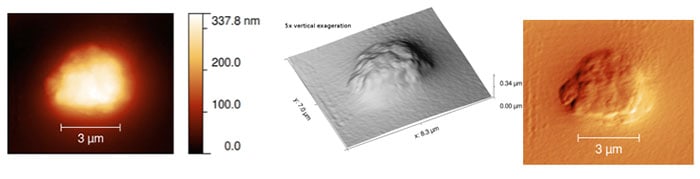
Particle pictures: Three representations of the same scan of a calcite particle on the MIDAS Flight Spare instrument. (Courtesy: Rosetta mission/MIDAS)
MIDAS collects dust in the vicinity of the comet on small (1.4 × 2.4 mm) targets and then scans them with the AFM to reveal their size, shape and texture in 3D, he explains. The device scans the collected dust particles using a sharp, needle-like tip and produces a 3D image of the particle with a maximum resolution of 4 nm. Unlike a standard AFM, it does not scan its tip continuously over the surface of a sample but carefully approaches the target at each point in the image.
The images show that the dust particles are built from smaller sub-micron grains, themselves apparently aggregates. Such hierarchical structures have only been hypothesised in theory until now and never observed directly.
“Our results also confirm that the grains forming the particles are elongated, which is similar to the shape of interstellar particles measured in remote observations,” says Bentley. “One question is how much of the material that went into building asteroids, planets and comets was reprocessed (melted and reformed for example) as opposed to that which remained as original ‘stardust’, and our results hint that at least some is original material.”
New models
Ludmilla Kolokolova of the University of Maryland in the US, who was not involved in this work, says that the Bentley and colleagues’ new work “enhances our fundamental understanding of cometary dust, and the processes that ultimately gave rise to planetary systems such as the solar system. Their discovery of a hierarchical structure in cometary-dust particles and their description of the basic building blocks of such particles might lead physicists to reconsider the interpretation of data obtained from ground-based observations of comets and re-evaluate the processes in protoplanetary nebulae – and will probably give rise to new models of how planets were formed,” she writes in a related Nature News & Views article.
“The particles described in this study were collected early on in Rosetta’s mission – before the dust density forced the spacecraft to fly farther from the comet (and reduce our chances of collecting more dust),” explains Bentley. “Fortunately, in February this year, we collected a large sample of dust. With only a few weeks left before the orbiter lands on comet 67P, so ending the mission, we are scanning as much of this target as possible to continue the story!”
Quantum star: Jian-Wei Pan before his television appearance.
By Hamish Johnston in Beijing
A few weeks ago China launched the world’s first “quantum satellite” from the Jiuquan Satellite Launch Center, which about 1600 km from Beijing. This morning I met the lead scientist on the mission, Jian-Wei Pan of the University of Science and Technology of China, who is visiting Beijing on his way home to Hefei from Jiuquan.
I asked Pan how the mission (called QUESS) was going, and in particular if his team has managed to get the satellite to send entangled pairs of photons back to Earth. He said we would have to wait for the team to write a paper about the satellite’s initial performance – so let’s just say he was in a very good mood! Stay tuned for more information about this pioneering mission that could lead to quantum communications in space.
Florence Bascom had to take classes for her geology PhD behind a screen so that she wouldn’t “distract” her male classmates. Maria Goeppert-Mayer didn’t have a full-time paid job as an academic physicist until 1960 – three years before she won the Nobel prize. And when Patricia Bath became the first female faculty member in the ophthalmology school at the University of California, Los Angeles, her peers tried to assign her an office next to where the lab animals were kept (she refused it, moved to Europe and later invented a device that removes cataracts). Their stories – and those of 47 other notable women – are told in Rachel Ignotofsky’s richly illustrated book Women in Science: 50 Fearless Pioneers Who Changed the World.
Ignotofsky’s choice of women to profile is admirably diverse, with a significant number of African-American women in the list and famous names such as Ada Lovelace and (of course) Marie Curie sharing space with less well-known figures. Each profile is dotted with anecdotes and quotations, including this gem from engineer and suffragette Hertha Ayrton: “An error that ascribes to a man what was actually the work of a woman has more lives than a cat.” The truth of Ayrton’s words is frequently apparent in other profiles. Rosalind Franklin is perhaps the most famous example of a woman whose scientific contributions were downplayed in her lifetime, but she was certainly not alone. Other once-overlooked figures include the geneticist Nettie Stevens, who identified the XY chromosome as male; the chemist Alice Ball, who developed an early treatment for leprosy; and the microbiologist Esther Lederberg, whose husband and lab partner failed to thank her in his Nobel prize speech even though they had done the prize-winning work together. (They soon divorced.)
The biochemist Gerty Cori was more fortunate: she and her husband Carl shared the 1947 Nobel Prize in Medicine after a career in which he refused to work at institutions that wouldn’t allow her to join him. After illness sapped her strength, he carried her around their laboratory so they could continue working together (how romantic!). But while supportive mentors, parents and spouses get their due, the real glory in Ignotofsky’s book belongs to the female scientists who, as she puts it “in the face of ‘No’ said ‘Try and stop me’ ”
What are the main aims of the National Natural Science Foundation of China (NSFC)?
The NSFC was set up 30 years ago in 1986 after being proposed by a group of scientists led by the Nobel-prize-winning physicist Tsung-dao Lee. They told the then Chinese leader Deng Xiaoping that the US has its own National Science Foundation and China should have something similar. He agreed.
How big is your budget?
It’s increased 300-fold since the NSFC was founded. Back then it was about ¥80m ($12m) annually. Now it’s about ¥24.8bn per year.
What areas does the NSFC fund?
We support all the main branches of natural science including mathematics, physics, chemistry, biosciences, earth science, engineering and materials, IT and medicine. We also support some data-driven social and management science too.
How much money does physics get?
We have two main budget lines. Physics I is mainly condensed-matter physics, while Physics II is particle physics, theoretical physics and astronomy. Altogether, they get more than ¥1bn a year.
How many researchers does the NSFC support?
We hand out about 40,000 new research grants each year, which together support about 150,000 people when you take into account students, postdocs and research assistants too. The success rate for those applying for funding is about 22–25%, which is okay. I think a quarter is the golden ratio – neither too high nor too low.
You were appointed president of the NSFC in 2013 – what have been your main achievements during that time?
I have secured a total budget increase of 50% during my three-year tenure. And as well as paying for researchers’ “direct” costs, the NSFC now also funds their “indirect” costs, such as the money for lab space, infrastructure and so on to the hosting institutions. Previously that money went to institutions as a lump sum and they’d charge scientists a certain percentage as a management fee. I’ve also changed the regulations so that someone applying for a grant can support however many graduate students, postdocs and so on that an individual researcher needs. There’s no upper limit on how many they can request.
What are your main challenges as NSFC boss?
I’ve just written an article in Nature saying the importance of raising the quality, integrity and applicability of Chinese science (534 467). In the article, I describe how the NSFC’s mission is to be a “FRIEND” of scientists: fair in reviews; rewarding in fostering research; international in global participation; efficient in management; numerous in grants; and diversified in disciplinary coverage. I also want to get more “monumental” contributions to different branches of science, not researchers just doing more of the same.
How do you evaluate whether grant money has been well spent?
Every year we have an external evaluation where independent experts check a certain percentage of grants in our eight main areas. We don’t monitor every single grant though. We also don’t evaluate the performance of individual researchers funded by the NSFC as we feel that would make them conservative and suppress their creativity.
So how do you measure success?
Publication records are one factor, of course, though we think quality is more important than the sheer number of papers produced. We also survey researchers to find out if they were satisfied with the performance of the NSFC – and that includes asking scientists who failed to receive grants. What’s interesting is that 20 years ago, when you look at the top 0.1% most cited papers, Chinese researchers accounted for less than 0.5% of those publications. Now they contribute a fifth of those articles.
What about tackling fraud and misconduct?
That’s important, yes. I want to reduce cases of misconduct, which have gone up a bit recently, and raise the overall reputation of Chinese research work.
What’s your view on open access?
Chinese researchers can publish in any journals – they don’t have to be open-access journals. However, the official policy of the NSFC is to support green open access, which means that scientists have to place a copy of their final paper in our own NSFC electronic repository 12 months after it’s been published in a peer-reviewed scientific journal. Having said that, China published 45,000 papers in open-access journals last year, which is 21% of the world’s total and exceeds the amount from the US.
Do you follow developments in physics?
It’s been very exciting to see the Laser Interferometer Gravitational-Wave Observatory detect gravitational waves and we are planning several initiatives of our own in China in this area. We’re also building the China Jingping Underground Laboratory in south-western China and we’ve got our satellite programme to search for dark matter and carry out space-to-Earth quantum communication.
When the amateur golfer Bryson DeChambeau shot a five-over-par 72 at the US Masters in April this year, his score – good enough to tie for 21st place – wasn’t the only thing that attracted the media’s attention. DeChambeau, it transpired, is a physics graduate who took the unusual step of cutting all of his irons and wedges to the same length, so that he doesn’t have to adjust the plane of his swing when he changes clubs (see “Physics at the Masters”, May p3). Most golfing physicists are not so dedicated (and few, if any, are as talented – DeChambeau has since turned professional and currently ranks in the top 150 in the world), but those with a serious interest in the science of their sport will definitely want to get their gloved hands on The Science of the Perfect Swing.
In the book’s introduction, author Peter Dewhurst notes that “the general theory of impact, the science of flight, and the mechanics of motion…are among the most fascinating of the physical sciences” and they are also, of course, integral to the game of golf. Dewhurst is an emeritus professor of theoretical and applied mechanics at the University of Rhode Island, US, and his book goes into an impressive amount of detail on nearly every aspect of golf, from the ridiculousness of “low friction” tees (which, he notes, “magically add 80 pounds” to a maximum impact force of nearly 3000 pounds) to the benefits of the high-performance drivers introduced in the mid-2000s.
Most of the book is written at the level of a beginning undergraduate mechanics course, but each chapter also contains a lengthy section on the “supporting physics”, which reads more like a scientific review article. Whether it actually moves you closer to a “perfect swing” is an exercise best left to the reader, but there is, at least, some support in the book for DeChambeau’s single-length clubs. For a player “on Tour”, Dewhurst writes, “the major requirement is not ultra-long hitting, so it can only be consistency of ball striking”.
2016 Oxford University Press £22.99/$35.00hb 288pp
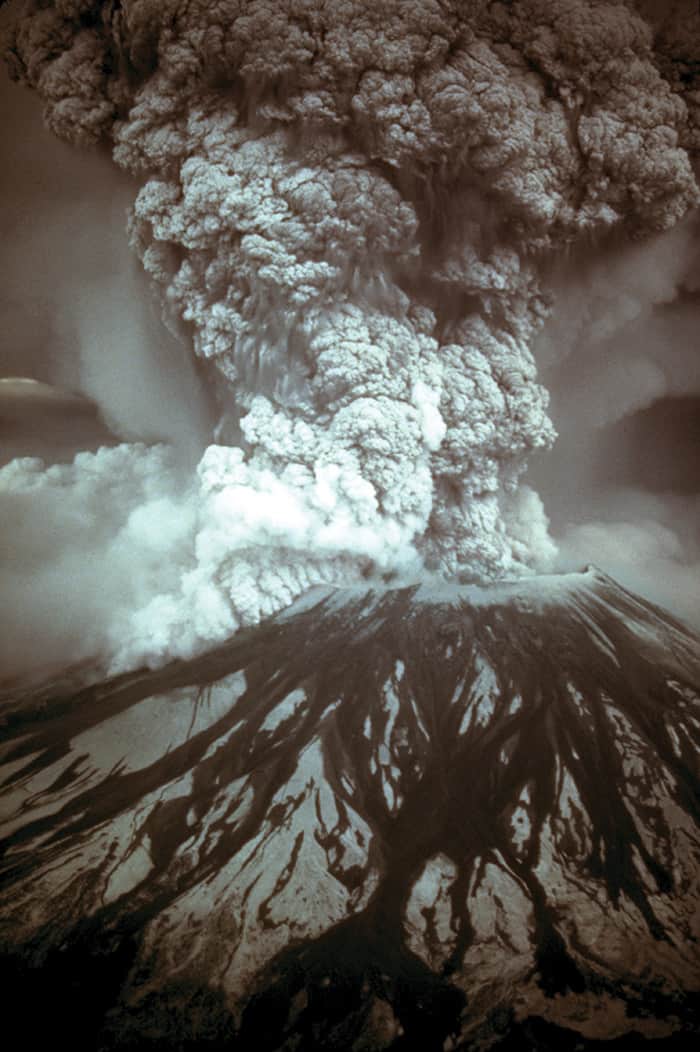
The 1980 eruption of Mount St Helens in the US is examined in minute detail in Steve Olson’s new book Eruption. (Courtesy: USGS)
Seconds before a cloud of dust and ash swept his observation post off the map, the American volcanologist David Johnston managed to send one last radio message: “Vancouver! Vancouver! This is it!” “It” was the devastating eruption of Mount St Helens on 18 May 1980, which laid waste to hundreds of square kilometres around the once-picturesque peak, scattered ash across 11 US states, and killed almost 60 people, Johnston included. The many factors – scientific, political and personal – that combined to put them in danger are the subject of Steve Olson’s book Eruption.
The book gets off to a slow start, with a long section devoted to the Weyerhaeuser timber company. The connection is that Weyerhaeuser owned much of the land around the volcano, and its grip on the local economy and politics (plus its desire not to interrupt clear-cutting operations over something so trivial as an active volcano) meant that the exclusion zone set up around the mountain was smaller than the scientists would have liked. But Olson’s intense focus on Weyerhaeuser (which includes a lengthy digression on its mid-19th century founding) and its battles with conservationists leaves correspondingly less space in the book for the science of the Mount St Helens eruption, and for the stories of the individual human beings caught up in it.
This is too bad, because Olson is a gifted science communicator, and he also makes the most of his source material later in the book when writing about the narrow escapes of several survivors. In one especially harrowing passage, Olson describes how two photographers drove at 100 mph down narrow, winding roads to outrun the blast, passing a slower car on a blind bend some two miles outside the supposed danger zone. The photographers survived. The occupants of the slower car did not.
The cover story in the September 2016 issue of Physics World magazine – now live in the Physics World app for mobile and desktop – reveals the fascinating new field of “crowd breath research”, which can even shed light on how cinema audiences react during the changing scenes in a movie. You can read the article here on physicsworld.com too.
The September issue also shows how to do crystallography without crystals, explains how first data from the Gaia spacecraft could revolutionize astronomy (see the above video for more on that), and contains one physics teacher’s fascinating story about what she did to change her school’s gender balance.
Don’t miss either reader feedback on the potential impact of Britain leaving the EU on physics or Robert P Crease’s Critical Point column on why science denial is one of the most important issues in the US presidential campaign.
Back in Christmas 2013, the CineStar cinema in Mainz, Germany, became an impromptu, oversized laboratory. Over the course of 108 screenings of 16 films, it hosted an unprecedented experiment on about 9500 moviegoers. Not that most of them noticed, or even knew they were under scrutiny. Science was likely the last thing on their brains as they flocked to the cinema to see the German hit Buddy or blockbusters such as The Hunger Games: Catching Fire and The Hobbit: the Desolation of Smaug.
But Jonathan Williams, an atmospheric chemist at the Max Planck Institute for Chemistry, whose research has taken him around the world, went to his local cinema in search of a story that wasn’t being shown on a screen. He was looking for a story told by the breath of a crowd. He chose the screening room of a cinema because it’s well contained. “It’s really just a box full of people,” he says.
Breath contains valuable information, if one can figure out how to decode it. When excited, we emit more carbon dioxide. After a swig of beer, we exhale ethanol in proportion to the amount in our blood. Our breath reveals if we’ve recently eaten an apple or smoked a cigarette. A human breath contains on average more than 200 easily measured volatile organic compounds (VOCs) – chemicals that exist in a gaseous state at room temperature. Most of those are inhaled initially, but many are generated by living cells and metabolic processes in the body. Not every breath is identical: researchers have identified thousands of individual chemicals that fluctuate depending on where people are, what they’re doing, and how their bodies work. A VOC may be innocuous or harmful; natural or synthesized.
“The breath is basically garbage,” says Joachim Pleil, an analytical chemist with the US Environmental Protection Agency at Research Triangle Park in North Carolina, US, and editor-in-chief of the Journal of Breath Research. “You breathe it out, you ignore it.”
A person’s breath may reveal truths they prefer to keep secret – like how many drinks they’ve consumed. In medicine, researchers are also investigating breath’s chemical signatures as potential biomarkers for diseases or ways to gauge a person’s health. Pleil points out that doctors have been using breath analysis for a long time: about 2400 years ago the Greek physician Hippocrates described foetor hepaticus or “the breath of the dead” – now understood to be a late sign of liver failure.
“Traditionally, breath research has focused on one person, and one breath,” says Pleil. “The hope has been to say something about an individual based on what they’re breathing out.”
Williams’ work is a departure from that model. At the CineStar, Williams wasn’t interested in individual-level data. He sought meaning through the large-scale analyses of the breath of large groups. In a recent Journal of Breath Research editorial he co-authored with Pleil, the scientists call their method “crowd-based breath analysis” (2016 J. Breath. Res.10 032001). The researchers say the method could be useful in many fields, from helping advertisers gauge an audience’s emotional response to a new product, to differentiating between healthy and unhealthy VOC profiles, to identifying people who may pose a threat of some kind. “There is huge potential for discovery within crowd breath research,” they wrote.
Watching the watchers
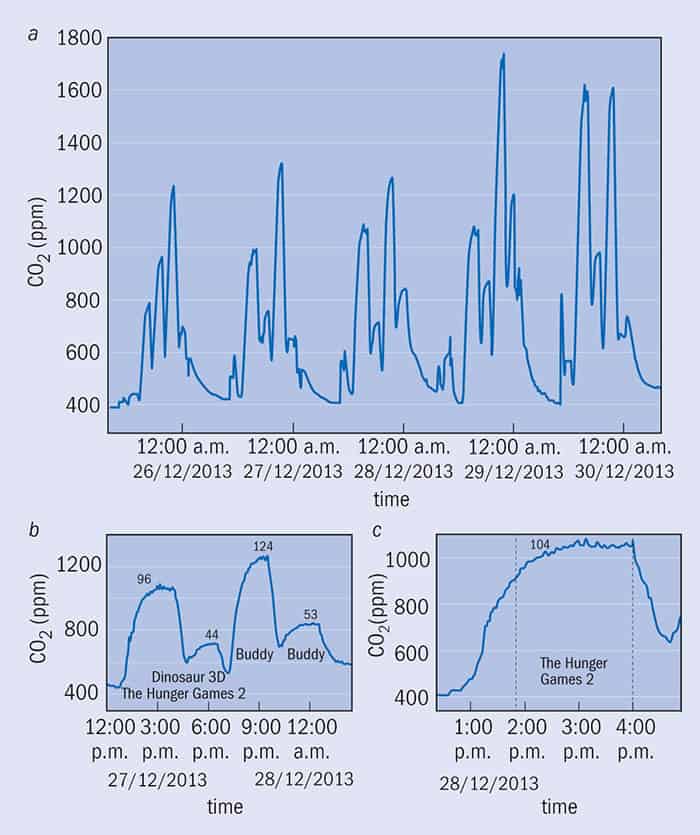
Like other theatres, CineStar in Mainz uses a ventilation system that pumps fresh air in through the floor and out through ceiling vents. Williams and his crew installed two devices in the outgoing ceiling ducts: an infrared gas analyser, which measured the airborne concentration of carbon dioxide (figure 1), and a proton transfer reaction time-of-flight mass spectrometer, which measured the traces of more than 100 other gases (see “The science behind crowd-based breath analysis”, below). The scientists collected real-time measurements of VOC levels every 30 seconds of a film as audiences laughed, gasped and were startled. Afterwards, they aligned individual measurements with a description of the film’s plot, broken down into 30 s chunks (2016 Scientific Reports6 25464 ).
1 Cinematic rhythm Selected sections of the CO2 measurements for (a) 5 days, (b) one day and (c) one film. The numbers above the peaks indicate the number of people in the audience. (Adapted from Scientific Reports6 25464)
Molecules associated with popcorn and fizzy drinks didn’t change throughout the movie. Predictably, the researchers found that carbon-dioxide levels rose and fell as audiences filled and emptied the screening rooms, respectively. So did levels of acetone and isoprene, two common by-products of metabolism. (Acetone is a by-product of fat catabolism, and isoprene is exhaled as the body makes cholesterol.) The scientists also observed that the VOC levels didn’t follow smooth curves; they were punctuated with small peaks.
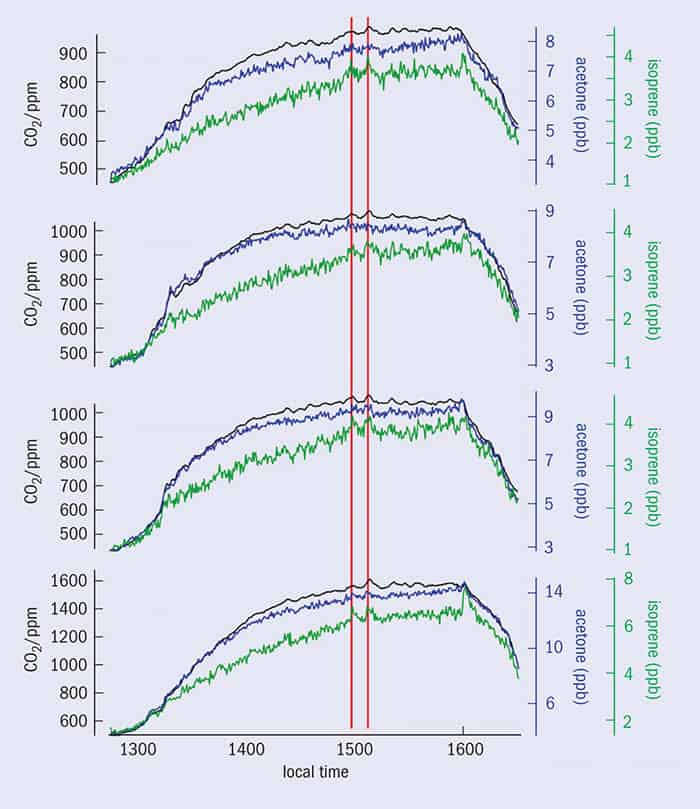
Williams suspected those peaks revealed something about how people reacted to the movie. Following that hunch, he and his team identified scenes connected to these VOC peaks – such as when Katniss’ dress ignites or the final battle begins in The Hunger Games: Catching Fire. The same peaks appeared at every screening, every day, as though during those times all the audiences were breathing in synchrony (figure 2). That repetition of the pattern gave Williams confidence that the connection they were seeing was both substantial and reproducible.
2 Fingerprint of a film Measurements of CO2, isoprene and acetone taken during four separate screenings of The Hunger Games: Catching Fire. The red lines indicate significant scenes. (Adapted from Scientific Reports6 25464)
Williams and his team then set out to see if the relationship between movie scenes and VOC emissions was causal. They annotated each 30 s interval of the films with descriptive labels that identified the genre or action of the scene. (“Comedy” or “chase”, for example.) Then, using the Mogon supercomputer in Mainz, they created a model based on two-thirds of the data that connected scene descriptions to VOC levels. For the remaining third of the data, they fed the VOC levels into their model to see if they would successfully predict scene descriptions and so prove a causal relationship. They found that VOC levels most successfully predicted scenes described as “suspense” or “comedy”. Scenes labelled “chase” and “romance”, on the other hand, weren’t significantly linked to VOCs.
Norman Ratcliffe, who has spent more than two decades analysing volatiles in gas, urine, faeces and blood at the University of the West of England in Bristol, UK, thinks Williams’ crowd-based methods have the potential to help interpret what breath VOCs can tell us. “It sounds like a very good approach,” he says. And it’s efficient, to boot: “You get the responses of hundreds of people in just one measurement.”
Into the real world
The vast majority of VOCs in the atmosphere are produced by vegetation, so Williams’ research typically takes him to verdant locales such as the Amazon rainforest or boreal forest in Finland. He’s studied pollution in Beijing, China, and later this year he’ll begin studying oil industry pollution and emissions in the Persian Gulf. The cinema project, he says, was borne of a natural question: how does human breathing affect the chemical composition of the atmosphere?
As it turns out, it doesn’t. “The amount [of VOCs] we emit as human beings is actually a very small amount,” he says. However, the question had led him to wonder if he could find some way to gauge human contributions. In April 2012 Williams’ team had used a mass spectrometer to measure VOCs during a football match at the Coface Arena in Mainz. Hoping to see a surge in carbon dioxide after a goal, the scientists had been disappointed when their data didn’t deliver. That project led Williams to think about running a similar experiment in a smaller space – like a cinema.
The new findings, as a proof of concept, suggest VOCs may be used to gauge human emotion, though the field is still in its early days. In addition to marketing, that idea may influence other fields. Pleil, who had been working on a series of papers about cellular respiration when he first met Williams, sees possibilities in health and threat assessment. Crowd breath analysis could help scientists describe a baseline VOC profile, in order to be able to use breath to identify individuals exposed to harmful substances. In health care, a person with a toxic VOC exposure might get treatment before symptoms begin. In security, a person queuing at an airport with jet fuel VOCs on their breath might be detained for questioning. (Do they work at an airport, or have they just built a dirty bomb?)
“This could be a valuable resource for trying to deduce what people think without giving them the opportunity to lie about it,” says Pleil.
Although Williams is soon heading to the Middle East, his work with VOCs and films already has a sequel: he’s currently sitting down with data collected during screenings of Star Wars: the Force Awakens. May the breath be with him.
The science behind crowd-based breath analysis
The wisdom of the crowds may be in our breath: recent research at Jonathan Williams’ lab at the Max Planck Institute for Chemistry in Mainz, Germany, shows a new way to study volatile organic compounds, or VOCs, generated by crowds in a cinema.
Joachim Pleil, at the US Environmental Protection Agency, says researchers can use two kinds of analysis for studying gas composition: offline and real-time. With offline analysis techniques, scientists have to collect a sample and take it to a lab. Real-time analysis happens as the sample is being created. “What Jonathan is doing probably would be difficult, if not impossible to do, with offline analysis,” he says. “The value of crowd breath is only apparent and can only be realized if you have online analysis.”
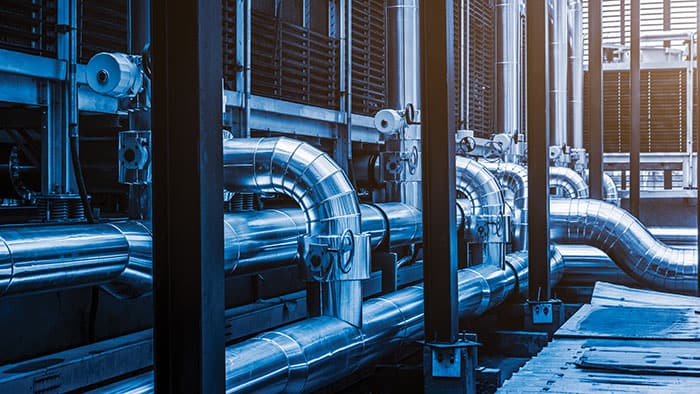
Gone with the wind Ventilation pipes can be used to analyse a crowd’s breath. (Courtesy: iStock/chinaface)
To measure carbon dioxide, the scientists used infrared spectroscopy, which beams infrared light through a sample. The carbon-dioxide molecules absorb this light at frequencies corresponding to their vibrational modes, so the difference between the initial and final infrared light translates to a measurement of the amount of carbon dioxide.
For the VOCs, Williams and his crew needed something more sophisticated to measure hundreds of VOCs every 30 seconds. That meant collecting high-resolution data in real time. There are many different tools for that purpose, but they selected proton transfer reaction time-of-flight mass spectrometry (PTR-MS), a real-time technology that was first developed in the 1990s by physicists at Innsbruck University in Austria. PTR-MS can measure even minuscule traces of a suite of airborne VOCs.
The tool first creates ions by attaching extra protons to molecules of ordinary water. Then it sends the ionized water vapour through a sample of air. When the ions collide with ordinary atmospheric ingredients such as nitrogen or oxygen, nothing happens. But when they collide with VOC molecules, the proton attaches itself to the VOC. That’s because most VOCs have a higher proton affinity than water, and gases such as nitrogen and oxygen have a lower proton affinity than water. With the protons attached, the tagged VOCs can then be measured in real time by a mass analyser, which identifies the individual varieties of VOC. “We use this method widely, and it measures fast,” says Williams.
Aiming high: Zhen Cao explains how to use a mountain to detect tau neutrinos.
By Hamish Johnston in Beijing
This evening I had dinner with Zhen Cao, who is one of China’s leading particle astrophysicists and works at the Institute of High Energy Physics of the Chinese Academy of Sciences here in Beijing.
Cao has found a great way to combine his passion for mountains and neutrinos: the Cosmic Ray Tau Neutrino Telescope (CRTNT), which, if built, will use an entire mountain in western China as a cosmic neutrino detector.