A quantum computer that can simulate interactions between fundamental particles has been unveiled by physicists in Austria. Four trapped ions were used to model the physics that describes the creation and annihilation of electron–positron pairs. While the result can be easily calculated using a conventional computer, problems that are beyond the reach of even the most powerful supercomputers could be solved by the computer if it could be scaled up to include about 30 ions.
The strange laws of quantum mechanics make it very hard for classical computers to model the behaviour of large numbers of microscopic particles. Because these objects can exist in superpositions and be entangled with one another, the amount of classical processing power needed to fully describe their interactions rises exponentially as the number of particles increases. It was this fact that prompted physicist Richard Feynman in the early 1980s to propose using quantum systems themselves – in the form of quantum computers – to model the behaviour of other quantum systems.
That vision has started to become reality in recent years, as scientists build quantum computers to simulate chemical reactions or devise new types of condensed-matter systems. These devices are nothing like the fabled all-purpose quantum computers capable of factorising large numbers, which would contain large numbers of quantum bits, or qubits. Instead, to date they contain just a handful of qubits, operating either as analogue devices – in which the interactions between qubits closely resemble those between the simulated particles – or digitally, where each interaction is represented by a series of discrete logical operations.
Gauge theories
Peter Zoller, Rainer Blatt and colleagues at the University of Innsbruck and the Institute for Quantum Optics and Quantum Information (IQOQI) have created a digital quantum computer and have used it to simulate the physics of a gauge theory. These theories describe how fundamental particles such as quarks or electrons interact with one another, and are at the heart of the Standard Model of particle physics. However, they impose severe constraints on modelling because each interaction they describe must obey a series of conservation laws not needed in other types of simulations. But over the last few years, theorists have begun to put forward algorithms that would allow quantum computers to model gauge theories.
The Austrian team has devised and implemented a quantum algorithm for efficiently modelling a simple type of gauge theory: one-dimensional quantum electrodynamics. The computer that the researchers use to run the algorithm uses four calcium ions as qubits. These are confined by electric fields and manipulated by a laser, so that each ion can exist in a superposition of two energy levels and can become entangled with the other ions.
Each ion represents a point in space, and its two energy levels correspond to the presence or absence of a particular subatomic particle – either an electron or a positron. Initially, the states of all four ions are set to show no particles, which means that the simulated system at that point is a pure vacuum. The ions’ quantum states are then changed by a series of red laser pulses fired at them. Those pulses can represent three effects: the creation or annihilation of electron–positron pairs in the vacuum; long-range electrical (Coulomb) interactions between the particles; or the energy associated with the particles’ masses. Once the sequence of laser pulses has ended, the final state of each qubit is read out using a second (blue) laser beam that causes the ions to emit light when they are in one energy state, but not when they are in the other.
Proof-of-principle
The team found that its quantum computer generated the correct final states within the margin of error imposed by laser noise and other limitations in the laboratory equipment. Although the calculation can be easily done using a normal desktop computer, team member Christine Muschik of IQOQI says the results provide a proof-of-principle demonstration that quantum computers can be used to simulate the interactions described by gauge theories.
The research is described in Nature. In an accompanying commentary, Erez Zohar of the Max Planck Institute of Quantum Optics in Garching, Germany, agrees that the research shows it is “realistic to use quantum-optics techniques to study particle physics and fundamental forces”. He believes that the quantum computer built by the Austrian group “serves as a beacon” to other physicists trying to build more complex devices, which, he says, might be able to simulate particle systems in more than one dimension or accommodate more complex gauge theories such as quantum chromodynamics.
Team member Esteban Martinez of the University of Innsbruck says that quantum simulators should outperform the best classical computers when they have about 30 qubits. He points out, in fact, that his group already has a simulator with that many ions, but says that the performance of this device is limited by the difficulty of addressing single ions and by instabilities in the lasers and magnetic fields. “We are working to improve all these things so that we can operate 30 ions in the same way that we currently operate four,” he says. As to when that might be possible, “10 years is a perfectly reasonable timescale,” he says.
For the last five years, NASA’s Juno spacecraft has been barrelling towards its final destination: Jupiter, king of the planets. On 4 July this year (or 4 July in the US, at least, actually early morning on 5 July in Europe) the four-tonne, spinning craft – which looks like an oversized propeller that has abandoned its plane – will fire its thrusters and slow down enough to be captured by the gas giant’s gravity. The burn should only last about 40 minutes, but they’ll be a tense 40 minutes: during that time, as Juno shifts from orbiting the Sun to orbiting Jupiter, the rest of its devices will go quiet. (As will the physicists at NASA’s Jet Propulsion Laboratory in Pasadena, California, tracking the mission from the ground and, one imagines, with fingers crossed.) Then the instruments should flicker back on, and over the course of more than 35 long, loping polar orbits throughout the following year, Juno will execute an intimate and unprecedented observation of our local colossus, beaming data back to Earth.
Scott Bolton, Juno’s principal investigator, says the effort to study Jupiter is no less than a desire to understand the origin story of the solar system. Bolton is a space physicist at the Southwest Research Institute in San Antonio, Texas, and has led the $1.1bn mission from idea to execution. “When you want to understand where we all came from and how the planets were made, you have to start with Jupiter,” he says. Jupiter’s composition seems more star than planet, as it is dominated by hydrogen, followed by helium. At the same time, its atmosphere is drizzled with the heavier elements – including carbon, nitrogen and oxygen – that make life on Earth possible. “Jupiter is enriched with the same stuff we’re made of,” says Bolton. “We’re trying to understand our own history.”
Bolton’s words echo a growing wisdom among astronomers: if you want to know details about how the solar system formed, or how giant, gassy worlds coalesce around far-flung stars, you have to ask Jupiter. It likely formed early and fast, sweeping up most material left behind after the Sun formed. Jupiter is more than twice as massive as all the other planets, moons, asteroids, comets and Kuiper-belt objects in our system combined. Because of its age and heft, the gas giant probably played a critical role in arranging the solar system, helping to jockey planets into their current positions. (With 67 known moons, it effectively hosts its own planetary system too.) Astronomers even credit Jupiter’s gravitational oomph for diverting comets and asteroids that might otherwise have plummeted into Earth and brought a quick end to life as we know it.
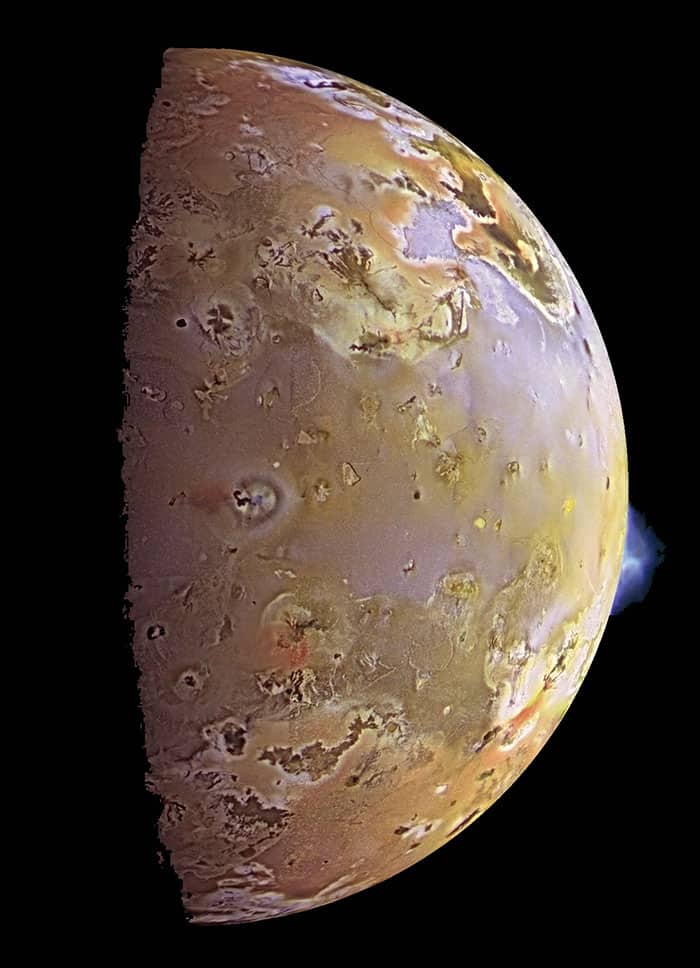
Explosive An erupting volcano on Io, taken by the New Horizons mission. (Courtesy: NASA’s Goddard Space Flight Center)
Ancient civilizations watched the planet with awe and interest, and astronomers have been probing its mysteries since Galileo Galilei first studied it and its moons through a telescope more than 400 years ago – observations that showed that not everything in the heavens orbits Earth. The more scientists learn about Jupiter, the more unknowns they find. Even after centuries of inquiry, Jupiter is shrouded in mystery.
Scientists don’t know the structure of its thick, hot atmosphere, or how much water that atmosphere contains. Even more mysterious is the structure of its centre, hidden far below. Brilliant light shows, called auroras, encircle the opposite poles like twin crowns – and even exist deeper in the atmosphere – though researchers disagree on how they form (see “Extraterrestrial light shows”, July 2016, pp37–39 in print). Ground-based observations of Jupiter and its moons offer tantalizing hints at answers to these mysteries, but the best way to ask how the king of planets ticks is to go there and see for ourselves.
Juno’s goals are simple. How did the planet form and evolve? What hides beneath Jupiter’s clouds? The answers to those puzzles may help answer even bigger questions about why planets form at all. “We’re after the recipe for the solar system,” Bolton says.
The story so far
In Roman mythology, Juno was the wife (and sister) of Jupiter, king of the gods, and she didn’t take kindly to his extramarital interests. To conceal an affair with a mortal priestess named Io, Jupiter concealed himself with a dense cloud cover. Not to be fooled, Juno handily swept the clouds aside – an action that resonates with the modern Juno mission.
The planet Jupiter, long a source of fascination for stargazers, appears in one of the first bona fide science-fiction stories. In 1752 French philosopher Voltaire published Micromégas, a story that reads a bit like Gulliver’s Travels, but in space. The tale follows the adventures of a 37 km-tall alien and his 2 km-tall friend as they compare experiences and explore the solar system. Their trajectory takes them to the moons of Jupiter and briefly to the planet itself: “They stopped at Jupiter and stayed for a week, during which time they learned some very wonderful secrets,” which are not, unfortunately, revealed in the story. (The duo later visits Earth, but as its inhabitants are too small to be seen, they dismiss the possibility of finding intelligent life there.)
The Juno mission represents the ninth Jovian visit by a human-built ship. The most recent was New Horizons, en route to Pluto, in 2007. The first arrived in 1972, when the Pioneer 10 spacecraft snapped 300 images and took measurements as it zoomed by at 132,000 km/h, about 130,000 km above the tops of the clouds. Data from that mission helped scientists to make early hypotheses about the fluid-filled interior and to analyse plasma in the planet’s giant magnetosphere – the region in which charged particles are affected by Jupiter’s magnetic field. The mission wasn’t entirely smooth sailing: some of the onboard instruments malfunctioned due to the intensity of the radiation surrounding Jupiter, but those problems helped guide the design of better protection for future missions. The next year, on its way to Saturn, Pioneer 11 flew by Jupiter, even lower and faster than its predecessor. The Voyager 1 and 2 missions followed in the late 1970s, sending back more data – and unanswered questions.
“The Voyager missions opened up a bunch of unknowns,” says physicist Theodor Kostiuk of NASA’s Goddard Space Flight Center in Maryland, who uses ground-based telescopes to study Jupiter’s atmosphere. Voyager, for example, identified active volcanoes on Io, a large inner moon, that affect the entire planetary system. (Prior to Voyager, astronomers didn’t know that volcanic activity existed anywhere else in the universe.)
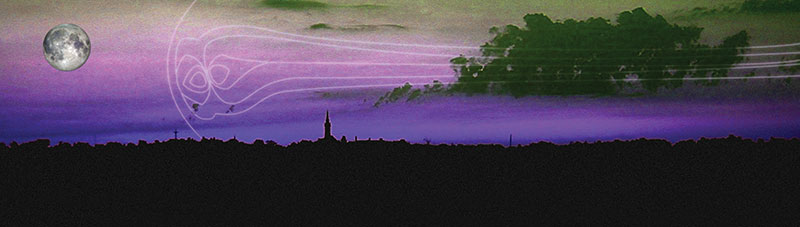
Picture this Jupiter’s magnetosphere as it would appear from Earth if visible. (Courtesy: NASA’s Goddard Space Flight Center)
The Ulysses spacecraft measured Jupiter’s magnetosphere during flybys in 1992 and 2000, when it used gravitational assists from the planet to slingshot itself towards the Sun, its primary research target. The Cassini–Huygens spacecraft, while en route to Saturn, took tens of thousands of pictures of Jupiter and made detailed measurements of its atmosphere during a six-month period in 2000 and 2001. The first orbiter to reach Jupiter was Galileo, which spent eight years circling the planet’s equator and studying the Jovian moons, but it ran into problems and did not ultimately fulfil all of its scientific goals.
Planetary space physicist Fran Bagenal, of the University of Colorado at Boulder, worked on Galileo’s science team and now leads the plasma research teams for both Juno and New Horizons, the mission that reached Pluto last year (see “Our new view of Pluto”, July 2016, pp40–43 in print). “Galileo’s observations told us a lot about the moons, but it had this problem,” she says. In 1991 Galileo’s 4.8 m high-gain antenna, which was shaped like an umbrella and designed to radio data back to Earth, only partially opened. Scientists tried for five years to fix the problem from Earth, but to no avail. “It meant we couldn’t do a lot at the planet itself,” Bagenal recalls. The mission couldn’t send back as much data as scientists had anticipated, and the spacecraft disintegrated during its intentional, final plunge into Jupiter’s turbulent atmosphere.
Juno is the scientific heir to Galileo, but it differs in important ways. Galileo’s price tag was about $1.4bn, whereas Juno’s estimated cost is about $1.1bn. Where Galileo circumnavigated the equator, Juno will orbit the poles. Galileo, like most spacecraft, used nuclear fuel to travel through space. Juno relies on solar power. Its three radial arms are 9 m arrays that hold 19,000 solar cells, and in January of this year Juno set a record for the farthest distance travelled using solar power. (The record was previously held by the European Space Agency’s Rosetta spacecraft, which travelled to the asteroid belt between Mars and Jupiter.)
In Earth’s neighbourhood, Juno’s solar cells receive enough sunlight to generate 14 kW – which could power 10 microwave ovens at once. Near Jupiter, where sunlight is weaker, the cells collect only enough light for about 400 W. That’s not enough to power a hair dryer, but it’s sufficient for Juno’s suite of scientific instruments. “It demonstrates that solar power works in a new environment that we hadn’t thought possible,” says Bolton. The radiation belts around Jupiter, he says, are “one of the harshest regions in the solar system”.
Preparing for the storm
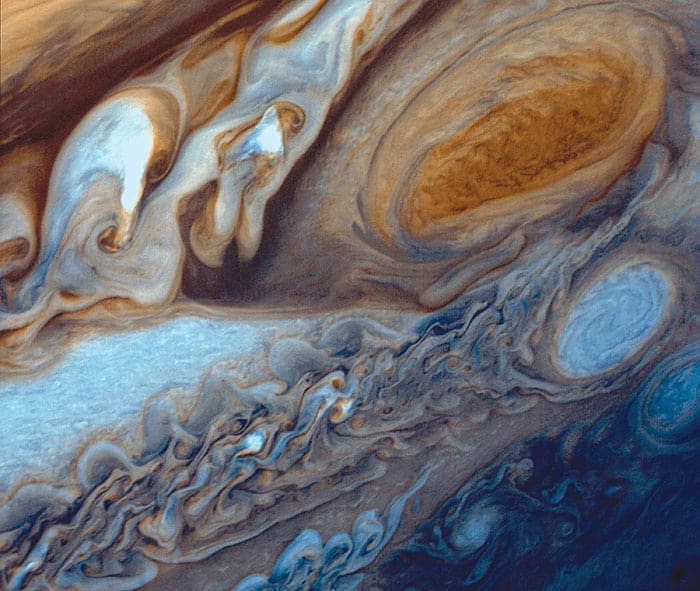
Jupiter is notoriously inhospitable. Winds blow at 650 km/h or more. Lightning strikes with 100 times the intensity of lightning on Earth. The Great Red Spot – the solar system’s biggest storm, which has been raging for more than three centuries – is so big it could swallow Venus.
The planet’s biggest threat to space travel, though, is radiation. Jupiter’s magnetic field is 10 times stronger than Earth’s. Indeed, its magnetosphere is the largest known structure in the entire solar system. If it glowed visibly, the magnetosphere would appear to observers on Earth more than twice as big as the full Moon. Such a sprawling magnetosphere traps a lot of high-energy particles, creating radiation belts that circle Jupiter, forming what must be the most hazardous doughnut in space. (The belts are similar in shape and structure to Earth’s Van Allen belts.)
“You’ve got this stream of electrons and protons circling the planet, and they’re lethal to spacecraft,” says astronomer and Juno team member Tobias Owen of the University of Hawaii, whose goal is to measure oxygen in Jupiter’s atmosphere. “Until now, spacecraft have been farther out. We’re going to be inside it.”
Swirling bands Jupiter’s atmosphere as imaged by Voyager 1. Vibrant bands of clouds carried by winds that can exceed 650 km/h continuously circle the planet’s atmosphere. Such winds sustain spinning anticyclones such as the Great Red Spot – a raging storm three and a half times the size of Earth. (Courtesy: NASA’s Goddard Space Flight Center)
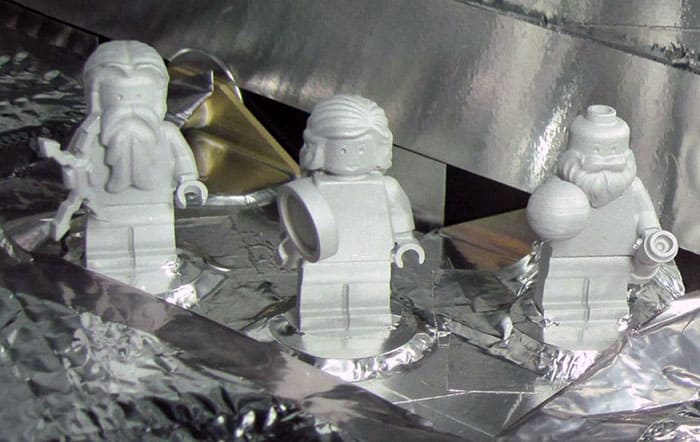
Instruments onboard Juno include a particle detector, magnetometer, ultraviolet and infrared spectrometers, and radio instruments for measuring fluctuations in the gravitational field. (The payload also includes three LEGO figurines, representing Juno, Jupiter and Galileo.) The electronic devices would ordinarily be crippled by the intense radiation, which is why they are safely housed in a protective vault with centimetre-thick titanium walls. Juno’s flight plan, which takes it over the poles, will also reduce exposure to the powerful radiation.
The same magnetic field that makes the mission so treacherous embodies one of the planet’s most pressing mysteries. Io’s active volcanoes, as Voyager observed, spew sulphur-dioxide particles that become ionized and fill the magnetosphere, says Bagenal. As they accelerate to high energies, many of the particles end up bombarding the atmosphere of Jupiter – a process that’s believed to contribute to the auroral light shows at the poles.
However, “we’ve never flown over the poles of Jupiter before, and we don’t know what it’s like up there” says Bagenal, whose research focuses on plasma in planetary magnetospheres. “We don’t know what processes accelerate those particles into the atmosphere.” Juno, she says, will be able to measure the magnetic field, charged particles and plasma waves as it looks down on the auroral emissions in the atmosphere. “We’re trying to put together the bigger picture of what causes the auroras, and how they work.”
Beneath the clouds
It’s tempting to assume that Jupiter’s auroras form like those on Earth, which arise after charged particles from the solar wind are accelerated along magnetic field lines into the upper atmosphere, where they collide with other particles and emit light. But such an explanation might be too simplistic for Jupiter. Ultraviolet images taken by the Hubble Space Telescope 20 years ago show that the auroras form round, oval-shaped structures near the poles. Though small-scale changes occasionally occur within and to each oval, “it really doesn’t vary a whole lot” says Bagenal.
That might be in part because Jupiter’s powerful magnetosphere protects its atmosphere from the solar wind. In that case, the auroras might be generated internally, from “an atmospheric region deep in the atmosphere” says Kostiuk. Using infrared imaging, Voyager identified a thermal aurora deeper in the atmosphere in the north hemisphere, which researchers have studied for three decades with ground-based measurements and, in 2001, data from the Cassini flyby. Kostiuk points out that recent ground-based measurements of the aurora in the infrared do show some variation with the solar cycle – suggesting a contribution from the solar wind.
From within or without? “That’s the big debate,” says Bagenal. She suspects the auroral emissions arise from how the plasma in the magnetosphere moves with respect to the planet, which completes a rotation in just under 10 hours. “At some point, the clutch begins to slip,” she says. “We think electric currents associated with that process are partly driving the auroras.” But scientists won’t know for certain until Juno takes a look.
Another of Juno’s scientific goals is to better understand the colourful, swirling bands of clouds. To date, it’s been difficult for scientists to probe the depths because it’s too hot, and the pressure is too great. Juno’s multi-frequency microwave radiometer will receive thermal radiation from the depths of Jupiter’s cloud cover, up to pressures about 1000 times Earth’s normal atmospheric pressure at sea level. That penetration will help researchers better understand the rotation of the atmosphere relative to the core – if it exists – and what elements exist there.
Mission mascots Three LEGO minifigures aboard Juno represent the Roman god Jupiter, his wife Juno and Galileo Galilei. (Courtesy: NASA/JPL-Caltech/KSC)
“The thing that’s most exciting to me is the determination of water deep in the atmosphere,” says Owen. “By measuring the water we’ll get an idea of the way that Jupiter came together.” Many astronomers have proposed models to explain Jupiter’s formation, but different models predict different levels of water. Measuring that abundance, says Owen, will help models get closer to approximating the origins of the planet. “Water abundance is key if you’re trying to understand how planets are formed in our solar system,” says Bolton.
Juno will also be studying what lies beneath the clouds. The planet likely contains a vast and bizarre ocean unlike anything found on Earth – and unlike anything that can even be simulated on Earth. It’s made of hydrogen under so much pressure that electrons separate from protons, and the fluid conducts electricity like a metal. As this strange sea rotates with the planet, it generates Jupiter’s powerful magnetic field. “We think that’s where the dynamo is produced,” says Bagenal.
But scientists don’t know how deep the liquid metallic hydrogen extends, or what’s underneath it. They hypothesize that Jupiter’s core is rocky and made of heavier elements. Since no device could reach the hydrogen sea – much less any core that lies beneath – Juno will map the interior structure by tracking changes in the planet’s gravitational field as it orbits.
The end of Juno
Juno will spend a full year measuring and sending data to astrophysicists on Earth, but Bolton warns that definite answers about Jupiter won’t show up immediately. “We’re limited on how we can interpret Juno’s data,” he says. Using gravity measurements to map the distribution of mass will be fairly straightforward. But to connect data on variables like temperature and pressure and forge one big, coherent picture will require physicists to agree on an equation of state to describe the conditions on Jupiter. That’s a challenge in and of itself: no-one has any idea how metallic hydrogen is supposed to behave. They also suspect, but can’t prove, that heavier elements likely dissolve in that strange soup.
Bagenal says the equation of state is a crucial and missing piece of the puzzle. “Every time we have a meeting of the interior working group of the Juno mission, these guys come up with a new equation of state,” she says. “They’re always improving, and always changing their minds. Since we launched, they’ve changed their minds a few times.”
At the same time, Juno’s data will immediately be put to use by theorists who come up with models of how Jupiter formed. “All theories on how Jupiter forms will have to be consistent with what Juno sees,” says Bolton. “By making these measurements, we will constrain the models.” Those limitations will, in turn, lead to more refined models that more accurately represent the reality of Jupiter.
Once Juno’s year-long data-gathering feast is over, it will change direction one last time. The spacecraft won’t be allowed to orbit indefinitely because of the unlikely chance it might collide with and contaminate Europa, a Jovian moon with a subsurface ocean where, one day, scientists would like to look for life. So instead of drifting off, Juno will end, like Galileo before it, by disintegrating during a final plunge into the heart of its host.
The latest version of the watt balance at the US National Institute of Standards and Technology (NIST) has made its first measurement of Planck’s constant (h) with an uncertainty of 34 parts per billion, demonstrating that the institute’s device – dubbed NIST-4 – is accurate enough to be used to redefine the kilogram. The data from this latest measurement values the h at 6.626,069,83 × 10–34 J s, with an uncertainty of ±22 in the last two digits.
For almost 130 years, the international definition of the kilogram has been based on a lump of platinum-iridium metal housed at the International Bureau of Weights and Measures (BIPM) in Paris. This “International Prototype of the Kilogram” – or “Le Gran K” – has been used to determine the International System of Units (SI), which governs measurements in everything from commerce to science.
But as the lump is a physical artefact, it is affected by the environment despite being housed in a secure, climate-controlled vault. Periodic inspections have shown that it has slowly been losing some of its mass due to its surface reacting chemically with the air, making the object unstable and difficult to handle. “The problem with the kilogram in Paris is that it’s so precious that people don’t want to use it,” says Stephan Schlamminger, a physicist in the Physical Measurement Laboratory (PML) at NIST in Gaithersburg, Maryland.
Global focus
There are seven base SI units: the metre, kilogram, second, kelvin, ampere, mole and candela. Because these values must be extremely stable over long periods of time, while also being universally reproducible, most of them are based on fundamental constants of nature. The kilogram, however, is the only unit still defined by a physical artefact.
To get round this problem, metrologists want to redefine the kilogram in terms of Planck’s constant. Lying at the heart of quantum mechanics, h links the frequency of a photon to its energy, which in turn can be related to mass through Einstein’s equation E = mc2. A watt balance – a device first proposed by physicist Brian Kibble at the UK’s National Physical Laboratory (NPL) in 1975 – does this by comparing the mass of an object with an electrical force.
Specifically, a watt balance relates mechanical power – measured in terms of the metre, the second and the kilogram – to electrical power measured in terms of the volt and the ohm. Because electric power can be measured precisely in terms of h – by applying two quantum-mechanical effects known as the Josephson effect and the quantum Hall effect – the watt balance connects this universal constant to mass.
New generation
The fourth-generation NIST-4 watt balance measures the weight of a test mass by determining the electromagnetic force needed to balance it. The force is created by sending an electrical current through a moveable coil of wire suspended in a magnetic field provided by a large permanent electromagnet. The coil becomes an electromagnet with a field strength proportional to the amount of current it conducts. When the coil’s field interacts with the surrounding magnetic field, an upward force is exerted on the coil, the magnitude of which is controlled by adjusting the current.
NIST’s first measurement with NIST-4 is found to be consistent with watt-balance measurements from other countries. However, the amount of uncertainty in the measurement is far lower than predicted, meaning that they are on track to redefine the kilogram. This measurement was essentially a dry run, according to Schlamminger, who adds that he and his colleagues “were hoping to achieve an uncertainty of within 200 parts per billion by this point, but we got better fast”.
All together now
For the 2018 redefinition to go forward, at least three experiments must produce values with a relative standard uncertainty of no more than 50 parts per billion, and one with no more than 20 parts per billion. The groups now have until July 2017 to publish new measurements of Planck’s constant to be taken into account for the redefinition of the kilogram.
All these values must agree within a statistical confidence level of 95%, while also agreeing with the value calculated using the alternative “Avogadro” method, which measures h by counting the atoms in an ultra-pure sphere of silicon. The combined results will be used to calculate a value of h that best fits all of the data.
Schlamminger’s team aims to get the uncertainty down to 20 parts per billion in the coming year – a goal they think they can reach by measuring more precisely how the current in the coil affects the magnetic field at the coil’s location and by reducing the measurement noise.
While redefining the kilogram is a big deal in the metrology community, it should have little impact on the outside world. “It’s the frustrating part about being a metrologist,” says Schlamminger. “If you do your job right, nobody should notice.”
In less than 100 seconds, Stephan Schlamminger, at the US National Institute of Standards and Technology (NIST) Gaithersburg campus, explains what exactly a watt balance is and how this device – which determines mass using fundamental constants as it compares electrical and mechanical power – will soon help the international metrology community to redefine the kilogram.
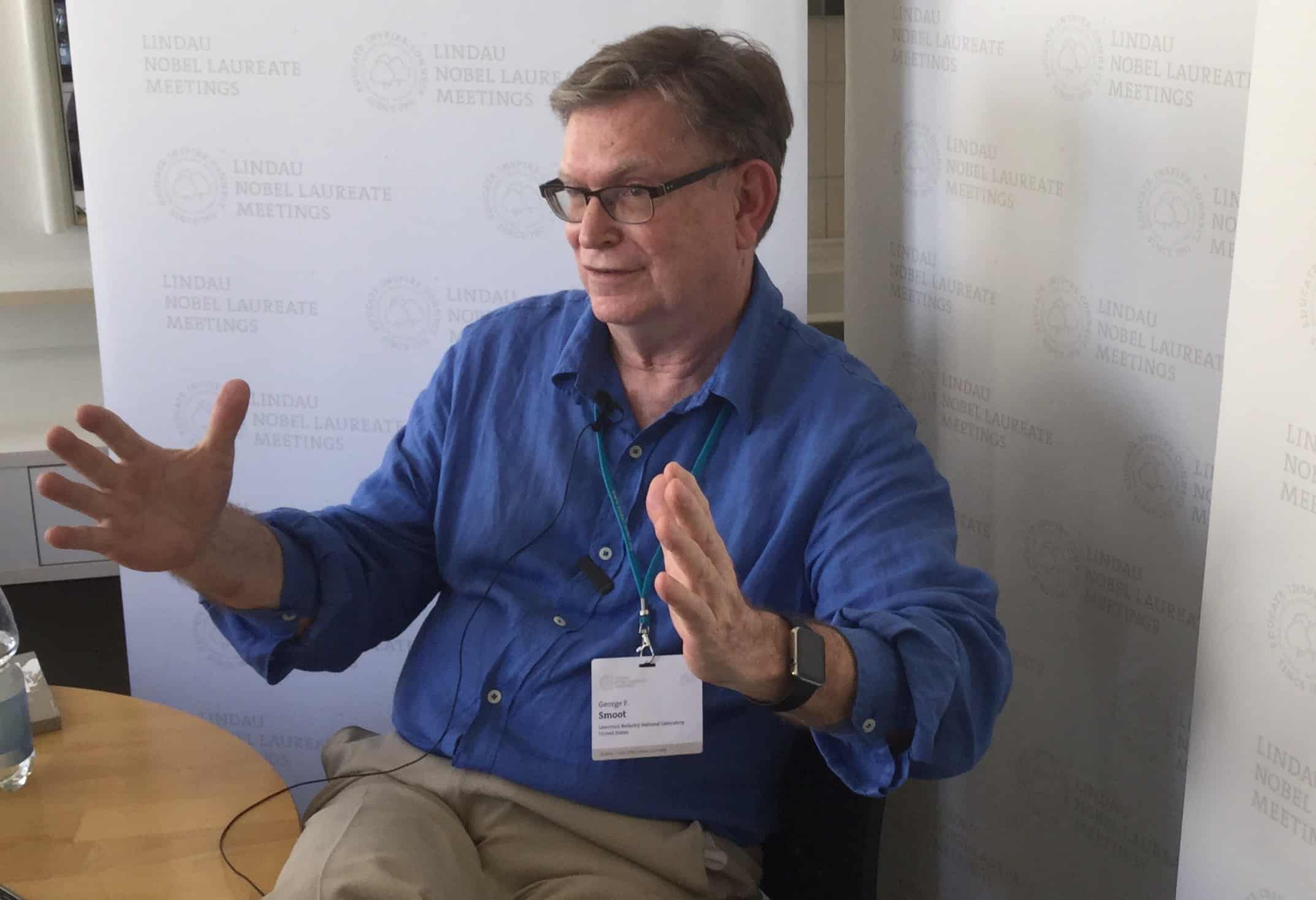
Measuring the universe: George Smoot enthuses about gravitational waves.
By Hamish Johnston at the Lindau Nobel Laureate Meeting in Germany
Yesterday I was in a fantastic session with George Smoot, who shared the 2006 Nobel Prize for Physics for discovering the anisotropy in the cosmic microwave background. He will be speaking today at the 66th Lindau Nobel Laureate Meeting about another important astronomical discovery, the first direct detection of gravitational waves that was made by LIGO in September 2015. Waves that were created by the merger of two unexpectedly large black holes.
A new set of codes that, for the first time, are able to apply Einstein’s complete general theory of relativity to simulate how our universe evolved, have been independently developed by two international teams of physicists. They pave the way for cosmologists to confirm whether our interpretations of observations of large-scale structure and cosmic expansion are telling us the true story.
The impetus to develop codes designed to apply general relativity to cosmology stems from the limitations of traditional numerical simulations of the universe. Currently, such models invoke Newtonian gravity and assume a homogenous universe when describing cosmic expansion, for reasons of simplicity and computing power. On the largest scales the universe is homogenous and isotropic, meaning that matter is distributed evenly in all directions; but on smaller scales the universe is clearly inhomogeneous, with matter clumped into chains of galaxies and filaments of dark matter assembled around vast voids.
Uneven expansion?
However, the expansion of the universe could be proceeding at different rates in different regions, depending on the density of matter in those areas. Where matter is densely clumped together, its gravity slows the expansion; whereas in the relatively empty voids, the universe can expand unhindered. This could affect how light propagates through such regions, manifesting itself in the relationship between the distance to objects of known intrinsic luminosity (what astronomers refer to as standard candles, whereby we measure their distance, based on how bright they appear to us) and their cosmological redshift.
Now, James Mertens and Glenn Starkman of Case Western Reserve University in Ohio, together with John T Giblin at Kenyon College, have written one such code; while Eloisa Bentivegna of the University of Catania in Italy and Marco Bruni at the Institute of Cosmology and Gravitation at the University of Portsmouth have independently developed a second similar code.
Fast voids and slow clumps
The distances to supernovae and their cosmological redshifts are related to one another in a specific way in a homogeneous universe, but the question is, according to Starkman: “Are they related in the same way in a lumpy universe?” The answer to this will have obvious repercussions for the universe’s expansion rate and the strength of dark energy, which can be measured using standard candles such as supernovae.
The rate of expansion of our universe is described by the “Hubble parameter”. Its current value of 73 km/s/Mpc is calculated assuming a homogenous universe. However, Bruni and Bentivegna showed that on local scales there are wide variations, with voids expanding up to 28% faster than the average value for the Hubble parameter. This is counteracted by the slowdown of the expansion in dense galaxy clusters. However, Bruni cautions that they must “be careful, as this value depends on the specific coordinate system that we have used”. While the US team used the same system, it is feasible that it creates observer bias and that a different system could lead to a different interpretation of the variation.
The codes have also been able to rule out a phenomenon known as “back reaction”, which is the idea that large-scale structure can affect the universe around it in such a way as to masquerade as dark energy. By running their codes, both teams have shown, within the limitations of the simulations, that the amount of back reaction is small enough not to account for dark energy.
Einstein’s toolkit
Although the US team’s code has not yet been publically released, the code developed by Bentivegna is available. It makes use of a free software collection called the Einstein Toolkit, which includes software called Cactus. This allows code to be developed by downloading modules called “thorns” that each perform specific tasks, such as solving Einstein’s field equations or calculating gravitational waves. These modules are then integrated into the Cactus infrastructure to create new applications.
“Cactus was already able to integrate Einstein’s equations before I started working on my modifications in 2010,” says Bentivegna. “What I had to supply was a module to prepare the initial conditions for a cosmological model where space is filled with matter that is inhomogeneous on smaller scales but homogeneous on larger ones.”
Looking ahead
The US team says it will be releasing its code to the scientific community soon and reports that it performs even better than the Cactus code. However, Giblin believes that both codes are likely to be used equally in the future, since they can provide independent verification for each other. “This is important since we’re starting to be able to make predictions about actual measurements that will be made in the future and having two independent groups working with different tools is an important check,” he says.
So are the days of numerical simulations with Newtonian gravity numbered? Not necessarily, says Bruni. Even though the general relativity codes are highly accurate, the immense computing resources they require means that achieving the detail of Newtonian gravity simulations will require a lot of extra code development.
“However, these general relativity simulations should provide a benchmark for Newtonian simulations,” says Bruni, “which we can then use to determine to what point the Newtonian method is accurate. They’re a huge step forward in modelling the universe as a whole.”
I have just been chatting with Carlo Rubbia, who shared the 1984 Nobel Prize for Physics for the discovery of the W and Z particles.
Rubbia gave a fantastic talk yesterday about future sources of energy and he was eager to expand on this topic. In particular, he told me about a new technology he has been working on to produce energy from natural gas without releasing any carbon dioxide – a technique called “methane cracking“. While this sounds like a fantastic solution to climate change, at least in the short term, he admits there are lots of technical challenges to overcome.
g-ASTRONOMY is a collaboration between the Imperial College London astrophysicist Roberto Trotta and chef Jozef Youssef, who is the author of a new book Molecular Gastronomy At Home. Molecular gastronomy is the branch of cooking concerned with the underlying scientific principles of food and the techniques used to produce it. In the media it is often associated with the type of experimental fine-dining experiences created by world-renowned chefs such as Ferran Adrià and Heston Blumenthal.
After meeting at the Cheltenham Science Festival in 2015, Trotta and Youssef embarked on a mission to break down the preconceptions about their respective disciplines. They worked with Youssef’s team at Kitchen Theory to develop a selection of canapés inspired by cosmology. This food is presented as part of a show called g-ASTRONOMY, during which diners are guided through the food while learning about molecular gastronomy and the cosmology concepts along the way.
A year later and Trotta and Youssef are back at the Cheltenham Science Festival to present one of the first outings of the g-ASTRONOMY show. The menu included a cocktail with layers representing distinct epochs of the early universe and a trio of chocolate truffles inspired by the idea of parallel universes. Physics World journalist James Dacey was at the event to find out more about the food, the motivations behind the project and what the collaborators plan to do next. It’s sure to be one of the tastier podcasts that you’ll hear this month.
A consortium of European physicists building a vast neutrino detector on the floor of the Mediterranean Sea has unveiled the science it will carry out. The Cubic Kilometre Neutrino Telescope (KM3NeT) will use strings of radiation detectors arranged in a 3D network to measure the light emitted when neutrinos very occasionally interact with the surrounding sea water. The details were revealed last week in a “letter of intent” in the Journal of Physics G: Nuclear and Particle Physics (published by IOP Publishing, which also publishes physicsworld.com). The collaboration says that the energy and direction of the detected neutrinos will be used to carry out astronomy and to improve our understanding of neutrinos themselves.
First proposed in 2004, the telescope was originally designed to be built at a single location. But disagreements among the project’s partner countries delayed the facility by several years. The new plan will see it spread out over two, and eventually perhaps three, different sites. The telescope, which was supposed to have been switched on in 2014 to let it take data alongside the US IceCube neutrino observatory at the South Pole, will now not become fully operational until 2020 at the earliest.
Telescopic trio
The new plan splits KM3NeT into “building blocks”, each of which consists of 115 strings. Along the strings will be 18 optical modules, each made from 31 photomultiplier tubes. Two of these building blocks will be assembled about 3.5 km underwater, some 100 km from the south-eastern tip of Sicily. Researchers hope to use them to confirm the 2013 discovery by IceCube of neutrinos originating from deep space and pinpoint the sources of those neutrinos. The Italian facility should become more sensitive than the Antarctic observatory about a year after coming online, according to KM3NeT spokesman Maarten de Jong of Leiden University and the National Institute for Nuclear Physics and High Energy Physics in Amsterdam. “The weak interaction between neutrinos and normal matter is a blessing and curse,” says de Jong, adding that “it makes detecting them notoriously difficult, which is why you need a giant detector”.
The third building block, meanwhile, will be assembled about 40 km offshore from Toulon in southern France, close to KM3NeT’s forerunner telescope ANTARES (a 12-string array based off the coast of France). The main aim here is to study the “mass hierarchy” of neutrino flavours, which is important in understanding matter/antimatter asymmetry. Assuming it is built on schedule, KM3NeT should reveal this hierarchy in about 2023, says de Jong, putting it ahead of rival experiments.
Building up
So far the KM3NeT consortium has received €31m to develop and test its detector technology, as well as to install 31 strings by the end of next year – the first string having already turned on in December 2015. According to de Jong, the additional €95m needed to complete the three building blocks, which will probably come largely from the EU, should be secured by the end of this year, enabling it to start up in 2020 as planned. He says that the completed observatory will be about twice as big but cost half as much as the original design because it will incorporate many photomultiplier tubes inside a single detector module.
Ultimately, de Jong and colleagues hope to expand KM3NeT so that it consists of seven building blocks, one or more of which might be built off the coast of Greece. Not only would that be attractive politically as a stimulus to Greece’s economy, he says, it would also make the telescope more sensitive to sources of neutrinos within our own galaxy.
IceCube principal investigator Francis Halzen of the University of Wisconsin–Madison describes himself as “a great fan” of KM3NeT, arguing that building a neutrino telescope in stages is “certainly reasonable”. Doing so, he says, means being able to “adjust the detector configuration depending on experience with operations and on scientific results”.
Is the UK now a sinking ship? (Courtesy: iStock/NatanaelGinting)
By Matin Durrani, Editor, Physics World
Amid all the noise and recrimination following the UK’s vote to leave the European Union (EU) in last week’s national referendum by a majority of 52% to 48%, I was reminded of a comment that Nicola Clase – Sweden’s ambassador to Britain – made to Times columnist David Aaronovitch before the referendum. When he sought her views on a potential British exit from the EU (Brexit), Clase replied: “It’s like when a child desperately wants to pee in his pants and does it. At first there’s a feeling of relief and for a few moments it’s nice and warm. Then he’s just cold and wet.”
It was a flippant comment for sure, but not far wide off the mark. As a new week dawns, physicists in the UK – and beyond – are coming to terms with the enormity and liable consequences of the vote. A poll by Nature in March showed that the vast majority of UK scientists were overwhelmingly in support of the EU, with 83% saying “no” to an exit. Although, legally, the outcome of the referendum does not have to be acted upon, we can expect huge and completely unnecessary uncertainty over the next few months, if not longer.
Learned societies in the UK, such as the Institute of Physics, which publishes Physics World, as well as the Royal Society and the Royal Astronomical Society, have been putting a brave face on the prospect of Britain quitting the EU. They underlined the importance of maintaining free movement of scientists to and from the UK, and ensuring British scientists continue to have access to EU research funds and EU-supported facilities. It will be great if those principles and policies remain in place – but there is no guarantee they will. In any case, why should the rest of the EU now want to bother making life easy for the UK as it negotiates a Brexit?