Physicists break record for laser-electron interaction

Researchers have converted the energy of an electron beam into a pulse of coherent light with an efficiency of 30% – much higher than the 0.1% efficiency of most free-electron lasers. While their demonstration produces only infrared light, the method could lead to efficient, high-power lasers operating over a range of wavelengths, including X-ray. Such X-ray sources could be used to etch circuits on semiconductor chips faster and more efficiently.

Using facilities at the Brookhaven National Laboratory in the US, the researchers demonstrated the energy conversion by first accelerating a beam of electrons in a five-metre-long tunnel. They then directed those electrons for several more metres along a helical path using magnets, before illuminating those electrons with an infrared laser.

The laser caused the electrons to slow down while emitting coherent light. Because the emitted light was the same wavelength as the laser, the process – known as stimulated emission – effectively amplified the original infrared laser beam. The degree of amplification depended on the starting energy of the electron beam, with the team saying it has broken the record for an interaction “between a free-space propagating laser pulse and a relativistic electron beam”.

The group successfully converted more than 30% of the electrons’ energy into a coherent light pulse that was three picoseconds long and had a peak power of about 100 gigawatts. Pietro Musumeci, a physicist at the University of California, Los Angeles, in the US, who was involved in the work, says that researchers first attempted this technique about 30 years ago but were only successful at converting beam energy into longer, microwave wavelengths.

Exceeding expectations

Musumeci’s group inferred the energy of the light pulse by measuring how much energy the electron beam lost and by comparing the measurements to a theoretical simulation, although the team plans to directly measure the pulse’s energy in a future experiment. He adds that it is, in principle, possible to convert up to 90% of the electron-beam energy into coherent light by making the experimental set-up longer. The laser would then stimulate the electron beam to emit for a longer time, thus converting more energy into coherent light.

The eventual goal is to create consecutive pulses to generate an efficient, high-power laser. Laser light is useful for scientific and industrial applications because it can be sharply focused and can efficiently fit “a lot of light in a small volume”, as Wim Leemans, director of the Berkeley Lab Laser Accelerator, who was not involved in the research, points out. This tightly focused light from a pulsed beam can be used, for example, to capture “snapshots” of rapid quantum phenomena.

However, coherent light sources are commonly inefficient, Leemans says. For example, an X-ray free-electron laser only has an efficiency of around 0.1%, making a technique that can convert 30% of the electron-beam energy into photon energy significant. Leemans, who is working on a portable X-ray laser that fits on a table, says that smaller laser sources could adapt this technique to achieve higher efficiencies.

Musumeci says that this technique could eventually be used to make efficient, high-power, 13 nanometre X-ray sources used to etch tiny circuits on semiconductor chips. “All the new generation chips in your iPhone and your computer are made with 13 nanometre light,” he says. “So if you have an efficient light source there, you can print more and faster.”

To tune the wavelength of the generated light pulse, he says, the infrared laser in their set-up would need to be replaced with a laser at the new wavelength, and the spacing of the magnets in the cavity would need to be changed.

The research is described in Physical Review Letters.
Flash Physics: Designer magnets from 3D printers, creating silicon-germanium glass fibres, towards a space-based gravitational-wave observatory

Creating designer magnets using a 3D printer

A new method that uses 3D printing to fabricate permanent magnets with specific, pre-determined magnetic-field shapes has been created by researchers at the Technische Universität Wien (TU Wien) in Austria. Their new technique allows for the production of complex forms of magnets, with precisely customised fields – these are especially required to create devices such magnetic sensors. “We often require special magnetic fields, with field lines arranged in a very specific way – such as a magnetic field that is relatively constant in one direction, but which varies in strength in another direction,” explains Dieter Suess, head of the University’s Christian-Doppler Advanced Magnetic Sensing and Materials laboratory. For this to be possible, the magnets need to produced with a specific geometric form – something the TU Wien team do on a computer, adjusting its shape until all requirements for its magnetic field are met. The design is then implemented via a special 3D printer, created by the team, which can handle magnetic materials. The magnet printer uses specially produced filaments of magnetic micro granulate, which is held together by a polymer binding material. The resulting object is made up of roughly 90% magnetic material and 10% plastic. Finally, the object is exposed to a strong external magnetic field, converting it into a permanent magnet. The team says its new process is fast, cost-effective and offers new possibilities including using different materials within a single magnet to create a smooth transition between strong and weak magnetism. The research is published in Applied Physics Letters.

Silicon-germanium glass fibres become a reality

While glass fibres are ubiquitous in most modern technologies – from internet cables to keyhole surgery – scientists are keen to expand the usage of such fibres by adding semiconductor core materials to them. Now, an international team of researchers, led by Ursula Gibson at the Norwegian University of Science and Technology, has created glass fibres with single-crystal silicon-germanium cores. Creating such fibres is a challenge mainly because silicon and germanium have different melting points. The researchers combined both materials in a fibre by scattering germanium flecks through the silicon fibre and then moving the fibre through a laser beam to rapidly heat it, thereby melting the semiconductors in the core in a controlled fashion. “If we take a fibre and melt the core without moving it, we can accumulate small germanium-rich droplets into a melt zone, which is then the last thing to crystalize when we remove the laser slowly,” says Gibson, adding that the team can “make stripes, dots…you could use this to make a series of structures that would allow you to detect and manipulate light.” The work could help in developing high-speed semiconductor devices, as well as in expanding the current capabilities of endoscopes, according to the researchers. The research is published in Nature Communications.

ESA seeks proposals for space-based gravitational-wave observatory

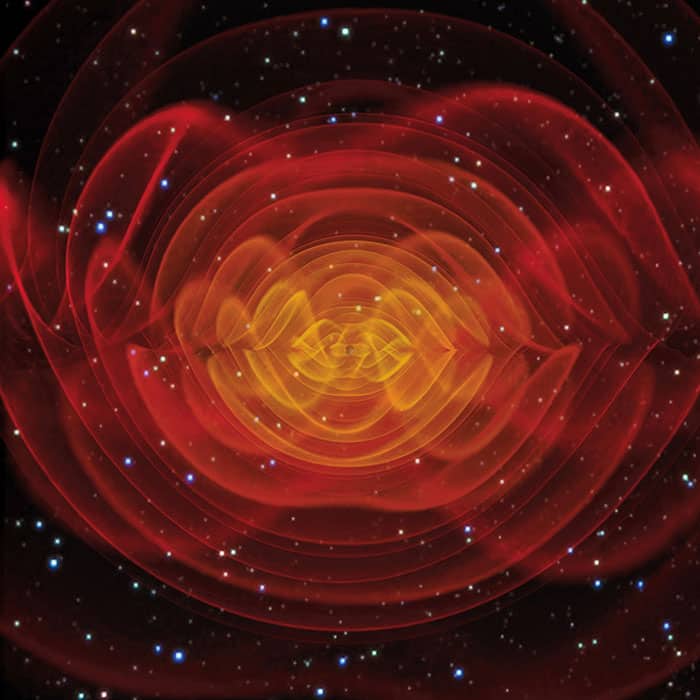
Illustration of the gravitational waves from merging black holes

The European Space Agency (ESA) has put out a call for European scientists to submit proposals for the first space mission to observe gravitational waves. A space-borne observatory that will specifically study gravitational waves – ripples in the fabric of spacetime created by accelerating massive objects – was chosen in 2013 as the third large mission (L3) in ESA’s Cosmic Vision plan. The decision was no doubt boosted by the first direct detection of gravitational waves made by the ground-based LIGO detectors in the US in February this year – a second detection was announced in June. In 2014, a “Gravitational Observatory Advisory Team”, composed of independent experts, was appointed. In the team’s final report earlier this year, they recommended that ESA pursues the mission, having verified the feasibility of a multi-satellite design with free-falling test masses linked over millions of kilometres by lasers. The decision also follows the successful performance of ESA’s LISA Pathfinder mission, which demonstrated some of the key technologies needed to detect gravitational waves from space, which was launched in December 2015. “Gravitational waves promise to open a new window for astronomy, revealing powerful phenomena across the universe that are not accessible via observations of cosmic light,” says Alvaro Giménez, ESA’s director of science. Letters of intent for ESA’s new gravitational-wave observatory must be submitted by 15 November, and the deadline for the full proposal is 16 January 2017. The selection is expected to take place in the first half of 2017, with a preliminary internal study phase planned for later in the year.


  • You can find all our daily Flash Physics posts in the website’s news section, as well as on Twitter and Facebook using #FlashPhysics. Tune in to physicsworld.com later today to read today’s extensive news story on a new method for generating laser light.

Recipe for success with topological materials

Fang and Weng were named in the Physics World Top 10 Breakthroughs of 2015 for their work on Weyl fermions, which are quasiparticles that they found lurking in their Weyl semimetal. Weyl fermions also have unique properties that could make them useful for creating high-speed electronic circuits among other applications.

Fang explains how his team of theorists uses mathematics and computer simulations to predict which materials are topological. He also explains how topological materials could be useful in creating quantum computers of the future. Weng then takes up the challenge of explaining just what a Weyl semimetal is and why it is home to Weyl fermions. He also explains how the topological material could be used to create another elusive quasiparticle – the Majorana fermion.

US unfazed by Russia ending reactor co-operation

A spokesperson for the US Department of Energy (DOE) has told Physics World that Russia’s recent decision to end an agreement between the Rosatom nuclear agency and the DOE into the feasibility of converting Russian research reactors to low-enriched uranium (LEU) will have “no practical impact” on reactor conversion.

The agreement between the two agencies, which was initially suspended in 2014, was terminated earlier this month, with the Russian government saying it had done so following the US’s decision to end civil nuclear-energy co-operation with Russia in 2014. The Russian government also blamed “other hostile steps and statements”.

The US has been seeking to eliminate highly enriched uranium (HEU) from civilian research reactors worldwide since 1978. But the DOE spokesperson says that the National Nuclear Security Administration (NNSA) does not expect any impact on work to remove highly enriched uranium from third countries, as it “is covered by a separate agreement that still has bilateral support”.

Global programme

Naturally occurring uranium contains less than 1% uranium-235 – the primary fissile isotope of uranium – by mass. But the proportion can be increased by enrichment, with HEU fuel containing at least 20% of uranium-235. Research reactors, however, often rely on “weapons-grade” uranium, which contains at least 90% uranium-235, to produce beams of neutrons that are intense enough for research purposes.

The US had predicted that the 74 reactors around the globe that still use HEU fuel would switch to LEU by 2018, although a recent report by the US National Academies of Sciences, Engineering and Medicine concluded that will now take until at least 2035.

Russia is home to 32 of the research reactors that still use HEU, with the US report citing non-technical factors as the main hindrance to their conversion. It claims that conversion “is not a high national priority for Russia” and that in recent years Rosatom and the US DOE “have severed nearly all ties”, with Russia no longer willing to accept US funding for conversions and the DOE curtailing interactions between scientists.

Before relations deteriorated, in 2014 Russia and the US successfully converted one reactor – the ARGUS reactor at the Kurchatov Institute in Moscow – from HEU to LEU fuel. The two nations also concluded that it was technically and economically feasible to convert five more.

Russia and the US have also been working together to remove HEU from other countries. At the end of September they announced that they had successfully repatriated 61 kg of Russian-origin HEU from the Maria Research Reactor in Poland, which was converted to LEU two years ago. Poland is now HEU-free.

Independent approach

Russia says that if it decides to convert further research reactors it will now “conduct this work independently”, although the government statement makes it clear this is not a priority. “We believe that the conversion of nuclear reactors from highly enriched to low-enriched uranium fuel in [Non-Proliferation Treaty] member states is not an end in itself,” it says. “In a number of cases, including medical-isotope production, HEU is most effective, and abandoning it does not make sense from a technological and economic standpoint.”

Russia has also suspended an agreement on nuclear- and energy-related research-and-development co-operation with the US, and an agreement that commits the two countries to eliminate parts of their weapons-grade plutonium stocks. In a statement, the Russian foreign ministry says it had suspended the plutonium pact in response to “unprecedented sanctions-related pressure”, hostile steps by the US since “the reunification of Crimea with Russia” and “an active build-up of NATO’s military infrastructure”.

Flash Physics: 3D stars shrink when hot, new laser sensor for gases, tracking solar waves

3D star structure shrinks when heated

While most solids expand when heated, some defy this thermodynamic trend and shrink instead. Now, an international team of researchers has combined two heat-expanding materials to fabricate a heat-contracting composite metamaterial. The team, led by Nicholas Fang at the Massachusetts Institute of Technology in the US, has created tiny, star-shaped structures out of interconnected beams. The sugar-cube-sized structures quickly contract in all three dimensions when heated to about 282 °C – previous such structures only shrunk in two dimensions. While each of the beams in the stars are made of materials that typically expand when heated, the team realized that when the beams were arranged in certain architectures, they pull inward when heated, causing the whole structure to effectively shrink and collapse much like a Hoberman sphere. The team also found that it could control the amount of contraction by changing the amount of copper nanoparticles added to one of the two materials used to build the structures. Such materials could have a wide variety of applications – they could be used in computer chips (which deform over time due to heat). They could also be used together with conventional materials to build objects that are subject to varying temperatures, including window frames, water pipes and space technologies. The research is published in Physical Review Letters.

New sensor is both laser and detector

A microscopic sensor that can be used to identify different gases simultaneously has been developed by researchers at the University of Vienna, Austria. The team uses quantum-cascade lasers, which emit light in the infrared range, to study gas samples. “Our quantum cascade lasers are circular, with a diameter of less than half a millimetre,” says team-member Gottfried Strasser, head of the University’s Center for Micro- and Nanostructures. “Their geometric properties help to ensure that the laser only emits light at a very specific wavelength.” This is particularly useful in carrying out chemical analyses of various gases, each of which only absorb very specific amounts of infrared light. Indeed, gases can be reliably detected using their own individual infrared “fingerprint”. Doing so requires a laser with the correct wavelength and a detector that measures the amount of infrared radiation swallowed up by the gas. The researchers’ device is both a laser and detector – they use two concentric quantum-cascade rings, which can both emit and detect light at varying wavelengths. One ring emits the laser light, which passes through the gas before being reflected by a mirror. The second ring receives and then measures the intensity of the reflected light. The two rings then immediately switch their roles, allowing the next measurement to be carried out. The sensor could have many applications in everything from environmental observations to medicine. The research is published in ACS Photonics.

Tracking solar waves from sunspots

Multiple images of sunspots by NASA's Solar Dynamics Observatory

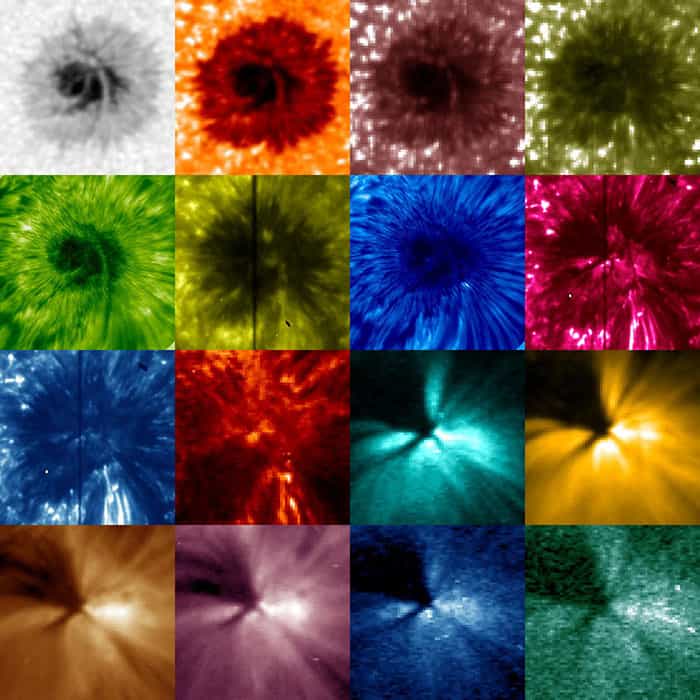
An international team of astronomers has tracked a particular kind of solar wave for the first time, as it swept upward from the Sun’s surface through its atmosphere. Plasma and other material courses through the Sun and its atmosphere, and understanding the movement of such charged gas reveals more about our star, including how it heats up its atmosphere, how it creates a steady flow of solar wind streaming outward in all directions, and the dynamics of the star’s magnetic fields. Tracking solar waves in particular helps researchers to study the solar atmosphere, and by imaging the flow of the material the researchers hope to determine how and why the Sun’s upper atmosphere or corona is so hot. “We see certain kinds of solar seismic waves channelling upwards into the lower atmosphere, called the chromosphere, and from there, into the corona,” says lead-author Junwei Zhao at Stanford University in the US. “This research gives us a new viewpoint to look at waves that can contribute to the energy of the atmosphere.” The team made used of data and imagery from NASA’s Solar Dynamics Observatory, NASA’s Interface Region Imaging Spectrograph and the Big Bear Solar Observatory in Big Bear Lake, California. Together, these observatories watch the Sun in 16 wavelengths of light that show its surface and lower atmosphere. Although it has long been predicted that waves on the Sun’s surface (photosphere), are linked to those in its lower atmosphere (chromosphere), the new analysis is the first time that scientists have managed to actually watch the wave travel up through the various layers into the Sun’s atmosphere. The research is published in Astrophysical Journal Letters.


  • You can find all our daily Flash Physics posts in the website’s news section, as well as on Twitter and Facebook using #FlashPhysics. Tune in to physicsworld.com later today to read today’s extensive news story on Russia terminating its co-operation with the US on moving away from using highly enriched uranium in its research reactors.

Societies seek action on rising helium prices

A report by three US societies has highlighted the threat of rising helium prices, finding that some institutions are paying two-and-a-half-times more for liquid helium than they did in 2009. The organizations – the American Physical Society, the American Chemical Society and the Materials Research Society – have created the “Conserve Helium” website to give researchers information on techniques that could reduce their helium usage and develop new helium-saving technologies.

Market forces

Research accounts for about 6% of the global helium market, yet the amount of helium available worldwide is limited. That shortage could worsen, owing to the impending closure of the US Federal Helium Reserve, which the Helium Stewardship Act of 2013 insists must shut by September 2021. Market forces will then control the element’s price, to the likely disadvantage of research customers. “It was clear there was going to be a problem down the road because of depletion of the helium reserve,” says low-temperature physicist William Halperin of Northwestern University, US, who sat on the 11 strong committee that wrote the report.

We want other federal agencies to realize that helium is non-renewable and has an uncertain future
Simon Bare, SLAC National Accelerator Laboratory

While the report by the three societies comes at a time when the price of crude helium has dropped slightly, that fall is not enough to offset the huge increases that have occurred in recent years. These rises have been worsened by the lack of bargaining power that small research institutions have. “By requiring scientists to pay such exorbitant prices for helium, funding is being diverted from other crucial priorities, such as training the next generation of American scientists,” the report asserts.

Helium broker

The panel recommends that the US government should provide guidance to agencies about conserving helium and build on an existing collaboration in which the Defense Logistics Agency acts as a “broker” to help academic institutions negotiate lower prices and tighter delivery schedules for helium. The report also calls on Congress to use some revenues from the Federal Helium Reserve to help researchers pay for equipment to cut helium consumption and for scientific societies to help academic researchers to transition to such equipment too.

In addition, the report also takes aim at the Bureau of Land Management (BLM), saying that it should develop regulations for selling helium to researchers who receive government grants. Indeed, the BLM has already been directed by the House of Representatives Committee on Natural Resources to fulfil the report’s relevant recommendations. “We want other federal agencies to realize that helium is non-renewable and has an uncertain future,” says Simon Bare, from the SLAC National Accelerator Laboratory, who co-chaired the panel that wrote the report. “If more groups at all sorts of institutions in the US reduce their use of helium by recapturing and recycling, it’s a good thing.”

The report, Responding to the U.S. Research Community’s Liquid Helium Crisis, can be found on the APS website.

Flash Physics: Oldest planet-forming disc spotted, Greek researcher wins 2016 Farinella Prize, nanoantennas produce fast optical switches

Oldest planet-forming disc spotted around red-dwarf star

A star surrounded by the oldest-known circumstellar disc – a primordial ring of gas and dust that usually orbits around a young star, from which planets can form as the material aggregates – has been discovered by an international team of researchers, together with a group of citizen scientists. Led by Steven Silverberg at the University of Oklahoma in the US, the team found that the newly identified red-dwarf star “AWI0005x3s” has a circumstellar disc (a rarity in itself for such a star), which seems to have lasted for an exceptionally long time. “Most discs of this kind fade away in less than 30 million years,” says Silverberg. “This particular red dwarf is a candidate member of the Carina stellar association, which would make it around 45 million years old [like the rest of the stars in that group]. It’s the oldest red-dwarf system with a disc we’ve seen in one of these associations.” Knowing that this star and its disc are so old may help scientists to understand why M-dwarf discs appear to be so rare. The discovery was made possible thanks to members of a NASA-led citizen-scientist programme “Disk Detective” – the project’s users were listed as authors on the research paper, which is published in the Astrophysical Journal Letters.

Greek researcher wins 2016 Farinella Prize for planetary dynamics

The 2016 Paolo Farinella Prize has been awarded to Greek physicist Kleomenis Tsiganis at the Aristotle University of Thessaloniki, for his work on the applications of celestial mechanics to the dynamics of planetary systems, including the development of the “Nice model”, which describes the migration of Jupiter, Saturn, Uranus and Neptune during the early phases of the solar-system’s evolution. It also explains how the interaction of the giant planets with a disc of left-over debris caused a temporary dynamical instability, which led to the outer planets moving to their currently observed orbital configuration. The annual prize, which was established in 2010 to honour the memory of the Italian scientist Paolo Farinella (1953–2000), acknowledges an outstanding researcher not older than 47 years who has achieved important results in one of Farinella’s fields of work. Each year focuses on a different area or research, and the 2016 prize focussed on applications of celestial mechanics in the solar system. “Tsiganis has produced impressive results in modelling the solar system. In particular, he contributed to a deep understanding of the early dynamical phases and architecture of our planetary system,” says prize-committee chair Alessandra Celletti.

Nanoantennas produce fast optical switches

An illustration of the switch set-up

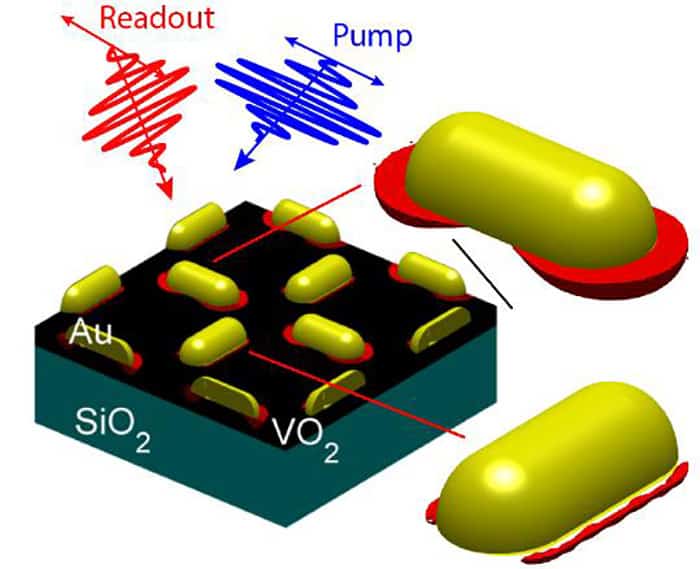
A fast nanoscale optical transistor that uses gold nanoantenna-assisted phase transition has been created by an international team of researchers. The researchers say the study will help develop antenna-assisted switches and optical memory. Small nanostructures that can interact strongly with light are of interest for many novel upcoming devices such as small optical circuits and metasurface flat optics. Nanoantennas are usually designed to function far below the diffraction limit via strong optical resonances. “If we are able to actively tune a nanoantenna using an electrical or optical signal, we could achieve transistor-type switches for light with nanometre-scale footprints for data communication,” says lead author Otto Muskens from the University of Southampton, UK. He adds that such active devices could also be used “to tune the antenna’s light-concentration effects leading to new applications in switchable and tuneable antenna-assisted processes”. The team used the properties of the antenna itself to achieve low-energy optical switching of vanadium dioxide – a phase-change material, which is a functional material and switches from an insulator to a metal above 68 °C. Gold nanoantennas were fabricated on top of a vanadium-dioxide thin film and were used to locally drive its phase transition. The research is published in the journal Light, Science and Applications.

  • You can find all our daily Flash Physics posts in the website’s news section, as well as on Twitter and Facebook using #FlashPhysics. Tune in to physicsworld.com later today to read today’s extensive news story on a plan to deal with the rising price of helium.

Supernovae analysis finds scant evidence for dark energy

A new statistical analysis of type 1a supernovae observations has failed to find substantial statistical evidence that the rate of expansion of the universe has been increasing over time. Instead, the calculations are consistent with a universe that is expanding at a mostly constant rate – something that could be at odds with the popular lambda-cold dark matter (ΛCDM) model of cosmology.

Type 1a supernovae are exploding stars that play an important role in astronomy as “standard candles” that emit the same type and quantity of light. This means that the distance to a supernova can be worked out simply from its brightness in the sky.

Prior to the late 1990s, cosmologists had assumed that the expansion of the universe should either be constant over time, or slowing down. But then a team led by Saul Perlmutter and another team led by Adam Riess and Brian Schmidt noticed that the rate of expansion of the universe has been increasing. The teams found that more than 50 distant type 1a supernovae are fainter than expected for their measured redshift.

The expansion of the universe causes the light from a supernova to be shifted to longer wavelengths when observed on Earth. This redshift tells astronomers how quickly the supernova was moving away from us when the explosion occurred – which gives us the rate of the expansion of the universe at that time.

Surprise discovery

The surprise discovery was evidence that the expansion of the universe has been accelerating. It earned Perlmutter, Riess and Schmidt the 2011 Nobel Prize for Physics and led physicists to speculate that this acceleration was driven by an unseen entity called dark energy.

The evidence for accelerated expansion is marginal
Subir Sarkar, University of Oxford

Since then, further independent evidence for the accelerating expansion has come to light in measurements of the cosmic microwave background (CMB) and observations of galaxies. Indeed, the accelerating expansion of the universe has become a pillar of the most popular theory of cosmology, ΛCDM, where Λ is the cosmological constant that describes the acceleration.

Hundreds of other type 1a supernovae have been observed since the 1990s, but now some physicists are beginning to doubt whether these observations support an accelerating expansion. Subir Sarkar of the University of Oxford in the UK, Jeppe Nielsen of the Niels Bohr International Academy in Denmark and Alberto Guffanti of Italy’s University of Turin have done a statistical analysis of data from 740 type 1a supernovae and concluded “that the data are still quite consistent with a constant rate of expansion”.

Overly simple

The difference between the trio’s study and previous analyses is how variations in supernovae light are dealt with. While all type 1a supernovae are nearly identical, astrophysicists know that there are important differences that must be accounted for. Sarkar and colleagues argue that the statistical techniques adopted for previous studies are too simple and not appropriate for the growing set of observational data.

Using a technique that Sarkar describes as “industry standard statistics,” the trio took a different approach to dealing with variations in the supernovae. They concluded that the deviation from a constantly expanding universe is less than about 3σ, which is a relatively poor statistical significance. “The evidence for accelerated expansion is marginal,” says Sarkar, who believes that the ΛCDM model needs rethinking.

Roberto Trotta of Imperial College London does not go that far, pointing out that there is other independent and strong evidence for the accelerating expansion. However, he acknowledges that the evidence for acceleration in type 1a observations does not appear to be as robust as previously thought. Trotta – who has developed a new statistical method for analysing type 1a data that is different than Sarkar’s – says that astronomers are poised to observe thousands of new type 1a supernovae and must be prepared to adopt more rigorous statistical techniques to analyse them.

The analysis is described in Scientific Reports.

Frightening physics films, a furry physics doodle and an epic pub crawl

By Hamish Johnston

There are still 10 days to go until Halloween, but some physicists can’t resist getting into the spirit a bit early. Over at Symmetry, Kathryn Jepsen suggests a few scary physics films that would make for a spooky movie night on 31 October. They’re not actually real films, but rather a series of posters dreamt up at Chicago’s Sandbox Studio in collaboration with the illustrator Ana Kova. My favourite is Poltergauss (right), because trying to understand magnetism is terrifying.

(more…)

From neutrons to neutrinos at the European Spallation Source

The 2bn European Spallation Source (ESS), currently under construction in Lund in southern Sweden, will be the world’s most powerful source of neutrons when it fires up in the early 2020s. With an average beam power of 5 MW, the ESS’s main focus is generating copious amounts of neutrons for a range of experiments from biology to condensed-matter physics. Yet there are plans afoot to also make the ESS a leading particle-physics lab and produce the world’s most intense beam of neutrinos.

The ESS Neutrino Super Beam (ESSnuSB) consortium – a team of 50 physicists in 11 European countries, led by Tord Ekelöf at Uppsala University, Sweden, and Marcos Dracos from Strasbourg University, France – say that an intense neutrino beam could be created by doubling the beam power of the ESS to 10 MW. The cost is estimated at 500m (plus 700m for a neutrino detector) – a sum just less than the actual cost of the ESS itself.

Neutrons will be generated at the ESS via a 2 GeV superconducting linear proton accelerator. Those protons are sent to a tungsten target and, in the process of spallation, produce neutrons. The proton beam at the ESS is delivered in 14 pulses every second. Each pulse is 3 ms long, meaning that the linear accelerator is only active about 4% of the time. The facility’s radiofrequency power generators deliver 125 MW of power during each pulse.

Ekelöf and colleagues say that by doubling the number of pulses in the ESS’s linac to 28 per second, thereby increasing the average beam power to 10 MW, half of this beam could be used to generate neutrinos. “In this way the accelerator will be used 8% of the time, which is still quite feasible technically,” says Ekelöf. “Linear superconducting accelerators currently exist that are used 100% of the time.”

There are, however, several technical challenges in doubling the ESS’s beam power. One is to work out the details of how to add more accelerator pulses to double the average power of what will already be the most powerful accelerator in the world. The doubling of the ESS accelerator power will require an increased cooling capacity in the power generators and in the accelerating cavities to compensate for the increased heat dissipation. And the capacity to operate at a higher frequency will also require some modifications to the power generators, such as increasing the power of their capacitor-charging current sources.

The ESSnuSB consortium is now looking to complete a design study via an EU COST Action – a way to co-operate and co-ordinate nationally funded research activities. When a design study and technical design have been carried out – a process that could take five years – the consortium will then look for funding. “It is clear that the additional cost that ESSnuSB represents will require strong political backing,” Ekelöf admits. “Yet it will be the only project to continue frontline experimental neutrino physics in Europe, a field in which Europe has a long tradition.”

Neutrinos oscillate between three different kinds of “flavours” – electron, muon and tau. To generate the neutrino beam, the protons would be made to hit a titanium target to produce pions that decay into muons and muon neutrinos. The neutrinos would be detected using a huge underground water-based Cherenkov detector located in the Swedish Dalarna region about 540 km north of Lund. There are two other planned projects pursuing the same goals as the ESS neutrino idea: the Deep Underground Neutrino Experiment in the US and Hyper-Kamiokande in Japan. These two projects are more advanced in their planning, yet the ESS neutrino project will be unique, thanks to the intense neutrino beam created by the ESS accelerator. It is this high intensity that will allow researchers to place the neutrino detector three times further away than is usual, something that will reduce systematic errors.

However, before the neutrino project at the ESS can get off the ground, the issue of who will pay for the upgrade to the ESS’s accelerator will need to be ironed out. According to Ekelöf, such an investment can only be achieved by an international agreement similar to that made between the 11 countries behind the ESS. Ekelöf claims that the ESS management are broadly supportive of the proposal, adding that they have agreed “to provide information and general support for the ESSnuSB collaboration’s ongoing studies”.

Allen Weeks, head of communications at the ESS, says that while they are focused on delivering neutrons for the foreseeable future, “the science [behind the consortium’s proposal] is very interesting and exciting for the neutron and particle physics communities”.

Copyright © 2026 by IOP Publishing Ltd and individual contributors