Physicists call for UK food-manufacturing strategy
The UK should create a national industrial strategy for food manufacturing, according to a report by the Institute of Physics (IOP), which publishes physicsworld.com. The publication – The Health of Physics in Food Manufacturing – looks at the role that physics can play in what is one of the biggest manufacturing sectors in the country. The report, which was launched today at an event at PepsiCo in Leicester, sets out the contribution that physics can make given that the manufacturing side has become more high-tech. It lists a number of recommendations, including that the government establish an industrial strategy committee for food manufacturing chaired by a government minister. This committee would provide a “co-ordinated, strategic, raised level of investment” in scientific research and development in food manufacturing, support collaborations between academia and industry, and spread awareness of the food sector’s reliance on technological innovation. It would also inspire physics students to move into the area.
Higgs-detector trio bag particle-physics prize
Jim Virdee, Michel Della Negra and Peter Jenni have been awarded the 2017 W K H Panofsky Prize in Experimental Particle Physics by the American Physical Society. The trio share the $10,000 award “For distinguished leadership in the conception, design and construction of the ATLAS and CMS detectors, which were instrumental in the discovery of the Higgs boson.” Virdee is professor of physics at Imperial College London and Della Negra splits his time between Imperial and CERN. Both physicists played key roles in the design, construction and operation of the CMS experiment at the Large Hadron Collider (LHC). Jenni is based at the University of Freiburg in Germany and played a crucial role in the design, construction and operation of the ATLAS experiment at the LHC. Data taken by ATLAS and CMS led to the discovery of the Higgs Boson in 2012.
Cosmic rays get past Earth’s magnetic field
A burst of cosmic rays spotted by astrophysicists working on the GRAPES-3 telescope in India has been linked to a short-lived weakening of the Earth’s magnetic field caused by an eruption of matter from the surface of the Sun. The event happened on 22 June 2015 and involved GRAPES-3 detecting a burst of atmospheric muons that lasted about 2 hours. These muons are created when cosmic rays collide with nuclei in the atmosphere and the muon detection rate is a measure of the intensity of cosmic rays that reach the atmosphere. Most cosmic rays are deflected by the Earth’s magnetic field before they reach the atmosphere – which protects us from harmful radiation. However, the Earth’s magnetic field can be deformed by the huge streams of charged particles that are produced in solar eruptions. This reduces the field’s ability to deflect cosmic rays. Writing in Physical Review Letters, Sunil Gupta of the Tata Institute of Fundamental research in Mumbai and GRAPES-3 researchers in India and Japan analyse the burst using numerical simulations of how the solar eruption affects the Earth’s magnetic field. They conclude that the cosmic-ray burst is related to a solar eruption that occurred on 21 June. The discovery could lead to better forecasts of radiation levels on the International Space Station as well as a better understanding of how solar activity affects the Earth’s magnetic field.
You can find all our daily Flash Physics posts in the website’s news section, as well as on Twitter and Facebook using #FlashPhysics. Tune in to physicsworld.com later today to read today’s extensive news story on dark energy.
Electrical currents in the oceans have a small but measureable effect on the Earth’s magnetic field and can be used to peer deep below the lithosphere. That’s the conclusion of geophysicists who have used three Swarm satellites operated by the European Space Agency (ESA) to make an extremely detailed map of the Earth’s magnetic field. Writing in Science Advances, the team explains that small electrical currents are generated when salty seawater is pushed by tidal forces. This induces a weak current in the Earth’s crust, which contributes to the overall magnetic field of the Earth. The team used measurements of the tidal magnetic fields to generate images of the electrical structure of the lithosphere and upper mantle down to a depth of about 250 km below the oceans. The study reveals a sharp increase in electrical conductivity at about 72 km depth, which could signify a boundary between the colder lithosphere on top and the hotter asthenosphere beneath. “These new results are important for understanding plate tectonics, the theory which argues that Earth’s lithosphere consists of rigid plates that glide on the hotter and less rigid asthenosphere that serves as a lubricant, enabling plate motion,” explains team-member Alexander Grayver from the Swiss Federal Institute of Technology in Zurich.
Laser-driven electrons break speed record
Speedy electrons: illustration of how an intense laser pulse (orange wave) causes electrons to oscillate at 8 PHz. (Courtesy: Research Group Attoelectronics/MPQ)
Electrons have been set oscillating at 8 PHz by Eleftherios Goulielmakis and colleagues at the Max Planck Institute of Quantum Optics in Garching, Germany. This smashes the previous speed record for the fastest human control of electrons by a factor of 100. Writing in Nature, the team describes how it created the oscillations by firing intense laser pulses at a piece of silicon dioxide. This material is normally an insulator, but when exposed to the pulses its electrical conductivity is boosted by a factor of about 10 billion billion. The rapid oscillation of the electrons caused the material to emit very short bursts of extreme-ultraviolet light, which were detected by the researchers. The research could someday lead to the development of computers that can run much faster than conventional electronic devices used today. “The idea of using lasers for guiding the motion of electrons inside solids such as to create high-frequency electronic currents is rapidly gaining momentum,” Goulielmakis explains.
New millimetre-wavelength eye on the sky
Perfect pixels: TolTEC is part of the Large Millimeter Telescope. It’s located on the summit of Sierra Negra, an extinct volcano in Mexico. (Courtesy: James Lowenthal)
Astronomers have unveiled a next-generation millimetre-wavelength polarimetric camera that will become part of the Large Millimeter Telescope (LMT) in Sierra Negra, Mexico. The device has been built by a team of astronomers led by Grant Wilson at the University of Massachusetts Amherst. It is the most sensitive polarimetric camera to date and will be used to conduct a series of surveys in star formation and galaxy evolution. Dubbed TolTEC, the camera will be operational by late 2018 and will offer a mapping speed that’s 100 times faster than LMT’s current capability. Observations that today take five years to complete will be done by TolTEC in a little more than one week, say the researchers. Another benefit of the camera is that it is capable of surveying the sky simultaneously in three frequency bands, compared with the current instrument’s single band. It is also sensitive to polarization as well as intensity. The researchers say that their camera will improve our understanding of star formation and galaxy-cluster physics. It will also carry out ultra-deep galactic exploration and magnetic-field surveys of the universe.
You can find all our daily Flash Physics posts in the website’s news section, as well as on Twitter and Facebook using #FlashPhysics.
To truly immerse oneself in Roger Penrose’s Fashion, Faith and Fantasy in the New Physics of the Universe is to fully experience the agony and joy of the theoretical physicist’s quest to reckon with the problem of quantum gravity. The search for a way to unite quantum mechanics and relativity drives the work of many physicists, especially ambitious and optimistic young PhD students. Indeed, there is something romantic about the effort, like a hero’s quest to make a lasting mark on the field by thinking deeply and then riding home triumphantly with the answer in hand.
The problem of course is that after nearly a century, the task has not only proved theoretically and experimentally insurmountable (so far), but it has also come with difficult sociological challenges. The story of quantum gravity is therefore not only about the joys of mastering difficult calculations, asking deep questions and exploring fantastical possibilities. It is also about wrestling for resources; taking unpopular and sometimes career-ending risks; and struggling to understand independence in the midst of a herd.
The decision by Princeton University Press to publish this work is an interesting one. The text lacks a natural audience, but for those who come to it and are willing to do the hard work of reading it, there are potential rewards. The book is offered as an overview of the boundaries of what we know in high-energy and gravitational physics, with a scientific critique and commentary on the sociological dynamics around these ideas. Penrose takes the view that getting beyond the boundary will require making sure that we are actually at the right one. To that end, he offers protracted semi-technical introductions to string theory, quantum mechanics, modern cosmology and his own pet programme, twistor theory.
Each of these introductions is very evidently biased by Penrose’s own perspective, and by what other practitioners in the field might call his misunderstandings. Fashion is based on a lecture Penrose gave in the early 2000s in which he expressed views that have since been challenged repeatedly by fellow physicists. Unfortunately, the book does not really wrestle with any of those challenges. Instead, Penrose sets up the “fashion”, “faith” and “fantasy” entirely from his perspective, knocks them down and ignores any factors that might upend his logic.
As an elder statesman of the field who has already left a lasting impression, it is possible that Penrose has earned the right to do this. When I was a young and optimistic student of loop quantum gravity who was excited to be seated near him at a dinner, I asked Penrose how he had come up with his majestic space–time diagrams, known as Penrose diagrams. He told me that he needed to draw space–time in order to understand it – that was all. Indeed, the book is replete with phenomenal visual representations of the physics under discussion, a reminder of Penrose’s ability to see and describe physics in a unique way.
A great strength of these discussions is that they include some of the best introductions to difficult topics that can be found in the semi-technical or amateur-oriented literature. For example, Penrose’s discussion of Feynman diagrams is very intuitive. He offers a historic perspective that can only come with having spent decades in the theoretical physics trenches, and his holistic views on the ties between the various branches of physics may help senior undergraduates or beginning graduate students gain some perspective on what they know.
Ultimately, what is most valuable about the book is the excellent example he offers in how to ask questions. He certainly raises more questions than he answers, and I found the answers he provides to be inadequate more than once. For example, Penrose believes that modern cosmology’s reliance on inflationary theory as a building block of our cosmic timeline is overly fantastical. He portrays us cosmologists as uniformly and simply invested in inflation, untroubled by open problems related to it, even though we are all troubled by many of the issues he raises. Despite this, I found that even as I disagreed with Penrose, he forced to me to think, and think deeply, about the fundamental assumptions I have relied upon as a researcher and the axioms I was taught as a student.
While the text has supposedly been made accessible by avoiding the use of differential calculus, in reality, one cannot follow it without knowing the material in a lengthy appendix. Within a few pages, this appendix introduces the concept of fibre bundles, which can be difficult for even a PhD-level physicist to fully wrap their mind around. Penrose’s optimism and expressed desire that the interested amateur will be able to navigate the text is admirable, but on reading, it seems unrealistic. An open admission that this text is intended for readers with a background in physics would have strengthened it. Certainly, such an admission would have shrunk the number of potential purchasers, but it would also have given the author more freedom to make his point.
Readers who struggle to follow the technical prose may, however, still appreciate the sociological commentary. Penrose is right to question the significant impact that the hyper focus on fashionable string theory has had on the physics community. He notes that the pressure to publish or perish and the feedback loop between this pressure and receiving funding is made all the worse by what may have been an excessive emphasis on one approach.
Similarly, questions raised about the faith we have in quantum mechanics are worth thinking through, even though here, again, Penrose refuses to grapple with critiques of his viewpoint. The one-sidedness in the author’s thinking is a general weakness of the book, and this makes it difficult to suggest that a non-expert or student read it without guidance. If one is not expert on the topics discussed, it is possible to be misled by Penrose’s biases. On the other hand, in some sense, this is exactly the phenomenon the text was meant to warn us about.
2016 Princeton University Press £19.95/$29.95hb 520pp
If you are studying a science subject, you have probably read that industries that recruit science, technology, engineering and maths (STEM) students are experiencing skills shortages. In the UK, both the government and employers have described these shortages as reaching “crisis” levels, claiming that a lack of suitably skilled workers is harming the country’s economy and making it less competitive internationally.
However, such “crisis” reports are not new or confined to the UK. Similar accounts have been regularly published here since the end of the Second World War, and they have also appeared in the US, Australia and several European countries. The common theme is that a current or imminent shortage of highly skilled science workers – often blamed on poor science teaching in school – is a threat to the economic and technological development of the nation.
One reading of these reports is that the recruitment of highly skilled science workers has always been a problem that is difficult to solve. This would be a straightforward explanation of the situation – except for the fact that not everybody agrees there is, or ever has been, a shortage. Working out what we mean by a “shortage” can be challenging and, unfortunately, we don’t always have the data available to find out how many STEM workers a country needs.
A problem of supply and demand
Despite the dearth of good data, governments have generally responded to reports of skills shortages with new and expensive policy initiatives. Because employers are most concerned about the numbers of applicants to highly skilled STEM jobs, the ultimate aim of many of these interventions has been to increase the number of graduates with science degrees. However, there are two big problems with trying to match the supply of STEM workers with demand.
The first problem is on the supply side. Producing highly skilled STEM graduates is a long-term process. Students can opt out of science subjects at various points and increasing the number of STEM graduates means persuading young people to continue studying the sciences throughout their education. Those who have already dropped the sciences are unlikely (and often unable) to pick them up later. This means that increasing the STEM workforce has to start in the early stages of education. We cannot drastically increase the number of STEM students over the course of just one or two years: plans must be made decades, rather than years, in advance.
The other problem concerns demand. As we have seen recently, future changes such as those promised by the UK’s vote to leave the EU can have immediate and considerable impact on the economy and, in turn, on the labour market. Among physicists, the decision to renew the Trident nuclear programme will have an effect on future demand for those in certain sub-specialities, as would a decision to scrap it. Whether the proposed Hinkley Point C nuclear power station is built – and perhaps which countries might be involved in funding it – will also have implications for demand. These and countless other developments all affect the demand for highly skilled STEM workers, and they do so on a timescale that is much quicker than the process of producing STEM graduates. This makes matching the supply of STEM workers to the likely demand for them very difficult indeed.
Even if we could predict an increase or decrease in the demand for STEM workers, we really need to know which kind of STEM workers are needed, and what STEM subjects students should study. Lumping all STEM graduates together isn’t actually that useful: we need to know what subject specialists are needed most urgently. To take the previous nuclear example, a surge in the number of biology graduates isn’t going to help meet increased demand for radiation physicists or nuclear engineers.
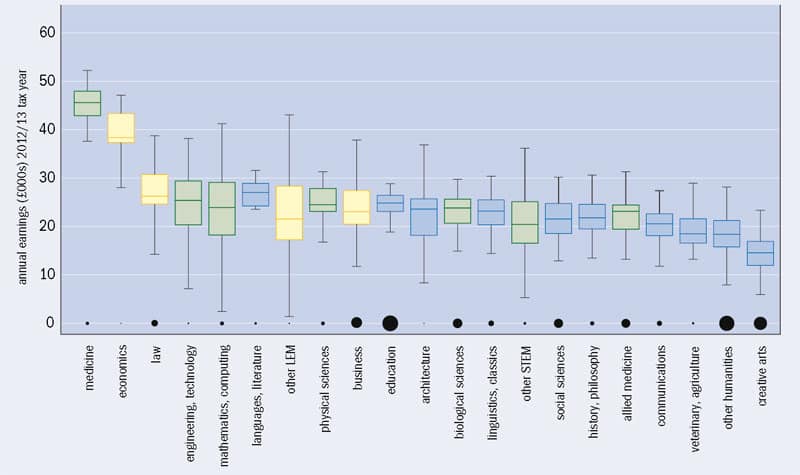
Where the money goes A report by the Institute for Fiscal Studies on UK graduate earnings compared median annual earnings for STEM graduates (green); graduates in law, economics and management (LEM, yellow); and other graduates (blue). Box plots show earnings in 2012/13 for women who graduated from UK institutions in 1999. The line in each box represents the median of institution medians, while the top and bottom indicate the 1st and 3rd quartiles and the whiskers are a rough measure of scatter in the data. In general, LEM graduates have the highest earnings, while the difference between STEM and other subjects (primarily humanities) is not as pronounced. The area of the black dots indicates the number of students in each subject. An equivalent graph for men showed earnings approximately 5–10% higher in most subjects. (Adapted from: How English Domiciled Graduate Earnings Vary With Gender, Institution Attended, Subject and Socioeconomic Background (Institute for Fiscal Studies Working Paper W16/06))
First jobs after graduation
In our study, which was funded by a grant from the Nuffield Foundation, we aimed to find out whether there really is a shortage of highly skilled STEM workers (and if so, in which areas) by bringing together analyses of the best available data in the area. We first looked at data collected by the UK’s Higher Education Statistics Agency (HESA) on the destinations of all graduates six months after they have finished their degrees. Every UK graduate is sent questions on their employment status and response rates are very high, at around 80%. Although HESA also collects data on the longer-term career outcomes, these data are based on only a sample of graduates and have very low response rates (22% in 2012), so here we have only used the data on immediate destinations.
We looked at HESA data from 1994/5 to 2010/11 because it was the best data for making long-term comparisons (the survey changed after 2011). Although the number of students going to university doubled during this period, we found that the patterns of early graduate destinations did not change very much. In general terms, STEM graduates (excluding those studying medicine or dentistry) didn’t have any real labour market advantage over those taking other kinds of degrees, and similar proportions of both groups entered “graduate” jobs (a term that, in essence, denotes jobs that involve some form of managerial, associate/professional or technical expertise). STEM graduates in general were also just as likely as non-STEM graduates to find themselves in positions at the lower end of the occupational scale, working in jobs such as routine sale assistants, caring roles and other elementary functions.
There were some differences between STEM subjects. Graduates in engineering, for example, were more likely than average to find themselves in highly skilled STEM jobs immediately after graduating, while those with degrees the biological sciences were actually less likely to be employed in such positions than those with degrees in some non-STEM subjects. Physicists were somewhere between the two. In every year we studied, between 5 and 10% of STEM graduates were unemployed six months after they graduated.
A relatively high proportion (around a quarter for all disciplines) of graduates in the biological, mathematical and physical sciences stayed on for postgraduate study. This could suggest that some of them were unable – or at least felt unable – to get the kind of job they wanted with just an undergraduate degree. In 2010/11, some 37% of physics graduates stayed on in full-time postgraduate study. If we include those who carried on studying part-time, balancing their studies with work, this figure rises to 46%.
In the same year, less than 5% of physics graduates who found employment were working as “science professionals” six months after graduating. Another 8% worked as “engineering professionals”, and the same proportion were teachers. A much larger proportion (19%), worked in business, finance and statistics, but the largest proportion (26%) were in non-graduate jobs, with 14% working in sales, customer services or other elementary occupations.
The occupational destination of students varies considerably depending on the type of higher education institution they have attended. STEM graduates from Russell Group institutions (such as the universities of Oxford, Manchester and Cardiff) had similar levels of full-time employment compared to those who attended institutions belonging to the University Alliance or Million Plus (UA/M+) groups – predominantly made up of former polytechnics such as the universities of Coventry, Bolton and Nottingham Trent. But a larger proportion of Russell Group STEM graduates gained graduate-level positions and they were almost three times as likely to enter highly skilled STEM jobs. Russell Group STEM graduates were also more likely than those from UA/M+ institutions to remain in education. However, similar proportions from both types of university found themselves unemployed six months after graduation (see table).
Looking further afield
The other data sets we used in our research were the 1970 British Cohort Study (BCS70) and the 1958 National Child Development Study (NCDS). Both of these “longitudinal” studies have tracked the education and careers of all people born in a particular week of the year these studies started. The 9000 or so participants in the BCS70 are now in their mid-40s and those in the NCDS are in their late 50s. The data collected for these studies allowed us to look at the long-term career trajectories of STEM graduates and to compare them with those of graduates in other subjects and also with non-graduates. This is important because it may take some time for graduates to establish their careers, and people also may move in and out of different kinds of jobs over their lifetimes. Because it is more recent and more complete, we will concentrate on the BCS70 data here, but results for the NCDS study were very similar.
Our analyses showed that the long-term career trajectories of STEM graduates and those with degrees in other subjects weren’t very different. By age 30 similar proportions had graduate jobs (86% of STEM and 84% of non-STEM graduates) and the most common jobs for both groups were teaching and “functional management” (managerial roles in finance, marketing, sales and so on). As they got older, many of those working in scientific jobs moved out of these roles, often into management positions. People were unlikely to move into scientific positions later in their careers, however, meaning that overall, fewer older respondents worked in science. If STEM graduates hadn’t entered highly skilled science jobs in their 20s they weren’t likely to do so later.
In fact, we found that surprisingly few STEM graduates worked in professional scientific, research or engineering positions at any time in their careers. At no point between the ages of 26 and 42 were more than 22% working as engineering, information technology and science-related professions (the three key “shortage” occupations) and by age 42 this figure had fallen to only 14%. A comparable proportion (12%) of 42-year-olds worked as teachers and 13% worked as functional managers. Teaching and management were also common destinations for graduates with degrees in other subjects.
Crisis? What crisis?
Our research shows little evidence of a shortage of STEM graduates of “crisis” proportions. Although most STEM graduates find work, and most of these jobs are graduate-level positions, only a minority of them work in highly skilled STEM positions; many more work in teaching, business or management than in science. This situation isn’t new, as our analysis of cohort data shows, and looks unlikely to change in the near future.
If employers are really having trouble filling essential jobs in their science industries, then why are so many STEM graduates working in jobs outside of science? One common explanation is that universities are not providing students with the skills that employers need. But as we have seen, it is nearly impossible to predict what skills will be needed in the future. In any case, universities have to provide a broad, general education; they offer more than just vocational training for particular positions.
Another possibility is that professions outside of science are regarded as more attractive by science graduates, either because they pay more or are seen as more interesting. There are rarely reports of a shortage of bankers, for example, even though the sector relies on recruiting graduates with the kind of mathematical skills that are common among STEM students. Is it actually the case, as many economists argue, that while there is no shortage of STEM graduates, there is a shortage of those who are willing to work for the pay and conditions that are currently on offer?
We would certainly not want to discourage any students from studying science. One of us (ES) is a former secondary school chemistry teacher and the other has taught undergraduates in the sociology of science. We both support science education, and we think that having graduates with science degrees is important for the economy but also for society more widely. Having more politicians with scientific backgrounds, for example, would almost certainly lead to better policy decisions in many areas.
STEM graduates have at least as good career outcomes as those studying other subjects and in some cases slightly better. But we are concerned that the regular scare stories about supposed shortages of scientists may unrealistically raise the expectations of students studying, or planning to study, STEM subjects at university. Science graduates have very promising career prospects – but so do graduates in general. Our research shows that differences in career prospects between degree subjects can easily be exaggerated and that in some respects where you study is as important as the subject on your degree certificate.
For some careers you will certainly need to have a science degree. But bear in mind that most STEM graduates never work in these types of jobs. Having a degree will undoubtedly help your career prospects, but you should study science because you enjoy it, not because you think it will give you a “leg up” in the graduate labour market. Unfortunately, our results show it probably won’t.
What physics graduates really do
(Courtesy: iStock/sorbetto/Mat Ward)
Physics graduates are employed in a wide range of sectors both inside and outside the STEM field. From our research the most likely jobs for physics graduates are (in no particular order) in the following areas:
physical science
IT analysis
software programming and development
business and financial occupations
secondary school teaching
higher education
While there are still many more male physics graduates than female, the types of jobs they do tend to be similar. However, by far the single largest occupational group for female physics graduates is secondary school teaching.
A European-led mission to Mars is feared to have been lost after it failed to communicate that it had successfully landed on the red planet. The lander – called the Entry, Descent and Landing Demonstrator Module (EDM) – is part of the Trace Gas Orbiter (TGO) mission that arrived at Mars only a few days ago, following its launch earlier this year by the European Space Agency (ESA). Both missions are a collaboration between ESA and the Russian space agency Roscosmos. Given that the probe has only enough energy stored in its battery to last up to 10 days, scientists are now in a race against time to figure out what could have gone wrong as the probe descended through the martian atmosphere.
The EDM, which is also known as Schiaparelli, successfully separated from the TGO on 16 October and took around three days to reach the surface of Mars. Yesterday, it entered the planet’s atmosphere at about 21,000 km/h and was supposed to decelerate using aerobraking before deploying a parachute. However, at some point during descent, ESA lost the signal from Schiaparelli that it was monitoring via the Giant Metrewave Radio Telescope near Pune, India.
It is currently unknown whether Schiaparelli fired a thruster to brake just before landing on the surface. During landing, the 577 kg probe was supposed to have taken images of the surface of Mars as well as other data such as pressure and temperature. In the coming days, scientists will listen to possible signals from the lander through orbiting probes such as ESA’s Mars Express mission and NASA’s Mars Reconnaissance Orbiter. “It is clear that these are not good signs,” Paolo Ferri, ESA’s head of mission operations told reporters at a press briefing yesterday.
Towards ExoMars
Yet there was some good news for the ESA team. The TGO has successfully entered into a highly elliptical orbit around Mars. In January 2017 ESA scientists will manoeuvre the TGO into a more circular orbit with an altitude of 400 km. Its four instruments include spectrometers, high-resolution cameras and a neutron detector, which will map Mars for sources of methane and also chart hydrogen below Mars’s surface up to a depth of around 1 m. After a calibration period, the TGO is expected to start operations in December 2017, and will then operate for five years.
It is currently unclear what the possible failure of the EDM will mean for the next part of the joint mission between ESA and Roscosmos. The ExoMars rover, which is due to launch in 2020, will carry a drill and a suite of instruments dedicated to exobiology and geochemistry research, searching for possible signs of life, characterizing the water and geochemical distribution of the surface, and identifying any hazards for future manned missions to the planet. ExoMars is expected to use the same landing techniques as the EDM.
Zahid Hasan of Princeton University in the US is the leader of a group that recently found the first clear evidence for the existence of Weyl fermions – massless particles predicted in 1929 as a solution of the Dirac equation. In this video, Hasan explains why semimetals containing Weyl fermions could be ideal materials for examining a variety of physical theories. He explains that, for instance, these so-called “Weyl semimetals” could be used to recreate the environment of the early universe and explore how the Higgs boson can imbue particles with mass.
This video is part of our 100 Second Science series, in which researchers give concise presentations covering the spectrum of physics.
Two physicists are among the winners of the 2017 L’Oréal-UNESCO For Women in Science Award. The Australian quantum-physicist Michelle Simmons has won “for her pioneering contributions to quantum and atomic electronics, constructing atomic transistors en route to quantum computers”. An award has also been given to the Chilean astrophysicist María Teresa Ruiz, “for her discovery of the first brown dwarf and her seminal work on understanding the faintest stars, including stars at the final stages of their evolution (white dwarfs)”. The award is presented to five female researchers annually, with each winner receiving €100,000. Awards are made on a regional basis, with Ruiz being the laureate for Latin America and Simmons being the Asia-Pacific laureate. Simmons is director of the ARC Centre of Excellence for Quantum Computation and Communication Technology based at the University of New South Wales. Ruiz is director of the Center for Excellence in Astrophysics and Associated Technologies, which is based at the University of Chile.
Graphene protects glass from corrosion
Cloudy wine glasses could be a thing of the past, thanks to researchers at the Institute for Basic Science in Daejeon, Korea. Rodney Ruoff and colleagues have developed a graphene coating that protects glass from the corrosion and weakening that occurs when hydrogen ions from water penetrate the glass surface, causing its silicate structure to dissolve. Graphene could be the ideal coating to prevent glass corrosion because it is extremely thin – just one atom thick – chemically inert, transparent to light and also very tough. Ruoff and colleagues tested this hypothesis by growing sheets of graphene on a copper substrate and then transferring it to both sides of pieces of glass. After 120 days of immersion in hot water, the graphene-coated glass samples suffered no change in fracture strength and surface roughness. In comparison, uncoated samples underwent significant corrosion. “In the future, when it is possible to produce larger and yet higher-quality graphene sheets and to optimize the transfer on glass,” says Ruof, adding “it seems reasonably likely that graphene coating on glass will be used on an industrial scale.” The work is described in Nano Letters.
Humanitarian mapping programme celebrates 15 years at CERN
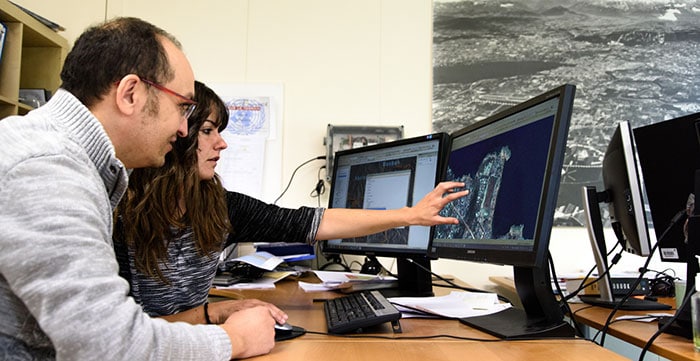
Disaster zone: members of UNOSAT work on satellite images of Haiti in October 2016 to assess the damage of Hurricane Matthew. (Courtesy: Maximilien Brice/CERN)
The United Nations satellite-mapping programme UNOSAT is celebrating its 15th anniversary at CERN in Switzerland. UNOSAT uses CERN’s powerful computer infrastructure to produce extremely precise maps of parts of the world that are experiencing humanitarian crises such as wars and natural disasters – including the recent Hurricane Matthew in Haiti. High-resolution satellite images from public and private sources are stored on CERN’s computer servers. The UNOSAT team then uses the Worldwide LHC Computing Grid to transform the data into maps that are relevant to governments and organizations providing assistance in affected areas. “CERN’s support is essential,” says UNOSAT manager Einar Bjørgo. “Without its powerful IT infrastructure, we wouldn’t be able to compile the satellite data we receive to make it usable.” UNOSAT has also “developed a smartphone application called UN-ASIGN, which allows people to take photos, geo-locate them and share them with UNOSAT”, says Bjørgo.
You can find all our daily Flash Physics posts in the website’s news section, as well as on Twitter and Facebook using #FlashPhysics. Tune in to physicsworld.com later today to read today’s extensive news story on a mission to Mars
Consciousness appears to arise naturally as a result of a brain maximizing its information content. So says a group of scientists in Canada and France, which has studied how the electrical activity in people’s brains varies according to individuals’ conscious states. The researchers find that normal waking states are associated with maximum values of what they call a brain’s “entropy”.
Statistical mechanics is very good at explaining the macroscopic thermodynamic properties of physical systems in terms of the behaviour of those systems’ microscopic constituent particles. Emboldened by this success, physicists have increasingly been trying to do a similar thing with the brain: namely, using statistical mechanics to model networks of neurons. Key to this has been the study of synchronization – how the electrical activity of one set of neurons can oscillate in phase with that of another set. Synchronization in turn implies that those sets of neurons are physically tied to one another, just as oscillating physical systems, such as pendulums, become synchronized when they are connected together.
The latest work stems from the observation that consciousness, or at least the proper functioning of brains, is associated not with high or even low degrees of synchronicity between neurons but by middling amounts. Jose Luis Perez Velazquez, a biochemist at the University of Toronto, and colleagues hypothesized that what is maximized during consciousness is not connectivity itself but the number of different ways that a certain degree of connectivity can be achieved.
Many ways of connecting
Perez Velazquez’s colleague Ramon Guevarra Erra, a physicist at the Paris Descartes University, points out that there is only one way to connect each set of neurons in a network with every other set, just as there is only one way to have no connections at all. In contrast, he notes, there are many different ways that an intermediate medium-sized number of connections can be arranged.
To put their hypothesis to the test, the researchers used data previously collected by Perez Velazquez showing electric- and magnetic-field emissions from the brains of nine people, seven of whom suffered from epilepsy. With emissions recorded at dozens of places across the subjects’ scalps, the researchers analysed every possible pairing of these data “channels” to establish whether the emissions in each case were in phase with one another. They added up the number of synchronized pairs and plugged that figure along with the total number of all possible pairings into a fairly straightforward statistical formula to work out how many different brain configurations that level of synchronicity yields. They then took the logarithm of that number to establish the brain’s entropy.
The data were analysed in two parts. In one, they compared the emissions from four of the epileptic patients when undergoing a seizure and when in a normal “alert” state. In the second, they compared emissions from the other five individuals when sleeping and when awake. In both cases, the bottom line was the same: subjects’ brains display higher entropy, or a higher value of a similar quantity known as Lempel–Ziv (LZ) complexity, when in a fully conscious state.
Varying results
Guevarra Erra admits that the results are not watertight. Indeed, the LZ complexity of one of the four epileptic patients in the first analysis showed no change between seizure and alert states (although that person did remain conscious during part of the seizure). In another individual, LZ complexity actually increased in the second analysis while that person was asleep. Guevarra Erra says that he and his colleagues didn’t carry out a statistical analysis of their results in part because of the “very heterogeneous” nature of those results. But he nevertheless remains “highly confident” that the correlations they have identified are real, particularly, he argues, because they were seen in “two very different sets of data”.
Peter McClintock, a physicist who works on nonlinear dynamics at Lancaster University in the UK, describes the research as “intriguing” but says that the consciousness–entropy correlation should be confirmed using a larger number of subjects. He also suggests investigating “what happens in other brain states where consciousness is altered”, such as anaesthesia.
Emergent property
Perez Velazquez and colleagues argue that consciousness could simply be an “emergent property” of a system – the brain – that seeks to maximize information exchange and therefore entropy, since doing so aids the survival of the brain’s bearer by allowing them to better model their environment. On the question of entropy, however, Guevarra Erra is cautious. He says that personally he would like to have a better understanding of the physical processes taking place in the brain before employing the label “entropy”, explaining that Perez Velazquez was keen to use the term in their paper. One option, he says, would be to carry out fresh experiments that measure thermodynamic quantities in subjects’ brains. He notes, for example, that magnetic resonance imaging can be used to measure oxygenation, which is directly related to metabolism and therefore to the generation of heat.
Guevarra Erra adds that he would like to extend their investigations beyond the hospital to cover more subtle but general cognitive behaviour. The idea would be to monitor a person’s changing brain activity as they focus on carrying out a specific task, such as discriminating between musical tones or trying to find their way round a labyrinth. This, he says, should help to establish whether varying “entropy” correlates with degree of awareness as well as simply with the presence or absence of consciousness.
A paper describing the work will be published in Physical Review E and is also available on arXiv.
Artificial spheres that resemble living cells have been made from proteins by physicists at the University of Saarland in Germany. The structures could someday be used to encapsulate and transport drugs to targeted locations in the body and were created by Karin Jacobs and colleagues. The spheres are made from hydrophobin molecules, which are naturally occurring stringy proteins that are used by fungi to create waterproof coatings. After noticing that the molecules tend to form clumps when in solution, the team used criss-crossing streams of oil and water to push the clumps together to form tiny hollow spheres with walls made from a double-layer of the proteins (see figure). The team was able to “inflate” the spheres by boosting the water pressure inside. The researchers were also able to create ion channels in the walls of the spheres, which could be used to simulate how living cells exchange ions with their surroundings. The physicists are hopeful that they could even make artificial vesicles using their technique, which is described in Advanced Materials.
Shape-shifting seen in zirconium nuclei
One fascinating aspect of some atomic nuclei is that they adopt non-spherical shapes in their lowest energy states. This phenomenon is known as shape coexistence and has proven very difficult to describe theoretically. Now, Tomoaki Togashi and colleagues at the University of Tokyo have performed computer simulations of zirconium nuclei containing 50–70 neutrons. These suggest that the nucleus is a sphere when it has 52–56 neutrons and then undergoes a transition to a deformed shape for a higher number of neutrons – something that is backed up by experimental evidence. The simulations also suggest that the transition is a quantum phase transition, say the physicist writing in Physical Review Letters. The calculations also predict that zirconium nuclei in the transition region around 56 neutrons can coexist in spherical and deformed shapes that differ very slightly in terms of energy. To study this further, Togashi and colleagues joined forces with an international team working on the S-DALINAC accelerator in Darmstadt, Germany. There, they found evidence for this shape coexistence in zircon-96, which has 56 neutrons. The experimental work is also reported in Physical Review Letters.
Silicon-qubit lifetime boosted by factor of 10
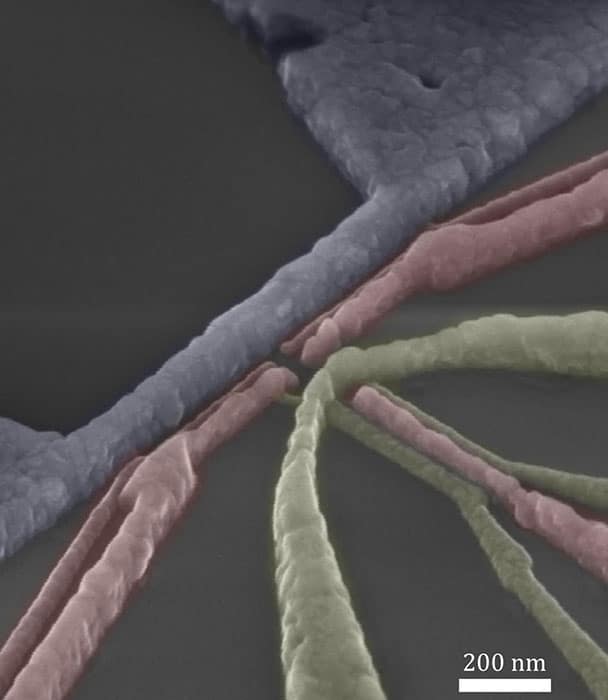
Scanning electron microscope image of a spin qubit. Highlighted are the positions of the tuning gates (red), the microwave antenna (blue), and the single electron transistor used for spin readout (yellow). (Courtesy: Guilherme Tosi, Arne Laucht/UNSW)
The lifetime of a quantum bit (qubit) of information stored in the spin of an electron in silicon has been increased by a factor of 10 by Andrea Morello and colleagues at the University of New South Wales in Australia. Silicon could be useful for creating quantum computers because electronic devices based on the semiconductor can be made with great precision. Quantum information can be stored in the spins of electrons in silicon, but several challenges must first be overcome before practical quantum devices can be made. One problem is that the spins interact with their environment and lose their quantum information in a process called decoherence. In this latest work, Morello’s team worked with the spins of individual phosphorous atoms that were implanted in silicon. Previous studies have shown that these spins can store quantum information for about 200 μs in the presence of a magnetic field. Writing in Nature Nanotechnology, the team describes how it has used an applied microwave signal to boost the lifetime of the spin qubits to 2.4 ms. The microwaves cause the spins to oscillate at a specific frequency, making them much more robust to interference. An added benefit of the new spin qubit is that it can be controlled using microwave signals – unlike the team’s previous spin qubits.
You can find all our daily Flash Physics posts in the website’s news section, as well as on Twitter and Facebook using #FlashPhysics. Tune in to physicsworld.com later today to read today’s extensive news story on the entropy of consciousness.
A new spectrometer-on-a-chip that employs two frequency combs has been unveiled by physicists at Caltech in the US. The precision spectroscopy system is based on pulsed lasers and uses a technique known as dual-comb spectroscopy. This makes it one thousand times more precise and nearly one million times faster than the standard instruments used today. Based on a millimetre-sized silicon chip, the device is an important step towards the creation of portable devices capable of the real-time and precise characterization of the chemical composition of biological or environmental samples. Experts say such devices could have a number of medical and military applications.
Optical spectroscopy is a powerful tool that is used in a wide range of sciences – including astrophysics, biology and chemistry – to determine the chemical composition of unknown specimens. It uses the fact that the frequencies at which a substance will absorb light, known as its absorption spectrum, can serve as a “fingerprint” that reveals which atoms and molecules are in the substance. The accuracy of these chemical fingerprints depends on how precisely a spectrometer can resolve these absorption frequencies from another.
The new spectrometer-on-a-chip was created by Kerry Vahala and colleagues, and it offers a resolution that is about a thousand times better than a conventional grating spectrometer. “Spectroscopists, if you can give them more resolution – they will always take it,” Vahala says.
Wideband pulses
The dual-comb spectroscopy technique was first demonstrated about ten years ago and some implementations have already achieved resolutions 10 million times better than conventional spectrometers. It uses two lasers known as frequency combs that each emit femtosecond-long pulses. Unlike standard lasers that emit in a narrow frequency band, frequency combs have a wide frequency spectrum consisting of many hundreds or thousands of narrow, equally spaced peaks resembling the teeth of a comb. This means the comb is capable of investigating multiple absorption lines simultaneously.
One comb is tuned such that the spacing between its teeth is slightly greater than the spacing in the other comb. The light from the first comb illuminates the material, which absorbs specific wavelengths depending on its chemical composition. When the resulting light is mixed with the second comb’s light, the output includes a radio-frequency envelope signal equal to the frequency difference between the two combs. This envelope is a beat frequency similar to that produced by two guitar strings slightly out of tune with another.
One cycle of this microsecond-scale envelope contains information about the entire absorption spectrum of the sample. Thus, by electronically processing one cycle of this signal, the spectrum can be produced in just microseconds. In contrast, spectrometers that use a diffraction grating take about one minute to acquire the same information.
Race to miniaturize
Although table-sized frequency combs have existed for more than a decade, the effort to shrink these systems to chip-scale has intensified in the past two years. “There’s been a kind of a race to make these things,” says Vahala, whose group is one of a handful in the world that have successfully made millimetre-sized combs.
The chip they produced houses two frequency combs made from two glass rings 3 mm in diameter, known as microresonators. A different laser directs light into the cavity of each glass ring. Each ring amplifies its light to create pulses known as solitons that make up the frequency comb. The team verified the accuracy of the chip by measuring the spectrum of hydrogen cyanide, which has absorption lines that match the frequency range generated by the two combs. Vahala says that the group is working on expanding the number of frequencies their tiny combs can generate.
Research funding agencies like the Defense Advanced Research Projects Agency in the US have been “investing heavily” in these high-precision spectroscopy techniques, according to Peter Delfyett, a frequency comb expert at the University of Central Florida who was not involved in developing the dual-comb chip. Chip-based technologies are of particular interest because miniature systems could be useful in a variety of different tasks. A chip could be installed on a drone for remote environmental monitoring, for example, or used in a breathalyzer to diagnose illness. They could even lead to applications that “we don’t even know about yet,” Delfyett says.
While technical details of the spectrometer-on-a-chip need to be improved, Delfyett predicts that this technology will be ripe for commercialization in less than a decade. “I’m very encouraged by the tremendous amount of effort the scientific community is putting into miniaturizing these comb sources,” he says.
The basics of how a frequency comb works are explained in this video of Paul Williams of the National Institute of Standards and Technology: “What is a frequency comb?”.