LIGO detects second black-hole merger

Hot on the heels of their revolutionary, first ever direct observation of gravitational waves announced in February this year, the LIGO and Virgo collaborations have identified a second gravitational-wave event in the data from the Advanced Laser Interferometer Gravitational-wave Observatory (aLIGO) in the US. The observation was made on 26 December 2015, just three months after the first gravitational-wave event was detected on 14 September 2015.

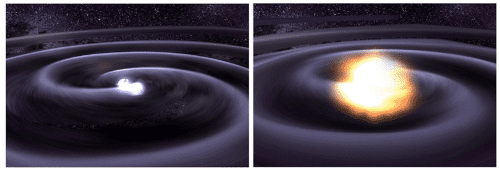
Gravitational waves are ripples in the fabric of space–time, and like the first detection, this latest signal was generated by the collision of two black holes. This time the black holes weighed in at 14 and 8 solar masses and merged to form a single, spinning 21-solar-mass black hole, some 1.4 billion light-years (440 Mpc) away. The collision and subsequent merger released approximately one solar mass of energy, which was radiated away as gravitational waves.

The so-called “Boxing Day event” is officially dubbed GW151226. In October 2015, LIGO recorded another possible event, dubbed LVT151012, which was below the threshold for an official detection. LIGO has therefore detected three events in the four months of observation since it was upgraded to aLIGO. This kicks off the era of gravitational-wave astronomy, and researchers can now begin to constrain predictions about the population of black holes in the universe.

At a press conference held today at the AAS conference in San Diego, LIGO spokesperson Gabriela González said “We are very proud of this being the beginning of gravitational-wave-astronomy. It takes a lot of people, physics and engineering to build these exquisite instruments…and they detected these gravitational waves very clearly.”

Black holes aplenty

Indeed, LIGO changed our view of the universe from its first observation in September. LIGO scientists had expected that binary neutron-star mergers would be one of the first systems that they would detect gravitational waves from. To date, these mergers have not been seen, while black-hole mergers – which were thought to be rare – have instead been detected.

Furthermore, the observed mergers have all involved stellar-mass binary black holes. This is surprising because theories previously suggested that such stellar-mass binaries would either not form at all or, if they did, would be too far apart to merge within the age of the universe. LIGO’s detections have now shown that the opposite is true, and that the rate of binary-black-hole mergers is higher than expected – between six and 400 per cubic gigaparsec per year.

Since the first event in September, theorists have been looking into how such binaries may merge – possibilities include massive binary-stars that both evolve into black holes that eventually merge or black holes in dense stellar environments like globular clusters, where the black holes would “sink” towards the cluster’s centre and merge with others.

Boxing Day binary

B S Sathyaprakash – a physicist at Cardiff University in the UK and a member of the LIGO collaboration – told physicsworld.com that the masses of the two black holes observed in GW151226 are more typical of what they expected for those that form via the evolution of massive stars. “With this system, we widen the debate about formation channels of binary black holes.” Commenting on the great distance to the merger, he says, “The distance to this system is about 70 to 80% of the maximum distance up to which we can confidently detect such systems,” adding that it was “not too surprising [that] our second detection comes from close to the horizon distance of our sensitivity; we survey a greater volume of space at that distance and so [there is] a greater chance of seeing an event.”

The masses of the black holes were smaller than those detected in the first event, which means that the signal was much weaker and was not as immediately visible to the human eye in the data as the September event was. On the other hand, the smaller masses meant that this signal lasted for longer in the detector, and was quickly flagged by LIGO’s online analysis systems and algorithms as a candidate gravitational wave. This occurs because lower-mass systems merge at higher frequencies than systems of larger masses. Heavier systems end up merging more quickly than lighter ones as their orbits quickly reduce, as they emit more radiation.
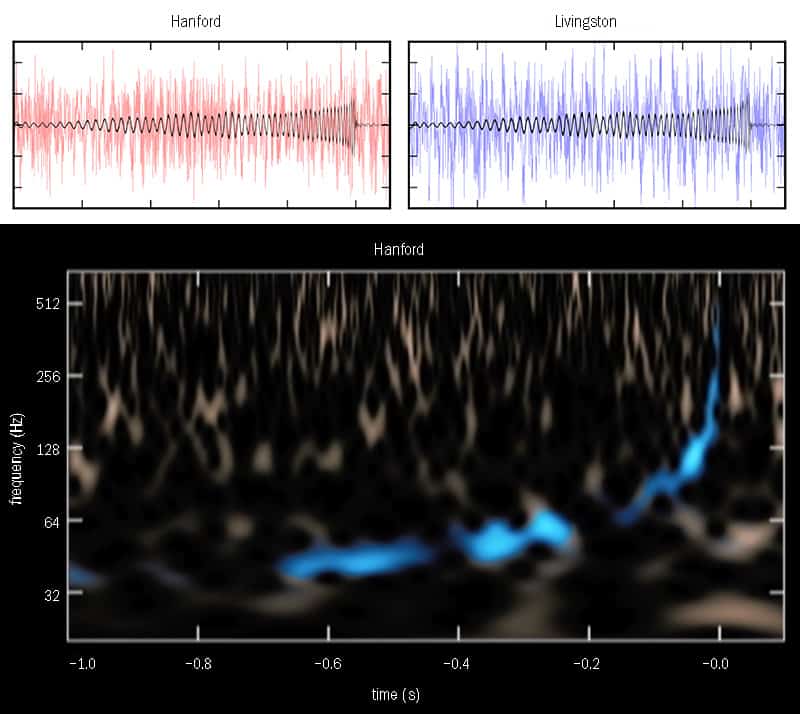
Several views of the gravitational-wave signal detected by LIGO

“This makes some intuitive sense when considering that the size of the black hole is directly proportional to the mass; the larger black holes will merge before they can get close enough to have high frequencies,” explains LIGO scientist Amber Stuver. Although the signal from the December event was not as strong as the first one (which involved masses that were about three times bigger) the statistical significance of the signal was comparable at 5.3σ, because it lasted for longer in the detector – nearly 1 s.

The latest signal was picked up within 70 s of it hitting LIGO’s detectors in December, and was instantly recognized as a good candidate. “I happened to be awake when the trigger came and a bunch of us got together on a teleconference and talked about it for a couple of hours. It was a fantastic Boxing Day present,” says Sathyaprakash.

The signal itself was composed of 55 gravitational-wave cycles that were produced as the two black holes spiralled towards one another. Because the orbital frequency of a system is half the frequency of the wave, the LIGO scientists know they observed about the last 27 orbits before merger. (To read more about the characteristic waveform of gravitational-wave events, including the inspiral, chirp and ringdown features, see “Ligo detects first ever gravitational waves – from two merging black holes”.)

Although only one solar mass of energy was radiated away in the GW151226 event – compared with the three solar masses in the first event – Stuver says that the fraction of mass radiated away in all three detections was nearly the same, up to about 5% of the total mass of the system. This suggests that the merger process for black holes is similar and any differences arise mainly due to differences in mass.

Another contributing factor that could affect the merger process is if either of the original black holes in the binary are spinning – if the spins are aligned, then more energy will be released and vice-versa. In the latest discovery, the LIGO researchers were able to tell that one of the companions had a spin parameter of at least 0.2 – this corresponds to a black-hole rotational speed of a tenth of the speed of light. All of the final black holes formed in the merger were spinning (Kerr) black holes – the spin of the final GW150914 black hole is around 0.7.

Sense and sensitivity

aLIGO’s detectors are currently being upgraded following the first run, further increasing its sensitivity and stability, before a planned engineering run that will begin next month. “Any new or persisting issues will be addressed and tested again before the next observing run, currently scheduled for the fourth quarter this year,” explains Stuver. “We are also very much looking forward to the Advanced Virgo detector [in Italy] joining the search sometime during the next LIGO observing run. This will greatly increase our ability to extract information about the gravitational-wave source from the signal, especially the location in the sky,” she adds.

Indeed, with three or more geographically separate detectors, researchers should be able to nail down where the signal originates from more clearly. Currently, aLIGO can only assay that a signal came from a general area of the sky, mainly by measuring how long it takes a gravitational wave to travel between the two detectors.

With these detections under its hat and an expected rate of one to two detections per month in the next run, it is fair to say that gravitational-wave astronomy is really taking off. “So many years of work by hundreds of scientists has gone into this search, and we are seeing clear evidence that not only do our detectors work, but there may be more things out there to see than we previously thought,” says Stuver.

Sathyaprakash agrees, adding that future detectors and observations will help us to “understand the formation and growth of black holes throughout cosmic history, which could shed some light on a long-standing riddle: when and how did monstrous black holes we now find at centres of most galactic nuclei form and grow?”

The research is published in Physical Review Letters.

Russian bear opens its arms to international science

By Susan Curtis in Moscow

As an update to my last post, Russia’s deputy minister for science and education, Ludmila Ogorodova, accepted that the 1990s had been a period of crisis management for Russian science, and that in the 2000s plans for rebuilding the academic sector were hampered by lack of funding. But she also pointed to figures suggesting that Russian science has turned a corner over the past couple of years.

(more…)

LIGO paints a clearer picture of its merging black holes

By Hamish Johnston

Physicists working on the LIGO gravitational-wave detectors have released more information about the merging black holes that they announced the discovery of earlier this year. Dubbed GW150914, we now know that the gravitational wave was created by the merger of one black hole that was 36 times as massive as the Sun with a smaller black hole that weighed in at 29 solar masses. The result of the merger was a black hole at 62 solar masses and a spin angular momentum of 0.67, where 1.0 is the maximum value of spin a black hole can have.

(more…)

Tsinghua University moves on up

Qi-Kun Xue from Tsinghua University , vice-president for research

By Matin Durrani in Beijing, China

I like big cities so I feel quite at home in Beijing with its skyscrapers, highways and endless traffic. Still, it was a pleasure yesterday on the third day of my visit to the Chinese capital to arrive at the green lawns of Tsinghua University. Situated in a former imperial garden, the university was founded in 1911 and is one of the top institutions in the country. According to the 2015–16 Times Higher Education rankings, it’s also the fifth best in Asia.

Quite why Tsinghua is so well rated quickly became clear as I listened to the numbers reeled off by Tsinghua’s vice-president for research Qi-Kun Xue: the university has 6000 research faculty and staff, a total research budget of $700m, and more than 40,000 students (two-thirds at postgraduate level). Like much of modern China, it’s benefiting from the government’s long-term commitment to growth through investment in facilities and infrastructure.

(more…)

Chiral molecules spotted in interstellar cloud

Scientists could be one step closer to understanding how life emerged on Earth, now that chiral molecules have been detected for the first time outside of the solar system. Chiral molecules, which play crucial roles in the chemistry of life, exist in two different structures that are mirror images of each other. Although the type of molecule detected (propylene oxide) is not a biological one, its discovery suggests that biologically relevant molecules could exist outside of the solar system. As well as suggesting that the precursors for life could exist elsewhere in the universe, the discovery could also help us to understand how chiral molecules – and life itself – emerged on Earth.

Just like human hands – which are mirror images of each other, but not identical – chiral molecules are referred to in terms of their right- and left-handedness. Chirality is an important property of life and most biological processes are “homochiral” – they are highly selective in terms of the handedness of the molecules involved. For example, most amino acids found in living organisms are left-handed, whereas most sugars produced by nature are right-handed.

Many scientists believe that chiral molecules were an important “prebiotic” precursor to life. Chiral molecules older than the Earth itself have been spotted in meteors and comets, which suggests that life may have extraterrestrial origins. As a result, astrobiologists studying the possible emergence of life on other planets are keen to understand where prebiotic chiral molecules are formed in the universe.

Missing line

This latest discovery was made by scientists working on the Prebiotic Interstellar Survey. They have caught sight of propylene oxide in the Sagittarius B2(N) interstellar cloud, which is about 390 light-years from the centre of the Milky Way. Propylene oxide has the chemical formula CH3CHCH2O and is used in the production of plastics. The team first spotted the molecule using the Green Bank Telescope, which is a radio telescope based in West Virginia. The researchers detected two spectral lines associated with the absorption of radio waves by propylene oxide. However, this was not enough evidence to be considered a discovery because they were unable to detect a third line associated with the molecule. This missing line was at a radiofrequency that is difficult to detect in the northern hemisphere, so the team joined forces with astronomers working on the Parkes Observatory in Australia – which detected the third spectral line.

This is…a pioneering leap forward in our understanding of how prebiotic molecules are made in the universe and the effects they may have on the origins of life

Brett McGuire, National Radio Astronomy Observatory

“This is the first molecule detected in interstellar space that has the property of chirality, making it a pioneering leap forward in our understanding of how prebiotic molecules are made in the universe and the effects they may have on the origins of life,” says chemist Brett McGuire of the National Radio Astronomy Observatory in Virginia, who did the study with Brandon Carroll of Caltech and colleagues. Carroll adds that “propylene oxide is among the most complex and structurally intricate molecules detected so far in space.” He says the discovery “opens the door for further experiments determining how and where molecular handedness emerges and why one form may be slightly more abundant than the other”.

Astronomers believe that complex organic molecules such as CH3CHCH2O form in interstellar clouds via several different processes. One process involves smaller, simpler molecules sticking to the surfaces of ice-coated dust particles, where the small molecules can join together to create larger structures. If the ice melts, the large molecules then become free to further react with molecules in the cloud and form even larger and more complex structures.

Polarized light

The radio-spectroscopy technique used to detect propylene oxide is unable to distinguish between right- and left-handed molecules, so the team cannot say if one handedness dominates the interstellar cloud. However, it may be possible to work out the chirality of the cloud by studying how polarized light interacts with the propylene oxide. A gas of chiral molecules will rotate the polarization of light passing through, which is how chirality was first discovered in the 19th century. Some scientists believe that exposure to circularly polarized light in space could result in the production of molecules with a specific chirality, which could then find their way to Earth and other planets via meteors and comets.

“By discovering a chiral molecule in space, we finally have a way to study where and how these molecules form before they find their way into meteorites and comets, and to understand the role they play in the origins of homochirality and life,” says McGuire.

The discovery is described in Science.

Russian physics comes in from the cold

By Susan Curtis in Moscow

It takes less than four hours to fly to Moscow from London, but it feels much more distant and mysterious. Even my colleagues at Physics World, who pride themselves on covering all of physics in all parts of the world, admit to a bit of a blind spot when it comes to Russian science, even though Russia has a strong tradition in physics as well as in mathematics and space science.

(more…)

Playing poker with robots on Mars

Photo of a rover prototype sitting on sand under red light inside a dome with a simulated starry sky

By Margaret Harris

How do you keep an astronaut alive, sane and (ideally) happy during a mission to Mars? The world’s space agencies would very much like to know the answer, but gathering data is tricky. The International Space Station (ISS) makes a good testbed for experiments on the physical effects of space travel, but psychologically speaking, ISS astronauts enjoy a huge advantage over their possible Mars-bound counterparts: if something goes badly wrong on the station, home is just a short Soyuz ride away. Martian astronauts, in contrast, will be on their own.

For this reason, space agencies have become interested in learning how people cope in extreme environments here on Earth, particularly in locations where rescue is not immediately possible. That’s why the European Space Agency (ESA) sent Beth Healey, a British medical doctor, to spend the winter of 2015 at Concordia Research Station, a remote base in the interior of Antarctica. During the continent’s nine-month-long winter, temperatures at Concordia can plunge as low as –80 °C, making it inaccessible even to aeroplanes, which cannot operate at temperatures below –50 °C. So once the last flight left in February 2015, Healey and the 12 other members of the overwintering team were stuck there until November.

(more…)

Lasers transform infrared into broadband white light

A new way to make broadband white light using a cheap, portable infrared diode laser has been developed by researchers in Germany. The technology uses nonlinear effects in a specially designed, easily produced, amorphous material to convert the infrared radiation into broadband visible light. The emitted light is also exceedingly directional, making it useful for high-spatial-resolution devices such as microscopes. It could also have applications in everything from lighting displays to projection systems.

The old-fashioned incandescent light bulb radiates evenly in all directions, and its newer, more efficient counterpart, the light-emitting diode (LED), sends light in all forward directions. This is useful for illuminating a room or a television, but applications such as light shows and microscopy require directional illumination.

Lasers are extremely tightly focused, but they also provide near-single-wavelength illumination, which is often undesirable – it gives a very unnatural image under a microscope, for example. Technologies currently available to provide a tightly focused beam of white light rely on nonlinear effects in, for example, photonic-crystal fibres. To excite these effects, high laser powers are required, which adds massively to the cost and energy requirements of the technologies.

Excited electrons

A new solution has now been developed by Stefanie Dehnen, Sangam Chatterjee and colleagues at the Philipp University of Marburg in Germany, who have synthesized a phosphor (a material that emits one wavelength when irradiated by another) comprising tin-sulfide surrounded by organic groups. When exposed to infrared radiation, the delocalized electrons surrounding the tin-sulfide core absorb the light and become excited. If they used a crystalline molecule, says Chatterjee, the light would be similar to that from a green laser pointer.

Crucially, however, the molecule synthesized by Dehnen’s group remains structurally amorphous – it is a white powder – with the organic groups randomly oriented. In this environment, there is no single lattice constant or vibrational frequency, so the light emitted does not have one pure frequency but is instead broadband. “Maybe certain atoms or certain types of molecules are corresponding somehow,” explains Dehnen, “But in this situation, you have a lot of different types of conformation and they will all give you another wavelength out.”

As the nonlinear effects were much easier to excite in their molecules than in photonic crystal fibres, the team found that powerful fibre lasers usually used could be replaced by simple diode ones. “[White-light] sources are available,” says Chatterjee, “But the laser is more on the $20,000–100,000 range, and our laser is more on the $3 range!” The researchers are continuing to investigate the details of the physics underlying the light conversion. They are also screening other similar compounds to ascertain whether any of them are more efficient or stable, and are investigating how to process the material most effectively. “White powder is bad from an optics point of view because white powder means scattering,” says Chatterjee. “That’s something we need to get under control – how to make this into a nice glass.”

Competing potentials?

Device-physicist E Fred Schubert of Rensselaer Polytechnic Institute in the US, who was not involved in the research, describes it as “a nice piece of work and an alternative path to create white light,” adding that its industrial promise “may show in the future”. He is sceptical, however, about the technology’s potential to compete with solid-state lighting. According to Schubert, organic phosphors have fallen out of favour because they lack the stability to tolerate high radiation fluxes.

He also questions the researchers’ description of their phosphor as “highly efficient”, saying that, while the 10% efficiency of their phosphor is high compared with other upconverting phosphors (phosphors that give out higher frequencies that they absorb), solid-state lighting uses downconverting phosphors with much higher efficiencies. “Before device people look at a phosphor, it has to have more than 90% efficiency,” he says. Finally, he says that display lighting normally requires “control of colour” rather than just broadband, white illumination.

The research is published in Science.

China's chief Moon scientist Ziyuan Ouyang outlines lunar plans

The Moon man: Ziuyan Ouyang in his office at the National Astronomical Obervatories with a lunar globe covered with images taken by Chinese craft

By Matin Durrani in Beijing, China

I caught up this morning on the second day of my visit to Beijing with Ziyuan Ouyang, chief scientist of China’s Moon programme at the National Astronomical Observatories, which lies not far from the city’s iconic “bird’s-nest” Olympic stadium.

I’d first met Ouyang on my last visit in 2011 when the country had so far launched two lunar missions – Chang’e 1 (which orbited the Moon for 18 months before crash-landing onto the lunar surface) and Chang’e 2 (another lunar orbiter that later moved off into interplanetary space).

China’s lunar efforts have continued and Ouyang explained to me what has happened since my last visit – and what the country plans to do next.

(more…)

Widening our view of the universe: NASA’s Wide Field Infrared Space Telescope

The 1998 discovery that the universe is expanding at an accelerated rate raised new and profound questions about the nature and fate of the universe. Based on measurements of the speed of distant supernovae, the discovery pointed to the existence of an invisible “dark energy” that dominates the universe’s mass-energy content and somehow drives the cosmic acceleration. Indeed, together with dark matter, physicists are blind to more than 95% of what makes up the universe. To map out the unseen we have to study the effects of dark energy on that which we can see, namely infrared light from distant galaxies, which means going into space.

Since the discovery of cosmic acceleration, various missions have been proposed to reveal the nature of dark energy, including NASA and the US Department of Energy’s Joint Dark Energy Mission study. The fruit of this effort was the 2010 categorization of the Wide Field Infrared Space Telescope (WFIRST) as a top priority by the US National Academy of Sciences. WFIRST is now a six-year mission being undertaken by NASA to observe the effects of dark energy from an L2 halo orbit 1.5m km from Earth.

A small team immediately began to work on design concepts for a metre-plus-class observatory and set out its scientific goals. Then, in 2012, it was announced that hardware for an optical telescope assembly with a Hubble-sized (2.4 m diameter) primary mirror, valued at more than $300m, was being transferred to NASA from the defence community. It was quickly ascertained that this hardware could be used for a dark-energy survey. The larger observatory, with twice the resolving power and more than triple the light collecting area, offered up to four times the scientific return of the initial design.

Since then, teams at NASA’s Goddard Space Flight Center in Maryland and the Jet Propulsion Laboratory in California have been working hard to pull together payload and instrument architectures that meet the scientific goals, while also overcoming the engineering challenges of designing around existing hardware. In December 2015 the study team presented its “Cycle 6” design to the Mission Concept Review Board. As a result, in February this year, NASA gave the mission the green light with WFIRST set to launch in the mid-2020s. Eleven science teams comprising more than 200 members are now in place to guide the mission goals.

Mission goals

WFIRST will tackle two key questions about the acceleration of the universe. First, it will address whether the speed-up is caused by a new energy component or simply by the breakdown of our understanding of gravity on cosmological scales. Second, if the acceleration is caused by a new energy component, WFIRST will see if its energy density is constant in space and time or if it has evolved over the history of the universe. To achieve this, the observatory will carry out three types of survey.

An imaging survey will measure the shapes and redshifts of a large number of galaxies and galaxy clusters, and will observe how their images are stretched as they pass tangentially around the location of dark matter. This “gravitational weak lensing” survey will cover 2000 square degrees (1/20th of the sky) to observe around 350 million lensed galaxies and 40,000 massive galaxy clusters. The results will produce a map of dark matter and cosmic structure rate of growth, thereby tracing out the distribution and time-evolution of dark energy.

A supernova survey will observe the spectral evolution of 2700 Type 1a supernovae as far out as 10.5 billion light-years via integral-field spectroscopy to correlate their distance (inferred by their brightness) and speed (inferred from their redshift). Finally, WFIRST will carry out a spectral survey of galaxies to study the imprint of primordial sound waves on the clustering of galaxies, also known as baryon acoustic oscillations. A survey of 22 million galaxies between 8 to 11 billion light-years away  will provide an absolute calibration of the expansion-rate history, as well as tests of general relativity based on localized redshift distortions in galaxy clusters.

Taken together and correlated, these three surveys vastly increase the accuracy of the 3D maps of the distribution of matter and gravity, and measure the expansion history of the universe, thereby revealing the temporal evolution of dark energy. WFIRST dark-energy programmes will measure cosmic expansion with an aggregate precision of 0.1–0.5%, which will be improved further as WFIRST’s cosmological data are combined with ground-based instruments such as the Large Synoptic Survey Telescope and other space-based missions such as the European Space Agency’s Euclid telescope.

Another mission goal for WFIRST is exoplanet science. A precise census of planets beyond our solar system is important for both understanding the formation of planetary systems and for determining the number of Earth-like planets in our galaxy. When a star in our galaxy passes between a more distant star, the gravitational microlensing effect produces a temporary increase in the brightness of the distant object. If that star also has a planet, an even shorter intensity spike may be observed, providing information about its orbit and mass. WFIRST’s microlensing survey will monitor 200 million stars in the galactic bulge over six two-month periods, with the hope of finding 2600 planets at least as large as Mars, including 300 Earth-mass planets. The microlensing survey will fill the gaps of missions such as the existing Kepler probe and the future Transiting Exoplanet Survey Satellite by revealing both smaller and farther-orbiting planets.

In addition to the wide-field surveys, WFIRST will also host a demonstration of technology for the first space-borne wavefront-controlled exoplanet coronagraph, which will image dozens of planetary systems orbiting other stars within a 40-light-year radius. The instrument will be able to see exozodiacal dust disks, far-out gas giants and smaller rocky planets nearer to their host star that are highly reflective. Direct imaging will even make it possible to detect changes in both brightness and spectrum as some exoplanets rotate on their axes. Such non-uniformities could indicate land and water masses.

Beyond Hubble

One way to quantify a telescope’s scientific power is its “A*Omega” value, which is the product of its aperture and its field of view. WFIRST’s primary mirror shares the same 2.4 m-diamteter aperture as Hubble, but Hubble was designed to accommodate five science instruments plus three fine guiders, each with limited fields of view. WFIRST has just one large Wide-Field Instrument (WFI) with three main modes, and the Coronagraph Instrument (CGI) with two main modes. But they pack a punch: of the 20 scientific questions listed in the National Academy of Sciences’ decadal survey of astronomy and astrophysics, WFIRST addresses 15 of them.

The WFI contains the Wide-Field Channel (WFC), which can view 0.28 square degrees of sky (about the same area as the Moon) with a resolution of 300 megapixels. In fact, the WFC will cover almost 90 times more sky than Hubble’s Advanced Camera for Surveys, and more than 200 times more sky than Hubble’s wide-field infrared mode. Furthermore, whereas Hubble’s low-Earth orbit allows only a 60% average orbital visibility period of just under one hour per 96-minute orbit, WFIRST’s L2 orbit allows continuous operation that will outpace Hubble’s infrared survey capabilities by a factor of 360.

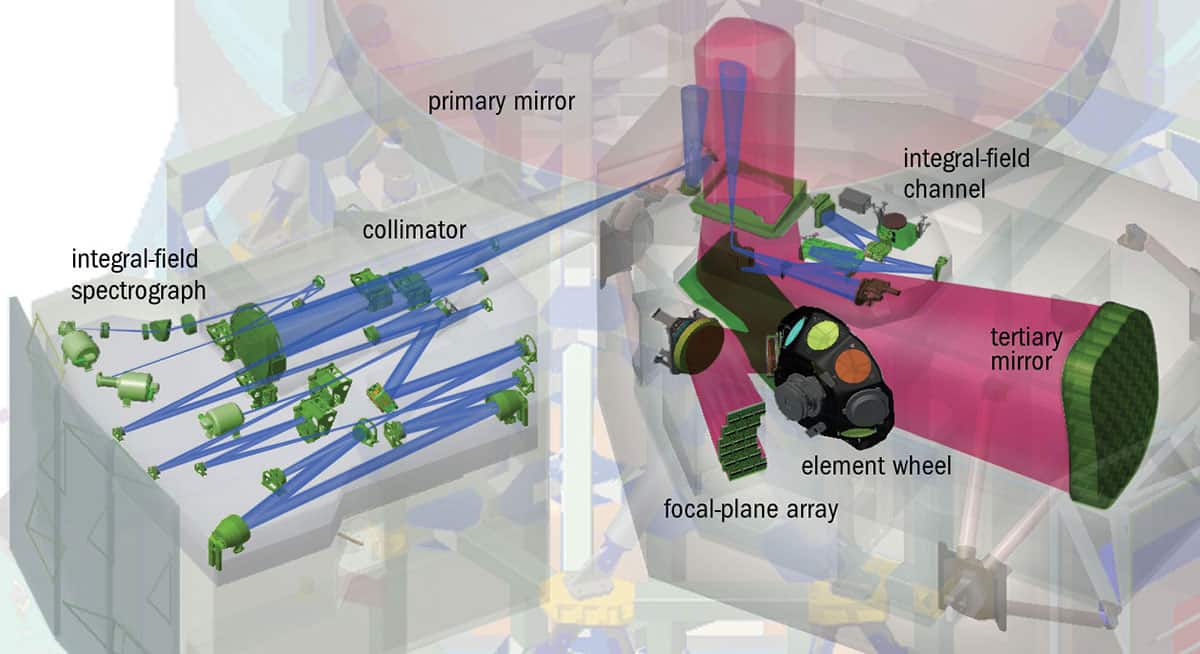
So how does WFIRST maintain or improve the quality of its images and increase the field of view despite having the same mirror size as Hubble? The answer is an advanced optical design that reuses the telescope’s primary and secondary mirrors, then adds a third tertiary mirror to create what is called a three-mirror anastigmat (TMA). Unlike Hubble’s two-mirror Ritchey–Chrétien design, a TMA can be optimized for a wide and flat diffraction-limited field. Therefore, a large array of sensors can be used at the focal plane to image a very large piece of the sky in high resolution.

Artist's impression of the WFIRST payload

This is perfect for WFIRST’s imaging, spectral and microlensing surveys. The WFI boasts a 300 megapixel array of 18 custom mercury-cadmium-telluride CMOS detectors, each with 4088 ×,4088 pixels measuring 10 µm across to see wavelengths from 0.76–2.0 µm. To accomplish this, NASA’s optical designers used a carefully selected set of design parameters and constraints in optical-design software. The specific optical design is the result of a delicate balance of performance, costs and programmatic issues.

One challenge in designing a system with such a high value of A*Omega is the tight volume and interface constraints. Despite having more than three times the volume of Hubble’s Wide-Field Camera, two additional flat mirrors are required to fold the optical path into the instrument volume. A carbon-fibre bowl-shaped motorized carrousel called the element wheel interchanges six bandpass filters and one spectroscopic dispersion unit called the grism. The grism combines a diffraction grating, powered prism and binary optical elements to maintain image quality over a wide field.

Another challenge was to extract the spectrum of a supernova cleanly from that of the host galaxy for the supernova survey. To do this the WFI also contains a breadbox-sized instrument called the Integral Field Channel, which contains a specialized image slicer that uses 120 micromirrors that can dissect a single distant galaxy into 0.15 or 0.3 arcsecond samples before passing it through a spectrograph. A small section of WFIRST’s telescope’s field is also picked off for the CGI. In order to image orbiting exoplanets within 0.1 arcseconds of the host star, its light must be blocked with a contrast factor of at least 1 part per billion. That is 1000 times greater than current instruments, including those on NASA’s James Webb Space Telescope (JWST). Cutting-edge technologies were implemented to achieve precision wavefront control unlike anything flown in space, including sensing and controls for two deformable mirror arrays, a fast steering mirror and a pupil occulting mask.

Many institutions and facilities are involved in making the WFIRST mission successful. Currently, the project team is developing a clear path for WFIRST integration and testing activities, including verification plans for each subsystem, individual instruments and the entire observatory. To accomplish this the team is refining optical error budgets and integrated modelling methods to account for each step of the way, from fabrication and assembly to on-orbit commissioning. Development and risk-reduction activities are still under way as WFIRST heads towards a detailed design in 2017.

To the future

In science, each mission or new tool informs and enables the next. WFIRST observations of new planets by the coronograph instrument will lay the technical and scientific foundations for a future imaging and spectroscopy mission that could image the atmosphere of exoplanets to look for “Earth 2.0”. Survey results, meanwhile, will make dark-energy equation-of-state parameters 10 times more precise and perhaps tell us how dark energy may eventually cause the fabric of space–time itself to break down.

Regardless of the results, the data produced by WFIRST will open up new questions for future missions to explore, and call for a new set of instruments. Flagship missions such as Hubble, JWST and WFIRST span more than two decades from initial studies to final launch, and NASA researchers are already looking at what the next such mission might look like. Hubble’s big surprise was how much we did not even know to look for. With WFIRST and other tools of the coming decade, we fully expect to be surprised at the questions they will lead us to.

Copyright © 2026 by IOP Publishing Ltd and individual contributors