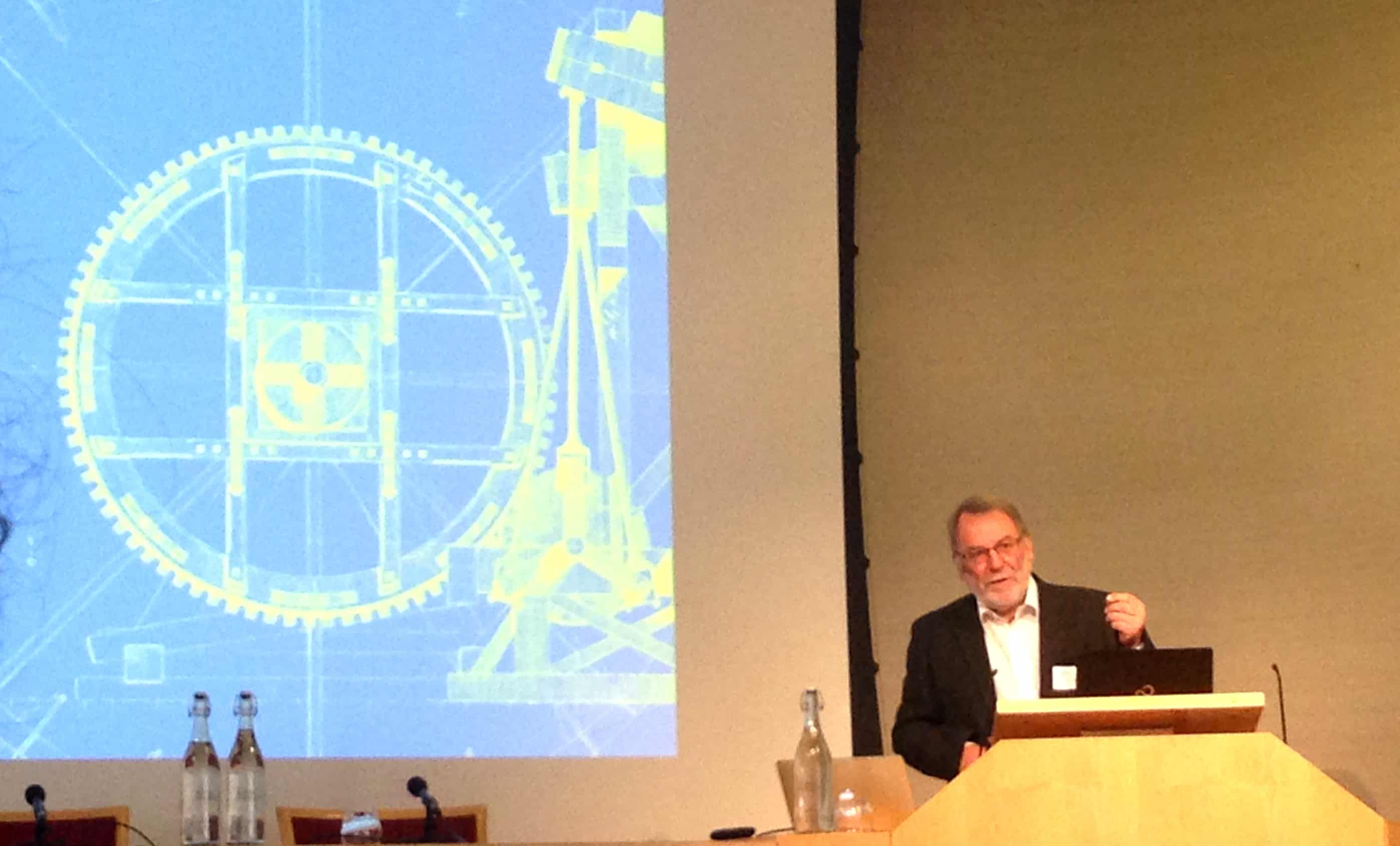
Futuristic views: Peter Knight opening the conference at the Royal Society in London. (Courtesy: Tushna Commissariat)
By Tushna Commissariat
Not a week goes by here at Physics World that we don’t cover some advance in quantum mechanics – be it another step towards quantum computing or error correction, or a new type of quantum sensor, or another basic principle being verified and tested at new scales. While each advance may not always be a breakthrough, it is fair to say that the field has grown by leaps and bound in the last 20 years or so. Indeed, it has seen at least two “revolutions” since it first began and is now poised on the brink of a third, as scientific groups and companies around the world race to build the first quantum computer.
With this in mind, some of the stalwarts of the field – including Peter Knight, Ian Walmsley, Gerard Milburn, Stephen Till and Jonathan Pritchard – organized a two-day discussion meeting at the Royal Society in London, titled “Quantum technology for the 21st century“, which I decided to attend. The meeting’s main aim was to bring together academic and industry leaders “in quantum physics and engineering to identify the next generation of quantum technologies for translational development”. As Knight said during his opening speech, the time has come to “balance the massive leaps that the science has made with actual practical technology”.
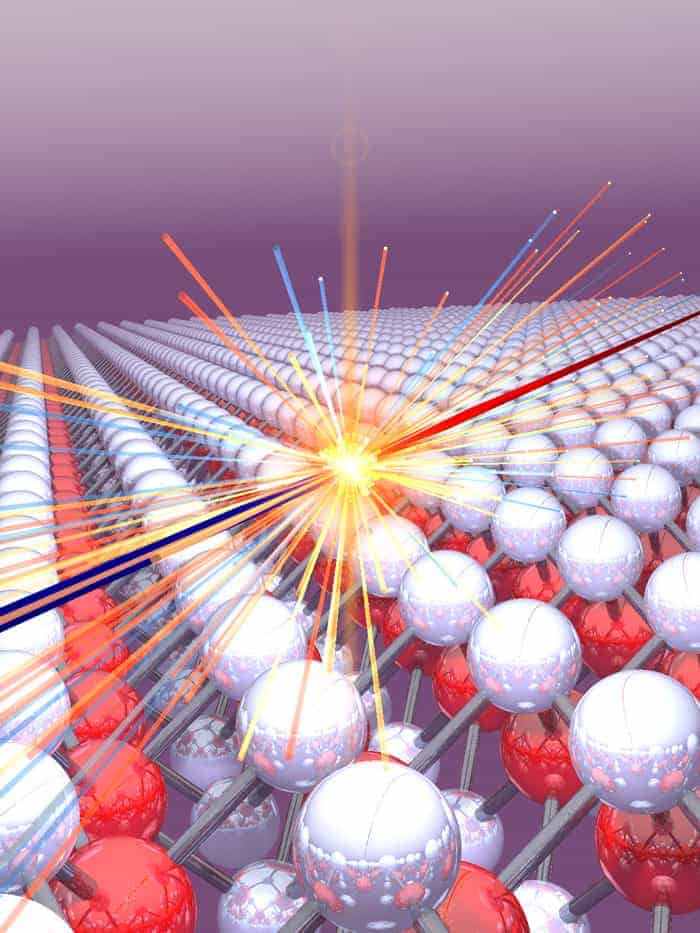
Clash and bang: exciton collisions within a semiconductor lattice. (Courtesy: Huber Group/University of Regensburg)
The first controlled collisions of quasiparticles within a solid have been achieved by an international group of physicists. By firing a laser pulse at a semiconductor, the group created “excitons” – electron–hole pairs bound to each other via electrostatic attraction. This new experimental technique could resolve the dynamics of the collision to about two femtoseconds. The researchers say that, apart from improving our understanding of the fundamental physics of excitons, the technique opens the door to studying the fast dynamics of quasiparticle interactions in solids. It could even be used to design semiconductor devices in the future.
Quasiparticles such as the exciton are configurations of particles that have distinctive collective behaviour. It’s analogous to a bubble in water, says Mackillo Kira at Philipps-Universität Marburg in Germany. When describing bubble behaviour, it’s easier to treat the bubble as a single particle “rather than considering all of the water molecules at once”, he says. Similarly, quasiparticles are a more illuminating way of studying the bulk behaviour of semiconductors and other solids compared with individual electrons. Quasiparticle interactions are often used to explain material properties such as resistivity, heat capacity and superconductivity.
Dynamical collisions
In the past, physicists have used spectroscopy to study quasiparticle structure, but this group is the first to observe quasiparticle dynamics in time. To create the excitons, the researchers fired a 10 fs optical laser pulse at a sample of tungsten diselenide. This pulse excited an electron from the valence band into the conduction band, leaving a positively charged hole in its place. The resulting electron–hole pair constitutes an exciton. The team then used a 23 THz sinusoidal laser pulse to collide the electron with its hole. Indeed, this is done by precisely tuning the timing of the second laser pulse, such that the electron and hole are stretched apart, before being accelerated toward one another in a collision. The electron and hole annihilate in the collision and emit a high-energy photon.
The team could observe the process of exciton creation, acceleration and annihilation to 2 fs resolution by detecting the frequency, intensity and direction of the emitted light. Kira told physicsworld.com that this high resolution is possible because of the shortness of the pulses and the precision with which they can be controlled. In particular, the first 10 fs optical pulse that creates the excitons is much shorter than the 50 fs oscillation period of the THz laser pulse. This means that the researchers could create excitons quickly enough to manipulate and collide them using the second laser pulse.
Precision timing
However, the biggest technical challenge was precisely timing the delay between the two laser pulses over many measurements, according to Kira. Because the light emitted in the collisions would be different depending on when the second laser pulse was fired, to achieve the 2 fs resolution, the researchers needed to replicate the timing in each collision precisely. To fully describe the collisions, the team turned to quantum mechanical principles. “When quasiparticles collide, they are not classical objects and also have aspects of waves,” says Kira. The wave-like nature of the excitons resulted in quantum mechanical behaviour such as interference patterns.
Using controlled collisions to study quasiparticles is a novel idea, says Dirk van der Marel at the University of Geneva, who was not involved in the research. The technique could be adapted to study the dynamics of more complex quasiparticles such as polarons or vortices in superconductors, he says. The level of control is “exciting”, says van der Marel, adding, “I’m sure that many people will follow this and try to do it themselves.”
Picking a top from among the three dozen in front of him, Kenneth Brecher gives it a quick twist with his fingers and lets it fall on his dining-room table. The little symmetrical object bounces once, then whirls furiously, all the while standing still and almost motionless on point. “I love tops!” he cries. Seeing the beautiful little performance – the top utterly silent yet responsive to the slightest bump, gust or other perturbation – it’s impossible not to share his enthusiasm.
Brecher recently retired after 35 years as a professor of astronomy and physics at Boston University in the US. For two decades, he designed hands-on, educational optics experiments and demonstrations thanks to a National Science Foundation-sponsored effort called Project LITE: Light Inquiry Through Experiments. One by-product of this project was his interest in kaleidoscopes, which I covered in a column last year (“Meet the kaleidoholics”). Another, via a roundabout route, turned into a passion for tops.
Ahead of my visit, Brecher filled his dining-room table with varieties of tops drawn from his collection of hundreds. Some are handcrafted, some machined. A few are of Brecher’s own design.
“That’s called a finger top,” he says, pointing to the one still spinning on the table. “This one’s a supported top,” he adds, indicating one that you start by holding it in a frame and pulling a string. “Whip tops” are kept going by lashing them.
Brecher picks up a hollow top whose surface is chiselled with horizontal and vertical ridges. It looks like a hand grenade. “Guess what this does!” he asks. I wonder if it makes a noise, and as Brecher sets it whirling, it duly emits a low, owl-like sound. “It’s a humming top,” he says. “Wait till you hear the resonant frequency!” A moment later, as it slows, the deep sound is joined by a haunting, higher-pitched overtone.
Brecher picks up a jar lid that he has turned into a top and spins it. “Look at the dynamics! It spins, wobbles and spins again,” he says, delighted. “I call it spobbling!”
From Tutankhamun to Maxwell
Tops are among the oldest and most universal kind of toys, with nearly all cultures having them. Toy tops were among the contents of Tutankhamun’s tomb dating from 1300 BC, while a whip top appears in a Hittite bas-relief from about 800 BC. Nearly all cultures, too, have found tops to have symbolic meanings.
Pieter Bruegel the Elder included them in his Children’s Games painting of 1560. Franz Kafka wrote a short story, “Der Kreisel”, in which a philosopher grows frustrated because, trying to understand a top, it stops spinning the moment he grabs it, symbolizing the ineffability of life. Hans Christian Andersen wrote a fairy tale – “Toppen og bolden” – about the unrequited love of a top for a ball, while Georges Bizet even devoted the piano composition La Toupie to a top.
More recently, the protagonist of the 2010 film Inception uses a top to distinguish between dreams and reality. If the top spins continuously, he knows he’s dreaming, while if it eventually falls over he knows he’s awake. Film critics had a field day discussing the significance of the fact that at the conclusion he spins the top, and the film ends without showing whether the top falls or not. One of the simplest of physical devices, a top usually consists of a mass symmetrically arranged about a spindle with a point at one end. When spun and given sufficient angular momentum, it whirls about that point without falling over. But despite tops having existed for so long, it is only relatively recently that scientists have begun to explain and exploit their physical properties. Indeed, their dynamics are still not entirely clear.
The study of spinning tops started in the 18th century with the mathematician Leonhard Euler (1707–1783). He wrote several papers on the subject, framing their motions in terms of angles of orientation now called Euler angles. Using these angles, most top dynamics can be described in terms of three basic motions: spin, precession and “nutation” – or the wobbling of the rotational axis.
Serious experimental research into tops had to wait till the 19th century, however, thanks to the curiosity of the young James Clerk Maxwell. One of his professors in Edinburgh was interested in vision, and used tops to create visual perception illusions. Soon afterwards, when Maxwell went to Cambridge, he devised his own colour-mixing disc, initiating the quantitative study of colorimetry.
A few years later, when Maxwell was back in Scotland as a professor in Aberdeen, he designed and built a special top that puts the support at the centre of mass so there’s no net gravitational torque and the top can be spin oriented in any direction. He also put in set screws that could be adjusted to raise or lower the centre of mass. “That turned the top into a highly sensitive instrument,” Brecher says, “allowing him to measure its responses to external influences.”
Having bought a replica of Maxwell’s original device, Brecher picks it off the table and points out the support, which lies inside a mushroom-like cap. “This is the most beautifully designed top ever!”
Gyroscopes
The theory of tops was given further impetus in the 19th century by the development of gyroscopes. These consist of a freely rotating central mass (a sphere or disc) on a mount, or “gimbal”, that holds this mass steady even when the support is tilted.
The German astronomer Johann Bohnenberger was the first to discover the gyroscope effect, in which the axis of a rotating object can maintain the same direction despite the movement of its support, and in 1817 he discussed in print devices he had built exhibiting it. A few decades later the French physicist Leon Foucault gave gyroscopes their name and used them to demonstrate the rotation of the Earth. Now they are all over, from inside mobile phones (where they track orientation) to outer space. “Gravity Probe B was the world’s most expensive gyroscope,” Brecher says. “Everyone in the US has spent $3 on it.”
Top theory was further advanced by the mathematician Felix Klein. In 1896 he delivered a series of lectures at Princeton University on rotating bodies, published the next year as The Mathematical Theory of the Top. Klein recruited his then-research assistant Arnold Sommerfeld to collaborate on a four-volume, 1000-page work, The Theory of the Top, which took them 14 years to complete. “Even that enormous work just scratched the surface,” Brecher adds. “It ignores frictional forces and the elastic properties of real-world tops.”
Top mysteries
One reason for Brecher’s fascination with tops is that several aspects of their motions are still unexplained. “Why, for instance, can the centre of mass of a spinning top rise up?” he asks. One of the first physicists to wonder about this was William Thomson, later Lord Kelvin, who as a 20-year-old student in 1844 went to the beach and noticed that he could make smooth rocks of certain shapes stand on end by spinning them, but could not fully explain why. “The answer has to do with friction,” Brecher says. “Two kinds are involved, rolling friction and sliding friction – but it’s a non-holonomic system, meaning that the forces depend on the velocities. There’s no analytic theory of that.”
A second mystery involves a visual phenomenon. The physicist Ernst Mach, Brecher says, may have been the first to write about the strange illusion that a slowly rotating, hard-boiled egg doesn’t appear solid, but jiggles as if made of jelly. “I call it the gelatinous ellipsoid effect,” he said, “and it’s still being investigated.”
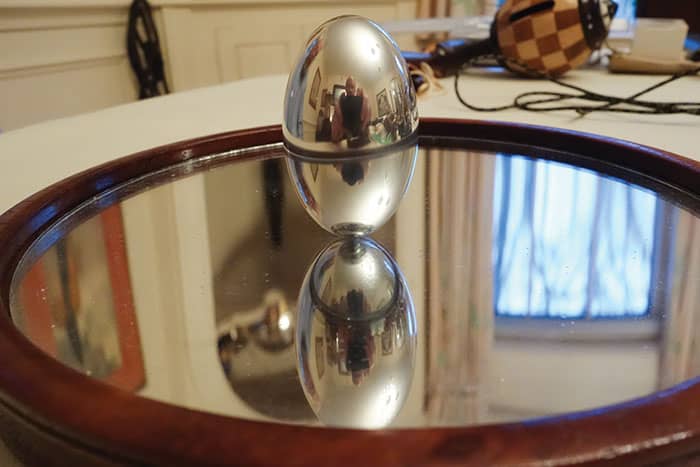
Golden egg The PhiTOP, which stands up on its end. (Courtesy: Robert P Crease)
A third mystery of top theory involves “tippe tops”, which look something like other tops except that they start spinning about the spherical bottom and then – if given enough angular momentum – flip over to whirl about the other end which has a spindle on it. The dynamics are related to those involved in the stone problem noted by Thomson, and also to the dynamics of “rattlebacks” – oblong objects that when spun one way begin to rock up and down and then begin to spin in the reverse direction. “But the tippe top has a single contact point, which creates a new set of issues.”
In his years as a professional astrophysicist, Brecher had many occasions to work on rotating objects. In 1976, for instance, he wrote the first paper on neutron-star precession. But his interest in tops literally spun off from another source. Brecher had been posting colour patterns on his Project LITE website that could be printed out, pasted on CDs and then spun with added spindles to reveal unexpected visual phenomena.
To illustrate, he shows me a disc painted with two bands – one alternating white and red segments, the other yellow and black – and puts it on a top. “When I spin this, what colours do you think you will see?” I guess pinkish for the white and red band, grey for the yellow and black. Brecher gives it a spin. Sure enough, the white and red bands blend together and look pinkish. But I gasp at the other, which turns bright green. Brecher claps his hands in delight. “Nobody expected that! It’s a new phenomenon!”
When Brecher tried to make tops for his patterns, so that he could put the instructions on his website, he encountered challenging mechanical issues. “The stem of the tops can’t be too long or too short, and you may want to alter how they spin,” he explains. Such issues led him to explore top dynamics. Along the way, he realized that he could use tops in astrophysics demonstrations – for instance, to illustrate how an accreting black hole radiates jets of gas. Sometimes the jets precess, while at other times the accretion disc precesses.
Brecher then shows me a demonstration of electromagnetism called Tesla’s Egg of Columbus. He puts a metal ellipsoid on top of a magnetic stirrer and turns it on. The ellipsoid begins to rotate before eventually standing up on end. “Induction,” he says. “The rotating magnet sets up eddy currents in the ellipsoid, which then interact with the magnet. Beautiful!”
Just over a year ago, Brecher says, he was exploring the rotations of simple ellipsoid shapes, trying to find unusual motions. “A rotating sphere does not have any interesting motions, while a spinning ellipsoid with a major to minor axis ratio of more than about 2 to 1 won’t stand up.” He found that a ratio of about 1.6 was optimal for getting the ellipsoid to stand on end with your fingers. When he realized that this was close to the much-hyped “golden mean” of 1.618, he decided to manufacture the ellipsoid at that dimension. He formed a company called Sirius Enigmas to market them as “pleasurable, relaxing and thought-provoking” executive toys.
“I call it the PhiTOP,” he says, plopping a golden egg-like object in front of me. I spin it with my fingers. It stands up on one end, standing silent and still while convexly mirroring the surrounding room. After a few minutes it rolls over on its side, and the reflection turns into the gelatinous ellipsoid effect.
The critical point
A few years ago, Brecher was passing through San Francisco airport en route to a physics conference when an airport security officer questioned him about the objects in his carry-on bag. Brecher replied that the objects were for demonstrations about the physics of tops. The officer insisted Brecher remove the material and explain, and Brecher gave a little demonstration. The line of travellers behind the two men grew, with some of them making impatient gestures, but the officer took his time and insisted on asking detailed questions about why the tops rise and turn over, and about the forces involved.
Brecher was delighted. “I told him ‘You ask better questions than my graduate students!’ ” he recalls. The officer flinched with resentment. “Just because I don’t have a college degree,” he said, “does that mean I don’t know how to think?”
Stunned, Brecher blushed with embarrassment. He had meant to be complimentary, but was inadvertently condescending, implying that only his students were curious and intelligent enough for such things. “I felt bad,” he recalls. “I mulled over that for the rest of the meeting.” It was a lesson, he finally decided, in the way the right kind of toy can draw us into the world, making us want to know more about its deeper structures, fostering the kind of impulse that attracts people to science in the first place.
A collimated beam of gamma-ray photons could be created by firing intense laser pulses into a specially designed plastic target. That’s the claim of physicists at the University of Texas in Austin, US, whose computer simulations suggest that the electrons liberated when the pulse hits the target are accelerated in zigzag trajectories along magnetic-field lines. The electrons would therefore emit synchrotron radiation in the direction of the laser beam – an effect that could be used to make a pulsed gamma-ray source tens of terawatts in power.
Firing intense laser pulses at a target rips electrons from their constituent atoms, creating a plasma with a huge electric-field gradient that can be thousands of times greater than those generated by conventional particle accelerators. This gradient accelerates electrons to energies of several gigaelectronvolts, and now Alexey Arefiev and colleagues have shown that – under the right conditions – these electrons will emit synchrotron light at gamma-ray energies as they curve around the field lines of a very strong magnetic field.
The magnetic field is generated by the fast-moving electrons in the plasma, and the team’s computer simulations suggest that it can be as strong as 0.4 × 10⁶ T. This is about 100,000 times stronger than the magnetic fields used during a medical magnetic-resonance-imaging (MRI) scan and is on a par with the magnetic field on the surface of a neutron star. Arefiev and colleagues say that the technique could be used to generate pulses of gamma rays with energies of several megaelectronvolts. The pulses could reach intensities of tens of terawatts and could be generated using existing petawatt pulsed lasers.
Straight and narrow
The simulations also suggest that building such a gamma-ray generator would involve big technical challenges. Under ideal conditions, the pulse should propagate through the plastic target in a straight line, creating a cylindrical region of plasma. In reality, however, some of the light and the accelerated electrons would deviate from the straight-line trajectory, creating gamma rays emitted in a “spray” across a number of different angles, rather than in a collimated beam.
Based on their simulations, Arefiev and colleagues suggest that this deviation could be minimized by creating channels in the target that have optical properties that prevent the light from being deflected. Potential applications for laser-driven gamma-ray beams include generating positrons via pair production; simulating astrophysical processes in the laboratory; nuclear spectroscopy; and medical applications such as therapy and surgery.
The first results from a detector designed to look for evidence of particles reaching us from a parallel universe have been unveiled by physicists in France and Belgium. Although they drew a blank, the researchers say that their experiment provides a simple, low-cost way of testing theories beyond the Standard Model of particle physics, and that the detector could be made significantly more sensitive in the future.
A number of quantum theories of gravity predict the existence of dimensions beyond the three of space and one of time that we are familiar with. Those theories envisage our universe as a 4D surface or “brane” in a higher-dimensional space–time “bulk”, just as a 2D sheet of paper exists as a surface within our normal three spatial dimensions. The bulk could contain multiple branes separated from one another by a certain distance within the higher dimensions.
Physicists have found no empirical evidence for the existence of other branes. However, in 2010, Michaël Sarrazin of the University of Namur in Belgium and Fabrice Petit of the Belgian Ceramic Research Centre put forward a model showing that particles normally trapped within one brane should occasionally be able to tunnel quantum mechanically into an adjacent brane. They said that neutrons should be more affected than charged particles because the tunnelling would be hindered by electromagnetic interactions.
Nearest neighbour
The researchers have now teamed up with physicists at the University of Grenoble in France and others at the University of Namur to put their model to the test. This involved setting up a helium-3 detector a few metres from the nuclear reactor at the Institut Laue-Langevin (ILL) in Grenoble and then recording how many neutrons it intercepted. The idea is that neutrons emitted by the reactor would exist in a quantum superposition of being in our brane and being in an adjacent brane (leaving aside the effect of more distant branes). The neutrons’ wavefunctions would then collapse into one or other of the two states when colliding with nuclei within the heavy-water moderator that surrounds the reactor core.
Most neutrons would end up in our brane, but a small fraction would enter the adjacent one. Those neutrons, so the reasoning goes, would – unlike the neutrons in our brane – escape the reactor, because they would interact extremely weakly with the water and concrete shielding around it. However, because a tiny part of those neutrons’ wavefunction would still exist within our brane even after the initial collapse, they could return to our world by colliding with helium nuclei in the detector. In other words, there would be a small but finite chance that some neutrons emitted by the reactor would disappear into another universe before reappearing in our own – so registering events in the detector.
If the brane energy scale corresponds to the Planck energy scale, there is no hope to observe this kind of new physics in a collider
Michaël Sarrazin, University of Namur
Sarrazin says that the biggest challenge in carrying out the experiment was minimizing the considerable background flux of neutrons caused by leakage from neighbouring instruments within the reactor hall. He and his colleagues did this by enclosing the detector in a multilayer shield – a 20 cm-thick polyethylene box on the outside to convert fast neutrons into thermal ones and then a boron box on the inside to capture thermal neutrons. This shielding reduced the background by about a factor of a million.
Stringent upper limit
Operating their detector over five days in July last year, Sarrazin and colleagues recorded a small but still significant number of events. The fact that these events could be residual background means they do not constitute evidence for hidden neutrons, say the researchers. But they do allow for a new upper limit on the probability that a neutron enters a parallel universe when colliding with a nucleus – one in two billion, which is about 15,000 times more stringent than a limit the researchers had previously arrived at by studying stored ultra-cold neutrons. This new limit, they say, implies that the distance between branes must be more than 87 times the Planck length (about 1.6 × 10⁻³⁵ m).
To try and establish whether any of the residual events could indeed be due to hidden neutrons, Sarrazin and colleagues plan to carry out further, and longer, tests at ILL in about a year’s time. Sarrazin points out that because their model doesn’t predict the strength of inter-brane coupling, these tests cannot be used to completely rule out the existence of hidden branes. Conversely, he says, they could provide “clear evidence” in support of branes, which, he adds, could probably not be obtained using the LHC at CERN. “If the brane energy scale corresponds to the Planck energy scale, there is no hope to observe this kind of new physics in a collider,” he says.
Axel Lindner of DESY, who carries out similar “shining-particles-through-a-wall” experiments (but using photons rather than neutrons), supports the latest research. He believes it is “very important” to probe such “crazy” ideas experimentally, given presently limited indications about what might supersede the Standard Model. “It would be highly desirable to clarify whether the detected neutron signals can really be attributed to background or whether there is something else behind it,” he says.
Can subatomic particles contain four or more quarks and antiquarks? The Standard Model of particle physics says an emphatic “yes”, but for decades after quarks were first postulated in the 1960s, physicists could not find any particles containing more than three quarks. Over the past 15 years, however, physicists have spotted particles that appear to contain four and five quarks and antiquarks.
In this audio interview, Mike Williams of the Massachusetts Institute of Technology in the US explains how collider experiments such as LHCb at CERN have discovered tetraquarks (two quarks and two antiquarks) and pentaquarks (four quarks and an antiquark). Physicists know very little about the internal structure of these exotic particles and Williams explains how they could resemble molecules – a proton bound to a meson, for example – or simply be a tightly bound collection of quarks. He also explains why studying tetraquarks and pentaquarks could improve our knowledge of quantum chromodynamics – the theory of how quarks interact with each other – and speculates on whether particles containing even larger numbers of quarks could exist.
A nuclear clock that is more precise than any atomic clock available today could soon be a reality, thanks to a discovery made by physicists in Germany. The team is the first to detect a crucial low-energy transition in the thorium-229 nucleus, which could be used to create a new frequency standard. Although the transition must be located more precisely before it can form the basis of a clock, the results provide the first direct experimental confirmation that the elusive transition exists at roughly the same energy it was predicted to have.
The best atomic clocks available today could keep time to within one second if they were left running for 13 billion years – the current age of the universe. These clocks work by keeping a laser in resonance with electronic transitions between energy levels in atoms or ions – with the "ticks" of the clock being the frequency of the laser light. The most important limitation on clock performance is how susceptible the device is to interference from stray electromagnetic fields. Nuclei are hundreds of thousands of times smaller than atoms and bound together much more tightly – and this makes nuclear transitions less sensitive to external electromagnetic fields.
It has long been a goal of some in the metrology community to produce a "nuclear clock" by locking a laser to a nuclear transition. The problem is that nuclear transitions tend to occur at energies that are thousands or even millions of times greater than the photons produced by today's lasers. However, the transition between the ground state of the thorium-229 nucleus and an excited state (called Th-229m) is expected to have only around 7.8 eV energy. This corresponds to the energy of ultraviolet photons, which can be laser-generated.
Existence doubted
Unfortunately, physicists trying to excite the nucleus using lasers with photon energies around 7.8 eV have so far found no evidence for the transition. This had led some researchers to ask whether the transition may have a different energy – and some had even doubted its existence. "People started to say 'Is there something wrong with the theory?'," says Lars von der Wense of Ludwig Maximilian University of Munich.
Now, Wense and colleagues have performed experiments that show the transition does exist, and that its energy is roughly what it is expected to be. Their measurements involve guiding a beam of thorium-229 ions onto a micro-channel plate detector. The nuclei are in the Th-229m excited state but do not decay significantly while in the beam. However, when the ions hit the detector, they are converted to neutral atoms and the nuclei decay within 1 s, producing a cloud of electrons. This, conclude the researchers, shows that the excited nucleus in a thorium-229 atom is able to decay via a rapid process called internal conversion. However, the excited nucleus in a thorium-229 ion cannot follow this decay path. This is because internal conversion involves the emission of an electron and will only occur if the energy released by the nuclear decay is greater than the ionization energy needed to separate the electron from the atom. Because the ions are positively charged, they have higher ionization energies than atoms.
Putting all of this together, the researchers could conclude that the transition has an energy between the first and third ionization energies of thorium – putting it in the 6.3–18.3 eV range.
Caught in a trap
The researchers now hope to nail the energy down more precisely by measuring the kinetic energies of the electrons produced by internal conversion as well as the lifetimes of the ions. "We are aiming to build a so-called Paul trap in a cryogenic environment," explains Peter Thirolf, who led the research. "We will be allowed to store our ions and observe them for the full span of their lifetimes." The researchers believe they may be able to narrow the energy range to a few milli-electronvolts, which should allow the laser physicists to start designing an appropriate laser to excite the transition. "We are doing this as part of a larger, European research consortium called nuClock, involving experimental groups like us and also laser people aiming at taking over our results," says Thirolf.
Atomic physicists Kyle Beloy of the National Institute for Standards and Technology in Boulder, Colorado, and Marianna Safronova of the University of Delaware, both believe the result is important. "When you have these big, expensive experiments where people are trying to go out and search for this transition, any useful information – like saying 'Yes, it exists' – is very comforting," says Beloy.
"I think I'm more excited to see that they plan to do the next step and actually measure the transition energy. If they, for example, say that it's not 7.8 ± 0.5 but 8.5 ± 0.3, it will give people guidelines as to where they should be looking when they're laser exciting," adds Safronova.
The transit of Mercury across the face of the Sun has begun. Alas here in Bristol the skies are grey and I have been watching a live feed of the transit from the Royal Observatory in Greenwich – which has been blessed with clear skies. That’s a real shame, because I had brought a small telescope into work and I was looking forward to projecting a magnified image of the Sun onto a screen to see the transit for myself.
Scientists have spent the last century or so busily plundering the electromagnetic spectrum, adapting almost every wavelength possible for all manner of applications. We listen to music through radio waves, cook our dinners using microwaves, turn our televisions on with infrared lasers, find forged bank notes with ultraviolet light and identify broken bones with X-rays.
Yet there is one region of the electromagnetic spectrum that has – until recently – remained relatively untouched. To astronomers who detect it from molecules in gas clouds in the farthest reaches of our galaxy, it’s known as submillimetre radiation. To the rest of the physics community, it’s better known by its frequency: terahertz.
Sandwiched between microwaves and mid-infrared light, terahertz radiation runs from about 0.3 to 10 THz (where 1 THz = 1012 Hz). Its potential is great: this kind of light could transform cancer screening, sniff out explosives and drugs, or communicate huge amounts of wireless data. However,terahertz radiation has been rarely exploited so far because terahertz generators do not come in a one-size-fits-all format.
Synchrotrons can produce lots of terahertz radiation, but they are big, centralized facilities. While you can create pulses of terahertz radiation relatively easily by firing near-infrared titanium-sapphire lasers at a semiconductor, this technique of “time-domain spectroscopy” – which can probe ceramics, plastics and other materials looking for hairline fractures or structural abnormalities – is expensive. It also lacks the power required by other applications.
In 2002 a new way of creating terahertz radiation was invented that, researchers hoped, would revolutionize terahertz physics. Known as the terahertz quantum cascade laser (QCL), this device has a bigger power output and a better signal-to-noise ratio than all previous terahertz devices. Hopes for it were high, but progress in developing compact, room-temperature terahertz QCLs proved slower than expected. Several big challenges still remain – so what will it take for terahertz QCLs to take the terahertz throne?
Two in one
One promising application of terahertz technology is screening for various types of cancer. That’s because if you expose cancerous parts of the body to terahertz radiation, they seem to have a different spectral response compared with healthy tissue. And because terahertz radiation has a lower energy than, say, X-rays, it doesn’t have the same destructive, ionizing effects on the body.
To be an effective source of cancer screening, however, terahertz scanners need to be portable, easy to use and cheap. The problem is that a conventional QCL-based terahertz scanner is bulky. It not only needs a source of terahertz radiation – the QCL itself – but it also needs a large cryostat of liquid helium or nitrogen to keep the QCL cool. Then there’s the optics to focus the beam and a separate, highly sensitive detector – with its own cryostat – to pick up the terahertz radiation reflected back from the sample.
Some terahertz detectors can operate without a cryostat, but they have poor sensitivity, a drawback that led Paul Dean – a physicist at the University of Leeds in the UK – to think of a different solution. He realized that by combining the emitter with the detector and having just one cryostat, he could substantially reduce the size of the device. Dean is currently testing his new technique, which – if successful – could be rolled out not just in hospitals, but everywhere a portable terahertz generator is required.
“The whole imaging system can be built to quite small specifications, with a footprint of maybe 50 cm2,” he says. The technique that lets him combine the terahertz emitter and detector is known as self-mixing interferometry and takes advantage of feedback directly into the laser. For an ordinary laser, feedback is a big no-no, as it stimulates extra unwanted emission that makes the laser light no longer coherent, rendering the laser dysfunctional. However, QCLs are immune to these effects.
What happens with self-mixing interferometry is that terahertz light reflected by a sample goes back into the QCL and changes the photon field inside the laser cavity. This, in turn, slightly alters the distribution of electrons in the energy levels inside the laser, which can be measured as an electrical signal. The characteristics of this signal give information about the material being scanned, such as whether body tissue is cancerous or not. The emitter and detector are one and the same thing.
It doesn’t take much power either, as Dean’s QCL has an output of mere milliwatts and can detect terahertz signals as small as a picowatt. He could use more power if he wanted: the terahertz group at Leeds holds the world record of 1.01 W from a terahertz QCL. It’s all a far cry from 2005 when Dean started out as a postdoc at Leeds and terahertz QCLs were still the new kid on the block.
“Back then, the terahertz QCL had only been around for three years and the powers were quite low, in the range of microwatts,” he recalls. “But today, rather than worrying about power, there are other things we have to focus on, such as maintaining the stability of the frequency and the temperature of the laser.”
Goldilocks lasers
Terahertz radiation is difficult to produce because it lies in a no-man’s land between radio waves and microwaves on the one hand, which are typically made by electronic devices, and infrared and visible light on the other, which are more related to optical physics. Radio waves, for example, are made by sending a rapidly oscillating electric current down an antenna, with the wavelength being proportional to the length of the antenna; its most efficient length is half the wavelength of the radio waves it is trying to produce. Terahertz radiation has such a small wavelength – less than a millimetre – that an electronic device made to emit this kind of light would have to be impossibly tiny.
Semiconductor optical lasers, meanwhile, generate photons thanks to electrons moving across the gap between the material’s higher-energy conduction band and its lower-energy valence band. The energy the electron loses to the photon is proportional to the size of the band gap, which means that terahertz radiation, being comprised of low-energy photons, needs small “Goldilocks” band gaps that are just the right size. “Unfortunately, as you try and get down to the terahertz frequency range, there are just no convenient semiconductor devices available with a suitable band gap,” says Giles Davies – a colleague of Dean at Leeds.
This is when the terahertz QCL first came into play. It was invented by a team of researchers in the UK and Italy that included Davies himself, who was then at the University of Cambridge. Published in Nature (417 156), their paper describing the invention has been cited more than 2000 times, so if anyone knows about these devices it’s Davies. QCLs consist of nanometre-thick layers of semiconductor – collectively known as a “superlattice” – that can be grown to exact specifications on wafers using molecular beam epitaxy. Rather than using the entire band gap between the conduction and valence bands, QCLs exploit sub-bands opened up in the conduction band.
1 Quantum wells
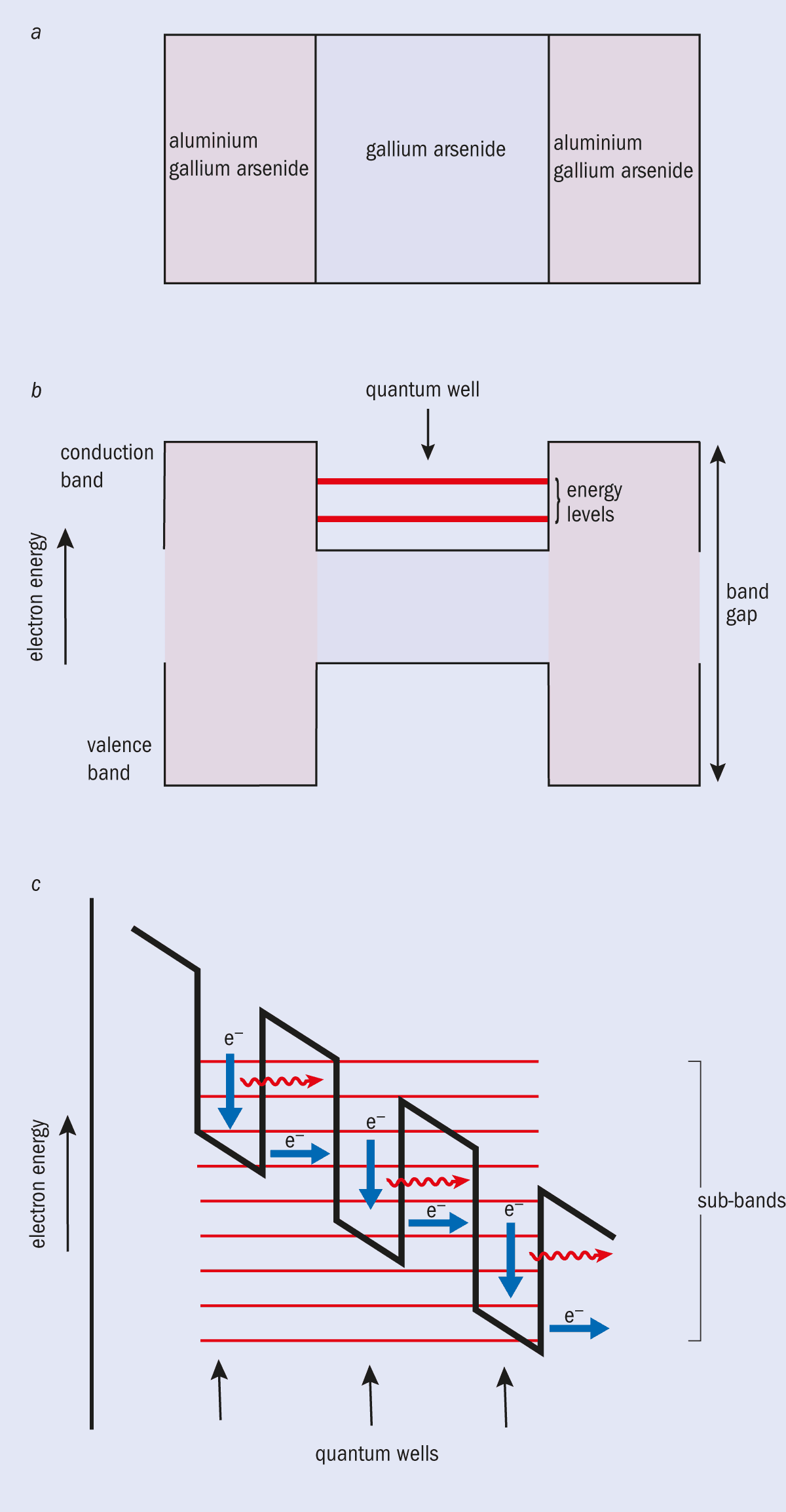
(a) Quantum cascade lasers consist of hundreds of alternating layers of high- and low-band-gap semiconductors. The low-band-gap material could be gallium arsenide (GaAs), while the high-band-gap material could be a derivative of aluminium gallium arsenide (AlGaAs). (b) This system forms a series of individual “quantum wells” in the GaAs. If each layer of GaAs is thin enough, the electronic energy levels in its conduction bands are split into a series of sub-bands. (c) Under an applied electric field, an electron that is injected into the structure can drop down from a high-energy to a low-energy sub-band, each time emitting a photon, which can be in the terahertz band.
The superlattices that the Leeds group uses are made from gallium arsenide sandwiched between layers of aluminium gallium arsenide (figure 1a). This arrangement creates a “quantum well”, which lets electrons move sideways along the gallium-arsenide layers but not down or up through the aluminium-gallium-arsenide layers unless it has enough energy to escape the well. Across many layers, the quantum wells act together to form sub-bands within the conduction band, creating a sequence of energy gaps (figure 1b). By applying a voltage, an electron starts to drop through these sub-bands, emitting a photon each time. By stacking units of these layered structures together into the overall superlattice, an electron continually drops through them, as though falling down a series of waterfalls (figure 1c).
The photons have about 100 times less energy than visible photons because the energy gaps between the sub-bands are 100 times smaller than the gap between the conduction and valence bands, which is typically around 1 eV. Since the physical width of the quantum wells determines the separation of the sub-bands and hence the energy of the photons, physicists can easily create structures to emit photons of any terahertz frequency desired. As Dean points out, it is the effect of these small sub-bands on the electron distribution in the laser cavity that renders QCLs immune to the problems of laser feedback, making his self-mixing interferometry method possible.
“You can open up these mini-gaps and inject electrons that drop across them,” says Davies. “Because they are small, the frequency is less than for a normal semiconductor. But that requires very significant development and the growth of layered semiconductor structures, which is why they have taken longer to develop, because we needed the materials research to catch up.”
Chilled out
These sub-bands are why terahertz QCLs have to be cooled. Thermal energy can easily excite the electrons to higher energy levels and, since the sub-bands are so small, it becomes increasingly hard to control which band the electrons are sitting in as the laser warms up. The first terahertz QCL in 2002 could only operate at temperatures up to 70 K. Moreover, it had to be pulsed so that the laser could cool between each terahertz burst. Today’s QCLs, which fire pulses of terahertz radiation that last less than 1 s, can run at 200 K, while continuous-wave QCLs work at up to 135 K.
So while there has been some improvement, cryostats are still needed. “I think where things have gone slower than we hoped when we developed the first terahertz QCL is with the temperature of operation,” says Davies. “It crept up gradually for a few years [but] has now plateaued, although there are new approaches to semiconductor design and materials that have the potential to address this.”
The dream of room-temperature terahertz generation has certainly not been extinguished. In fact, by bending the rules, one team led by Manijeh Razeghi at Northwestern University in the US has achieved just that.
Based at the university’s Center for Quantum Devices, Razeghi has been a world leader in semiconductor devices for several decades. After seeing the first infrared QCL demonstrated at low temperature and power by Jérôme Faist’s group at Bell Labs in 1994, she decided to maximize the possibilities for terahertz research. “I immediately tried for a room-temperature, continuous-wave terahertz quantum cascade laser,” Razeghi recalls.
How the feedback system works
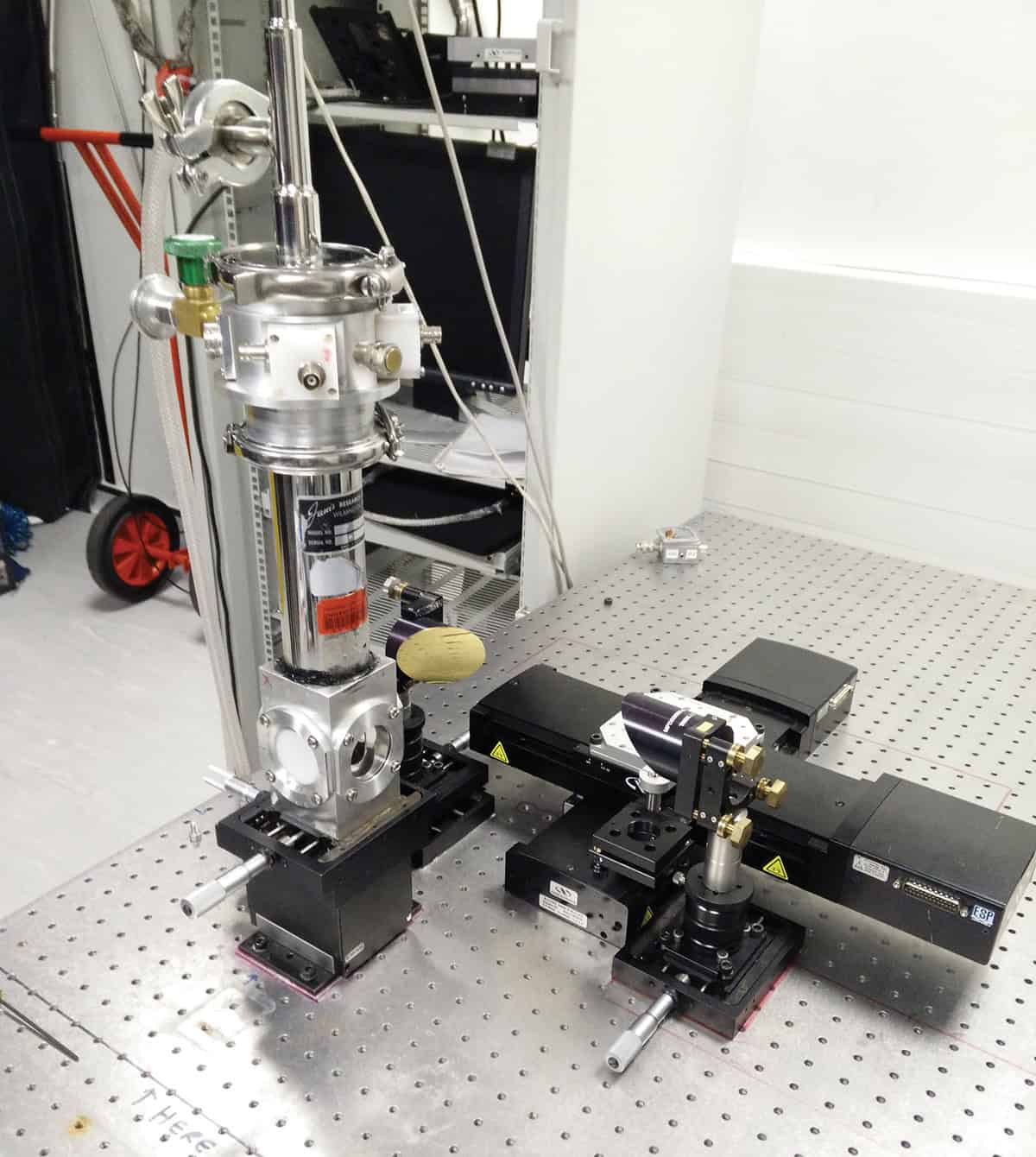
Bright future Much of Paul Dean’s self-mixing apparatus set-up at the University of Leeds could be miniaturized further for commercial use. (Courtesy: Paul Dean/University of Leeds)
Terahertz scanners are large and bulky, but they could be drastically shrunk in size thanks to the “self-mixing interferometry” system developed by Paul Dean at the University of Leeds (see main text). His secret is to make the quantum cascade laser (QCL), which lies at the heart of the scanner, work double duty – acting as both the emitter and the detector.
The QCL produces a beam of terahertz radiation that is focused by a series of mirrors onto the target, such as a sample of body tissue. The radiation reflected back from the target then re-enters the QCL’s cavity via the mirror system, where it alters the electrical properties of the laser. A digital acquisition board measures the change in the voltage signal and sends it to a computer for analysis.
The system, which is about 1 m tall, could be miniaturized further and made more compact. The large silver cryostat (stacked vertically in the photo) can be replaced by a smaller cryostat that does not require cryogenic liquids. The mirrors, which have a focal length of 10 cm, could be replaced by lenses, shortening the optical system, while the black cross-shaped structure on the floor, which acts as the bed for the target sample, could also be shrunk.
In 2011 she achieved her dream. While terahertz QCLs have to work at cryogenic temperatures, mid-infrared QCLs have no such limitations because their band gaps are wide enough to function at room temperature. Razeghi and her colleagues therefore used a technique in which two mid-infrared QCL beams of marginal frequency difference are mixed together. When two photons – one from each beam – annihilate, they spontaneously produce a third photon with a frequency equal to the difference between the two lasers. If the two beams are designed to have a frequency difference between them equal to a terahertz frequency, then a terahertz photon is produced (Appl. Phys. Lett.99 131106).
Initial experiments with this technique – known as “difference frequency generation” – produced just microwatts of power, but they proved the method worked. Now, in a new paper published in March in Scientific Reports (6 23595), Razeghi’s team reports having achieved milliwatt powers using this approach. “The people using cryogenic quantum cascade lasers have been working on them for a long time and have never gotten warmer than 135 K for continuous-wave operations,” she says. “That’s not very convenient for applications.”
Although Dean remains open minded over the promise of difference frequency generation, Davies is not yet completely won over. “While achieving room temperature is great, the power output is still quite low,” he says. “When you use a nonlinear technique, you inevitably lose the power. I guess it’s horses for courses.”
Quest for the killer app
As Razeghi points out, whether you have enough power or not comes down to how convenient a particular source is for a given application. In the case of Dean’s work with self-mixing interferometry for cancer screening, milliwatts do fine. For something requiring a stronger punch, then the cryogenic QCLs are so far the only way to reach high enough powers in a convenient, compact system. High powers are also needed to overcome the fact that terahertz radiation is strongly attenuated by water vapour in the atmosphere, in our bodies and in building materials.
Astronomers have long been aware of the effect of water vapour when studying terahertz light, being forced to build telescopes in this frequency band on high, arid ground so that the Earth’s atmosphere does not absorb all of the terahertz radiation en route from space. Indeed, observing atomic species in the upper atmosphere and performing astronomical observations are two of the most promising applications of terahertz technology, prompting the Leeds team to work with researchers at other universities and the Rutherford Appleton Laboratory to develop terahertz QCLs for satellite and space missions.
Back on Earth, estimates suggest that compact QCL terahertz sensors could be in everyday use within the next 10 years. For Dean’s work it might take a little longer, not because the technology isn’t ready, but because medical trials will need to take place too. Doctors will also have to be trained to know what to look for in a terahertz scan. “Within a medical setting, the time frames are probably a bit longer,” admits Dean. “On the other hand, something more straightforward such as scanning parcels for explosives or drugs with QCLs could be ready in a 10-year time frame.”
When that happens, terahertz physics will truly be able to join the rest of the electromagnetic spectrum in our everyday lives.
In case you have ever wondered why so many theoretical physicists study climate change, physicist Tim Palmer from the University of Oxford in the UK has a simple answer: "because climate change is a problem in theoretical physics". Indeed, Palmer, who won the Institute of Physics' 2014 Dirac medal, studies the predictability and dynamics of weather and climate, in the hopes of developing accurate predictions of long-term climate change. The answer, according to Palmer, lies at the intersection between chaos theory and inexact computing – which requires us to stop thinking of computers as deterministic calculating machines and to instead “embrace inexactness” in computing. Palmer talked about all this and more in the latest public lecture from the Perimeter Institute in Canada – you can watch his full talk above.
When someone says the word "physicist", what image or persona comes to mind? That is the question the Institute of Physics (which publishes Physics World) was hoping to answer with its recent member survey based on diversity, titled "What Does a Physicist Look Like?" The Institute's main aim with this diversity survey, which about 13% of its members responded to, was "to understand the profile of our members and gain some insights into who they are – diverse people with different ages, ethnicities, beliefs and much more". You can read its entire results here.