In 1887 Albert Michelson and Edward Morley performed an experiment to detect the influence on the speed of light of the ether – the medium in which light waves were thought to travel. They reasoned that because the Earth was moving through the stationary ether, the speed of light would be different in mutually perpendicular directions. That difference, although probably tiny, should show up when light waves travel out and back along two arms and then interfere where they cross.
What Michelson and Morley found, instead, was probably the most celebrated “null result” in physics: there was no discernible difference in the speed of light in any direction. This failure to observe the expected result went unexplained for nearly two decades, until Albert Einstein’s 1905 special theory of relativity showed that the ether was not, in fact, required to understand the properties of light.
Whether the Michelson–Morley null result directly motivated special relativity is still disputed, but in any event it established a context for Einstein’s revolutionary idea. It also demonstrates why null results can be as significant as positive discoveries. Indeed, certain areas of physics are full of important null results. Might some of the fundamental constants of nature, such as the gravitational constant or the fine-structure constant, actually vary over time? Might the proton decay very slowly, as some theories beyond the Standard Model of particle physics predict? Could there be a “fifth force” that modifies gravity in a material-dependent way? Might dark matter consist of weakly interacting massive particles? Exquisitely sensitive experiments and observations have so far failed to find any evidence for these things. Yet we still keep looking, and null results place ever tighter limits on what is possible.
In other areas of physics, though, an awful lot of null results never see the light of day. If you do an experiment to look for a predicted but not terribly earth-shaking effect – a new crystal phase of a material, say – and you fail to find it, who is going to be interested? Which journal is going to want a paper saying “We thought we might see this wrinkle, but we didn’t”?
Some researchers feel this is as it should be. Isn’t there, after all, enough literature to wade through (and to referee) without also having to worry about things that proved not to be so? Others, however, think that null results are vital to the way science proceeds, and that their worth needs to be recognized and respected – perhaps in journals dedicated to that purpose. The debate between these two sides has produced a few intriguing possible solutions, while also revealing some deep disagreements about how best to do – and fund – scientific research in the modern era.
The value of nothing
Alexander Lvovsky is someone who believes there are reasons to accentuate the negative. A quantum physicist at the University of Calgary in Canada, he argues that in his field many groups wind up working on similar (even identical) problems, and so publishing a negative result would make research more efficient by removing dead ends quickly.
A study published in the Proceedings of the National Academy of Sciences last November provides some support for this view. In it, geneticist Andrey Rzhetsky of the University of Chicago, US, and colleagues attempted to gauge the efficiency of the scientific process of discovery by analysing how researchers select the problems they work on. Using biochemistry papers listed on the MEDLINE database from 1976 to 2010, they created a map, or network, in which the nodes were scientific concepts (in this case the specific molecules being studied) and the edges were the relationships between them (such as physical interactions or shared clinical relevance). Hence, research on molecules that are close together in this network is probably exploring tried and tested types of interaction, while links between distant nodes represent more innovative, perhaps speculative investigations.
The network structure that Rzhetsky and colleagues uncovered is one that suggests a rather conservative research strategy, in which individual researchers focus on “extracting further value from well-explored regions of the knowledge network”. They also found that this strategy has become more conservative over the years, slowing the pace of discovery. Scientific research, they argue, would be more efficient if it were more co-ordinated: for example, if scientists published all findings, positive and negative, to avoid repeating experiments.
The trend towards conservatism in research is very much in line with what Lvovsky sees as a likely outcome of a bias towards positive results. Combined with a “publish or perish” mentality, he says, this bias “encourages scientists not to engage in hard, challenging scientific problems, but to concentrate on those which are guaranteed to yield a [positive] result”. This problem, he says, “affects primarily young scientists who need to make a career”. Lvovsky reckons this is happening in his own field of quantum optics, where he says it has become common to “publish experiments whose result is known in advance, simply by giving them an exciting interpretation”.
A bias towards exciting results is perhaps understandable, but Jian Wu of the East China Normal University in Shanghai argues that null results needn’t be boring. “Sometimes a result is very interesting even if it is not the expected one and cannot be understood with available theories or models,” Wu says. Even so, he adds, “It is hard for such a null or negative result to be published in general journals, which are mainly looking for significant advances.” That bias can discourage further exploration of unexpected and unexplained findings.
Perhaps one of the most compelling reasons to publish null results is simple honesty. Although Lvovsky acknowledges that “it is the positive results that take science and technology forward”, everyone knows that science isn’t the endless succession of triumphs found in the literature. To pretend otherwise, Lvovsky says, “distorts the scientific truth”. Not only do “failures” predominate; they are also an important part of the record. Brian Nosek, a psychologist at the University of Virginia, US, who specializes in the cognitive biases that can manifest themselves in the conduct and reporting of science, notes that if people never hear about failures to reproduce an effect, they will assume it’s well established.
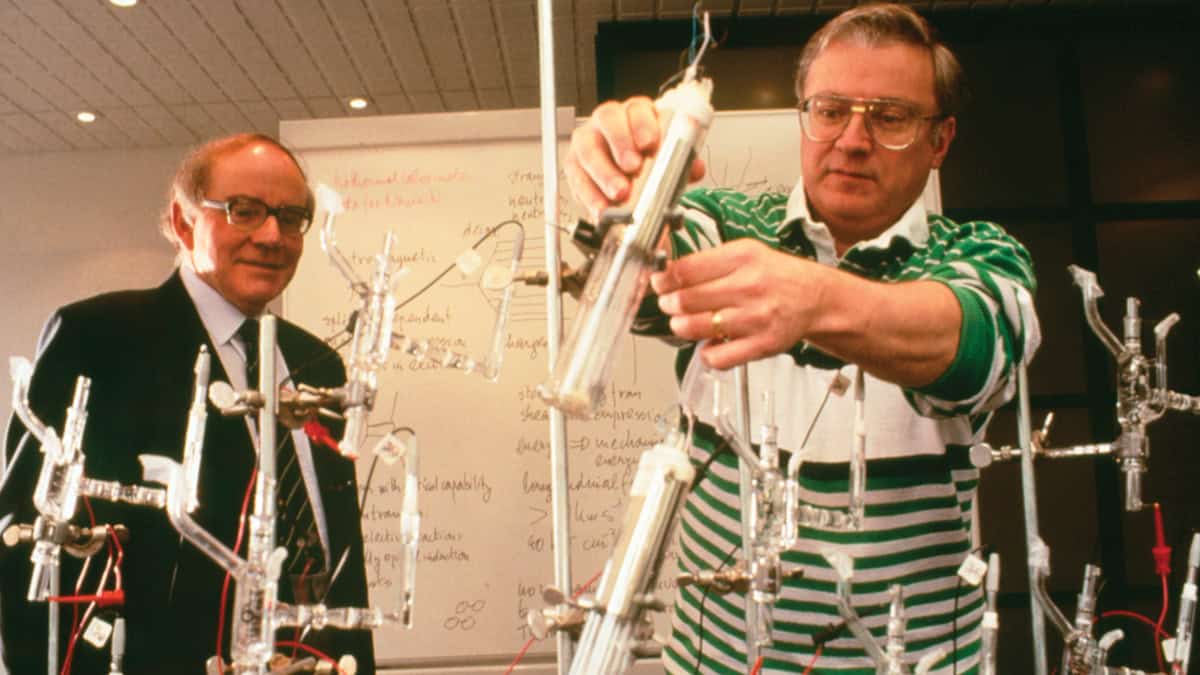
False positive Martin Fleischmann and Stanley Pons’ (left) 1989 announcement of “cold fusion” led to a flurry of published null results showing that the experiment could not be confirmed. (Courtesy: Philippe Plailly/Science Photo Library)
This skewing of the literature may, Lvovsky says, have played a role in some notorious incidents of false claims in physics. Faked nanotechnology results published by the then-Bell Labs researcher Jan Hendrik Schön in the late 1990s took years to unravel. Similarly, after the electrochemists Martin Fleischmann and Stanley Pons announced in 1989 that they had achieved “benchtop nuclear fusion” during electrolysis of heavy water – an announcement soon backed up with a sketchy paper published in the Journal of Electroanalytical Chemistry – there was a flood of apparent confirmations of the result. But it took much longer for carefully documented null results to emerge. Some of the most thorough and convincing were described in long papers in Nature, which led eventually to a general disavowal of the “cold fusion” claimed by Fleischmann and Pons. By that stage a large amount of time and money had been spent on a chimera.
Other ways of saying ‘no’
That null results like those investigating cold fusion were published in a top journal shows just how unusual that episode was. Usually, such journals insist on positive findings that more obviously seem to advance what we know. Might, then, the best place for null results be in journals dedicated to them?
“The difficulty of a null-result journal is the review procedure – how to decide which result is worth publishing,” Wu says. It’s extremely difficult for an editor or referee to judge the quality of a paper reporting a null result, he adds, because there could be so many reasons (including bad technique) why nothing was seen. Yet Nosek questions whether this problem should afflict null-result papers more than others. “Null results can be obtained because of incompetent execution of the research protocol, but so can positive results,” he says.
Perhaps more problematic is the status of such a journal. “It may have trouble succeeding, because if the journal is defined as publishing what no other journal will publish then it is defining itself as a low-status outlet,” says Nosek. That’s not a foregone conclusion, though. Lvovsky suggests that a null-result journal “must require that the accepted articles, rather than just reporting failures, demonstrate that failure derives not simply from a simple lack of prowess but from substantial scientific or technical reasons”. In other words, the reasons for the failure must be provably identified.
Unaccounted for Pharmaceutical research has been criticized for not publishing null results that are actually very important to the advancement of medical science. (Courtesy: iStock/teekid)
That, however, may be easier said than done. “Finding a true null in an experiment is very difficult to do, as one has to effectively limit all possible outcomes that might produce a zero,” says atomic physicist Andrew Murray of the University of Manchester, UK. “These can include the possibility that we measured the wrong thing, noise, something broken in the experiment, or some other artefact might lead to us not seeing anything. It is far easier to measure a finite quantity than a true zero in almost every experiment I know of.”
Given that challenge, the very notion that one can obtain a definitive null result could propagate a false idea that science is black and white, Murray adds. “Politicians and many policy-makers who are not scientists often make statements and draw conclusions without considering that there must be uncertainties in any measurement,” he says. “The existence of a journal that states that one can obtain a definitive null could imply that such precision measurements are possible on a general scale. I think that’s a dangerous precedent to set.”
All the same, null-result journals do exist, such as the Journal of Negative Results in BioMedicine. Interestingly, that publication also provides an outlet for “unexpected, controversial and provocative results” – an implicit acknowledgement, perhaps, that those are the kind of findings for which null results tend to have the most importance. Last year the science journal PLOS ONE, which has no editorial selection criteria beyond technical competence of submitted papers, started collating its negative results in a collection called “Missing Pieces”.
It’s surely no coincidence that these initiatives tend to be in the life sciences. Null results have received more attention there because of the vested interests that may accompany and even induce publication biases. Pharmaceutical companies, for example, might publish positive findings of drug trials but not negative ones. It’s for such reasons that Nosek has proposed an alternative to the regular publication of null results: peer-reviewed declarations of the objectives of an experiment before the data are collected (https://osf.io/8mpji/wiki/home). In these “registered reports”, Nosek explains, “The question and methods of the study are reviewed, and then if they pass review, the outcomes will be published regardless of whether they are positive or negative.” This procedure would protect against publication bias and improve research design, while also “focus[ing] research incentives on conducting the best possible experiments rather than getting the most beautiful possible results”. About two dozen (primarily life-sciences) journals are already offering registered reports as a submission option, he says.
What about the complaint that null results would just add more literature through which researchers have to wade? “There is already too much information,” says Nosek. “For an individual, the amount of science being produced is effectively infinite.” But the answer, he says, is not to suppress negative data, but “to improve search and discovery of information that is relevant and useful”.
Null results can also be released and discussed along less formal routes – as happened in 2011 with the alleged detection, made by researchers in the Italy-based OPERA collaboration, of neutrinos travelling faster than light. This was an extraordinary “positive” claim, revolutionary if true – and so understandably it stimulated several follow-up studies that rapidly disproved the idea. These studies were disseminated via the arXiv preprint server and through informal personal networks, and in the views of some physicists, they turned what could have been an embarrassment for the discipline into a demonstration of good, efficient scientific method. If that testing had relied on the usual peer-reviewed channels, says Nosek, it could have taken years.
No-one, then, seems to doubt the potential value of null results. The chief difficulty lies in establishing effective channels for communicating them. If we can find a way of doing that, we may find that discovering nothing is a vital part of discovering anything.
A method of using spectroscopy to determine the sex of a chicken egg before it hatches is being developed by researchers at the Dresden University of Technology and the University of Leipzig, in Germany. The technique – which will soon be applied commercially – could provide an alternative to the routine hatchery practice of killing male chicks shortly after birth.
In the rearing of egg-laying chickens, around half of all chicks born in poultry farms are considered commercially unviable because they are male. As well as being unable to lay eggs, the male chicks are of a breed optimized for egg laying rather than meat production and therefore not used as a food source. As a result, they are culled after birth, with their remains being used for other purposes, such as the production of animal feed.
In the UK alone, it is estimated that around 30–40 million chicks are culled each year. Worldwide, the count is in the billions annually. Similar culling practices are also employed commercially with other poultry – including male turkey poults and female ducklings, as the latter gain less weight than their male counterparts, making them less suitable for the production of foie gras. In the UK, chicks are gassed to death or fed to reptiles and birds of prey. In other countries they are often shredded alive in industrial grinders.
No nerve cells
Gathering together a multidisciplinary team of chemists, engineers, veterinarians and physicists, the work of Dresden’s Gerald Steiner and colleagues may offer a more humane alternative – sexing the chicks before they have hatched, after three days of incubation. At this stage, an embryo’s blood vessels will have formed, Steiner explains, “but not the nerve cells, so they can’t feel pain”. The researchers believe that it is more ethical to cull the chicks at this point in their development.
To determine the chick’s gender, the researchers first use a laser beam to cut a small, circular hole at the top of the egg. Next, near-infrared spectroscopy is used to determine the sex of the embryo based on its DNA content – which is around 2% higher in male chicks. “To the naked eye, we can’t see the difference between male and female embryos, but the computer can – if it’s programmed to do so,” says Steiner.
Patched up
Having refined their technique over time, the team are now able to sex each egg, with 95% accuracy, in less than a minute. If an egg is determined to contain a female chick, the laser-cut hole is patched up with adhesive tape and returned to the incubator – where it can then hatch. Eggs containing male chicks can be disposed of. In the future, the researchers say, a use may also be found for the discarded male embryos – such as in fish food, or shampoo.
Having proven the principle of the technique, the hope now is to develop machines to carry out the sexing automatically on an industrial scale. In Germany, the outcome of the work is keenly anticipated. Public concern over animal welfare has encouraged the government to spend €3 million towards developing research that supports the voluntary phasing out of chick-shredding by 2017.
“Although it would be a step forward if male chicks were no longer gassed or shredded alive, this would certainly not make eggs an ethical product,” comments Isobel Hutchinson, a campaign manager at the British animal rights organization Animal Aid. She adds: “The killing of male chicks is just one disturbing aspect of an unthinkably cruel industry.”
Earlier this year, researchers working on the Advanced Laser Interferometer Gravitational-wave Observatory (aLIGO) made the first ever detection of gravitational waves. The waves are believed to have been created by the merger of two binary black holes, in an event dubbed GW150914. Now, however, new theoretical work done by an international team of researchers suggests that other hypothetical exotic stellar objects – such as wormholes or “gravastars” – could produce a very similar gravitational-wave signal. While it is theoretically possible to differentiate between the different sources, it is impossible to tell whether GW150914 had a more exotic origin than merging black holes because the signal was not strong enough to be resolved.
The researchers point out that, in the future, the detection of stronger gravitational-wave signals could reveal more information about their sources – especially once the sensitivity of aLIGO is increased to its ultimate design level. In addition, future space-based detectors, such as the European Space Agency’s Evolved Laser Interferometer Space Antenna (eLISA), could reveal tiny discrepancies between detected and predicted signals, if they exist.
Ringing frequencies
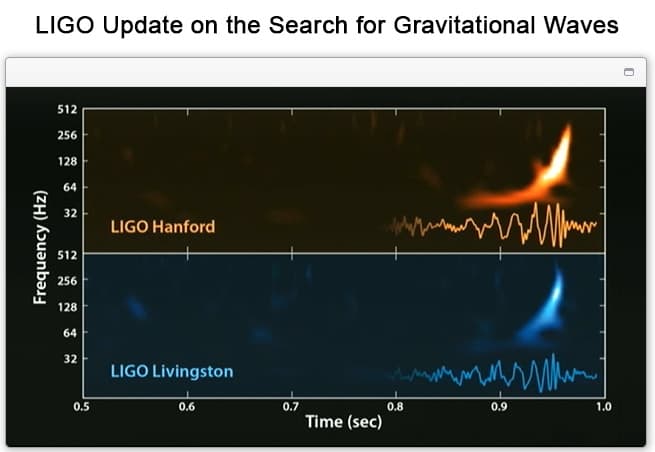
Einstein’s general theory of relativity provides a very clear theoretical framework for the type of gravitational-wave signal that would be produced during the collision and subsequent merger of massive, compact bodies, such as black holes. Gravitational waves are produced constantly before, during and just after a merger. The waves’ frequencies will vary, telling us when the black holes’ orbit begins to reduce and they begin their slow inward collapse, or “inspiral”. The smaller the initial distance between the two, the more radiation is emitted as the black holes plunge into one another. This produces a characteristic “chirp” waveform, wherein the frequency and the amplitude of the waves increase until they peak at the merger.
But such a cataclysmic merger initially gives birth to a highly distorted black hole, which rids itself of its deformity almost instantly, by ringing like a bell and producing further gravitational radiation. The system quickly loses energy and the strength of the waves decays exponentially to form a “ringdown” signal, all of which was picked up by aLIGO for GW150914.
Ringing chirp The vital waveform of gravitational-wave event GW150914 showing the inspiral, chirp and ringdown features. (Courtesy: LIGO/Phys. Rev. Lett.116 061102)
The chirp and the ringdown signal are of immense interest as these carry crucial information about the mass and spin of both the initial black holes, and of the newly formed one. “This ringdown phase is very important: just as a Stradivarius violin vibrates in a characteristic way, so too do black holes. Thus, by studying carefully how it rings, you hope to know the black hole itself,” says physicist Vitor Cardoso from the University of Lisbon, Portugal.
These vibrational modes of a nascent black hole – known as quasinormal modes – must be detected within the signal, to be absolutely certain that the gravitational waves have arisen from coalescing black holes. Our current understanding suggests that these vibrational modes are inherently linked to a black hole’s key feature – its event horizon, or the boundary past which nothing, not even light, can escape from its gravitational pull.
Light rings
But new simulations and analysis – carried out by Cardoso together with team members Paolo Pani and Edgardo Franzin – have shown that a virtually indistinguishable ringdown signal can be produced by a “black-hole mimicker”, thereby potentially allowing us to detect these exotic objects. These mimickers are hypothetical objects that could be as compact as black holes but do not have an event horizon. They could be gravastars – celestial objects whose interior is made of dark energy – or wormholes – a tunnel through space–time connecting two distant regions of the universe.
These exotic objects possess “light rings”, which are yet another artefact of general relativity – a circular photon orbit which is predicted to exist around very compact objects. “A light ring is very different from an event horizon, because signals can escape from regions within the light ring – although they would be highly red-shifted – whereas nothing can escape from the event horizon,” explains Cardoso. All compact objects would in theory possess a light ring. Indeed back holes have one that is associated with the border of their silhouette. These are the so-called “black-hole shadows” that lie just outside of their event horizon. On the other hand, neutron stars, while very compact, are not compact enough to develop a light ring.
Cardoso and colleagues looked into objects with only light rings and found that “if an object is compact enough to possess a light ring, then the ringdown would be almost identical to that of a black hole. The more compact the object, the more similar the ringdown”. Indeed, the team’s simulations showed that the ringdown signal is mostly associated with the light ring. It is the light ring itself that is vibrating, not the event horizon.
Mimicking wormholes
The team’s simulations calculated this explicitly for a wormhole, but Pani told physicsworld.com that the “same result is valid for gravastars and, as we claim, for all ultracompact black-hole mimickers”. But the researchers’ analysis also showed that these mimickers eventually leave an imprint in the gravitational-wave signal in the form of “echoes”, which are reflections of the waves from the surface of these objects. “These echoes may take a long time to reach our detectors, so it is important to scrutinize the data even long after the main pulse has arrived,” says Cardoso. More precisely, the mimicker signal will ultimately deviate from that predicted for a black hole, but only at late times.
LIGO scientist Amber Stuver, who is based at the LIGO Livingston Observatory in Louisiana, US, is “thrilled” by the possibility that aLIGO may have detected an exotic object, but she confirms that “there is nothing in our observations that is inconsistent with this being a normal stellar mass black-hole system possessing an event horizon. Until we have evidence otherwise, we can’t claim that this was anything but a stellar mass black hole binary merger.” She tells physicsworld.com that “advanced detectors such as aLIGO, aVirgo, and KAGRA will need to increase their sensitivity” to pick up such signals. She also points out that the GW150914 event “was detected with aLIGO at about 30% of its design sensitivity. The potential is real that, if these exotic horizonless objects are out there mimicking black holes, we may very well find them in the near future”.
B S Sathyaprakash from Cardiff University in the UK, who is also a part of the LIGO team, agrees with the theorists’ work, saying that “Our signal is consistent with both the formation of a black hole and a horizonless object – we just can’t tell.” He further explains that, although Einstein’s equations predict how slightly deformed black holes vibrate, our understanding is incomplete when their deformation is large. “That’s why we need a signal in which the post-merger oscillations of the merged object are large, and this can happen if we detect even more massive objects than GW150914, or if GW150914 is at least two to four times closer.” Then, it would be possible to distinguish the signals, he says.
Cardoso acknowledges that “black-hole mimickers are very exotic objects and by far black holes remain the most natural hypothesis”. But he adds: “It is important to understand whether these exotic objects can be formed (for example in a stellar collapse) and if they are stable. Most importantly, we only focused on the ringdown part, but it is equally relevant to explain the entire gravitational-wave signal, including the inspiral and the merger phases. This would require performing numerical simulations with supercomputers to understand whether this picture is viable or not. We are currently working on this.”
Gold coast: the Hinkley Point C power station will be built next to existing reactors in Somerset. (CC BY-SA 2.0 Richard Baker)
By Hamish Johnston
What will soon be the most expensive object on Earth? The answer, according to Greenpeace, is the Hinkley Point C nuclear power station that is slated for construction in south-west England. According to the BBC, the environmental group reckons the station will cost £24bn ($35bn) whereas EDF – the company that will build it – puts the construction cost at £18bn. In contrast, the Large Hadron Collider at CERN cost a mere £4bn. While the price tag on Hinkley Point C – which should produce 3.2 GW of electricity by 2024 – is eye watering, building a reactor on the cheap is not really an option.
Still, Hinkley Point C will not be the most expensive object ever built by humans. That honour goes to the International Space Station, which the BBC says cost nearly £78bn. There’s something comforting in knowing that the single highest expenditure ever has been on science – maybe civilization isn’t doomed after all.
Physics stretches from the small to the large, from the simple to the complex and from low energy to high. It spans the entire alphabet too, with this month’s issue of Physics World including everything from the race to produce anti-atoms (A) at the CERN particle-physics lab near Geneva to a study of the physics of zombies (Z).
Zombies don’t exist, obviously. But we look at two physicists – Alex Alemi and Matt Bierbaum – who have studied the statistical physics of how zombies spread. As science writer Stephen Ornes explains, their interest emerged from a fun student project, but has led to a paper in a leading peer-reviewed journal and helped generate a wider appreciation of statistical physics.
If you’re a member of the Institute of Physics (IOP), you can now enjoy immediate access to the new issue with the digital edition of the magazine in your web browser or on any iOS or Android mobile device (just download the Physics World app from the App Store or Google Play). If you’re not yet in the IOP, you can join as an IOPimember for just £15, €20 or $25 a year to get full access to Physics World digital.
A curious type of nonlocal phenomenon known as one-way quantum steering has been demonstrated experimentally for the first time by two independent groups of physicists. This phenomenon is similar to quantum entanglement but applies when one of the two parties sharing a quantum state does not trust the source of quantum particles. The researchers say their work could help to broaden applications of quantum cryptography.
The idea of quantum nonlocality was first discussed in a famous paper published by Albert Einstein, Boris Podolsky and Nathan Rosen in 1935. The trio described a thought experiment designed to illustrate the inadequacies of Niels Bohr’s interpretation of quantum mechanics, in which an object being measured and the measuring device are regarded as one inseparable whole. Einstein, Podolsky and Rosen argued that either information could travel instantaneously between two points (so apparently contradicting special relativity) or quantum theory was incomplete; in other words, “hidden variables” were needed in addition to the wavefunction to describe physical reality.
As it turned out, Bohr was vindicated. Physicists have gone on to acquire compelling, if not completely watertight, evidence for nonlocality, and have exploited the phenomenon in quantum-communications technology. The most familiar example is quantum entanglement, put forward by Erwin Schrödinger in response to the paper by Einstein and colleagues, in which pairs of quantum particles can be prepared such that even when placed a long way away from each other, a measurement on one of them instantaneously fixes the state of the other. However, there are other forms of nonlocality, including the stronger Bell nonlocality, discovered by the Northern-Irish physicist John Bell, which is inconsistent with the theory of local hidden variables.
Halfway house
In a sense, quantum steering, introduced by Schrödinger, is a halfway house between these other two forms of nonlocality. The two parties involved in a quantum transaction, known traditionally as Alice and Bob, both trust the source of quantum particles when it comes to entangling pairs of those particles. For Bell nonlocality, meanwhile, neither of them trusts the source. But when they do quantum steering, only one of them, let’s say Bob, trusts the source. In this way, Alice can “steer” the state of the particles observed by Bob, which means that measurements she carries out on her half of the entangled particle pairs affect Bob’s state in a way that cannot be explained classically.
If the quantum states employed in steering are symmetrical, then Alice and Bob can steer each other. However, if the states are asymmetrical, then Alice and Bob will not steer one another to the same degree. Indeed, there are some states for which Alice (for example) can steer Bob but not the other way round. This is known as one-way quantum steering.
In 2012 Roman Schnabel and colleagues at the University of Hannover in Germany observed this kind of steering, but they did so only in a limited context – for “Gaussian” measurements carried out on “Gaussian” states. The latest research, in contrast, was designed to demonstrate one-way steering of a given type of state, regardless of the measurements carried out on it.
Tricky problem
The two experiments use similar apparatus to create quantum states from entangled pairs of photons, but they test steering in different ways. Specifically, they take different approaches to the tricky problem of verifying that Bob cannot steer Alice (in addition to showing that Alice can steer Bob). This involves showing that no matter what Bob does to his state, he can never alter Alice’s state in a way that could not be achieved classically. Chuan-Feng Li of the University of Science and Technology of China in Hefei and colleagues did so by specifying that Bob can only ever perform two distinct measurements, while Geoff Pryde and co-workers at Griffith University in Brisbane, Australia, were able to do so for any arbitrary number of measurements.
Li says that one-way steering could find practical applications in asymmetric quantum information. For example, he says, it could be applied to one-way quantum key distribution, which involves creating a secret key that can be used to encrypt and decrypt messages by encoding weak laser pulses in time. This would allow cryptography even if one of the two communicating parties does not trust their measurement device.
Elegant and convincing
Nicolas Brunner of the University of Geneva, whose group last year set out the theory of one-way quantum steering, praises the Chinese and Australian groups for their “elegant and convincing experimental demonstration” of one-way steering. He says that applications of the work “can be envisaged” but believes that a “killer application” still has to be found.
Schnabel agrees that applications are still probably some way off. “For steering in quantum information, it is usually enough to define steering in the desired direction [i.e. Alice to Bob],” he says.
The research is reported in two papers published in Physical Review Letters.
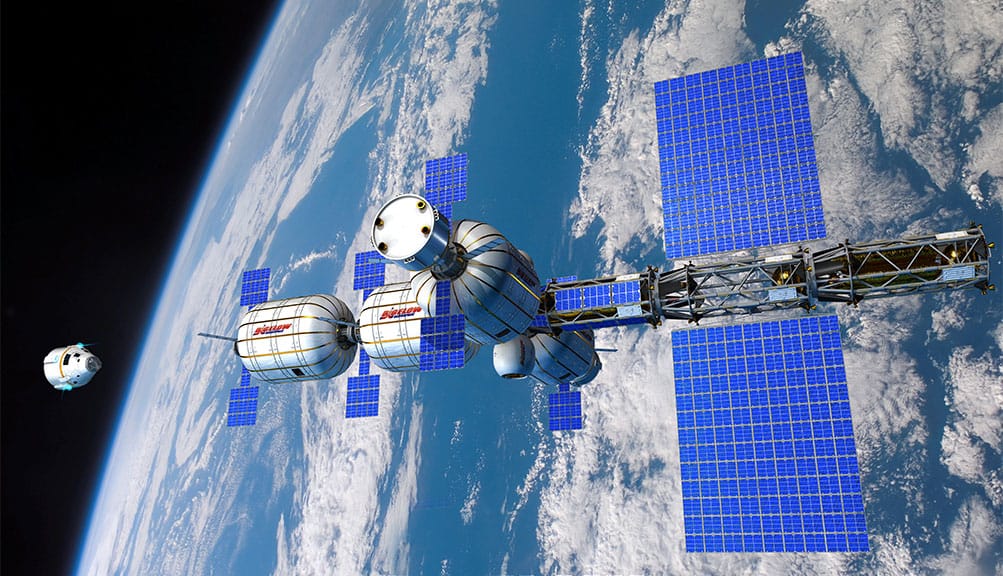
Artist’s impression of a space station comprising four B330 inflatable pods, which are the white cylinders. (Courtesy: Bigelow Aerospace)
By Hamish Johnston
It’s never been a better time to be a space enthusiast, as more and more countries are unveiling space programmes and it seems like a new mission is launched or announced just about every week.
Probing strings: Joseph Conlon’s new book defends string theory from sceptics. (Courtesy: Shutterstock/Picsfive)
In defence of strings
Joseph Conlon is not one to mince words. In the opening chapter of his book Why String Theory?, he observes that while he and his fellow string theorists are sometimes regarded as “the intellectual equivalents of John Wayne, using the power of pure thought to conquer the untamed territories of physics”, it is also true that “a more recent outlook sees them as surrender monkeys who…fled from experiment for a combination of mathematical arcana and personal wonga”. The truth, he adds, is “more human than the first and richer and more powerful than the second”. Over the next 13 chapters, Conlon defends this thesis with linguistic verve and self-deprecating wit, tracing the history of string theory from its origins in the late 1960s to its present-day applications in (among other areas) quantum field theory. The result is probably the best popularly oriented defence of string theory since Brian Greene’s The Elegant Universe became a runaway bestseller back in 1999, yet in many ways the two books are polar opposites. Greene’s work was published during one of string theory’s periodic upswings, and its confident tone reflected both the times and the personality of its boyish, enthusiastic author. Conlon is no less a wunderkind than Greene (at age 35, he is already a full professor at the University of Oxford), but his authorial style tends towards the wry and British – especially in chapter 7, which covers “Direct experimental evidence for string theory” (it is a very short chapter). He also approaches his subject after more than a decade of intense external scepticism, including the so-called “String Wars” of the mid-2000s. Hence, the prevailing question Conlon addresses is not so much “Is string theory true?” but rather “Is it useful?” The answer he gives is a firm “yes”, and while this may seem like a retreat from the days when string theory was touted as a nascent “theory of everything”, Conlon is a practical sort of theorist. As he puts it, “My interest in string theory is in what it can offer to physics that can be probed by experiment,” and not its mathematical beauty or its potential to reconcile quantum mechanics and gravity. As such, he writes, “String theory [can] be treated as a tool, compatible with an agnostic attitude to its status as the fundamental theory of this world.”
2016 CRC Press £19.99/$ 29.95pb 260pp
Lucky chances
In 1993 Joan Ginther won $5.4m in a Texas lottery. Several years later, she won another $2m, followed by $3m in 2008 and $10m in 2010. Was her stupendous success just luck? Or had Ginther – a mathematician by training – somehow found a way of gaming the system? Her story is one of 10 unusual tales to feature in Joseph Mazur’s book Fluke: the Math and Myth of Coincidences. Like Ginther, Mazur is a mathematician, and although he has never won millions in the lottery, he has certainly experienced some very peculiar coincidences – including one time when he bumped into his own brother in a café in Crete, despite neither of them knowing beforehand that the other was on holiday there. But just how unlikely are such occurrences? In the book’s opening chapters, Mazur tells a handful of these coincidental stories, places them into categories such as “chance meetings of humans in precise timing and space” and promises to analyse them in greater depth later on. Next, he leads the reader on a pleasant and informative stroll through the mathematics of chance and probability (including a fresh twist on the “birthday problem” – the odds that in a group of N people, at least two will share a birthday). The idea, presumably, is to equip less mathematically experienced readers with the tools needed to appreciate the analyses that follow. Beyond this point, though, things start to unravel. Of Mazur’s 10 coincidental tales, only three receive a complete or mathematically satisfying analysis. One of them is Ginther’s quadruple lottery success, which Mazur deftly shows is both stupendously unlikely for any individual lottery player andpractically inevitable for one of the several billion people playing the world’s 166 lotteries over a period of nearly two decades. As he points out, “Her wins seem striking only because we are viewing them as happening to one specific person, Joan Ginther.” The other seven tales receive a much more cursory treatment (three get barely a page each), and the rest of the book is padded out with five tenuously linked essays about flaws in DNA evidence; Wilhelm Röntgen’s accidental discovery of X-rays; the exploits of rogue trader Jérôme Kerviel; extrasensory perception and other psychic powers; and “the planned coincidences of literature and folktales”. Individually, each of these essays has its merits, but the overall impression is of a book that, after a bright and energetic start, lost its way somewhere around the halfway mark.
Accelerator physicists in five European countries are developing plans for the world’s first high-energy laser plasma accelerator facility for use by science and industry. If built, the facility will deliver high-quality beams of electrons with energies up to 5 GeV. The EuPRAXIA consortium includes researchers at 16 institutes in the European Union (EU), including the DESY lab in Germany, the Italian National Institute for Nuclear Physics, the French national research council and the Science and Technology Facilities Council in the UK. EuPRAXIA also has 18 associate partners worldwide, including the Lawrence Berkeley National Laboratory (LBNL) in the US, RIKEN in Japan and CERN in Switzerland.
The idea of laser plasma acceleration has been around for more than 30 years, and in 2014 physicists using the LBNL’s Berkeley Lab Laser Accelerator managed to accelerate electrons to energies as high as 4.2 GeV. The process involves firing very intense laser pulses into a gas to create a plasma. As a pulse travels through the gas, it rips electrons away from the positive nuclei, therefore creating a huge electric-field gradient in its wake. This gradient can be thousands of times greater than that found in conventional particle accelerators – and therefore can accelerate electrons to high energies over much shorter distances than conventional facilities.
The result is a compact accelerator that is not much larger than the laser used to create the plasma. That means that a laser plasma accelerator can be housed in a small building, rather than stretching over hundreds of metres or even several kilometres.
High-quality beam
While laser plasma accelerators exist at several laboratories around the world, EuPRAXIA steering-committee member Carsten Welsch says that “no infrastructure exists where the quality of the accelerated beam satisfies the requirements of industry”. Welsch, who is at the UK’s Cockcroft Institute of Accelerator Science and Technology, adds that “creating such a facility would be a major breakthrough and would attract users from many different sectors”.
Welsch told physicsworld.com that an important goal of EuPRAXIA is to develop technology to “sharpen” the energy spectrum of the electron beam produced by laser plasma accelerators. Today’s accelerators produce electrons with a very wide range of energies, and this spread would have to be reduced significantly before a facility could be used as a source of electrons for scientific and industrial applications.
According to Welsch, one important early use of a European laser plasma accelerator would be to create a compact free-electron laser (FEL). FELs use high-energy electrons to produce coherent X-rays, which have a wide range of applications in physics, chemistry, biology and materials science. The European XFEL at DESY in Hamburg, which is currently under construction, has a 3.4 km-long electron accelerator, and the possibility of having much smaller laser-based facilities would be very attractive to science and industry. Welsch describes a laser-driven FEL as a “realistic goal” for EuPRAXIA, and says that high-quality X-ray beams could be created.
Non-destructive testing
Other uses for a laser plasma accelerator include high-resolution radiography, which utilizes pulses of electrons to image the internal structure of an object such as a turbine blade without having to destroy it.
Welsch says that EuPRAXIA will spend the next 3–4 years making a strong case for building a laser plasma accelerator in Europe. This will include beam-dynamics studies and the development of diagnostics to fully characterize all aspects of the plasma and the beam. “Then we will be talking to EU policy makers to get a laser plasma accelerator onto the scientific facility road map,” he adds.
Welsch told physicsworld.com that EuPRAXIA has not proposed possible locations for the facility, but he believes that a number of European countries would be interested in hosting the accelerator.




 By Matin Durrani