Quantum filter integrates 20,000 Josephson junctions

Arrays containing as many as 20,000 Josephson junctions have been created by physicists at CSIRO in Australia. The devices are made from a high-temperature superconductor and operate at liquid-nitrogen temperatures. With further development, the devices could be used in a range of applications, including magnetic-field sensing and as radio-frequency antennas.

The devices are called superconducting quantum interference filters (SQIFs), which are 2D arrays of superconducting interference devices (SQUIDs). A SQUID is a loop of superconductor that is broken in two places by Josephson junctions – electrical insulators through which the superconducting current can tunnel.

An important feature of a SQIF is that it comprises loops of different sizes. When a single SQUID is subject to an applied magnetic field, it develops a voltage that is a periodic function of the field strength. The period of this oscillation is related to the area of the loop, which means that the sum of voltages from a large number of SQUIDs with different loop sizes is more or less constant at most applied magnetic-field strengths – but has a very sharp minimum at zero applied field. This makes a SQIF extremely sensitive to very weak magnetic fields, as well as to electromagnetic radiation at radio and microwave frequencies.

Stepped approach

The SQIFs made by Emma Mitchell, Cathy Foley and colleagues at CSIRO comprised 20,000 Josephson junctions with loop areas that have a random size distribution. The Josephson junctions were made by creating several “steps” on the surface of a magnesium-oxide (MgO) substrate. The surface was then coated with a 220 nm layer of the high-temperature superconductor YBCO topped with a 50 nm gold layer. Finally, a patterning and etching process was used to create the loops. The Josephson junctions occur at the step edges, where the crystal structure of the YBCO is interrupted, creating an insulating gap of just a few nanometres.

According to Mitchell, the main challenge in building the arrays is reducing the variability in the operating parameters of individual Josephson junctions. These inconsistencies arise from difficulties in fabricating the tiny insulating gaps, as well as uncertainties in estimating the electrical properties of the superconducting thin film. “Accurate modelling of even simple [high-temperature] superconducting circuits remains a serious limitation in the early stages of development in this field,” explains Mitchell.

Radio antenna

The researchers’ SQIF is able to detect magnetic fields of less than about 1 μT with a sensitivity of 1530 V/T. In comparison, a similar array of identically sized loops has a sensitivity of just 165 V/T. The team was also able to use the SQIF to detect electromagnetic radiation at several frequencies, including 30 MHz.

Potential applications for SQIFs include highly sensitive magnetometers for use in geophysical exploration. The devices could also be used as large-bit digital-to-analogue converters; low-noise amplifiers; and sub-wavelength radio-frequency antennas. Mitchell points out that SQIFs based on high-temperature superconductors can be cooled using compact cryocooler devices, which means that they could be mobile and deployed in the field. This is unlike previous SQIFs that were based on low-temperature superconductors and are much more difficult to cool.

The team is now trying to improve the bandwidth and sensitivity of its devices by modifying the SQIF design and superconductor film parameters. “Future work will also focus on their operation in ‘real-world’ environments,” says Mitchell. The team has already managed to create SQIFs with as many as 54,000 Josephson junctions.

The SQIFs are described in Superconductor Science and Technology.
Magnetic vortices record history of Earth’s magnetic field

The vortex-like structures in grains of magnetite can reliably preserve magnetic information, remaining unaltered by temperature changes, thereby recording the history of the Earth’s magnetic field. That is the latest finding of researchers in Germany and the UK, who used electron holography to map the magnetic properties of individual grains. The work could help us to investigate the nature of the Earth’s magnetic field as it has evolved and changed over billions of years, as well as improve our understanding of the Earth’s core and plate tectonics.

The ability of magnetic minerals in certain rocks to capture a record of the Earth’s magnetic field at the time of their formation is a vital geological tool. Not only does it offer information on how the planetary core’s magnetic properties have changed over time, it also provides crucial evidence to support the theory of plate tectonics, showing that different continents must have moved relative to each other to explain the apparently different movements of the poles recorded by rocks across the globe.

Cool imprint

The most magnetic natural mineral is the aptly named magnetite, a commonly occurring oxide of iron. Like its other magnetic peers, magnetite typically acquires its geomagnetic imprint as it cools from molten lava. Once below its Curie temperature, tiny magnetite grains align with the Earth’s dipole. Later, this palaeomagnetic signal, which records the field intensity and direction, can be measured.

A problem when studying this rock record, however, is that not all magnetite grains are created equal, with different-sized grains adopting different magnetic domain structures based on their size. Indeed, there are three types of grains, and the smallest has long been considered “just right”. These so-called single-domain structures are magnetically near-uniform, found in grains less than 80 nm long, and are valued for their thermal stability – being able to retain magnetic signals, even if heated, over geologically useful lengths of time.

Different domains

Unfortunately, “it is only in a small part of naturally occurring magnetite that [these] magnetic structures, known for being very stable with respect to temperature fluctuations, are found”, explains physicist Trevor Almeida of the University of Glasgow, formerly of Imperial College London. Far more abundant, however, are grains of larger sizes, typically in the order of 0.1–10 μm. These form so-called pseudo-single-domain (PSD) structures, which have similar properties but are not uniform and instead often form vortex-like structures.

Despite past mathematical modelling and bulk measurements of magnetic rocks, the reliability of the signal recorded in these common pseudo-single-domain grains has remained poorly understood – until now. Almeida and colleagues have, for the first time, visualized the behaviour of PSD grains during heating. To do this, the team used an imaging method called electron holography, mapping out the vortex structures of magnetite grains of various sizes as they were heated to 550 °C – just short of their Curie temperature – and then allowed to cool.

The researchers found that while the magnetic vortices did change their strength when heated – and, in the case of the smallest PSD grains, their orientation also changed above 400 °C, adopting a lower energy state – on cooling, they returned to essentially their original state. This overall conservation of the grains’ magnetic record, in the face of the temperature change, demonstrates that the presence of PSD signals in rock does not prevent the recovery of reliable bulk palaeomagnetic information.

“These remarkable images show that vortex structures in natural magnetic systems can hold information about how the Earth’s inner structure evolved,” says team member Wyn Williams of the University of Edinburgh. He told physicsworld.com that “this is a game-changer in our understanding of rocks’ ability to act as reliable magnetic recorders, and helps us see a little clearer into the Earth’s history”.

From volcano to lab

Lennart de Groot, a geophysicist from Utrecht University in the Netherlands who was not involved in this study, says the findings are amazing and of great importance. He cautions, however, that the laboratory conditions do not entirely correspond to those found in a volcanic setting. Cooling there would not occur in a vacuum, making the grains potentially susceptible to chemical alteration. He also points out that “the grain size is rather small compared with natural igneous rocks”, adding that “larger grains can change their magnetic distribution over times of around one year; here the grains are cooled to room temperature within minutes after heating and any time dependencies on longer time scales may therefore be missed”.

Michael Winklhofer of the Ludwig Maximilian University of Munich, who was also not involved in Almeida’s work, highlights the importance of the research to the reconstruction of the ancient magnetic field from magmatic rocks. He notes, however, that the technique is limiting in that it cannot measure the out-of-plane magnetic field – meaning that it is difficult to tell whether the vortex cores are magnetized up or down, and if they stay in the same direction when heated and cooled again.

The research is described in Science Advances.

Wendelstein 7-X: a stellar fusion device

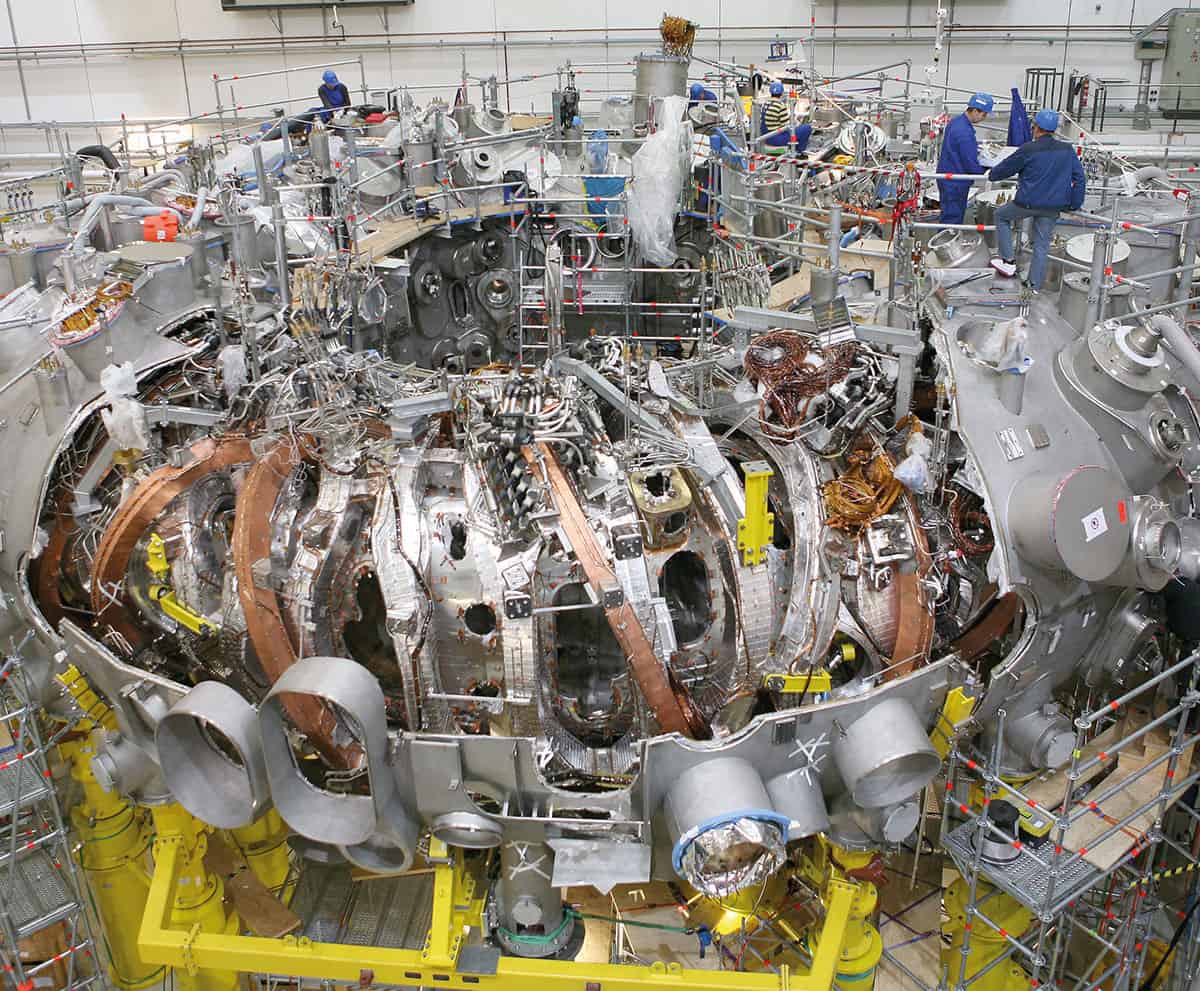
In February 2016 German chancellor Angela Merkel made a special trip to Greifswald – a small city in the north-east of the country next to the Baltic Sea. Merkel, who has a PhD in physics, was personally on hand to usher in a new era of plasma physics as she switched on the 1bn ($1.1bn) Wendelstein 7-X fusion device. Built on the outskirts of the city at the Max Planck Institute for Plasma Physics (IPP), Merkel’s visit marked the start of the reactor’s scientific run as the device burned its first hydrogen plasma at a temperature of 80 million degrees for about a quarter of a second.

Following the successful start of operations, Merkel declared that Wendelstein 7-X is “a unique experiment” that could “take us one step closer to the energy source of the future”. “[It] is the world’s most important fusion device of the stellarator type,” Merkel noted, adding that experiments could provide “important insights into whether stellarators can one day be used for the commercial production of energy”.

While experimental fusion devices have been around for decades, most of them – such as the ITER reactor currently under construction in France – are tokamaks. Stellarators and tokamaks both use magnetic fields to confine a plasma, but how they do this is different. To hold the plasma in place, the particles in the plasma need to be driven through a helical pattern. A tokamak uses toroidal magnets to generate a magnetic field that travels around the tokamak. This is combined with a vertical looping magnetic field generated by an electrical current induced in the plasma by a transformer. But as transformers only work in pulses, it makes it very difficult to generate a steady-state plasma – the plasma can collapse in between the pulses.

Stellarators, however, only use magnetic fields generated outside the plasma. This means that the magnetic fields can be continuous, in theory making it easier to generate a steady-state plasma. Yet stellarators are fiendishly difficult to build as the use of external magnetic fields means that, compared with tokamaks, a different plasma shape is needed. The optimal plasma for the latest generation of stellarators resembles (when viewed from above) a pentagon, varies in cross-section and moves through a more-pronounced twisting pattern than in a tokamak. Generating a magnetic field that can create these patterns requires magnets with a complex 3D geometry that need to be as close as possible to the plasma. Because of this, the inside of the reactor is far from a smooth torus like a tokamak – it is an incredibly complex 3D shape. Indeed, building Wendelstein 7-X has proved challenging, with the project costs doubling from the original 500m estimate.

The next generation

The first stellarator was developed at Princeton University in the US by physicist Lyman Spitzer in the 1950s. It created the helical pattern by confining the plasma in a figure-of-eight-shaped tube. Later designs used superconducting coils – in combination with toroidal coils – that spiralled around a doughnut-like tube to generate the required magnetic field. Before Wendelstein 7-X came online earlier this year, the world’s largest and most successful stellarator was the Large Helical Device in Toki, Japan, which had a performance approaching that of a similarly sized tokamak. It began operating in 1998 and uses two superconducting helical coils to twist the plasma.

The first “advanced” stellarator was Wendelstein 7-AS, which operated at the IPP’s institute in Garching, Germany, from 1988 to 2002. In the US, the helically symmetric experiment (HSX) was built at the University of Wisconsin-Madison, and started operating in 1999, while in 2004 researchers at the Princeton Plasma Physics Laboratory started building their own larger device – the National Compact Stellarator Experiment (NCSX). However, because of spiralling budgets it was cancelled four years later with the project struggling to assemble the various 3D sections and magnets with the required precision.

Wendelstein 7-X is part of a new generation, and rather than relying on helical and toroidal magnets, it uses complex 3D superconducting magnets to confine and twist the plasma.

Indeed, theoretical physicists calculated the best shape for the plasma and so derived the basic shape of the coil that can produce the desired magnetic field. The computing power required to calculate the optimal shape of the magnetic field and magnets needed to generate it was not available until the 1980s.

Complex design

During the construction of Wendelstein 7-X, it took about 12 years to perfect the design of the magnets and build a suitable prototype. Physicists and engineers went back and forth until they reached a compromise between coil shapes that could be manufactured and the optimal plasma shape. The main sticking point was the minimum radius through which the superconducting coils could be bent. Engineers also had to work out how to construct magnets with these complex 3D coils at the centre.

The Wendelstein 7-X stellerator

The construction of the magnets is similar to those on tokamak reactors. A niobium–tin superconductor is embedded inside a cable of copper wires – during operation this is cooled with liquid helium to a temperature of 4 K. Most superconductors enclose this cable in a stainless-steel jacket, but Wendelstein 7-X uses aluminium jackets to provide the flexibility needed for the complex 3D shapes. The conductor is then wound through 108 turns to create the magnetic coil and enclosed in a steel case filled with hardened sand and resin. The final 3.5 m-high magnets weigh six tonnes.

While a similar-sized tokamak device would need around 18 magnets, Wendelstein 7-X has 50 primary “bean-shaped” magnets. A stellarator is normally much lower and wider than a tokamak, which, assuming the same plasma volume, gives it a much larger circumference. According to Thomas Rummel, who managed the magnet production, this requires more magnets to avoid gaps between coils that could be detrimental to the magnetic-field stability.

The final design for Wendelstein 7-X uses five sets of 10 magnets. Each set has a different geometry and is on a different electrical circuit so the magnetic fields can be adjusted separately. This is necessary because the plasma does not travel around a perfect circle. Wendelstein 7-X also has 20 flat secondary superconducting magnets on two electrical circuits. These are not absolutely necessary for operating the stellarator, but provide “flexibility to allow a broader range of plasma parameters”, notes Rummel. This will allow researchers to investigate the physics of the plasma in more detail.

One big step

While stellarator research is set to be hugely improved by Wendelstein 7-X, which hopes to maintain a plasma for around 30 min, it is still behind that of conventional tokamaks such as ITER, and it may never reach parity. “Unfortunately, stellarators are one big step behind tokamaks and are not yet in a position to think about power generation,” says Rummel. “Our research over the next year will concentrate on finding the best plasma shape, holding the plasma stable and trying to find clever ways to bring the energy out.”

Physics saves humanity, the large rainfall collider and other environmental highlights on Earth Day

By James Dacey and Hamish Johnston

Today is Earth Day, so let’s temporarily rename this regular Red Folder column as the Green Folder. Either way, today we’re going to focus on the Earth and environmental issues. The official website of Earth Day – an initiative now in its 46th year – has details about the various initiatives and events taking place around the world today.

First, let’s pay tribute to a physicist whose work had a profound influence on the climate and energy debate in the UK and beyond. Sir David Mackay died on 14 April aged 48 following a battle with cancer. Mackay is remembered among other things for his pragmatic approach to energy and his 2008 book Sustainable Energy: Without the Hot Air (free access) was hailed for its rigour and refreshing absence of rhetoric. Mackay’s writings attracted the interest of the British government who appointed him as chief scientific adviser to the Department of Energy and Climate Change in 2009, a post he held for five years. Ever prolific, Mackay was blogging about his experiences right up until two days before his death.

(more…)

Graphene doped with hydrogen reveals its magnetism

Hydrogen atoms can induce magnetism in graphene and be used to create a uniform magnetic order across the 1D material. That is the finding of researchers in Spain, France and Egypt, who also demonstrated that it is possible to atomically manipulate hydrogen atoms on graphene to control the local magnetic state.

Graphene is a sheet of carbon just one atom thick that has a number of unique properties. But it is not magnetic. “The incorporation of magnetism to the long list of graphene capabilities has been pursued since its first isolation in 2004,” says Ivan Brihuega of the Autonomous University of Madrid. “The use of spin as an additional degree of freedom would represent a tremendous boost to the versatility of graphene-based devices.”

Sublattice imbalances

The honeycomb structure of graphene is made up of two hexagonal sublattices, and magnetism can occur when there is an imbalance between the sublattices. While it is theoretically possible, modifying graphene in a controlled way to induce magnetism has proved challenging. When it has been done, it has been difficult to determine the atomic origin of the magnetic moments.

In theory it should be possible to create magentic graphene through hydrogenation. When a hydrogen atom is added to graphene, it binds to one of the carbon atom’s atomic orbitals – the pz-orbital. This causes an imbalance in the spin states, which in turn creates a net magnetic moment. To address previous challenges, Brihuega and colleagues investigated the impact of single hydrogen atoms on graphene sheets. “We directly visualize, at the atomic scale, how graphene magnetism emerges after the adsorption of a specific hydrogen atom,” he explains.

The team used scanning tunnelling microscopy (STM) to view the hydrogen atoms and examine the energy states. When a single atom was absorbed on graphene, the researchers observed the production of a local magnetic moment. This was characterized by a spin-polarized state at the Fermi energy level, with two narrow peaks in the density of states, as the theory predicted.

Twin peaks

To demonstrate that the split peaks are induced by magnetism, the team added hydrogen atoms to nitrogen-doped and phosphorus-doped graphene, because the magnetism in graphene is thought to be sensitive to doping. Indeed, the team found that the split peaks associated with the magnetic moment disappeared in the doped graphene. Further experiments also showed that the spin-polarized state extends several nanometres away from the hydrogen atoms, and can drive the direct coupling of magnetic moments over large distances, creating a uniform magnetic order.

When there is more than one hydrogen atom on a region of graphene, the magnetic state depends on how these atoms are attached to the sublattice. When two hydrogen atoms are absorbed on the same sublattice, they show ferromagnetic coupling. But if they are on different sublattices, the result is non-magnetic, because the two balance each other out. The researchers also found that it is possible to tailor the local magnetic state of graphene by using STM to manipulate and move individual hydrogen atoms, switching the magnetism on and off as needed.

Magnetic switch

Brihuega and colleagues showed that if you take the nonmagnetic configuration of two hydrogen atoms on on different sublattices and then remove one of them, a spin-split state immediately emerges, confirming the creation of a magnetic moment. Likewise, if the researchers started with the magnetic configuration of two hydrogen atoms on the same sublattice and then laterally moved one to the opposite sublattice, the split peaks disappeared, indicating that local magnetism had been switched off.

“Our measurements prove that the induced magnetic moments can couple at very long distances and determine the coupling rules between them,” says Brihuega. “And very importantly, we achieve the controlled manipulation of single hydrogen atoms, which demonstrates that hydrogen atoms can be used as building blocks to tailor graphene magnetism at will.”

While their experiments were performed at 5 K, Brihuega believes that room-temperature graphene magnetism will also soon be a reality. “A different question is when such magnetism could be used in a real device,” he acknowledges. “In a standard material, the normal answer would be that it will take quite some time; however, graphene has already been shown to be anything but standard, and one should not be very surprised to see such a device soon.”

The research is published in Science.

Supernova sediments still rain down on Earth and the Moon

A radioisotope of iron produced by exploding stars has been discovered both on the Moon and in cosmic rays that are entering the solar system, bolstering the theory that at least two supernovae exploded within our galactic neighbourhood some two million years ago. The research has revealed that deposits from these massive cosmic blasts still rain down on Earth today. While previous research has found samples of the isotope that have accumulated on Earth and the Moon in the distant past, this is the first measurement of the present-day rate.

Previous research has unearthed deposits of iron-60 (60Fe) in deep-sea crusts and sediments at the bottom of the Earth’s oceans. These results suggested that two supernovae exploded 1.5 and 2.3 million years ago, at distances of 290 and 325 light-years from the Sun (see “Finding the earth-bound evidence for supernovae in the galactic neighbourhood”).

Moon dust

If supernovae really did explode relatively close to the Sun, then evidence should be found not only on Earth, but also elsewhere in the solar system. Realizing this, a team of scientists from the Technical University of Munich in Germany, together with colleagues in the US, has discovered an excess of 60Fe in lunar samples returned to Earth by the Apollo 12, 15 and 16 missions. The isotope is thought to enter the solar system and settle on the Moon as dust.

It is also possible that cosmic rays impacting on the lunar surface interact with elements such as nickel and create 60Fe, potentially leading to confusion. However, this type of interaction would also produce a radioisotope of manganese, 53Mn, and the ratio between the two produced by cosmic rays is fixed, says team member Gunther Korschinek. “So, an increase of 60Fe should therefore be reflected in an increase in 53Mn, if the isotope did not originate from a supernova,” he adds.

Instead, the researchers found only a surplus of 60Fe – between 10–60 million atoms per cm2. Taking into account the half-life of 60Fe, which is 2.62 million years, then at the time the isotope was deposited, its abundance on the Moon would have been between 0.8 × 108 and 4 × 108 atoms per cm2. This concentration is similar to what is been found on Earth. Korschinek told physicsworld.com that the “lunar data are objective proof that 60Fe entered our solar system around two million years ago, and has been deposited on every object in the solar system”.

Cosmic-ray cloud

Supernovae can also produce cosmic rays composed of 60Fe nuclei, and new results from NASA’s Advanced Composition Explorer spacecraft have identified a handful of these cosmic rays with energies between 195 and 500 MeV. Analysis by a team led by Robert Binns of Washington University, St Louis, indicates that the 60Fe cosmic rays also originated from the two nearby supernovae. The 60Fe is thought to have first been produced by one supernova explosion, with the shock wave of the second accelerating the 60Fe nuclei to close to the speed of light.

Although the supernovae exploded an estimated 1.5 and 2.3 million years ago, we can still detect their cosmic rays because they have been held up by the tangled interstellar magnetic field that deflects them. “It is best to think of the cosmic rays accelerated by a supernova as an expanding cloud emanating from the supernova shock wave, rather than a wave of particles that passes by,” says Binns.

Complete picture

Both of these findings, coupled with previous results, are painting a convincing picture that at least two supernovae did explode near the Sun in the past few million years. “The two Nature papers [and the results from the lunar samples] tell the same story as the ACE cosmic-ray isotope measurements are telling us,” says Martin Israel, a fellow team member of Binns. “It’s always nice to see the same conclusion from more than one line of investigation.”

The findings give scientists a means of learning more about the process of creating heavy elements within supernovae, which are then blown out into space and recycled into the next generation of stars and planets. “It opens the door to search for other long-lived radioisotopes from the same events,” says Korschinek. “Or, if the radioisotopes are much longer lived, we could search for different supernova events in our galaxy.”

Binns’ research is published in Science, while Korschinek’s research is published in Physical Review Letters.

Making space for nonlocality

Wolfgang Pauli, the Austrian-born pioneer of quantum physics, is best known for two things. One is the vastly important Pauli exclusion principle, which explains the periodic table and the mechanical, electrical and optical properties of solids. The other is the “Pauli effect”: whenever Pauli entered a lab, normally reliable equipment failed. Of course, the Pauli effect is an anecdotal phenomenon, and was considered humorous by many of his colleagues. Pauli himself, however, did not consider it mere chance, and believed it to be a sign of the underlying synchronicity of nature. Indeed, he corresponded regularly with the psychologist Carl Jung about this belief. Thinking deeply about quantum physics can, it seems, greatly broaden your view of what is explicable, real and intuitive.

George Musser’s book Spooky Action at a Distance focuses on one of quantum physics’ more challenging concepts, nonlocality, and its multitude of implications, particularly its assault on space itself. To most people familiar with the word, including physicists, nonlocality is the idea that separate entities can affect each other instantaneously over any distance – that prodding an atom on the other side of the universe could make one in a lab here on Earth jump. It is usually encountered in discussions of quantum entanglement. However, the idea of nonlocality (and hostility towards it) has a surprisingly long history and reach.

Musser, a journalist and contributing editor to Scientific American, does an entertaining job in tracing this history of nonlocality in science and philosophy, from the ancient Greeks to today. One real strength of the book is making one aware that nonlocality is not an issue purely for quantum physicists. Newton’s concept of gravity, for example, is fundamentally nonlocal; every particle in the universe affects every other instantaneously and with nothing tangible passing in-between. Newton only embarked on this programme of study as a result of his interest in magic, and his work was viewed with great suspicion by his contemporaries. Following suit, Einstein coined the phrase “spooky action a distance” when discussing the phenomenon.

A large portion of the book is dedicated to the struggle Einstein had in accepting the existence of nonlocality, and his debates with Bohr. There is a great deal of discussion of various interpretations of quantum physics and how they deal with nonlocality, from parallel universes to the all-pervasive guiding waves proposed by David Bohm. Surprisingly little space, by comparison, is dedicated to the relationship between nonlocality and realism (the idea that there are real particles with real properties before you measure them), as famously encoded in the inequalities of the Belfast-born theorist John Bell. In the words of the Austrian experimental physicist Anton Zeilinger, “Locality is not the problem.” Instead, he tells Musser, “In my eyes the main culprit is realism.”

But quantum physics is not the only area of physics battling with the issue of nonlocality. Throughout the book, whenever we think we have climbed to some level of understanding, black holes are invoked to knock us off our perch, with their seemingly bottomless ability to warp our concepts of space and time. Another subject explored is the possibility that the uniformity of the universe is not a coincidence, but rather a sign that everything was nonlocally linked at the earliest stages of time, leading to similarities that persist today.

Nonlocality is therefore much more than just spooky action at a distance, and for me the most powerful aspect of the book’s narrative was explaining the concept of separability. This is the idea that objects separated in space are separate objects, which may seem like a tautology, but the properties of quantum entanglement really seem to suggest that distant particles need not lead distinct lives. The book uses the fact that single objects can exist in many places as a reason to radically reassess the concept of space. As the cosmologist Sean Carroll puts it in Musser’s book, “Space is totally overrated… space [is] totally bogus. Space is just an approximation that we find useful in certain circumstances.”

The book later moves on to quantum field theory, and the fact that its integral ingredient – Einstein’s fundamentally local theory of relativity – ironically leads to vast levels of nonlocality. The author compellingly paints pictures of quantum fields correlating distant events, while carefully steering us away from thinking of 3D space, particles and waves. In fact, it may well be these correlations that define the meaning of space. As Musser puts it, “When we first encountered entanglement, it seemed to transcend space. Today, physicists think it might be what creates space.”

This is a compelling idea: that space as we experience it is not fundamental, but rather emerges from something deeper. Space may be defined by the interactions, interrelations and organization between objects (the wittily titled “quantum graphity”), or through the structure of cause and effect (causal set theory). Sadly, at this point the book becomes rather jumbled, and one is barraged with an ever-increasing array of these emergent theories, glossed over so fast as to only confuse rather than inform. We have matrix model string theory, AdS/CFT holographic theory, noncommutative geometry, twistor theory… even the people working on it seem overwhelmed. “Everyone who has thought about [nonlocality] goes through phases of excitement and depression,” says Hans Halvorson of Princeton University, adding “I’m feeling a bit depressed now.” Theorist Fotini Markopoulou-Kalamara says she felt “more discouraged than encouraged” and has left physics for industrial design. It’s hard not to feel the same exasperation when faced with such an avalanche of theories.

The journalistic style of this book is smooth and pleasing, rich with personal interviews that touch on the inner workings of researchers, and vignettes from contributors’ lives to add colour. Musser is a witty writer (he describes wave–particle duality as being akin to a vegan butcher); however, sometimes he over-extends his metaphors, particularly in comparing complex physical situations to complex emotions. He several times directly compares entanglement and love, and suggests that physical contact can lead to entanglement. Incorrect statements, though, are few and far between, especially considering the scope of this book. As an experimental physicist, I certainly learned a lot, and am armed with new visual metaphors and fresh insight into an often perplexing field.

  • 2015 Scientific American/Farrar, Straus and Giroux £18.49/$27.00hb 304pp

Web life: The Physics Mill

So what is the site about?

The Physics Mill is a blog written by Jonah Miller, who is working on a PhD in numerical relativity at Canada’s Guelph-Waterloo Physics Institute. If the phrase “numerical relativity” rings a bell even though Einstein’s general theory of relativity isn’t your speciality, it’s probably because you heard a lot about it in February, when physicists working at the Laser Interferometer Gravitational Wave Observatory (LIGO) announced that they had observed a gravitational-wave signal. By matching this observed signal to a database of possible waveforms calculated using numerical relativity techniques, the LIGO scientists determined that the signal came from a gravitational wave produced during the merger of two black holes. Numerical relativity also made it possible to work out the masses and rotation rates of both the initial black holes and the final one created in the merger. In short, Miller’s favourite subject is very much in the spotlight right now – an excellent reason to pay a visit to his blog.

What are some sample topics?

The LIGO discovery is, of course, at the top of the pile, with (as of mid-March) a series of three long posts covering the direction, source and “poetry” of the first directly observed gravitational wave. Each of these posts is accessible and interesting, and also contains a few details (such as the likely composition of the stars that collapsed to form the pair of merging black holes) that were not widely remarked upon in the immediate aftermath of LIGO’s discovery. But Miller has been blogging off and on since 2012, when he was still an undergraduate studying physics and mathematics at the University of Colorado-Boulder, US, so the blog’s archive also includes posts on decidedly non-astrophysical topics such as graphene, the four-colour theorem in mathematics and how field-effect transistors work.

Who is it aimed at?

Miller is writing his blog as a public-outreach project, so many of the posts (including the recent LIGO series) are accessible to anyone with an active interest in physics. Judging from reader comments, though, many visitors to The Physics Mill know at least as much about these topics as he does, and now and then one of these experts will pick up on a mistake or two. It’s to Miller’s credit that he always engages with these comments, writing updates that explain errors or oversimplifications; as he puts it, “I…want to understand these topics better, and one of the best ways to learn is to teach.”

Can you give me a sample quote?

From a March 2016 post on the direction of LIGO’s gravitational waves: “We believe that the merger of a neutron star and a black hole (or two neutron stars) will produce a gamma ray burst. Now, it’s hard to imagine that the merger of two black holes, which is what LIGO measured on 14 September 2015, could produce such a thing. But people were looking anyway. And one of the gamma-ray detectors, Fermi’s GBM, thought it saw something. When LIGO announced its detection, the Fermi researchers went back through the data the GBM had collected and looked for excess power from it. They found what looked like an event and, after much analysis, concluded that the probability it was a false alarm was approximately 0.22%. This is certainly exciting, but physicists are a cautious lot. Something exotic might be happening but I also urge caution. We need more gravitational-wave detections to understand what’s going on. We’ve entered the age of gravitational-wave astronomy. It’s only a matter of time.”

Carbon nanotubes light up on photonic chips

A single carbon nanotube has been used as a scalable and tunable light source and integrated into a nanoscale waveguide by researchers in Germany. The nanotubes are part of a photonic-crystal waveguide that converts electric signals into light. The researchers hope their work could advance the field of optoelectronics and help to produce faster computer chips.

Thanks to the vast numbers of data being generated and shared on a daily basis, traditional electronic processing techniques have been struggling to keep up. Instead, researchers have been focusing on optical-telecommunication systems that contain integrated optical circuits with nanoscale photonic emitters with specific properties. Indeed, many communication systems today already use light as the best and fastest medium to transfer data, thanks to its speed and energy-efficiency. For example, fibre-optic cables are routinely used as waveguides for the global transmission of telephone and Internet signals.

Light on chip

To make use of these properties on a much smaller scale, such as a computer chip, a stable nanoscale light source is required, with optical properties that can be easily tailored. The source also needs to be electronically triggered and be easily integrated into an on-chip waveguide network.

Now, researchers at the Karlsruhe Institute of Technology (KIT) in Germany and colleagues have taken an important step from fundamental research towards application by integrating microscale carbon nanotubes (CNTs) into a nanostructured waveguide that is capable of converting incoming electric signals into clearly defined optical signals.

When an electric voltage is applied, the nanotubes produce photons, acting as a compact light source. The team’s waveguides are processed such that the wavelength at which the incoming light is transmitted is precisely defined. The researchers used electron-beam lithography to engrave the micrometre-long waveguides with nanoscale cavities that determine the waveguide’s optical properties. The resulting photonic crystals reflect the light in certain colours, much like the structural colours observed on the wings of butterflies.

Colour customized

“The nanostructures act like a photonic crystal and allow for customizing the properties of light from the carbon nanotube,” say Felix Pyatkov and Valentin Fütterling of KIT. “In this way, we can generate narrow-band light in the desired colour on the chip.”

The researchers positioned 1 μm-long and 1 nm-wide CNTs on metal contacts in a transverse direction to the waveguide. They also developed a process so that the nanotubes could be integrated into highly complex structures. Using “dielectrophoresis” – a method originally used in biology to separate particles using inhomogeneous electric fields but now often used to deposit, manipulate and orient nanoparticles – the researchers deposited the CNTs from their solution and arranged them vertically onto the waveguide.

The KIT team says that its work shows how CNTs meet the requirements of the next generation of computers that combine electronic components with nanophotonic waveguides. The signal converter bundles the light about as strongly as a laser and responds to variable signals with high speed. CNTs are also highly tunable sources because they can be easily modified simply by changing the cavity length.

The researchers also point out that their method eliminates any broadening of the light’s linewidth (which results in a loss of information) caused by temperature or any surface interactions, because the linewidth of the molecular emitter is determined only by the quality factor of the photonic crystal. Indeed, the optoelectronic devices developed by the team can already be used to produce light signals in the gigahertz frequency range from electric signals, which is compatible with active photonic networks.

The research is published in Nature Photonics.

Cosmic rays, diamond anvils and spintronics in Utah

Gardens at the University of Utah

By Hamish Johnston in Salt Lake City

Yesterday afternoon I hopped on a tram bound for the University of Utah. As you can see in the above photo, spring has sprung in Salt Lake City and the campus was resplendent in blossoms with views over snow-capped mountains.

I was at the university to film several 100 Second Science videos with Utah physicists including Shanti Deemyad, who studies the properties of matter under extremely high pressures. She is particularly interested in understanding the quantum properties of solids at temperatures near absolute zero – properties that can be enhanced when materials such as lithium are squeezed at pressures that are more than 10 million times greater than Earth’s atmosphere. This is done using a diamond anvil and Deemyad’s lab has 20 or so of them.

(more…)

Copyright © 2026 by IOP Publishing Ltd and individual contributors