Patterned liquid crystals guide light through planar lens

A new way to control light using liquid crystals has been developed by researchers in Japan, who believe that their method offers many of the advantages of an artificial “metasurface” while being much easier to fabricate on an industrial scale. Among other applications, the researchers believe the work could be useful for the production of “smart” glass.

Traditional refractive lenses have numerous uses, but also several problems. Most notably, the phase of a wave has to be continuous at both surfaces, with phase accumulating continuously as the wave propagates through the lens. This means that, to create a macroscopic deflection of light, a macroscopic thickness of lens is required, which often makes the lenses undesirably heavy or bulky. They are also insensitive to polarization – which is sometimes an advantage but does limit the possibilities that can be realized.

Resonating problems

In 2011 researchers at Harvard University unveiled an alternative type of lens called a metasurface, which uses dielectric or metallic resonators to interfere directly with the electromagnetic field of the wave. This changes the phase discontinuously at a single point in space, allowing for flat lenses. Unfortunately, the resonators have to be smaller than the wavelength of the radiation. This is relatively easy in the case of infrared radiation, but becomes increasingly difficult for shorter wavelengths such as visible light, for which nanometre-scale resonators are required, thus limiting the prospects for mass production.

Hiroyuki Yoshida, Masanori Ozaki and Junji Kobashi at Osaka University in Japan have taken a different approach, using two surfaces with a layer of cholesteric liquid crystals – liquid crystals with a helical structure that are chiral – between them. The rod-shaped molecules can form themselves into helical structures that interact with light waves, reflecting light with the same circular polarization as the helix, while transmitting light with the opposite polarization unperturbed. The researchers realized that they could control the phase imprinted on the reflected light (and thereby shape the reflected wavefront) by controlling the phase of the helices at every point around the surface of the lens.

Spiral self-assembly

This required controlling the orientation of every liquid crystal on one surface, and the rest of each helical structure would self-assemble from that starting orientation, almost like a spiral staircase building itself from the bottom step. The researchers achieved this using a process called photo-alignment, which required just a commercial LCD projector and a rotatable waveplate. “You don’t need to make tiny structures,” says Yoshida, “so we didn’t need any nanofabrication techniques.”

The researchers fabricated two optical devices from liquid crystals: a deflector to focus reflected light and a special type of lens called a Fresnel lens, which is used for theatrical lights and some camera lenses. Both devices achieved almost total circular-polarization selectivity. Yoshida believes this could be useful in smart glasses, because it could enable all of the light from a projector to be reflected into the wearer’s eye, whereas current designs transmit half of this light out through the lens.

One advantage of the lenses over metasurfaces is that the patterns are not fixed, but can be made responsive to temperature or electric field, potentially allowing the optical effects to be switched on and off at the touch of a button. The researchers are currently only able to deflect the reflected beam by about 0.5° but are working to optimize this – something that involves miniaturizing the patterns of the cholesteric liquid crystals. Yoshida told physicsworld.com that they “have confirmed that we can go up to 7° or so, but the technology to miniaturize the patterns is still under development”.

Path to real-world device

Surface scientist Hiroshi Yokoyama of Kent State University in Ohio describes the work as “pretty significant”. “Not everything is new,” he says, “but it certainly has novel aspects: the applications seem to be very up to date and there’s a strong interest in developing thin-film lenses and optical components.” Shin-Tson Wu of the University of Central Florida agrees, saying that the work solves “a long-standing challenge to realize light deflection with cholesteric liquid crystals”.

However, both Yokoyama and Wu note that the results were measured using a monochromatic laser, and say that the lens would probably encounter problems with broadband light. “A single glass lens has a chromatic aberration [it focuses different wavelengths at different distances]; this is also true, or even more significantly so, in the case of a pattern-alignment liquid-crystal lens,” explains Yokoyama. “That has to be solved in order to make this a real, working device.”

The research is published in Nature Photonics.
Riding a laser beam to Alpha Centauri, how the Sun pushes on the Earth and 22 kinds of space tape

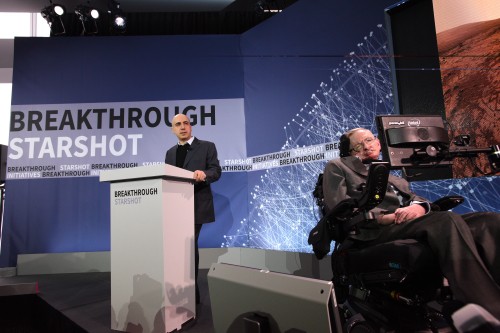
Photograph of Yuri Milner (left) and Stephen Hawking

By Hamish Johnston

What to do if you have millions of dollars lying around and a keen interest in physics? The physicist turned Internet tycoon Yuri Milner has already spent some of his fortune rewarding leading scientists and funding research. His latest project is called “Starshot” and involves spending a cool $100m on sending a spaceship to Alpha Centuri – the closest star system to Earth at just 40 trillion kilometres away.

(more…)

The single-atom engine that could

Physicists in Germany have taken mechanical miniaturization to the ultimate limit by producing a heat engine – one of the key inventions of classical thermodynamics – made of only one atom, and have measured its output. While microscale heat engines have been proposed and built in the past, this single-atom design is the smallest to date.

The heat engine, which converts a difference in temperature to mechanical work, is the archetypal machine of classical thermodynamics. The classical thermodynamic definition of temperature involves the average energy of a large number of particles, and is therefore not directly applicable to a single atom. However, a well-defined, classical thermodynamic temperature can still be obtained for such a particle, using the so-called ergodic theorem, which states that the average energy of a large number of particles in a region of space is equal to the energy of a single particle over a period of time. “That was a really tricky part of the design of the heat engine: how can you make use of the time-averaged definition of temperature?” explains lead researcher Kilian Singer of the University of Mainz.

Temperature trap

The solution was to confine the particle – which in this case was a calcium ion (40Ca+) – in a funnel-shaped trap, allowing it to undergo Brownian motion in a radial direction. The researchers then heated the ion using electrical noise, and as its temperature increased, its oscillations in the radial direction became larger, causing it to sample regions of higher potential, sending the particle towards the end of the trap at which it was less tightly confined. “You can think of it like a balloon in a funnel,” explains team member Johannes Roßnagel, who is Singer’s PhD student. “When you inflate the balloon, it will move towards the larger end of the funnel.”

When the electrical noise was switched off, however, the ion cooled, causing it to sink back towards the narrower, steeper end of the trap. By turning the noise on and off periodically, the researchers set up axial oscillations of the ion between the two ends of the trap. If left undamped, these oscillations would have become increasingly large until the particle escaped the trap. However, the researchers applied another laser to damp the oscillations, thus maintaining the particle in steady harmonic oscillations.

Auto comparison

“We have characterized the damping behaviour of the laser very well and we know exactly how much energy is dissipated by this damping laser,” says Roßnagel. “We know that, in a steady state, the energy produced by the engine and the energy damped by the damping laser are equivalent. That’s how we determine the output energy of the engine.” The researchers calculated the output power, finding it to be around 3.5 ×10–22 W. When scaled by the number of particles and difference between the temperatures of the hot and cold reservoirs, the researchers calculate that this output power is comparable to that of a modern car engine.

While Roßnagel himself admits that “you will never find a Mercedes driven by our heat engine”, he says that the team’s main goal is to get a better understanding of the thermodynamics of single particles, for the future development of other devices. Specifically, the researchers are interested in turning the idea around to produce refrigerators for heat management in nano-electronics. Their next research goal is to cool the atom further and confine it more tightly, so that it no longer behaves as a classical particle undergoing Brownian motion but as a quantum wavepacket. “The room left at the bottom is in temperature,” says Singer.

Cold-atom physicist Jean-Philippe Brantut of ETH Zurich describes the work as “a major achievement”, both as a “milestone” and as a pointer towards future work. “From this point onwards,” he says, “they can really start to explore how thermodynamics behaves in contact with quantum mechanics, and that’s somewhere you have a lot of open questions.”

The research is published in Science.

Computer gamers solve quantum problems

More than 10,000 computer-game enthusiasts have helped physicists in Denmark to design better protocols for running quantum computers. The researchers at Aarhus University created a suite of games called Quantum Moves, which mimic operations in a hypothetical quantum computer. When faced with challenges that resemble real design problems, the gamers came up with better solutions than those calculated by the physicists.

Citizen science uses the brainpower of ordinary people to solve very difficult scientific problems. Successful projects tend to use innate human skills such as pattern recognition and game playing – tasks that people are often much better at than even the most powerful computers. Popular projects include Galaxy Zoo, which relies on volunteers to classify the shapes of galaxies in telescope images, and Foldit, which makes a game out of the fiendishly difficult problem of predicting how proteins fold.

Now, Jacob Sherson and colleagues in Aarhus have created Quantum Moves, which uses citizen science to help design a quantum computer that stores and processes quantum bits (qubits) of information in an array of atoms trapped in an optical lattice.

Quantum speed limit

A fundamental challenge facing anyone trying to build a quantum computer is that qubits are fragile and will lose their quantum nature (coherence) as they interact with their surroundings. This problem can be overcome by performing the quantum computation in a much shorter time than it takes for the coherence to be lost. This means that calculations must be done as quickly and efficiently as possible. An added complication is the “quantum speed limit”, which puts a fundamental limit on how fast a “perfect” quantum computation can be done – any faster, and Heisenberg’s uncertainty principle starts to degrade the result.

 We are downloading our common intuition to the computer
Jacob Sherson, Aarhus University

These complications make it extremely difficult to work out the best way to solve a problem on a quantum computer. “We are at the borderline of what we as humans can understand when faced with the problems of quantum physics,” says Sherson, who wants to design a quantum computer based on atoms trapped in an optical lattice of potential wells. A key challenge in designing such a device is how to move the atoms about the lattice quickly and efficiently without destroying their coherence.

This is simulated in a Quantum Moves game called BringHomeWater, which challenges players to use optical tweezers to pluck an atom from one lattice site and move it to another site. The atom is represented as a quantum-mechanical wavefunction that lies like a pool of water at the bottom of a potential-energy well at the lattice site. The optical tweezers are represented as a second potential well that can be moved towards the lattice site so that the “water” can flow into the tweezers and then be shifted to a second lattice site (see video).

The faster the water is moved, the easier it is to spill it, and the object of the game is to find the quickest way of moving the water without spilling any – which is analogous to optimizing atom movements in a quantum computer.

Clever humans

Sherson’s team has found that the humans are much better than current computer algorithms at devising optimal ways of moving atoms. Indeed, the human strategies allowed the physicists to place new lower bounds on the quantum speed limit.

He and his colleagues used data gleaned from how more than 10,000 people played Quantum Moves to create graphical representations of how people solve problems. “The players solve a very complex problem by creating simple strategies,” explains Sherson. “Players automatically search for a solution that intuitively feels right.” This is unlike a computer, which undertakes a methodical search through available options to look for the base game plan.

Indeed, Sherson believes that the insights gleaned from Quantum Moves could be used to boost the performance of computer algorithms that design quantum-computing protocols. “If we can teach computers to recognize these good solutions, calculations will be much faster,” he says. “In a sense, we are downloading our common intuition to the computer.”

As well as fulfilling an important role in scientific research, Sherson believes that Quantum Moves can also give the public important insights into the strange world of quantum physics. “By turning science into games, anyone can do research in quantum physics,” he says. “We have shown that games break down the barriers between quantum physicists and people of all backgrounds, providing phenomenal insights into state-of-the-art research.”

The games are available to play at ScienceAtHome and the research is described in Nature.

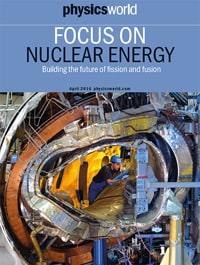
Physics World 2016 Focus on Nuclear Energy is out now

By Michael Banks

Proponents of nuclear power in the UK have endured an agonizing wait for Hinckley Point C – a European pressurized water reactor (EPR) to be built in south-west England that would fulfil 3.5% of the UK’s electricity needs. Earlier this year, it looked as if the French utility giant EDF would finally give the project the thumbs up and start construction. However, following months of political wrangling – and resignations by senior EDF executives – a final decision by the EDF board is yet to see the light of day.

Cover of the 2016 Physics World Focus on Nuclear Energy

Hinckley Point C is not the only EPR under construction that has been beset with delays and cost hikes: two in China, one in France and one in Finland have also had issues. In this first-ever Physics World Focus on Nuclear Energy, we delve into the EPR design and Hinckley Point C, as well as look ahead to other, more ambitious reactor designs in the pipeline – known as generation-IV designs – that could vastly reduce the amount of nuclear waste produced. Although work on such designs has slowed following the 2011 Fukushima nuclear accident in Japan, supporters argue that generation IV will still play a vital role in the long term.

The focus issue is not only devoted to fission, but fusion too. For decades physicists have dreamed of using fusion to generate electricity and, with construction well under way on the ITER fusion tokamak in Cadarache, France, that vision is now getting closer to a reality. But is ITER the only way forward? We explore how several private firms are developing small-scale fusion technologies, while in Germany a novel “stellarator” device has just started up that promises to deliver a “steady state” plasma.

(more…)

A nuclear revival: European pressurized water reactors

The headlines have not been kind to Hinkley Point C – a proposed nuclear reactor for south-west England. In the planning stages for almost a decade, the reactor has been hit by numerous delays as well as fights over funding and the price of the electricity it would generate. It was thought a breakthrough would come in early February when the French electricity giant EDF – the majority shareholder in the facility – would finally agree to start construction, but that had still to be announced as Physics World went to press.

The site at Hinkley is currently home to Hinkley Point A, a Magnox station that has been in the process of being decommissioned since 2000 after a 35-year life, as well as Hinkley Point B, which is an advanced gas-cooled reactor (AGR) station that opened in 1976 and still generates around 1250 MWe of electricity. Hinkley Point C is scheduled to begin operating in 2025 and will generate 1600 MWe – about 3.5% of the UK’s electricity needs. It will also be one of the first new nuclear power stations to be built in the UK for more than 20 years.

Hinkley Point C represents the future of nuclear energy generation in the UK – a new type of design that promises higher output and greater efficiency with less waste. It is a European pressurized water reactor (EPR) – a “third generation” reactor that is based on the pressurized water reactor (PWR), a type of light-water reactor. There are around 300 PWRs currently operating around the world, with 75 alone in France. PWRs use water as the primary coolant, which is pumped under high pressure to the reactor core where it is heated by the energy from nuclear fission. The heated water then flows to a steam generator where it transfers its energy to a secondary system where steam is generated and flows to turbines that, in turn, spins an electric generator. The EPR is basically a “beefed up” PWR, according to Paul Norman, who runs a Master’s course in the physics and technology of nuclear reactors at the University of Birmingham in the UK. “They are the next evolution, the next step up in PWR design,” he adds.

Hinkley Point C is not the first of its type. Four other EPR units are being built around the world (see “Delays and costs overruns – the EPR story” on page 8). Two reactors in China are scheduled to come online in 2017, while ones in both Finland and France have been hit by costly delays and are expected to be online in 2018.

The common feature of PWRs is that they are simple to operate: they require less intervention, less fuel and are easier to maintain than previous designs. They also have advanced, and/or “passive” safety features that rely on physical forces such as gravity and convection, with little or no need for mechanical devices such as pumps. “Water reactors are cheaper and simpler, more economical, and don’t have complex parts,” says Norman. “The EPR has the highest power and highest thermal efficiency of any PWR, and a host of back-up safety systems.”

Following the Fukushima nuclear accident in Japan in 2011, regulators in the four countries that were building EPR reactors demanded small tweaks to the design to take into account a possible Fukushima-style event happening with an EPR. They are now thought to be very safe and include several mechanisms to prevent accidents from occurring. They have four independent emergency cooling systems, each providing the required level of cooling for the decay heat that continues for one to three years after the reactor’s initial shutdown.

EPRs also have a leak-tight containment around the reactor as well as an extra container and cooling area if a molten core does manage to escape the reactor. The two-layer concrete wall with a total thickness of 2.6 m is designed to withstand impact by aeroplanes and internal overpressure. “There are many positives for the EPR design,” says Norman. “But there are also negatives where the designs following Fukushima could have been overtweaked with safety systems going too far, increasing the complexity and build times.”

Learning from the past

There are currently 14 AGRs operating in the UK and one PWR, which is located in Sizewell, Suffolk, and is the UK’s newest reactor, having opened in 1995. While the UK’s expertise is with gas-cooled reactors, Peter Haslam, head of policy at the Nuclear Industry Association (the trade association for the civil nuclear industry in the UK), does not see there being an issue with switching to water reactors. “There are clearly opportunities for the UK supply chain to be involved with a different reactor design, so that has a positive effect,” he says.

Hinkley Point C received planning consent in early 2013, yet it has taken years to get the project off the ground with wrangling over finance as well as the price for the electricity it would generate. Last year, the UK government provided a £2bn ($2.8bn) sweetener to support the reactor and later in the year EDF and China Guangdong Nuclear Power Group (CGN) signed an investment agreement for £18bn to build it. Under the agreement, CGN will take a 33.5% stake in Hinkley Point C with EDF owning the rest. Meanwhile, the two firms would also build another EPR at Sizewell in Suffolk, as well as a reactor in Bradwell, Essex. The latter will be built using Chinese reactor technology with CGN being the majority stakeholder.

Pricing has been a major obstacle for the project, in particular the “strike price” – the minimum price for electricity that is paid for what the reactor produces over a 10-year span. If the price for electricity generated at Hinkley Point C is below the agreed strike price – £92.50 per megawatt hour – then the government will top up the rest with the money coming from the consumers of electricity rather than being state subsidized. Yet the agreement works both ways and if the price of electricity increases beyond the strike price, then EDF will pay back the difference.

In February, EDF was expected to finally announce that it was going ahead with building the reactor, but progress has since stalled as it seeks to get approval from the firm’s board. “The economics of new nuclear builds are heavily weighted towards construction,” adds Norman. “You need to get that capital upfront as most of the cost of a reactor is in building it and that is where the Chinese investment has been so important to get it off the ground.”

Yet if construction does start soon, the reactor is expected to be roughly built on time and to budget, mostly because the firm has learned lessons from previous reactors riddled by delays, especially Olkiluoto 3 in Finland. “Olkiluoto 3 was the first of a kind so it is breaking fresh ground,” says Norman. “The general thought is that when you have a handful of new reactors, the next one you build will be a smoother process.” Some of those benefits have already been seen in the latest two EPR reactors that China is building, which are so far roughly on budget and have not been hit by major delays.

Norman’s view is shared by Haslam. “Olkiluoto 3 hasn’t been a huge success story, but the lessons from the previous reactors have been applied to Hinkley Point C to ensure it will be closer in terms of time and budget,” he says. “The key point is that we have learned the lessons of previous reactor builds and the UK EPR has passed the regulatory process – it is a stable reactor.”

Delays and costs overruns – the EPR story

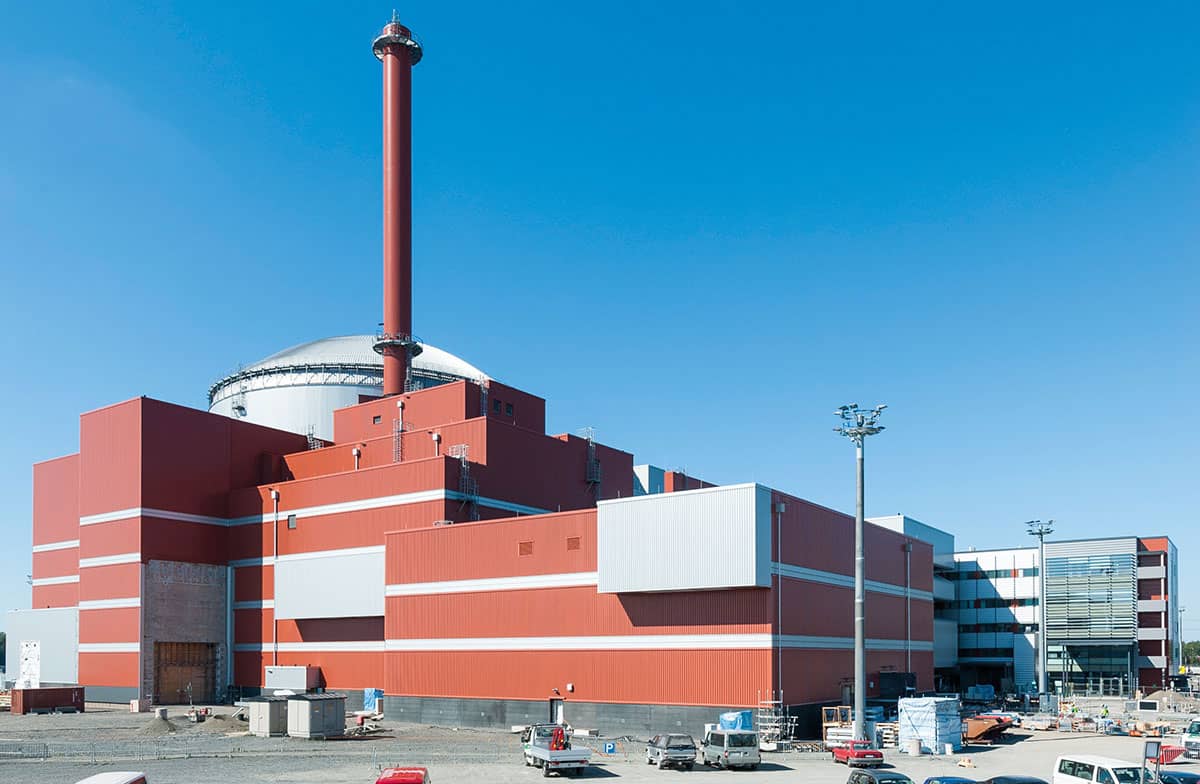
The Olkiluoto 3 European pressurized water reactor

As well as Hinkley Point C in the UK, four other European pressurized water reactor (EPRs) are currently being built around the world – two in Europe and two in China. Yet they have been plagued by delays and cost hikes.

Olkiluoto 3

The first-of-a-kind EPR at the Olkiluoto Nuclear Power Plant on the Olkiluoto Island in south-west Finland has been under construction since 2005 and was initially scheduled to come online in 2009 at a cost of around 4bn ($4.4bn). With an output of 1600 MWe, the reactor is being built by Areva and Siemens for the Finnish electricity operator TVO. Yet it has seen several revisions to its start-up date and has been hit by quality-control issues as well as the supply of components. It is now expected to be online by 2018 with the project estimated to cost at least 8bn.

Flamanville 3

Construction of the EPR at the Flamanville Nuclear Power Plant on the north-west coast of France began late in 2007. With an output of 1630 MWe, the plant was expected to be operational within four years. Yet by 2011, EDF, which is the operator of the plant, announced that the costs had increased 50% to 6bn and that the project would be delayed until 2016. When the Fukushima nuclear accident hit in March 2011, it led to French regulators demanding changes to the design. Last year, Areva, which is building the reactor, announced that “anomalies” had been detected in the reactor’s vessel and by late last year EDF announced that costs has escalated to 10.5bn with the reactor set to open in 2018.

Taishan 1 and 2

Taishan 1 and 2 are the first two reactors based on Areva’s EPR design to be built in China, with the firm managing to win the bid to build them in 2007 at a cost of 8bn. Taishan 1 has been under construction since 2009 and is expected to start up in early 2017, while work on Taishan 2 began in 2010 and it is scheduled to begin operating later in 2017. The reactors – both generating around 1750 MWe – are located on China’s south coast around 140 km west of Hong Kong and will be owned by the Guangdong Taishan Nuclear Power, a joint venture between EDF and China Guangdong Nuclear Power Group.

What can we learn from comets?

There has been a renewed fascination with comets ever since the European Space Agency’s Rosetta mission made its rendezvous with comet 67P/Churyumov–Gerasimenko in 2014. But beyond the sheer engineering triumph of reaching the icy rock and setting the “Philae” lander on its surface, why are astrophysicists so excited comets? In this video from our 100 Second Science series, Alan Fitzsimmons of Queen’s University Belfast explains how studying comets can teach us about the history and evolution of our solar system. Fitzsimmons believes we can also use the study of such comets to better understand planetary evolution in other solar systems.

If you enjoyed this video explainer, then check out more from our 100 Second Science series.

Diamond quantum bit is controlled using light and sound

Physicists in the US are the first to use a combination of light and sound to control the state of a diamond-based quantum bit (qubit) of information. The team used a laser pulse and a sound wave to modify the energy state of an electron in a nitrogen vacancy (NV) centre in diamond. According to the researchers, the technique could be further developed for controlling qubits in a chip-based network of NV centres.

A nitrogen vacancy (NV) centre occurs when two neighbouring carbon atoms in diamond are replaced by a nitrogen atom and an empty lattice site. For anyone trying to build a quantum computer, NVs are useful as qubits because they have an electron that is extremely well isolated from the surrounding lattice – information can be stored in an NV by placing it in a certain electronic state, which can then be maintained for a long time, even at room temperature. What is more, an NV qubit can be entangled with the polarization state of a photon, and such spin–photon entanglement could form the basis of future quantum computers.

Sound control

However, this isolation also has its downside for quantum-computer designers because it makes it very difficult to connect and control NV-based qubits in a quantum computer. One possible way forward is to use sound waves, which could propagate through a chip containing many NVs and modify how individual NVs interact with light.

Now, Andrew Golter, Hailin Wang and colleagues at the University of Oregon and Oregon State University have shown how sound waves can change the photon energy required to put the NV into an excited state. They have also shown that sound can be used to control the NV centres in a way that preserves their quantum coherence – something that is important for quantum-computing applications.

The team began by coating a 500 μm-thick diamond wafer with a film of zinc oxide just 400 nm thick. Two antenna-like electrodes were placed at opposite ends of the wafer. Zinc oxide is a piezoelectric material, so when an oscillating electronic signal is applied to one of the electrodes, it creates a mechanical vibration on the surface of the wafer. This creates a surface acoustic wave (SAW) with a frequency of about 900 MHz that propagates across the wafer to the second electrode, where it is detected (see figure).

Creating sidebands

The wafer contains an NV centre that is several microns below the zinc-oxide-coated surface. This is close enough that the surrounding diamond lattice expands and contracts as the SAW passes overhead. When the SAW is switched off, the NV will absorb and emit photons of frequency ωo – which corresponds to the excitation energy of the NV. When the SAW is switched on, however, the vibrational energy of the lattice can also contribute to the excitation of the NV. This results in two new frequencies – called “sidebands” – at which photons can also be absorbed and emitted. These sidebands occur at ωo ± ωm, where ωm is the frequency of the SAW.

The team detected these sidebands by shining light on the NV to put it into an excited state, and then observing the fluorescent light that is given off when the NV drops down to its lowest energy state. As expected, the team observed light at three frequencies, ωo and ωo ± ωm.

The physicists were also able to measure quantum interference within the primary transition (ωo) and the sideband transitions. This is important because it shows that the opto-acoustic and optical transitions of the NV centre are coherent, and therefore both light and sound can be used to control its quantum state.

Phonon control

In particular, sound waves could offer a way of controlling the quantum states of large numbers of NV centres that are integrated within a chip. In such schemes, NV-based qubits could be designed to emit and absorb quanta of sound, or phonons. These phonons could be used to transport quantum information between qubits in an integrated quantum computer.

“You can imagine a 2D array of NV centres networked together by sound waves travelling back and forth across the surface of the diamond,” explains Golter. He also points out that the opto-acoustical control of qubits has already been successfully demonstrated using trapped-ion qubits. “Combining optical and acoustic control the way that we did follows on from techniques used to great success in trapped-ion systems, where lasers and the vibrations of the ions within the trap were used for quantum control and to couple multiple ions together.”

The research is described in Physical Review Letters.

Nanocrystal inks used to build flexible transistors

A high-quality, flexible transistor, made entirely from colloidal nanocrystals, has been developed by a team in the US. By sequentially depositing their components in the form of nanocrystal “inks,” the researchers could make transistors using standard industrial methods, without the need for high-temperature, high-vacuum specialist equipment. The work can be scaled up, so it could be applied to a variety of materials, and even in the design of printable circuits for wearable or implantable electronic devices.

The transistor has been the central component of the electronics industry since its Nobel-prize-winning invention by John Bardeen, Walter Brittain and William Shockley in 1948. Modern CMOS (complementary metal-oxide semiconductor) computer chips contain billions of transistors etched into a single, high-purity silicon wafer. However, scientists and engineers are now keen to incorporate electronic devices into ever-more unlikely places: from wearable displays on clothes to implantable glucose monitors. Many of these applications demand flexible devices, whereas crystalline silicon is inherently brittle.

Flexible crystals

Electrical engineer Cherie Kagan and colleagues at the University of Pennsylvania have been part of a worldwide effort exploring the potential of colloidal nanocrystals to create flexible transistors and other electronic components. “In the past, we’ve shown that you can make conductive wiring using silver nanocrystals,” says Kagan. “We’ve also shown that we could use semiconductor nanocrystals, or quantum dots, to make good semiconductor layers.” However, to create transistors, they had to turn to conventional techniques of high-performance computing to deposit the source, gate and drain connections, as well as the insulating layer, by vacuum evaporation. Kagan told physicsworld.com that because fabrication facilities are very expensive, “simple printing- and coating-based methods” are attractive – especially for applications that require devices over large areas.

Now, Kagan’s team has created the first transistor built entirely from various types of nanocrystals. The researchers first deposited a layer of conductive silver nanocrystals from solution on a flexible polymer, using a photoresist to define the position of the electrode. After removing the photoresist, they deposited a layer of insulating aluminium-oxide nanoparticles from another solution, surrounding the gate electrode. On top of this, they deposited cadmium-selenide quantum dots – these act as the transistor’s semiconductor channel. Finally, the researchers patterned more silver nanocrystals on top to act as the source and drain leads. Mixing indium nanocrystals with the silver of the source and drain leads and heating the devices to 250 °C after manufacture allowed the researchers to dope the semiconductor channel with metal ions (n-doping), as the indium diffused from the silver leads into the cadmium selenide.

An electric field was created by raising the electrical potential of the gate electrode, thereby attracting electrons into the semiconductor, increasing its electrical conductivity and allowing current to flow between the source and drain electrodes. This allowed the device to behave as a field-effect transistor (FET) – the most industrially popular type of transistor used today. Upon testing, the team found that its devices functioned as well as state-of-the-art FETs produced by vacuum evaporation.

Looking forward

“The next step would be to exploit what we’ve demonstrated and to develop some of the 3D-printing-based techniques for additive manufacturing. That’s the one that excites us the most as we think about how you would be able to connect these different layers on your substrate to make integrated circuits.” But Kagan also points out that, for standard CMOS logic architectures, they would need to develop a p-type transistor, in which conductivity occurs via positive “holes” and raising the gate potential turns off the transistor. Dmitri Talapin, from the University of Chicago, who was not a part of Kagan’s team, suggests a potential solution for this, saying that “future printable circuits will combine p-type organic transistors with n-type nanocrystal devices to enable CMOS device architecture. The work of the Kagan group represents an important milestone on this way.”

Nanocrystals expert Maksym Kovalenko of ETH Zurich in Switzerland, who was not involved in the current work, describes the research as remarkable, adding that it shows the “level of maturity in this field”, now that it is possible to make nanoparticles, as well as tune their properties. “I think this shows very clearly that you can make any major optoelectronic device fully out of nanoparticles,” he adds.

The research is published in Science.

Storytelling matters

Photo of a table used in the Jewish Passover for the ritual known as Seder

Passover, held this year on 22–30 April, celebrates the liberation of the Jews from slavery in Egypt. I’m an outsider to this (and any) religion, but the Passover holiday fascinates me for its storytelling. On its first or second night (usually), participants engage in a ritual known as Seder, which involves narrating the story of Exodus and then enjoying a meal. The narrative is based on a script called the Haggadah, which in Hebrew means “telling”. The Haggadah is not a sacred text but the prompt for an informal and participatory story that comes in many versions, from solemn and serious to playful and even irreverent.

The way the Haggadah presents the story has ingenious aspects that, I think, transcend any strictly religious context. These aspects even help to frame a recent controversy about the history of science.

Out of Egypt

The everyday practice of science involves much casual storytelling, from recaps at the beginning of talks and in the first paragraphs of many articles to the shortcuts colleagues give each other about why things are done this way rather than that. These informal narratives are not complete in all their details, nor do they need to be. They’re a way of reminding people of what’s important, making sure they are alert and fresh. A good history of science adopts a more comprehensive approach but can have, I think, the same ambition.

Last year, however, the Nobel-prize-winning physicist Steven Weinberg sparked a controversy about history of science. In his book To Explain the World, Weinberg wrote that he was seeking to tell “how science progressed from its past to its present” from the perspective of a “modern working scientist”. His explicit desire was to judge “the past by the standards of the present” rather than to understand the past on its own terms as historians typically do. Weinberg’s approach was like looking at the history of architecture in anticipation of today’s buildings and codes.

Several historians of science sharply criticized Weinberg’s book, and Weinberg was equally firm in answering them. His rebuttals included an article in the New York Review of Books and a talk he gave in a session about his book, which I helped organize, at this year’s March meeting of the American Physical Society. The dispute raises deep questions about the purpose of science history. Should it be primarily about how technical features of today’s science emerged? Should it focus on earlier forms of science and how these evolved? Or can history of science have some other end, such as to make its audience – scientists and non-scientists alike – alert to the practice and meaning of science?

I know it’s crude, but here’s where Seder helps frame the issues. Weinberg’s view is that the story of Exodus should be told backwards from the viewpoint of the Promised Land, where life – tweaked, perhaps – is as good as it gets. For some of his critics, the story should be told from the perspective of participants starting in Egypt onwards. Yet another possibility is that the story should be oriented neither by life in Egypt nor the Promised Land, but should serve to put us more on alert to the present, helping us see in it possibilities for what may still lie ahead. The merits of these three possibilities depend on the needs and interests of the audience.

I find Seder instructive for another reason as well. At one point, the unfolding story halts for a moment of reflection as the participants consider four questions about the meaning of the story. Being Jewish, evidently, is more than a matter of beliefs, rituals or even birth within a group whose history includes the Exodus. It means belonging to a community whose members are in danger of forgetting that story and who therefore periodically refresh their awareness of it, making that historical experience part of the current moment. Telling the story changes the tellers, aiming to enrich them by seeking to make them more humble and agile in responding to the present.

One might say, similarly, that being a scientist is less a matter of accepting a set of beliefs, using techniques and instruments, or even of having a university degree – and more about being flexible enough to re-examine the assumptions and concepts you’ve inherited in the light of experience. It’s a flexibility of mind you can nurture by exposing yourself to examples, too numerous to mention, from science history.

The critical point

Seder’s storytelling contains yet another radical element. At one point, the Haggadah stages an imagined conversation between the participants and four children who don’t get what’s happening, and it has the participants hear and respond to the children. The children misunderstand in different ways: a wise child who wants to understand the story better; a wicked child who denies its relevance; an ignorant child who doesn’t know what’s going on; and a simple and apathetic child who can’t pose questions well. However crudely, the Haggadah thus requires participants to grapple with scepticism, ignorance and indifference towards the very community whose struggles and continued existence are being celebrated.

I find this a helpful reminder of how to communicate science to often sceptical, ignorant or uninterested politicians or members of the public. Calling such people dumb, wicked, ideological and stupid, however tempting, guarantees more resistance and opposition. A powerful way of getting through to such people is through the history of science by retelling – whether formally, informally, seriously, playfully or irreverently – how and why today’s scientists do what they’re doing.

Copyright © 2026 by IOP Publishing Ltd and individual contributors