Adding a topological fold to origami metamaterials

A metamaterial that is soft along one edge and rigid along the other, yet also displays mechanical topological properties, has been developed by an international team of researchers. This is the first time that topological origami and kirigami techniques have been applied experimentally to metamaterials – artificial materials with tunable, well-defined properties. Apart from having developed a metamaterial with two distinct topological phases, the team is also working on theoretical guidelines for the future design and development of such materials.

Researchers have become increasingly interested in recent years in using he ancient Japanese arts of paper folding and cutting – origami and kirigami, respectively – to build and create a variety of metamaterials. Indeed, Bryan Gin-ge Chen, at the University of Massachusetts Amherst, who led the latest work, sees origami as one of the earliest examples of a metamaterial. “All designs are folded from a square sheet of paper, but many different shapes and structures can result, [which] is exactly in line with the principle that a metamaterials’ properties come from structure rather than composition,” he explains.

Chen and colleagues in the US and the Netherlands were inspired by the novel idea of “topological mechanics”, developed in 2014 by Charles Kane and Tom Lubensky from the University of Pennsylvania. Originating from the topological states seen in quantum physics, the idea was extended by Kane and Lubensky, who showed that there is a special class of mechanical structures that can be “polarized” so they are soft or floppy along one side, while being hard or rigid along the other.

Special class

“What’s special about these topologically polarized materials is that if you cut the system in half, each of the two new pieces now has a rigid side and a floppy side too,” says Chen. The two new surfaces created by making such a cut, he explains, “somehow know how they are to act, just like how cutting a magnet in two leaves you with two magnets, not a separate North and South pole”.

Since Kane and Lubensky’s 2014 paper, many other researchers have modelled how such materials could be exploited in a system with masses connected by springs. Chen and his team have instead developed theoretical tools to find such behaviour in origami and kirigami structures. Their aim has been to design origami structures that can flex and deform controllably, which will be necessary for future “smart” materials that can evolve their shape or properties at will. The team then applied its designs to create a simple origami strip that shows the edge deformations that would arise from topological polarization.

The structure is a series of four-sided plastic units connected using hinges. By squashing it between two plates, the team could make the material buckle at the hinges to form valley-like structures. The pattern was designed so the material is asymmetrically rigid along its length.

Degrees of freedom

Another benefit of the materials’ flexibility arising from the topological polarization is that it can withstand some imperfection in how it is built, Chen explains. The team also saw interesting effects – such as additional flexibility or rigidity – that appear when different origami designs are side-by-side in a composite sheet.

Chen adds that for structures that are not too rigid or floppy, a careful balancing and accounting of the material’s “degrees of freedom (DOF) and the constraints between them is fundamentally important for a mechanical structure”. His colleague Vincenzo Vitelli from the University of Leiden in the Netherlands says that the DOFs simply mean that the material can fold in some places and not in others, and do not depend on local properties like material parameter variations.

Chen cautions that the guidelines the team is developing are still a work in progress. “We know that ‘topological’ origami and kirigami materials must have a precise balance of DOF and constraints in each unit cell,” he says. “It also seems that in order to get topologically polarized structures consisting of patterns that repeat in two directions, we have to include holes (a kirigami structure), unlike the 1D repeating strip.” However, his team is still investigating how the angles and pattern of creases determines the topological polarization in different cases. According to Chen, the current work lays the foundation for future studies on origami and kirigami as “topological metamaterials”.

The research is published in Physical Review Letters.
Thwarting an alien invasion, pi in the sky, listening to the LHC and more

A guide laser

By Hamish Johnston

Sometimes, the biggest laughs on April Fools’ Day come from the stories that read like hoaxes but are actually true. One such item is a proposal by David Kipping and Alex Teachy of Columbia University in the US, who have come up with a way of hiding the Earth from aggressive civilizations on distant planets (at least I think this is real, but I wouldn’t be surprised if it were an elaborate hoax!).

(more…)

White dwarf with nearly pure oxygen atmosphere surprises astronomers

The first known white-dwarf star with an oxygen atmosphere has been spotted by astronomers from Brazil and Germany. The discovery comes as a complete surprise because an oxygen atmosphere is not predicted by any current theoretical model of stellar evolution. The researchers believe that the star’s original atmosphere of hydrogen and helium was stripped away, possibly by the gravitational pull of a companion star. The discovery could provide important information about how stars like the Sun evolve into white dwarfs.

“It’s quite outstanding,” says Boris Gänsicke of the University of Warwick in the UK, who was not involved in the discovery. “It’s a really rare, needle-in-a-haystack kind of discovery that you wouldn’t search for…but finding it may be a little but important piece in a jigsaw about stellar evolution.”

Becoming a white dwarf is the ultimate fate of most stars smaller than about 10 solar masses – including, of course, the Sun. After such a star burns up its helium via nuclear fusion, it sheds its outer layers and its core collapses under gravity to form a very dense ball of plasma that occupies about the same volume as the Earth. Most white dwarfs are unable to fuse carbon and have cores of carbon and oxygen. However, the heaviest stars that become white dwarfs are believed to undergo steady carbon fusion before collapsing into white dwarfs with cores of oxygen, neon and magnesium. These elements are difficult to observe, however, because gravity draws the heavier elements towards the core. The atmospheres of almost all white dwarfs are therefore dominated by the lightest elements – about 80% of white dwarfs have atmospheres dominated by hydrogen, and the rest by helium.

Star search

To find their white dwarf with an oxygen atmosphere, S O Kepler and Gustavo Ourique of the Federal University of Rio Grande do Sul and Detlev Koester of the University of Kiel combed through publically available data on 4.5 million stars from the Sloane Digital Sky Survey (SDSS).

It’s a really rare, needle-in-a-haystack kind of discovery that you wouldn’t search for
Boris Gänsicke, University of Warwick

The one star that they identified – called SDSS J124043.01+671034.68 – is 1200 light-years away and has an emission spectrum that suggests that its atmosphere is 96% oxygen. Neon and magnesium are the next most abundant elements, and the star also contains trace amounts of silicon and no detectable hydrogen or helium. Further analysis of the spectrum and comparison with mathematical models suggested that its mass is just over half that of the Sun. This makes the star even more puzzling, because a star that forms a white dwarf of this mass should be too small to undergo carbon fusion. Therefore, the white dwarf should not contain any oxygen at all, let alone at its surface.

The trio point out that several recent models suggest that, under specific circumstances, stars as small as 5.5 solar masses could undergo limited carbon fusion, creating a violent thermal pulse that would ignite off-centre and propagate outwards. However, this alone would not explain the observations, says Kepler: “These models say you might have a nucleus of carbon and an atmosphere of oxygen but do not predict that all the helium should be lost.” The final white-dwarf mass predicted in these models is also about one solar mass – much larger than seen here.

Stripped away

Kepler suggests that both of these problems could be resolved simultaneously if the outer layers were stripped away, exposing the products of carbon fusion beneath. He believes the most likely cause is interaction with another star: “To me, it must have come from a binary evolution,” he says. “It’s called a common envelope situation, where when you throw material into the white dwarf, it blows the envelope and the envelope is lost from both stars.” He cautions, however, that, “In a formal calculation, the stars do not lose that amount of mass.” More data are needed to develop the models and these should be forthcoming in the next few years from the GAIA space observatory, Kepler says.

Gänsicke points out a subtler but even stranger feature of the star’s spectrum than the oxygen atmosphere: the traces of silicon. “The nuclear burning must have proceeded one step further than the production of oxygen, neon and magnesium,” he says. “Most textbook astronomy would predict that, once you get to that [further] stage, you will not be able to stop nuclear burning all the way up to iron and you will produce a neutron star.”

The research is published in Science.

The April 2016 issue of Physics World is now live

PWApr16cover-200By Matin Durrani

The April 2016 issue of Physics World magazine is ready and waiting for you to access via our app for mobile and desktop.

Our cover story this month is about Rydberg atoms – those super-sized atoms that are one of the hot topics in condensed-matter physics – and in particular how they could be used to create quantum computers.

You can also find out how virtual-reality tools could help you to learn about the science of optics and learn more about a new research centre at the National Autonomous University of Mexico that’s bringing a fresh approach to the science of complexity.

If you’re a member of the Institute of Physics (IOP), you can now enjoy immediate access to the new issue with the digital edition of the magazine in your web browser or on any iOS or Android mobile device (just download the Physics World app from the App Store or Google Play). If you’re not yet in the IOP, you can join as an IOPimember for just £15, €20 or $25 a year to get full access to Physics World digital.

(more…)

3D-printed dog's nose sniffs out why canines are excellent chemical analysers


By Tushna Commissariat

After a long trip in the US – attending the APS March meeting and visiting both the Maryland campus of the National Institute for Standards and Technology, as well as the Brookhaven National Laboratory in New York – I finally made my way back home yesterday. As I flew out of New York, I was reminded of my visit to NIST’s Surface and Trace Chemical Analysis Group, where researchers develop a variety of ways to detect contraband substances at airports and other public locations. While the team looks into a variety of ways to detect trace residues of banned substances such as drugs or explosives that may be found on people or objects – from mass spectroscopy to thermal desorption to vapour-sampling – my favourite was their canine research that led them to create a 3D-printed dog’s nose!

(more…)

Carried away by a well lit shadow

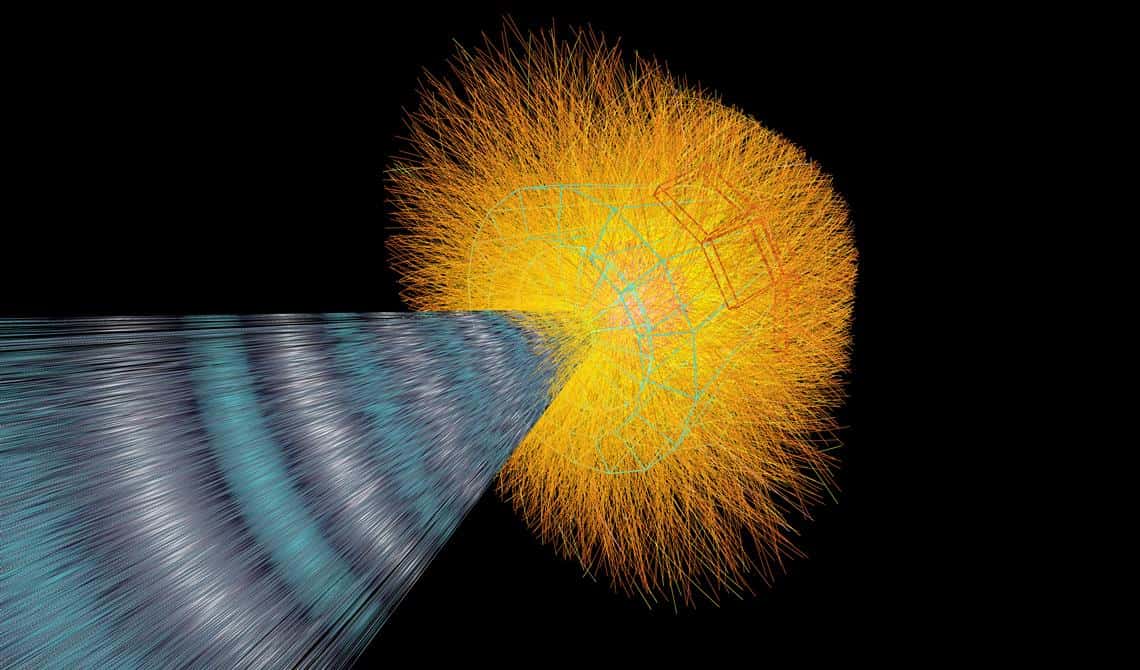
Simulation of a lead ion collision in ALICE

By James Dacey

As concept albums go, the latest release by Jake Hertzog can certainly be stacked at the intellectual end of your record collection. This week, the US jazz-rock guitarist released his sixth studio album, entitled Well Lit Shadow – a suite of solo electric-guitar tracks inspired by images from the Large Hadron Collider (LHC) and other experiments at the CERN particle-physics lab. You can find details of how to purchase or stream the album on Hertzog’s website.

Now, I’m not the world’s biggest jazz aficionado but I gave the album a listen and it’s far more accessible than the concept might suggest. Hertzog’s musicianship shines through and bright walking riffs on tracks such as “Star Drops” and “Traces of You” evoke images of devoted researchers working through vast amounts of data in pursuit of knowledge. According to Hertzog’s website, some of the pieces are very literal attempts to depict the chaos and beauty of subatomic-particle collisions, while other tracks are more abstract meditations on the deeper meaning of these experiments. The album’s title track is described as “a musical poem dedicated to the philosophical implications of this science”.

(more…)

Rivers of stars could point to cold dark matter in the Milky Way halo

Streams of dark matter interacting with rivers of stars could provide astrophysicists with important information about the distribution and make-up of dark matter in the halo of the Milky Way. That’s the conclusion of Jo Bovy of the University of Toronto, who has calculated that it should be possible to observe the effects of dark matter on the stellar streams that are known to encircle our galaxy.

The theory of cold dark matter (CDM) is one of the cornerstones in our understanding of the evolution of structure in the universe. It posits that the haloes surrounding galaxies such as the Milky Way should be clumpy, with myriad blobs of dark matter held together by gravity. The Milky Way’s halo is also home to a swarm of globular star clusters and dwarf galaxies, some of which are being torn apart by gravitational tidal forces to create streams of stars that can stretch halfway around the galaxy.

For more than a decade, astrophysicists have suspected that dark-matter clumps could be detected by observing how their gravitational pull affects the motions of stars in stellar streams. Sceptics, however, point out that the Milky Way’s gravity can also stretch the dark-matter clumps into long streams – and it would be much more difficult to observe the effect of such dark-matter streams on stellar streams.

Mapping in 3D

Now, new research by Bovy suggests that streams of dark matter can still be detected through their interactions with stellar streams pulled from globular clusters. His calculations reveal that careful measurements of the motions of stars within these stellar streams could reveal the presence of dark-matter streams. These dark-matter streams could then be traced back to the clumps of dark matter that feed them. Ultimately, it should be possible to create a 3D map of dark matter in the Milky Way halo, he argues.

“I think it’s one of the only ways where we can actually measure whether these little clumps of dark matter truly exist in the haloes of galaxies,” Bovy told physicsworld.com. He also says that such measurements provide an excellent opportunity to study the nature of dark matter and work out if dark matter is indeed “cold”.

Tiny clumps

CDM refers to hypothetical dark-matter particles that move much slower than the speed of light. This sluggishness should allow gravity to group CDM particles into relatively small clumps. While CDM is currently the most popular description of dark matter, an alternative theory is that dark matter is “warm” and hence moves faster than CDM. Warm dark matter would still be able to form clumps, depending on the energy of the particles, but these clumps would be no smaller than the smallest galaxies.

Bovy points out that the motion of the stellar streams should be able to reveal clumps of dark matter as small as 10 million times the mass of the Sun. If small clumps are found, this would be strong evidence that dark matter is indeed CDM.

“If [Bovy] is correct that the dark-matter clumps can be detected using streams, then that would be terrific,” enthuses Kathryn Johnston of Columbia University in New York. In 2002 Johnston was part of a team that first suggested that undisturbed dark-matter clumps could be detected via stellar streams. “Our halo is the one place in the universe where I think we can really test this,” she says.

Data deluge

Astronomers have so far discovered about two dozen stellar streams. They are not easy to find because they appear merely as over-densities of background stars in images obtained by the Sloan Digital Sky Survey telescope in New Mexico. The European Space Agency’s Gaia mission, which is measuring the positions and motions of a billion stars, will help find new streams, as will the upcoming Large Synoptic Survey Telescope (LSST) currently under construction in Chile.

Johnston says that “the amazing data sets on the horizon from Gaia and LSST” are encouraging astrophysicists to focus on stellar streams. “We have real data coming, which means we must develop robust methods to measure the streams,” she says.

Bovy agrees: “I think it’s a very exciting area. The next few years, especially with the data from the Gaia satellite, are going to be of particular interest to the greater physics community, as this is one of the ways we can actually learn something new about dark matter.”

Bovy’s research is described in Physical Review Letters.

Diversifying utopia

In around 1612, an English vessel set sail across the Pacific westbound from Peru with a year’s worth of supplies. At first the winds blew favourably, but after a few months they changed direction. For a while, the boat’s progress merely stalled but eventually the sailors were blown far off their route. Struggling against the elements, they exhausted their provisions and many fell ill. Abandoned to nature – and feeling lost in “the greatest wilderness of waters in the world” – they gave up hope, prayed and “prepared for death”.

A miracle saved them. Cloud formations appeared that usually indicate land, and the sailors headed that way. Soon they came upon a hitherto unknown island with a small but well-built port. After landing and disembarking, the crew learned that the island, called Bensalem – a name that joins a Hebrew word meaning son or offspring with one meaning peace, safety or completeness – was efficiently and wisely ruled by an academy of scientists called Salomon’s House. The sick sailors were cured, and those who had been victims of nature now felt free.

Thus begins New Atlantis by the philosopher and scientist Francis Bacon (1561–1626). Like any parable, its metaphors are easy to decode. The vessel represents humanity making its long journey in an often unpredictable and threatening world. Without special knowledge of this world, the sailors get weary, sick and lost. When finally saved, their first instinct is to attribute their salvation to a miracle, though in reality they were saved and cured by humans who had taught themselves to understand and control nature – even, apparently, the weather conditions that brought the sailors to the island.

Bensalem is Bacon’s vision of a community organized to take full advantage of science and technology. He realized that science and technology would not only revolutionize how we think about the world, but also how we must organize ourselves socially and politically. Scholars find New Atlantis fascinating because, before the advent of modern science, Bacon understood how vastly collaborative an effort it would have to be.

Bacon describes Bensalem as open to diversity. While predominantly Christian, for instance, it includes a practising Jewish community whose members are regarded as equals. But where are the women? While Bacon has been taken to task for his occasional use of sexist language (“Cooking Bacon”, November 2015), I am unaware of anyone who has discussed the virtual absence of women from his scientific utopia.

The vessel that sails into Bensalem does not seem to have any women on board. Salomon’s House, while having men and women among its attendants and servants, is governed by a board of “fathers”. Still more disturbing is Bacon’s description of Bensalem’s “Feast of the Family,” which celebrates men who have sired 30 living descendants. During this festival, the father is seated on a special chair whose canopy has been decorated by his daughters. The mother? She’s kept out of sight in a room off to the side behind a concealed door.

How could Bacon – a prophet of the scientific and technological age – have been so dismissive of 50% of its population?

I can think of two possible ways to be charitable to Bacon, neither convincing. One is to say that neglecting women was not Bacon’s intention, and that New Atlantis is incomplete. After all, it was published posthumously by William Rawley, Bacon’s secretary, who added the phrase “a work unfinished” to its title. Rawley noticed that the parable contains virtually no discussion of political and social matters, which one naturally expects in a discussion of a utopia, and concluded that the work must be unfinished. Surely, we might say, he would have added women in completing it.

I don’t buy that argument. The story contains no real openings for such a discussion. Moreover, the description of the feast is complete – and it shuts away the matriarch.

The second way would be to say that Bacon was a man of his time. He wasn’t writing about women but how science and technology would change the world. His account simply reflects the atmosphere of the world he was living in, which lacked women in leadership positions.

This, too, is nonsense. Queen Elizabeth I was England’s monarch during the first part of his career; Bacon grew up in her royal household and served as her counsel. More importantly, Bacon was far-sighted in other regards. In New Atlantis he foresaw, long before the advent of modern science, not only the rich and extensive array of instruments, devices, materials and labs needed in a fully functioning scientific community, but its social structure too, including teachers, publishers, technicians, libraries and museums. He anticipated the powers and dangers of technology, and the conflicts that might arise between scientific communities and the state. How could it be that he foresaw no women as having a role in his “offspring of completeness”?

The absence of women is a deep flaw in Bacon’s New Atlantis , but I can’t figure out why it’s there. I don’t see the place as inherently patriarchal, so why weren’t women equal participants? Today it would be unthinkable to see women as anything but equal collaborators in any vision of a flourishing scientific community.

The critical point

That locked-up matriarch in Bacon’s tale haunts me. She makes me wonder if his motive was to banish a potentially disruptive presence. But why did he see women as potentially disruptive? Recent cases of sexual harassment in science – coupled with ongoing controversy over why there are so few women in science – make me suspect that the undercurrents of sexism, four centuries after Bacon, are more powerful than we suspect, so that detecting and eradicating them will be harder than we think.

New gravimeter-on-a-chip is tiny yet extremely sensitive

A tiny device that can make very precise measurements of the Earth’s gravity has been unveiled by physicists at the University of Glasgow in the UK. While their gravimeter is not quite as sensitive as the best available sensors, the team says that it could be produced for a 1000th of the cost. It is also significantly smaller and lighter than current devices, and could be deployed in drone aircraft or in multi-sensor arrays to perform a range of tasks, including mineral exploration, civil engineering and monitoring volcanoes.

Gravimeters are sensors that measure the local acceleration due to the Earth’s gravity. Today, the smallest high-precision devices weigh several kilograms and are the size of a loaf of bread. They have found use in a wide range of applications, from mineral exploration – detecting changes in local gravity caused by mineral deposits – to civil engineering, where they can be used to detect voids under roads or railway tracks. They can also be used to detect magma movements deep underground, which often happen before volcanic eruptions.

Most commercial gravimeters work by making a very precise measurement of the position of a mass that is pulling down on a spring. A measurement is made with the gravimeter in a location of interest and then compared with a separate measurement made at a reference location. Doing this reveals the difference in local gravity between the two locations to a precision of about 10–8 m s–2. While other devices are available for measuring gravity – including quantum gravimeters – all options tend to be cumbersome and difficult to use. Furthermore, they are very expensive, with a typical price tag being in excess of $100,000.

Smartphone inspired

Now, Giles Hammond and colleagues at the University of Glasgow have built a gravimeter that could offer a simple, compact and low-cost way of measuring gravity. The chip uses a microelectromechanical system (MEMS) that is similar to that used in accelerometers, which are ubiquitous in smartphones. However, the new device is about 1000 times more sensitive to accelerations than the devices found in consumer electronics.

The gravimeter is based on a “proof mass”, which is a piece of silicon about 10 mm long that sits on top of two flexible struts – much like a vehicle sitting on top of a leaf-spring suspension. The mass, struts and frame are all made from a single 200 μm-thick silicon wafer using standard semiconductor-manufacturing processes.

Gravity pulls the mass down while the struts push it up, leaving it in an equilibrium position that is defined by three quantities: its mass, the spring constant of the struts and the acceleration due to gravity (g). The spring constant and the mass are fixed values, and therefore any change in the position of the silicon is a result of a change in the local value of g.

Tiny changes

The position of the mass is measured by using an LED to shine light onto the mass, casting a shadow on a detector behind the mass. The optics are set up so that tiny changes in the position of the mass are detected as changes in the amount of light reaching the detector.

While silicon is a very convenient material to manufacture, it will expand and contract significantly with changes in temperature. To get around this problem, the team used a heater and a very precise thermostat to maintain the temperature of the sensor to within 1 mK.

To test the gravimeter, the device was set running for several days to measure Earth tides. This is the tiny oscillation in the strength of the gravitational field caused by the distortion of the shape of the Earth by the tug of the Moon. Sure enough, the gravimeter data showed a clear oscillation with a period of about 12 h that matched what is expected from the Earth tides.

The device has a sensitivity that is about ten times worse than the best commercial devices. According to the team, the device is still sensitive enough to detect a tunnel of cross-sectional area 2 m2 at a depth of 2 m, and could be used to find an oil reservoir with a volume of 50 m3 at a depth of 150 m.

Quantum technologies

Hammond told physicsworld.com that the team is now working with a geological-survey company to develop a portable gravimeter that can be tested in the field. While the current design only measures acceleration in one direction, the physicists plan to create a device that works in 3D. Hammond also says that the team is working on improving the method for measuring the position of the proof mass, which uses technologies developed by the UK’s QuantIC programme for developing quantum imaging technologies.

The gravimeter is described in Nature.

How to succeed at networking in science

Imagine you are a student attending your first science conference. It’s going pretty well. You went to a great talk this morning, and when you asked the speaker a question, their answer was really helpful – in fact, you think it might help crack the problem you’ve been working on. Now you’ve got a couple of hours before the evening poster session, so you pull out the conference programme, check your schedule – and let out an involuntary groan. It’s time for the conference’s official “networking” session.

You know that networking is important. In fact, you’ve probably been told that it’s vital for your career. But as you approach a room full of people chatting over drinks and nibbles, you find yourself wondering, how is this going to help me?

For many scientists, networking does not come naturally. In some cases, this is simply because we’re shy. But it’s also easy to confuse networking with schmoozing, sucking up in order to get a job, or “selling” one’s work – tactics that are frowned upon by many scientists, who believe the quality of research should speak for itself. Whatever the reasons, though, this edition of the Physics World podcast will explain what networking really is and convince novices to give it their best shot – while also suggesting a few tips to help more experienced networkers make the most of their next conference.

In this podcast, you will hear from a number of top networking specialists:

  • Alaina Levine, science careers consultant and author of the book Networking for Nerds: Find, Access and Land Hidden Game-Changing Career Opportunities Everywhere;
  • Margaret Harris, Physics World‘s careers and reviews editor, who tried some of Levine’s tips at the 2016 annual meeting of the American Association for the Advancement of Science (AAAS);
  • Rush Holt, physicist, former US congressman and chief executive officer of the AAAS; and
  • Geri Richmond, physical chemist and president of the AAAS.
Copyright © 2026 by IOP Publishing Ltd and individual contributors