Mathematical footprint: Using crime investigations to make numbers come alive. (Courtesy: iStock/TPopova)
As detectives go, Freddy Carmichael isn’t exactly hard-boiled. Sure, he used to work as a private investigator in New York City, but ever since he moved out of the big smoke and into the sunny Los Angeles guesthouse of a sports-mad couch potato called Pete Lennox, it seems like all cases have revolved around…mathematics problems. Naturally, there is a simple explanation for this: Freddy and Pete are the main characters in LA Math, an ingenious attempt to blend detective fiction with mathematical instruction written by James D Stein, an emeritus professor of mathematics at California State University, Long Beach.
Stein’s hybrid series of tales shows Freddy and his slovenly sidekick Pete using a range of mathematical tricks to solve whatever crimes come their way. A case of suspected embezzlement at the city council is resolved with a discussion of percentages. A potentially nasty dispute between LA’s biggest bookies gets cleared up with a bit of probability theory. The mystery surrounding the book’s lone murder – of an heiress who tries to write her killer’s name in blood before she expires – becomes crystal-clear thanks to Pete’s knowledge of compound interest.
The mathematics involved is fairly light (the book’s title refers to “liberal arts” as well as Los Angeles), and so are the detective stories in it in it; despite the book’s noir-ish cover, there is very little gore or grit here and Stein’s style owes more to Rex Stout’s Nero Wolfe tales than to modern crime dramas. Still, the stories are fun and the lengthy mathematical appendices linked with each chapter ensure that you’ll pick up a couple of new tricks.
2016 Princeton University Press £18.95/$24.95hb 256pp
Over the past year the world’s computers, mobile phones and other devices generated some 12 zettabytes of data. And by 2020 that number is predicted to rise to 44 zettabytes – nearly as many bits as there are stars in the universe.
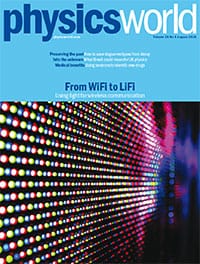
In the August 2016 issue of Physics World magazine – now live in the Physics World app for mobile and desktop – Harald Haas from the University of Edinburgh in the UK explains how the humble household light bulb could soon be transformed into the backbone of a revolutionary new wireless communications network based on visitible light.
Known as “LiFi”, the system could not only contribute to next-generation 5G mobile-phone systems, but also unlock the potential of the “Internet of things”, create”smart” cities, help with the introduction of driverless cars and offer new ways to monitor the health of old people. You can also read the article here.
The August issue also shows how neutrons could help in the search for new drugs, why we need to solve the ethical dilemmas surrounding space mining, and how physicists are helping to save daguerreotype photographs from decay. Don’t miss either our look at the impact of Brexit on European physics.
Over the past year the world’s computers, mobile phones and other devices generated an estimated 12 zettabytes (1021 bytes) of information. By 2020 this data deluge is predicted to increase to 44 zettabytes – nearly as many bits as there are stars in the universe. There will also be a corresponding increase in the amount of data transmitted over communications networks, from 1 to 2.3 zettabytes. The total mobile traffic including smartphones will be 30 exabytes (1018 bytes). A vast amount of this increase will come from previously uncommunicative devices such as home appliances, cars, wearable electronics and street furniture as they become part of the so-called “Internet of Things”, transmitting some 335 petabytes (1015 bytes) of status information, maintenance data and video to their owners and users for services such as augmented reality.
In some fields, this data-intensive future is already here. A wind turbine, for example, creates 10 terabytes of data per day for operational and maintenance purposes and to ensure optimum performance. But by 2020 there could be as many as 80 billion data-generating devices all trying to communicate with us and with each other – often across large distances, and usually without a wired connection.
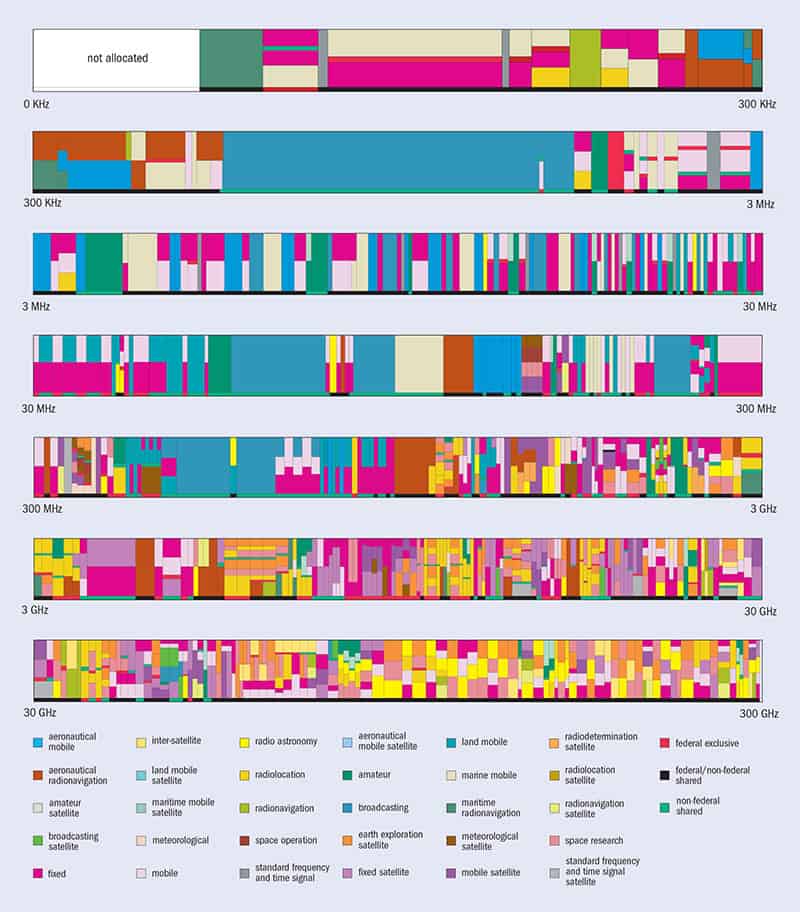
1 A crowded field The radio-frequency spectrum (3 kHz to 300 GHz) in the US has been allocated to various wireless services. Most of the spectrum is already ‘full’ and in many cases the same frequency band is used for multiple services. Visible light (430–770 THz) could be an alternative way of transmitting data wirelessly.
So far, the resources required to achieve this wireless connectivity have been taken almost entirely from the radio frequency (RF) part of the electromagnetic spectrum (up to 300 GHz). However, the anticipated exponential increase in data volumes during the next decade will make it increasingly hard to accomplish this with RF alone. The RF spectrum “map” of the US is already very crowded (figure 1), with large chunks of frequency space allocated to services such as satellite communication, military and defence, aeronautical communication, terrestrial wireless communication and broadcast. In many cases, the same frequency band is used for multiple services. So how are we going to accommodate perhaps 70 billion additional communication devices?
At this point it is helpful to remember that RF is only one small part of the electromagnetic spectrum. The visible-light portion of the spectrum stretches from about 430 to 770 THz, more than 1000 times the bandwidth of the RF portion. These frequencies are seldom used for communication, even though visible-light-based data transmission has been successfully demonstrated for decades in the fibre-optics industry. The difference, of course, is that the coherent laser light used in fibre optics is confined to cables rather than being transmitted in free space. But might it be possible to exploit the communication potential of the visible-light region of the spectrum while also benefitting from the convenience and reach of wireless RF?
With the advent of high-brightness light-emitting diodes (LEDs), I believe the logical answer is “yes”. Using this new “LiFi” system (a term I coined in a TED talk in 2011), it will be possible to achieve high-speed, secure, bi-directional and fully networked wireless communications with data encoded in visible light. In a LiFi network, every light source – a light bulb, a street lamp, the head and/or tail light of a car, a reading light in a train or an aircraft – can become a wireless access point or wireless router like our WiFi routers at home. However, instead of using RF signals, a LiFi network modulates the intensity of visible light to send and receive data at high speeds – 10 gigabits per second (Gbps) per light source are technically feasible. Thus, our lighting networks can be transformed into high-speed wireless communications networks where illumination is only a small part of what they do.
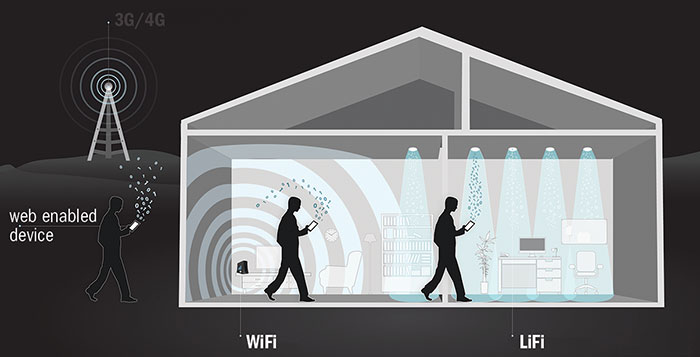
The ubiquitous nature of light sources means that LiFi would guarantee seamless and mobile wireless services (figure 2). A single LiFi access point will be able to communicate to multiple terminals in a bi-directional fashion, providing access for multiple users. If the terminals move (for example, if someone walks around while using their phone) the wireless connection will not be interrupted, as the next-best-placed light source will take over – a phenomenon referred to as “handover”. And because there are so many light sources, each of them acting as an independent wireless access point, the effective data rate that a mobile user will experience could be orders of magnitude higher than is achievable with current wireless networks. Specifically, the average data rate that is delivered to a user terminal by current WiFi networks is about 10 megabits per second; with a future LiFi network this can be increased to 1 Gbps.
2 Data delights Within the LiFi network, every LED light source acts as an access point for wireless multiuser communication. The high density of light sources makes it possible to achieve orders of magnitude improvements in data density compared to current systems. This LiFi network would complement existing RF-based networking technologies such as WiFi.
This radically new type of wireless network also offers other advantages. One is security. The next time you walk around in an urban environment, note how many WiFi networks appear in a network search on your smartphone. In contrast, because light does not propagate through opaque objects such as plastered walls, LiFi can be much more tightly controlled, significantly enhancing the security of wireless networks. LiFi networks are also more energy efficient, thanks to the relatively short distance between a light source and the user terminal (in the region of metres) and the relatively small coverage area of a single light source (10 m2 or less). Moreover, because LiFi piggybacks on existing lighting systems, the energy efficiency of this new type of wireless network can be improved by three orders of magnitude compared with WiFi networks. A final advantage is that because LiFi systems don’t use an antenna to receive signals, they can be used in environments that need to be intrinsically safe such as petrochemical plants and oil-drilling platforms, where a spark to or from an antenna can cause an explosion.
LiFi misconceptions
A number of misconceptions commonly arise when I talk to people about LiFi. Perhaps the biggest of these is that LiFi must be a “line-of-sight” technology. In other words, people assume that the receiver needs to be directly in line with the light source for the data connection to work. In fact, this is not the case. My colleagues and I have shown that for a particular light-modulation technology, the data rate scales with the signal-to-noise ratio (SNR), and that it is possible to transmit data at SNRs as low as –6 dB. This means LiFi can tolerate signal blockages between 46 and 66 dB (signal attenuation factors of 40,000 – 4 million). This is important because in a typical office environment where the lights are on the ceiling and the minimum level of illumination for reading purposes is 500 lux, the SNR at table height is between 40 and 60 dB, as shown by Jelena Grubor and colleagues at the Fraunhofer Institute for Telecommunications in Berlin, Germany (2008 Proceedings of the 6th International Symposium Communication Systems, Networks and Digital Signal Processing 165). In our own tests we transmitted video to a laptop over a distance of about 3 m. The LED light fixture was pointing against a white wall, in the opposite direction to the location of the receiver, therefore there was no direct line-of-sight component reaching the receiver, yet the video was successfully received via reflected light.
Another misconception is that LiFi does not work when it is sunny. If true, this would be a serious limitation, but in fact, the interference from sunlight falls outside the bandwidth used for data modulation. The LiFi signal is modulated at frequencies typically greater than 1 MHz, so sunlight (even flickering sunlight) can simply be filtered out, and has negligible impact on the performance as long as the receiver is not saturated (saturation can be avoided by using algorithms that automatically control the gain at the receiver). Indeed, my colleagues and I argue that sunlight is hugely beneficial for LiFi, as it is possible to create solar-cell-based LiFi receivers where the solar cell acts as a data receiver device at the same time as it converts sunlight into electricity.
A third misconception relates to the behaviour of the light sources. Some have suggested that the light sources used in LiFi cannot be dimmed, but in fact, sophisticated modulation techniques make it possible for LiFi to operate very close to the “turn on voltage” of the LEDs. This means that the lights can be operated at very low light output levels while maintaining high data rates. Another, related concern is that the modulation of LiFi lights might be visible as “flicker”. In reality, the lowest frequency at which the lights are modulated, 1 MHz, is 10,000 times higher than the refresh rate of computer screens (100 Hz). This means the “flicker-rate” of a LiFi light bulb is far too quick for human or animal eyes to perceive.
A final misconception is that LiFi is a one-way street, good for transmitting data but not for receiving it. Again, this is not true. The fact that LiFi can be combined with LED illumination does not mean that both functions always have to be used together. The two functions – illumination and data – can easily be separated (note my previous comment on dimming), so LiFi can also be used very effectively in situations where lighting is not required. In these circumstances, the infrared output of an LED light on the data-generating device would be very suitable for the “uplink” (i.e. for sending data). Because infrared sensors are already incorporated into many LED lights (as motion sensors, for example), no new technology would be necessary, and sending a signal with infrared requires very little power: my colleagues and I have conducted an experiment where we sent data at a speed of 1.1 Gbps over a distance of 10 m using an LED with an optical output power of just 4.5 mW. Using infrared for the uplink has the added advantage of spectrally separating uplink and downlink transmissions, avoiding interference.
Nuts and bolts
Now that we know what LiFi can and cannot do, let’s examine how it works. At the most basic level, you can think of LiFi as a network of point-to-point wireless communication links between LED light sources and receivers equipped with some form of light-detection device, such as a photodiode. The data rate achievable with such a network depends on both the light source and the technology used to encode digital information into the light itself.
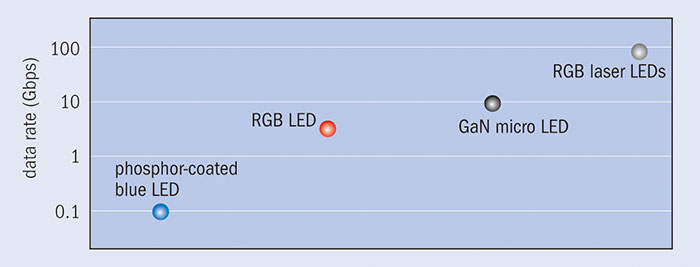
First, let’s consider the available light sources. Most commercial LEDs have a blue high-brightness LED with a phosphorous coating that converts blue light into yellow; the blue light and yellow light then combine to produce white light. This is the most cost-efficient way to produce white light today, but the colour-converting material slows down the light’s response to intensity modulation, meaning that higher frequencies (blue light) are heavily attenuated. Consequently, the light intensity from this type of LED can only be modulated at a fairly low rate, about 2 MHz. It is also not possible to modulate the individual spectral components (red, green and blue) of the resulting white light; all you can do is vary the intensity of the composite light spectrum. Even so, one can achieve data rates of about 100 Mbps with these devices by placing a blue filter placed at the receiver to remove the slow yellow spectral components.
More advanced red, green and blue (RGB) LEDs produce white light by mixing these base colours instead of using a colour-converting chemical. This eases the restrictions on modulation rates, making it possible to achieve data rates of up to 5 Gbps. In addition, one can encode different data onto each wavelength (a technique known as wavelength division multiplexing), meaning that for an RGB LED there are effectively three independent data channels available. However, because they require three separate light sources, these devices are more expensive than single blue LEDs.
3 Faster, brighter, longer A comparison of the various currently available light-emitting diode (LED) technologies and the corresponding achievable LiFi data rates.
A third alternative – gallium-nitride micro LEDs – are small devices that achieve very high current densities, with a bandwidth of up to 1 GHz. Data rates of up to 10 Gbps have recently been demonstrated with these devices by Hyunchae Chun and colleagues (2016 Journal of Lightwave Technology, in press). This type of LED currently is a relatively poor source of illumination compared with phosphor-coated white LEDs or RGB LEDs, but it would be ideal for uplink communications – for example, in an Internet of Things where an indicator light on an oven is capable of sending data to a light bulb in the ceiling – and in the future we may also see these devices in a light bulb due to rapid technology enhancements.
Lastly, white light can also be generated with multiple colour laser diodes combined with a diffuser. This technology may be used in the future for lighting due to the very high efficiency of lasers, but currently its cost is excessive and technical issues such as speckle have to be overcome. However, my University of Edinburgh colleagues Dobroslav Tsonev, Stefan Videv and I have recently demonstrated a white light beam of 1000 lux covering 1 m2 at a distance of 3 m, and the achievable data rate for this scenario is 100 Gbps (2015 Opt. Express23 1627).
As for the modulation, my group at Edinburgh has been pioneering a digital modulation technique called orthogonal frequency division multiplexing (OFDM) for the past 10 years. The principle of OFDM is to divide the entire modulation spectrum (that is, the range of frequencies used to change the light intensity into modulated data) into many smaller frequency bins. Some of these frequencies are less attenuated than others (due to the nature of the propagation channel and LED and photodetector device characteristics), and information theory tells us that the less-attenuated frequency bins are able to carry more information bits than those that are more attenuated. Hence, the dividing of the spectrum into many smaller bins allows us to “load” each individual bin with the optimum number of information bits. This makes it possible to achieve higher data rates than one gets with more traditional modulation techniques, such as on– off keying.
These high data rates make it easier to adapt to varying propagation channels, where the frequency bin attenuation changes with location – something that is important for a wireless communications system. The whole process can be compared to an audio sound equalizer system that individually adjusts low frequencies (bass), middle frequencies and high frequencies (treble) to suit a particular optimum sound profile, independent of where the listener is in the room. My former students Mostafa Afgani and Hany Elgala, together with me and my colleague Dietmar Knipp, have demonstrated what is, to the best of our knowledge, the first OFDM implementation for visible light communication (2006 IEEE Tridentcom129).
The bright future
LiFi is a disruptive technology that is poised to affect a large number of industries. Most importantly, I expect it to catalyse the merger of wireless communications and lighting, which are at the moment entirely separate businesses. Within the lighting industry, the concept of light as a service, rather than a physical object you buy and replace, will become a dominant theme, requiring industry to develop new business models to succeed in a world where individual LED lamps can last more than 20 years. In combination with LiFi, therefore, light-as-a-service will pull the lighting industry to enter what has traditionally been a wireless communications market.
In terms of how it affects daily life, I believe LiFi will contribute to the fifth generation of mobile telephony systems (5G) and beyond. As the Internet of Things grows, LiFi will unlock its potential, making it possible to create “smart” cities and homes. In the transport sector, it will enable new intelligent transport systems and enhance road safety as more and more driverless cars begin operating. It will create new cyber-secure wireless networks and enable new ways of health monitoring in ageing societies. Perhaps most importantly, it will offer new ways of closing the “digital divide”; despite considerable advances, there are still about four billion people in the world who cannot access the Internet. The bottom line, though, is that we need to stop thinking of light bulbs as little heaters that also provide light. In 25 years, my colleagues and I believe that the LED light bulb will serve thousands of purposes, not just illumination.
A tiny laser that emits “twisted light” has been unveiled by researchers in the US and Italy. Measuring just 9 μm across, the semiconductor device can produce a beam of light that carries orbital angular momentum. While improvements are needed before the laser can be commercialized, it could someday be used to boost the bandwidth of optical-telecommunication systems. Twisted light could also find use in quantum computing and quantum communications.
In a beam of light with orbital angular momentum (OAM), the wavefront of the light’s electric and magnetic fields twists around the direction of propagation, creating a vortex in the middle of the light beam. OAM occurs in well-defined and unique modes, and researchers have already created prototype optical-telecommunication systems that use these modes to transmit information. The ability to use several different modes at the same time could increase the amount of data that can be sent along an optical fibre. Physicists have also shown that the OAM of single photons can undergo quantum teleportation, and OAM could someday be used to transfer quantum information in quantum computers and quantum-cryptography systems.
But before many of these applications can come to fruition, researchers must work out how to miniaturize OAM lasers and integrate them into optical chips – most OAM sources available today are too bulky and not compatible with semiconductor-based optoelectronics.
Clockwork laser
Now, Liang Feng, Natalia Litchinitser and colleagues at the State University of New York at Buffalo and the Polytechnic University of Milan have created a tiny OAM laser that comprises a ring of semiconductor material with outer and inner diameters of just 9 μm and 7 μm, respectively. The ring is about 1.5 μm tall and sits on a semiconductor substrate. The top surface of the ring resembles a clock face with “tick” marks at regular intervals made from two different materials (see figure).
This structure is known as a “microring” – and it is well known that laser light will circulate within such a ring when the device is “pumped” using an external laser. In a conventional microring, however, the light will circulate in both clockwise and anticlockwise directions. Each rotational sense carries equal and opposite OAM, which effectively cancel each other out in the light emitted by the laser.
This is where the clock-face pattern comes in. The materials used to create the pattern are chosen to have specific indices of refraction such that light can only flow in one direction. The outer wall of the microring also has a periodic modulation of the refractive index, which causes the circulating light to propagate upwards and emerge from the ring and into free space.
State-of-the-art suppression
The laser produces infrared light in a specific OAM mode, and Feng says that the laser has a sideband suppression ratio of approximately 40 dB. This is a measure of the quality of the laser light, which he describes as state-of-the-art for microring lasers. However, he also points out that the laser is currently driven by an external source of laser light – which is not practical for commercial devices for optical telecommunications. He says that the team is now working towards more practical devices that are driven by electrical signals. One goal of the researchers is to create OAM lasers that can be integrated on an advanced signal-processing chip.
An important shortcoming of the laser is that an individual microring laser can only output one OAM mode. Therefore a selection of different lasers would be required to encode data in different modes. Feng says that creating a single ring that can output different modes on demand would require further research and development.
Topping this week’s Red Folder is an “Animated history of physics” narrated by the Irish comedian and science enthusiast Dara O Briain. Running from Galileo to Einstein’s general theory of relatively – and giving very short shrift to quantum mechanics – it’s more of a selected history. You can enjoy the animations and O Briain’s soothing brogue in the video above.
O Briain often teams up with the particle physicist and media celebrity Brian Cox, who is also in the news recently for teaching children in London how to ignite potentially explosive gas. Before you call social services, it was all in the name of science education and part of Cox’s visit to St. Paul’s Way Trust School. Cox had been invited to the school’s summer science school and obliged by leading an experiment into the properties of methane. “There is no shortage of enthusiasm for students and young people when you talk about science and engineering,” Cox told the Reuters news agency.
Jupiter’s Great Red Spot – the largest and longest-persisting storm in the solar system – may provide the energy required to heat the planet’s upper atmosphere to the unusually high values observed. So says an international team of astronomers, who believe they have found that the atmosphere above the storm is hundreds of degrees hotter than anywhere else on the planet.
Thanks to our relative proximity to the Sun, the Earth is efficiently warmed by solar energy. Indeed, both the surface and the atmosphere of our planet is heated by sunlight, up to altitudes as high as 400 km, where the International Space Station orbits. On the other hand, Jupiter is more than five times more distant from the Sun, and yet its upper atmosphere has average temperatures that are comparable to those of Earth. Indeed, the temperatures of the upper atmospheres of all of the solar system’s giant planets are much hotter than would be expected if the Sun were their only heat source. This anomaly was first noticed nearly 40 years ago, and has since been dubbed the giant-planet “energy crisis”. But an actual energy source, beyond sunlight, has evaded scientists.
Hot at the poles
For Jupiter specifically, it is known that the planet’s powerful aurorae at the poles impart nearly 200 GW per hemisphere into the atmosphere, which explains the temperatures measured in those areas. However, for the low to mid-latitudes of Jupiter, no such source has been identified. This is despite the fact that the temperature measured there is nearly 800 K, which is 600 K warmer than it should be if the planet was merely heated by the Sun.
Now though, thanks to new observations of the Jovian atmosphere above the Great Red Spot (GRS), James O’Donoghue and Luke Moore at Boston University in the US, together with Tom Stallard and Henrik Melin at the University of Leicester in the UK, suggest that it is the storm driving the planet’s atmospheric heating. After ruling out solar heating from above, the team “designed observations to map the heat distribution over the entire planet in search for any temperature anomalies that might yield clues as to where the energy is coming from”, says O’Donoghue.
Stormy coincidence or clue?
In December 2012, the team observed Jupiter for nine hours using the SpeX spectrometer on the NASA Infrared Telescope Facility. A Jovian day itself is rather short – a measly 9 hours and 56 minutes – thanks to the planet’s quick spin. The planet-wide infrared emissions that the team observed showed that much-higher-than-expected temperatures exist at high altitudes. “We could see almost immediately that our maximum temperatures at high altitudes were above the Great Red Spot far below,” says O’Donoghue, adding that the team immediately wondered if this was a “weird coincidence or a major clue”?
Hotting up
The GRS storm has been raging for more than three centuries – while its size and colour has fluctuated over time, it is so big it could swallow Venus, and has winds that take six days to complete one spin. The atmosphere above the storm is on average 1600 K hotter than anywhere else on the planet, including the auroral region. Until their recent observations, there was no evidence that linked this huge powerhouse to the heated upper atmosphere, according to the researchers.
“Energy transfer to the upper atmosphere from below has been simulated for planetary atmospheres, but not yet backed up by observations,” O’Donoghue says. “The extremely high temperatures observed above the storm appear to be the ‘smoking gun’ of this energy transfer, indicating that planet-wide heating is a plausible explanation for the ‘energy crisis’,” he adds. The researchers concluded that, if sufficient heating does not come from above (i.e. via the Sun) and there is no heating in situ via magnetospheric interactions (like with the aurorae), then by a process of elimination, it must come from below.
Sizzling sounds
As to the mechanism via which this energy is imparted, O’Donoghue and colleagues deduce that the storm produces acoustic waves – which are vertically propagated from the lower atmosphere – that deposit their energy, via viscous dissipation, into the upper atmosphere. Acoustic waves are routinely produced above thunderstorms and this kind of effect has been observed on Earth above the Andes mountains. Indeed, this method has been previously suggested for Jupiter, with models suggesting that hundreds of degrees of heating could be imparted this way. But this is the first direct observation of a localized source of heating, which clearly links the upper and lower atmosphere, according to the researchers.
“This fantastic result, showing how the upper atmosphere is heated from below, was produced directly from Leicester’s 2012 observing campaign, which was designed to try and answer why Jupiter’s upper atmosphere is so hot,” says Stallard. He adds that the Juno mission, which reached the planet earlier this month, “will be measuring the aurora and its sources, and we expected the auroral energy to flow from the pole to the equator. Instead, we find the equator appears to be heated from plumes of energy coming from Jupiter’s vast equatorial storms.”
Preparing to navigate the exhibit hall at the European Science Open Forum on crutches. (Courtesy: Margaret Harris)
As I prepared to travel to Manchester earlier this week for the 2016 European Science Open Forum (ESOF), I had an unwanted extra item on my to-do list: working out, in detail, whether it was physically possible for me to attend.
My problem was my foot: a few weeks ago, I broke it, and as ESOF approached, it became clear that my injury wouldn’t heal in time. I was wary of trying to do a conference on crutches, but the reassuring responses to my queries (yes, my hotel had accessible rooms; yes, the venue for the conference, Manchester Central, was “very accessible”) convinced me that it would be okay. So I headed off to Manchester last Sunday for two days of science talks – and got an eye-opening lesson on what it’s like to attend a scientific conference with a physical disability.
The trip started well. My accessible hotel room had a walk-in shower and grab bars in all the right places, and staff were cheerful and helpful. However, the half-mile walk from my hotel to the ESOF venue was too long for me to manage easily. My solution was a series of taxis, which worked okay, but as the finance department at Physics World towers will attest, even short taxi rides add up when you have to take four of them a day. A conference-goer on a bare-bones travel stipend would struggle to afford it.
Once I reached the conference venue, getting to the scientific sessions was straightforward, if strenuous. Most ESOF talks were located on the venue’s ground floor, and there were lifts for those that weren’t. However, like most convention centres, Manchester Central is a large building, and this posed its own challenges. ESOF attendee Carole Mundell, an astrophysicist at the University of Bath who is also using crutches at the moment, summed up the problem nicely. “Everywhere feels (or sometimes is) incredibly far away on crutches, which are remarkably uncomfortable and tiring after a short time,” she said. “Corridors feel long even when one is on the way to the lift.”
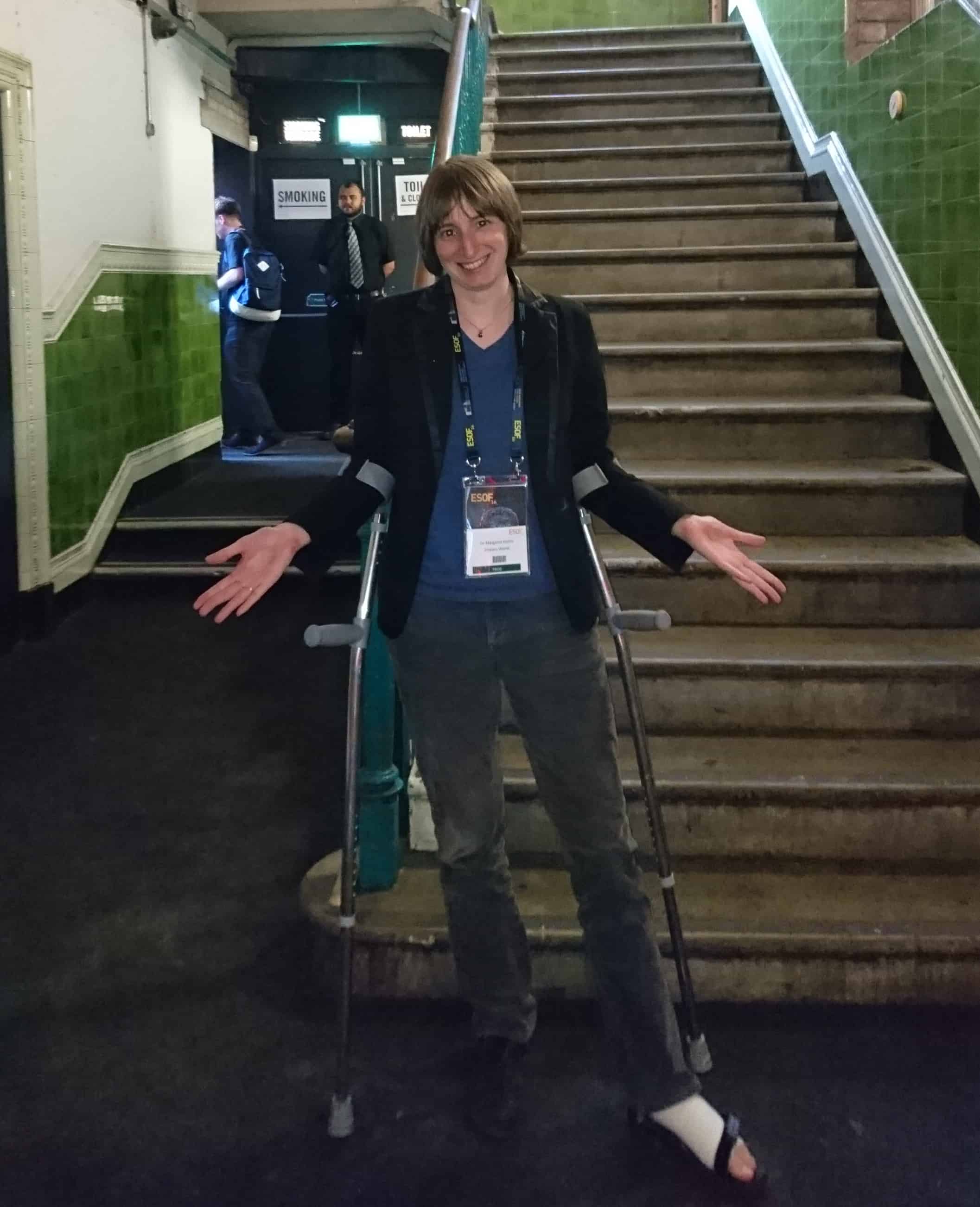
Me at the bottom of the stairs at Manchester’s Albert Hall, the not-so-accessible venue for the official ESOF party. (Courtesy: Margaret Harris)
The real issues, though, lay with the conference’s social programme. Mundell described the usual stand-up, drinks-and-nibbles receptions as “quite exhausting”, and at the official ESOF party on Monday evening, I ran into the only serious problem of my trip. The party was on an upper floor of the Albert Hall, Manchester’s famous music venue, and when I asked a bouncer if there was a lift, he looked at me as if I’d requested a rocket ship, said “No”, and jerked his head in the direction of a long staircase (left).
In retrospect, there must have been a service lift somewhere, and I ought to have complained until I was taken there. But it didn’t occur to me at the time, and it might not have done me much good if it had. Another crutch-using ESOF attendee, the American science journalist Laurie Garrett, told me that when she’d asked conference staff to open up a cordoned-off section of an auditorium so she could sit in an aisle seat (there being none left in the main area), they refused “until I put up a stink, at which point they treated me like someone who’d put up a stink.”
Unlike people with more severely restricted mobility, I am capable of climbing stairs, so that’s what I did – slowly, carefully, one hop at a time. But once I reached the top, I found that in the entire hall full of scientists listening to music and chatting over drinks, there was not a single chair or other place to sit down. That made the party inaccessible to me, and after 15 minutes, I had to leave.
The experience left me intensely frustrated – not for myself, but for scientists with serious permanent disabilities, who deal with these problems all the time. What effect this has on their careers and conference attendance is hard to say, as everyone is different (but here is a description of the accommodations one physicist with permanent disabilities needs to help her attend events). However, it did strike me as potentially significant that although ESOF was expecting 4500 attendees, Garrett and Mundell were the only other visibly disabled people I could find there – and their injuries, like mine, are not permanent.
One final thought. As I was leaving the conference on Tuesday, I noticed a kerfuffle on the #ESOF16 Twitter hashtag. Apparently, the ESOF panel on EU science policy was entirely composed of white men, and several people (men as well as women) were complaining about it. The issue of all-male panels is real and the attention being paid to it is encouraging. However, as I crawled awkwardly into the final taxi of my trip, it occurred to me that when it comes to supporting diversity in science, getting more women onto panels is really only the beginning.
As an astronomer, educator and science advocate at Columbia University in the US, David Helfand has spent his career knocking down faulty arguments and misleading “facts” that cling on despite the huge amount of information available to modern audiences. In his book A Survival Guide to the Misinformation Age, Helfand explains how the same “habits of mind” that make someone a good scientist can also give non-scientists “an antidote to the misinformation glut”. These habits include making back-of-the-envelope estimates, and distinguishing between correlation and causation. Without such tools, Helfand writes, “you are a dependent creature, doomed to accept what the world of charlatans and hucksters, politicians and professors provides, with no way out of the miasma of misinformation”. At this point, many of Helfand’s readers will be punching the air with shouts of “Yes! I’ve been saying this for years!” And therein lies the challenge. In theory, Helfand’s book aims to convert non-experts to the scientific “cause” and teach them how to debunk misinformation. In practice, the book will probably appeal most to people who already agree with him and are perfectly capable of doing their own debunking. That does not make book worthless. Far from it: there is a long and noble tradition of using popular-science writing to encourage fellow-combatants in the fight against pseudoscience (Carl Sagan’s 1995 book The Demon-Haunted World is another example). The deeper problem is one that Helfand hints at near the end of the book, where he describes a study showing that people who reject (say) theories of evolution or climate change are not, in the main, either ignorant or lacking in scientific skills. Instead, they simply refuse to accept ideas that conflict with their pre-existing religious or political beliefs. Helfand rightly calls this conclusion “disturbing”, but he does not really engage with it. That’s unfortunate, because if this study is valid, then the premise of Helfand’s book is flawed, and he and many other defenders of science are fighting with precisely the wrong weapons. Disturbing indeed.
2016 Columbia University Press $29.95hb
Scientist or writer?
Stephen Heard writes about 75,000 words per year, more than many novels. But Heard is not a novelist. Instead, he’s an evolutionary ecologist at the University of New Brunswick, Canada, and he reckons his annual written output – spread across journal papers, grant proposals, peer reviews, technical reports and administrative documents – is fairly typical for a senior scientist. Since writing is such a significant part of a scientist’s working life, it’s important to do it well, and Heard’s book The Scientist’s Guide to Writing: How to Write More Easily and Effectively Throughout Your Scientific Career promises to help you do just that. The book is not a step-by-step guide to producing particular scientific documents. Instead, it focuses on topics such as building good writing behaviour; understanding the content and structure of scientific papers; developing a clear and appropriate writing style; and making the most of the revision process. Some of Heard’s tips for good scientific writing are straightforward (“an abstract is not a movie trailer and does not need to avoid plot spoilers”), while others are a bit off-the-wall (to combat procrastination, he suggests you “hang a small stuffed animal or the like near your writing station, and think of it as your writing conscience”). The most important tip, though, is one that recurs throughout the book, and can be summed up in three words: remember your reader.
2016 Princeton University Press £16.95/$21.95pb 320pp
On the evening of 6 June 1989, two days after the massacre at Tiananmen Square, an official from the US embassy invited the astrophysicist Fang Lizhi and his wife, Li Shuxian, to take refuge at the US embassy in Beijing. For the next 13 months, under the precarious protection of the US ambassador, they remained inside the embassy, until delicate negotiations yielded an arrangement by which they were permitted to depart China for the UK. During this period of exile, Fang and Li were not allowed to communicate with the outside world. With time on his hands, Fang began to write this memoir, which is one of the most insightful accounts we have of the chaotic period of Chinese history that began with the founding of the People’s Republic of China and culminated with the Tiananmen massacre. It is also a revealing portrait of a courageous scholar whose role in history has been compared to that of Andrei Sakharov in the Soviet Union or Galileo in 16th-century Florence.
Born in Beijing in 1936, Fang had a childhood that was remarkably tranquil, given the Japanese occupation, the Second World War and the civil war that followed. Then, toward the end of 1948, Nationalist troops occupied his high school and Fang joined the Federation of Democratic Youth, an underground organization with links to the Communist Party. The following year, after the Nationalist defeat, Mao Zedong proclaimed the founding of the People’s Republic of China. At about the same time, Fang’s aptitude for science began to shine, and he entered Peking University three years later, flush with excitement about physics and patriotic fervour.
While still an undergraduate, Fang was invited to join an elite group whose core task was to calculate a model for neutron diffusion in a breeder reactor. Nowadays, this calculation could be done with an iPhone in less than a second; then, it took 300 of the brightest young physicists in China several months to work it out with abaci. But physics was not his only passion, and his memoir becomes a love story as he describes meeting a brilliant and spirited classmate, Li Shuxian. Their shared passions for physics and Communism fed a growing romance, and when they (first Li, then Fang) were invited to join the Communist Party, their future looked golden.
Upon graduation, Fang was assigned to a “work unit” of the Chinese Academy of Sciences, while Li was given a post as an interpreter for visiting Soviet physicists. Meanwhile, though, a string of incidents was leading Fang and Li first to question Communist orthodoxy, and ultimately to become completely disaffected with the party. In 1957 Mao Zedong announced his “Let a hundred flowers bloom” policy. This supposed attempt at liberalization quickly revealed itself as a cynical plot to ferret out and persecute anyone with the temerity to question the party line. Fang and Li walked right into the trap: together with a friend, Ni Wansun, they began drafting a letter to the Party Central Committee calling attention to some of the harm the “Anti-Rightist” crackdown was doing to the party. Warned by friends not to send the letter, they abandoned their plans, but copies of Ni’s outline were distributed. That was enough. Fang summarizes the events that followed with characteristic irony, calling it “a splendid success: in a single blow an entire gang that had planned one whole letter that had never been mailed was completely annihilated”. All three were expelled from the party, and although Li was permitted to remain at Peking University under a cloud, Ni was fired from his academic post and sent to do labour reform. Fang, meanwhile, was banished to an impoverished village, where he did manual labour for eight months.
For the next 15 years, Fang’s career oscillated between extremes. After he returned to Beijing in 1958, he was appointed to the newly founded University of Science and Technology (USTC), where he embarked on a picaresque odyssey in physics, beginning with nuclear and elementary particle physics, then solid-state physics, then laser physics and finally cosmology. In 1961 he and Li married, and they later had two sons. However, both Fang’s research and his family life were regularly interrupted, as he was repeatedly sent away to labour as a farmer, a coal miner, railway builder and brick maker. His descriptions of these assignments – particularly the bizarre attempts to increase farm productivity during the Great Leap Forward – are both comical and horrifying, as they resulted in the death by starvation of more than 20 million people. Fang also gives a first-hand report of the persecutions during the Cultural Revolution, which caused many gifted intellectuals to commit suicide.
The death of Mao in September 1976 precipitated a dramatic change in Fang’s fortunes. In February 1979 he was reinstated as a member of the Communist Party. He was allowed to travel abroad, which he did frequently and with relish, becoming something of an international celebrity for his outspoken views on science and intellectual freedom. In 1981 he became a member of the Chinese Academy of Sciences, and in 1984 he was appointed vice-president of the USTC.
This might have been Fang’s happy ending but for, as he puts it, his “addiction to trouble”. The reform movement that followed Mao’s death gained momentum rapidly, becoming especially popular among students, who regarded Fang as a hero and often invited him to speak at their gatherings. Initially, party leaders had encouraged these reforms, but by early 1987 Deng Xiaoping had had enough. Fang was expelled from the party for a second time and sacked from his position at the USTC. He obtained another job, teaching cosmology at the Beijing Observatory, but by this time, the democracy movement had caught fire with students throughout China, and attempts to suppress it only fanned the flames. The movement culminated in May 1989 with the occupation of Tiananmen Square and its brutal suppression on 4 June, when some 300,000 troops opened fire on the crowd, killing thousands of demonstrators and sending Fang and Li into their 13-month exile at the US embassy.
Fang does not cover the post-embassy period in his memoir, but Perry Link, a noted scholar of East Asian languages and culture, has enriched his beautiful translation with an insightful foreword and afterword. In the latter, we learn that, after their release, Fang and Li spent several months at the University of Cambridge before moving to the Institute for Advanced Study in the US. In 1992 Fang accepted an appointment at the University of Arizona, where he remained until his untimely death in 2012.
What will be the legacy of Fang? He has been called a brilliant scientist, and he was certainly a prolific researcher, but I cannot identify any singular contributions with a lasting impact on astrophysics or cosmology. It is instructive, though, to compare his circumstances with those of Sakharov. Like Fang, the Soviet dissident and nuclear scientist was persecuted by his government for defending intellectual freedom. However, Sakharov also enjoyed a privileged life in the company of some of the greatest physicists of the time, including Lev Landau, Vitaly Ginzburg and Yakov Zel’dovich. Fang had no such peers. Yet with virtually no contact with the international research community – and with the almost constant distractions of the Maoist chaos – he succeeded in educating himself and his colleagues in modern astrophysics.
As I write this review, I have just returned from a visit to some of the leading centres for astrophysics in China. Several of the leaders at these institutions are former students of Fang. Many younger scientists have been inspired by the example of his life, so eloquently documented in this memoir. That, surely, is his true legacy.
A new study of the radioactive decay of manganese-54 counters previous measurements that suggest that the rate of decay is influenced by Earth’s orbit of the Sun. Mark Silverman of Trinity College in Hartford, Connecticut, analysed decay-rate data taken over a three-year period and found no evidence for an annual variation to within one part in 104
Radioactive decay is a quantum-mechanical process whereby the probability that a nucleus will decay is a fixed value for that specific isotope. This means that for a sample containing a large number of identical nuclei, the rate at which decay events occur will fall exponentially as time progresses.
While exponential decay has been observed in the vast majority of nuclear-decay studies, several anomalies appear to have cropped up over the 10–15 years. One involves the decay rate of manganese-54, which has been reported to vary annually by researchers at Purdue University in the US. The same team has also reported drops in the decay rate that occured during solar flares. (see “The mystery of the varying nuclear decay”). One possible explanation for these anomalies is that the decay rate is affected by neutrinos emitted by the Sun – however, there is currently no known physical mechanism for this to occur.
Environmental effects
Manganese-54 is an interesting case because it decays to chromium-54 by capturing an atomic electron. The rate of electron capture in some other nuclei is known to be affected by environmental influences, and Silverman points out that it could be possible that this is what is being seen in manganese-54.
Silverman looked for variations in the manganese-54 decay rate in data acquired by scientists at the Institute for Reference Materials and Measurements (IRMM) in Geel, Belgium. Researchers at the metrology lab placed a sample of manganese-54 in an ionization chamber and measured the number of nuclear decays that occurred per unit time at several intervals over a three-year period. This corresponds to about 3.6 half-lives of the isotope and therefore a very well-defined exponential decay was observed.
While the Belgian lab’s aim was to gain a better value for the half-life of the isotope, Silverman says he was able to perform “the most stringent examination to date showing that the electron-capture decay of manganese-54 is in exquisite agreement with standard nuclear physics”.
Residual deviations
To do so, Silverman calculated the amount by which individual measurements of the decay rate – made at many different times over the three years – deviated from the rate predicted by exponential decay. Because of the random nature of the decay process, these “residual” values are not zero but have positive and negative values that occur with frequencies that form a well-defined statistical distribution centred at zero deviation. According to Silverman, the shape of this distribution is in excellent agreement with a decay rate that is constant throughout the study.
Silverman then looked for evidence that the residuals had some sort of time dependence – was the decay rate slightly lower or slightly higher at certain times of the year? Again, no evidence was found. He also found no evidence for short-term changes in the decay rate that could be related to solar activity such as solar flares. However, Silverman does admit that as the data were not gathered continuously over the three-year, some potential solar events could have been missed.
Finally, Silverman introduced fake annual variations into the data to test the efficacy of his analysis techniques. He found that his methods are sensitive to an annual modulation as tiny as one part in 104, which is about 10 times smaller than previously reported variations in the manganese-54 decay rate.
Social value
Silverman told physicsworld.com that he did his analyses because he believes it is important to test reports of apparent violations of fundamental physical laws. “It saves theorists the task of trying to account for processes that do not occur,” he says, adding “it helps remind experimentalists that most such violations are the results of instrumental artefacts rather than new laws of physics.” He also says such tests have a wider social purpose to “help demonstrate that the laws of physics are reliable, a not insignificant social point to be made at a time when much of humanity is inclined toward irrational belief in the supernatural”.



 By Matin Durrani